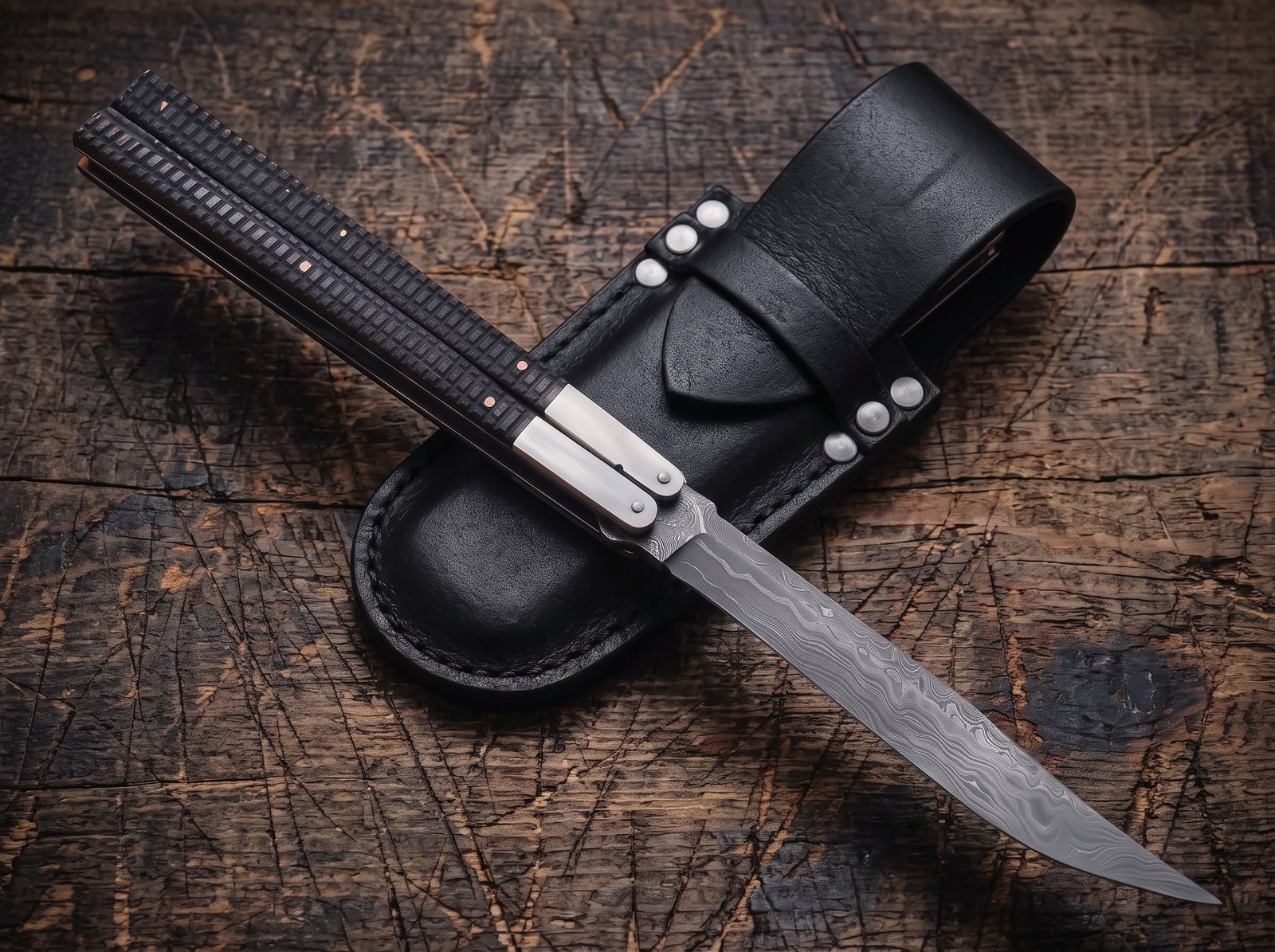
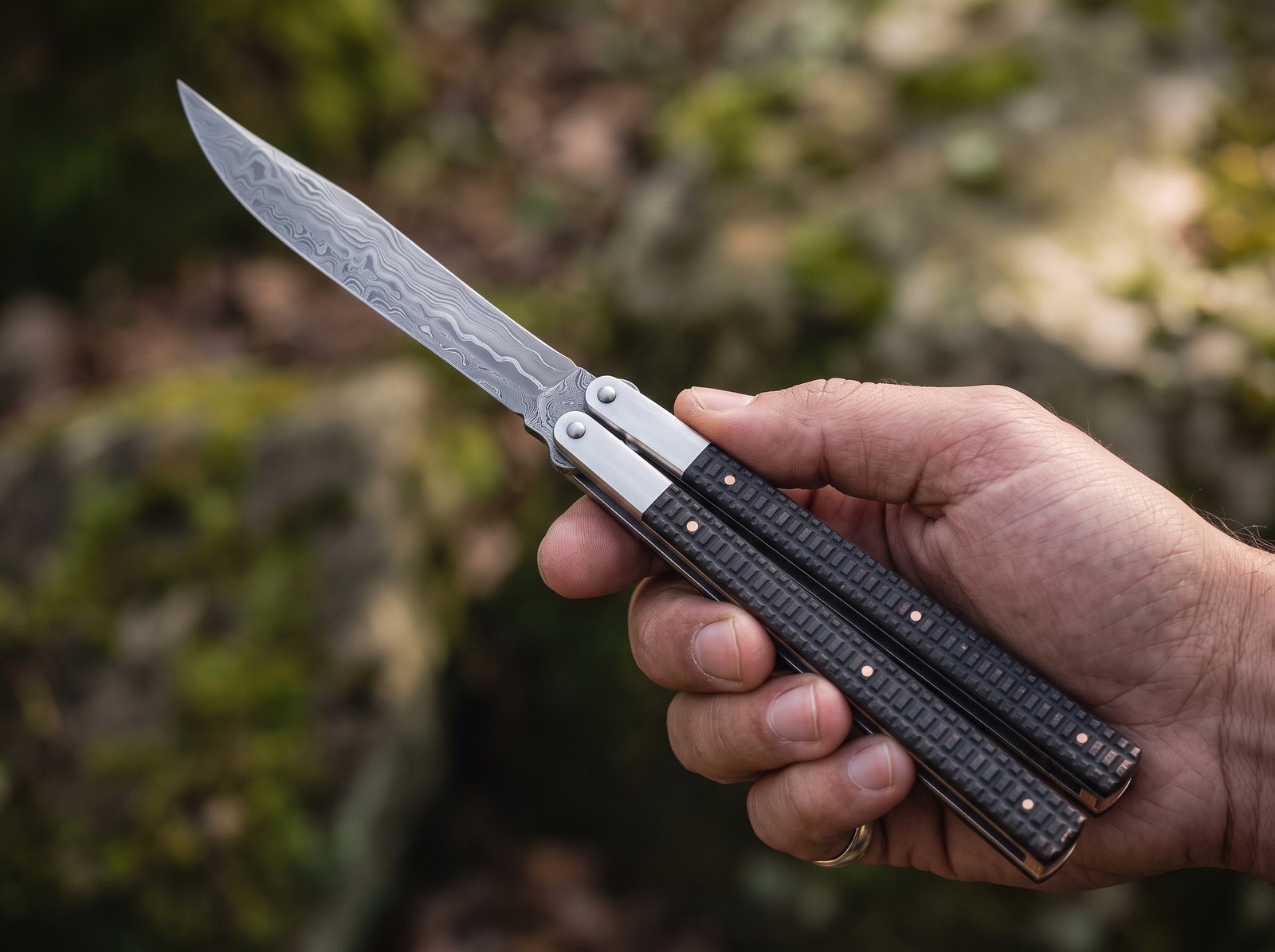
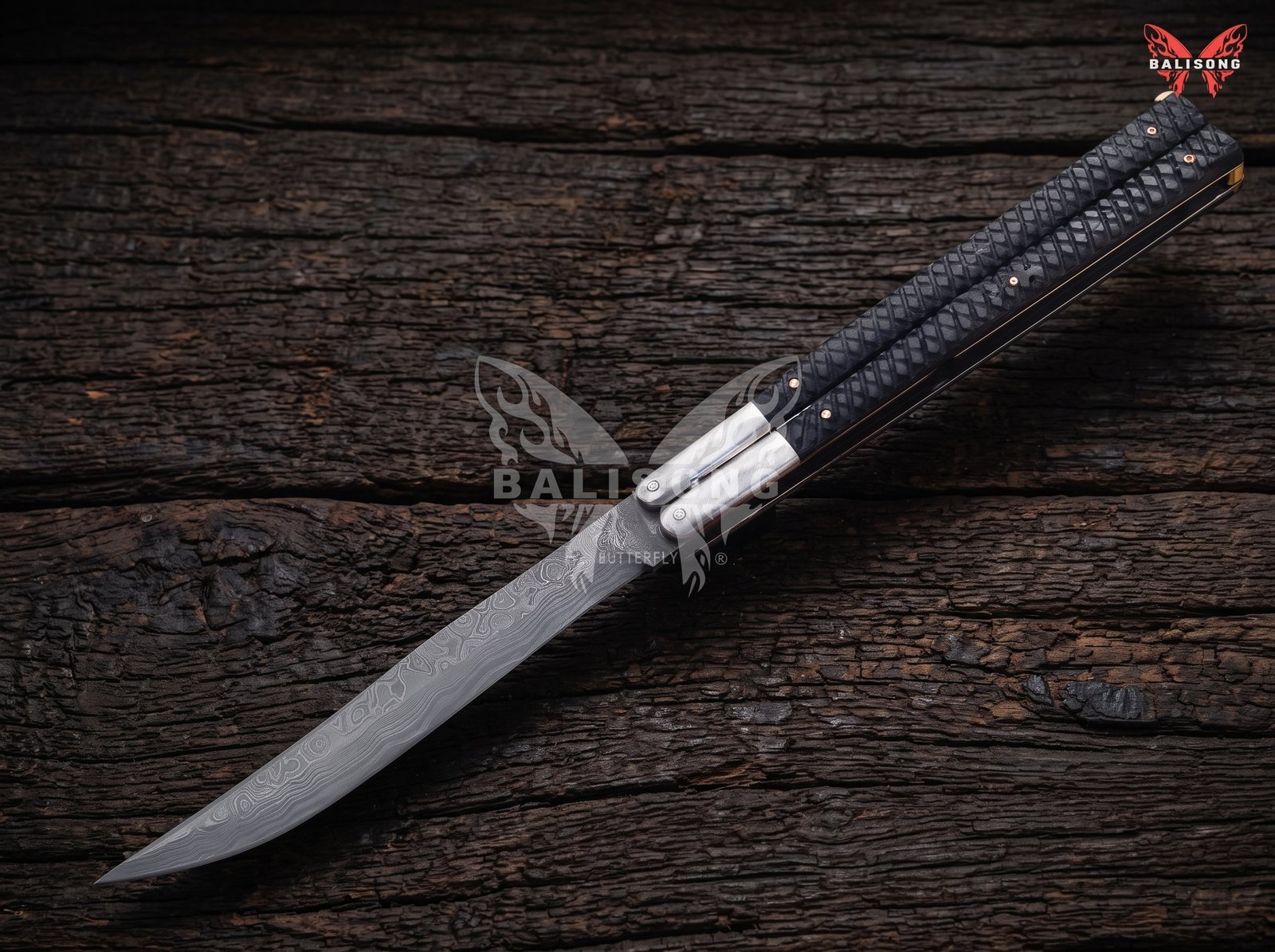
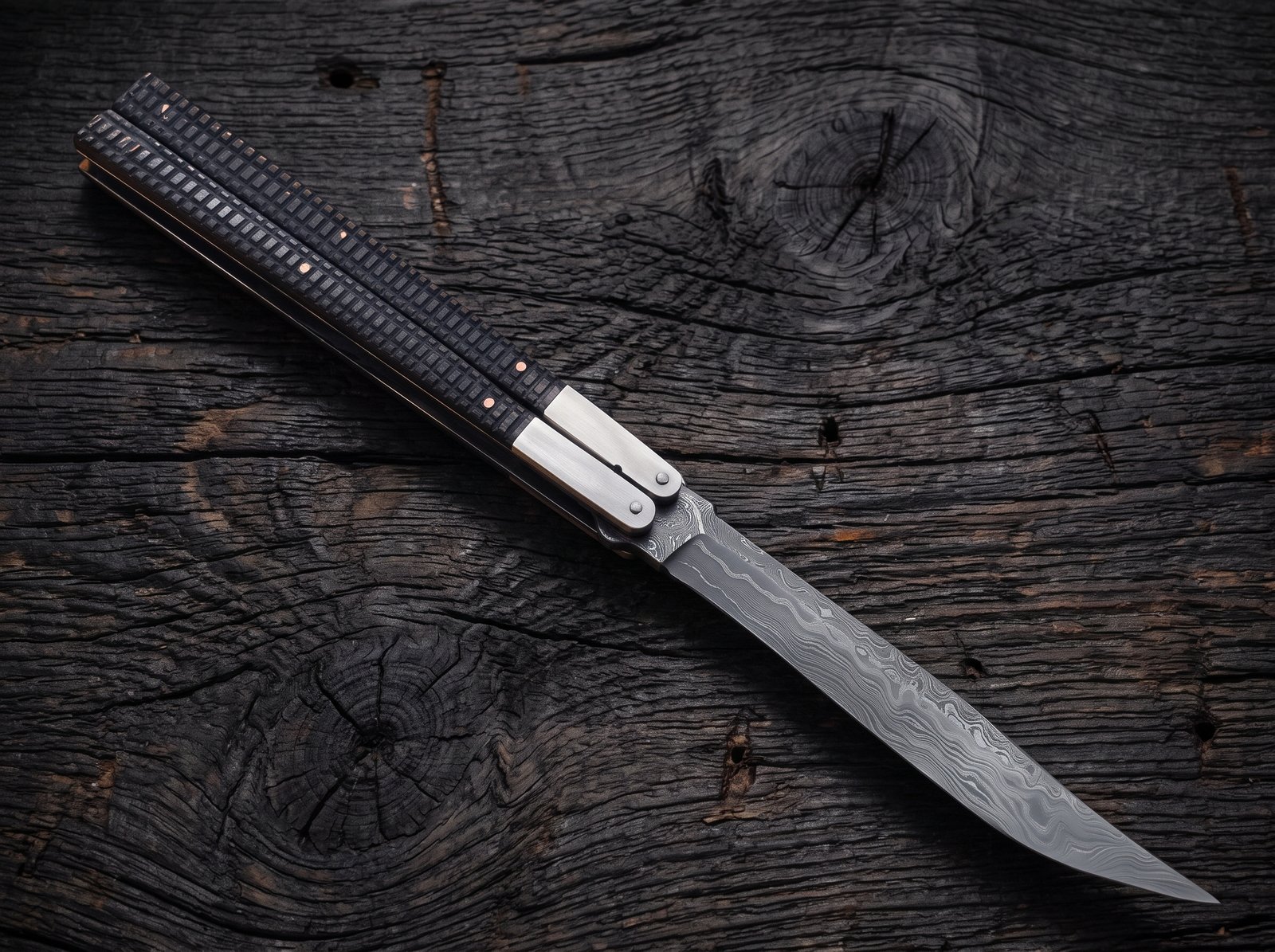
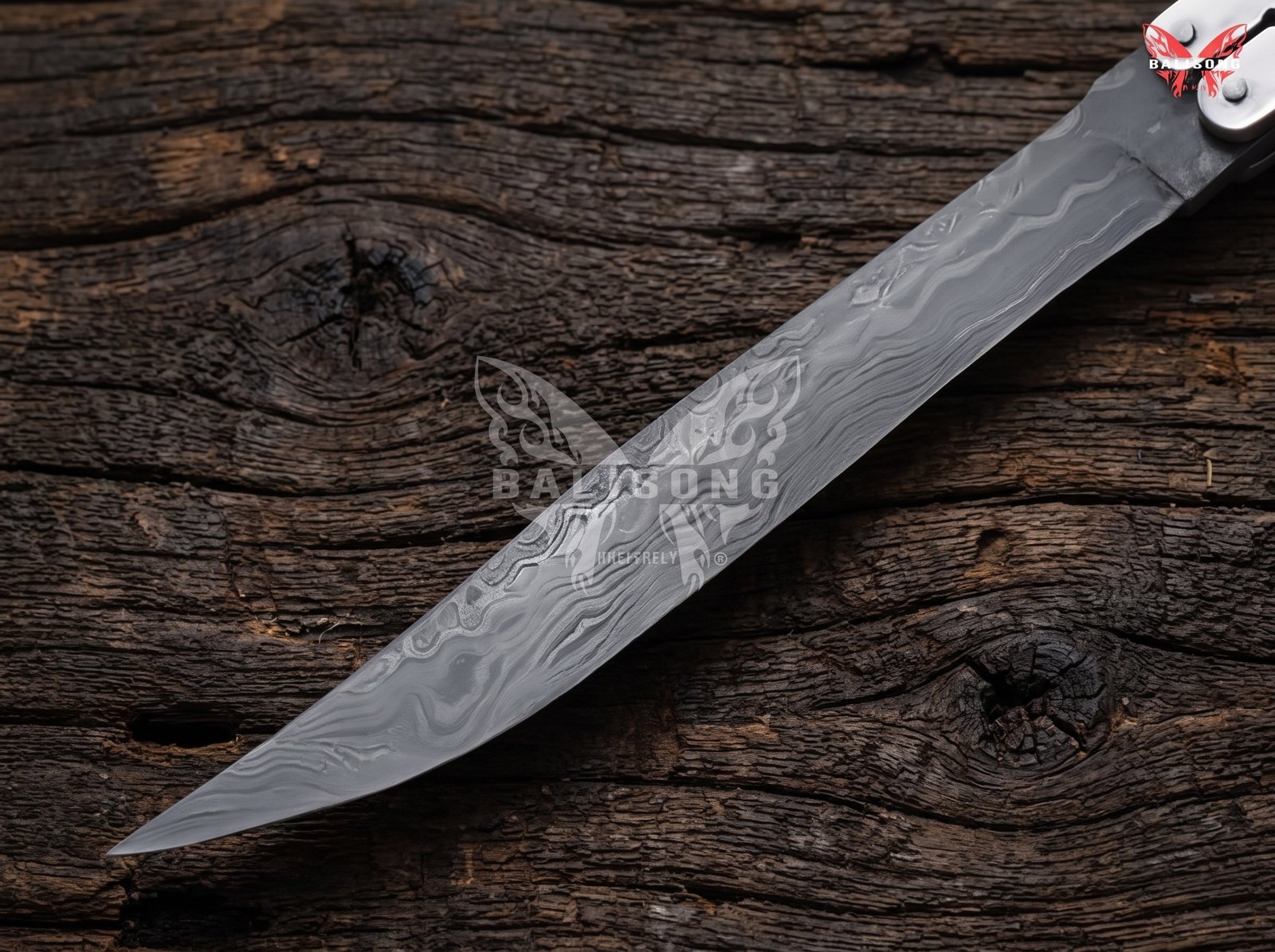
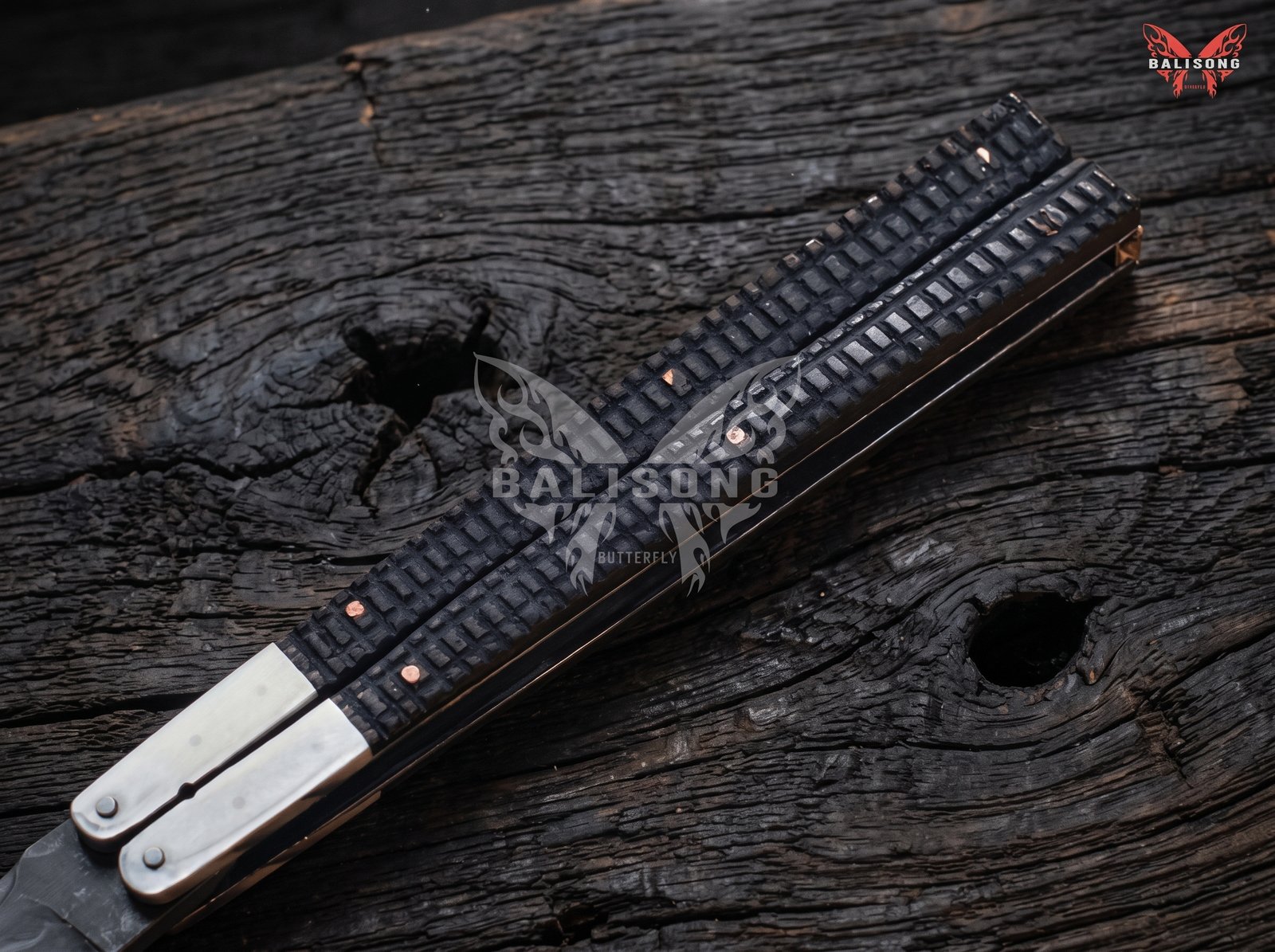
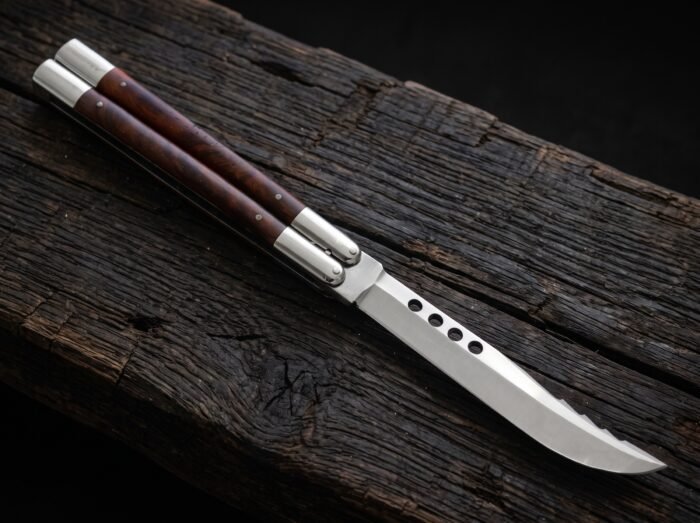
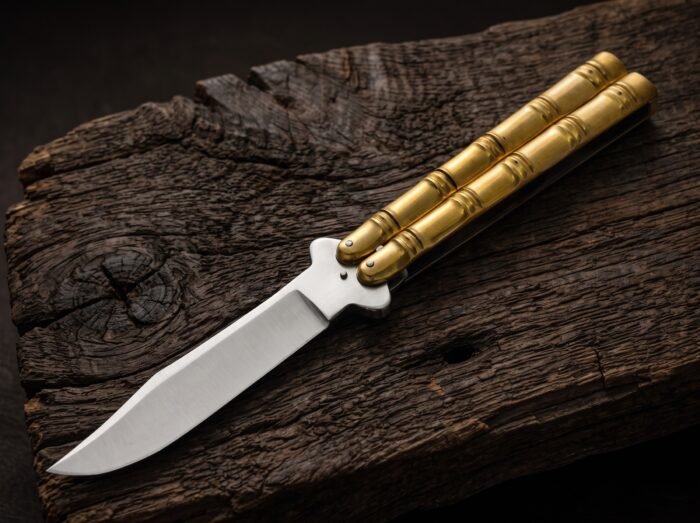
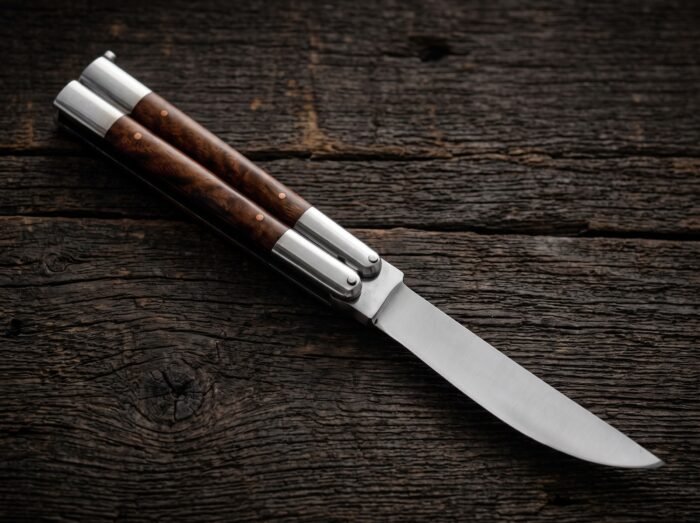
Part of our Limited Edition line: a Philippine Visayan balisong with a Damascus blade and a black micarta handle on brass. 29cm open, a 14cm blade, 220g. It is the only knife on this page that is not D2, and that changes what it looks like, what it costs us to make and how you have to look after it.
What Damascus steel actually is on a butterfly knife
Damascus is not a steel. There is no bar stock anywhere labelled “Damascus” that a maker buys by the kilo, and this trips up a lot of people who are otherwise well informed.
It is a process. You take layers of high carbon steel, heat them, forge weld them into a single billet, then fold and draw that billet out and repeat until you have built up a great many layers. The pattern you see is the edges of those layers showing at the surface after grinding and etching.
Which is why the specification for this knife describes the blade as Damascus and as tempered high carbon steel at the same time. Both are correct and they are not in tension. Damascus tells you how the blade was made, high carbon tells you what it was made from.
The part that annoys us
Search for a Damascus butterfly knife and you will find them at $35 with free shipping, wearing a swirl pattern that looks close enough in a photograph.
Forge welding takes a skilled person a long time at a hot forge with a meaningful failure rate, because billets delaminate and folds trap scale and the whole thing goes in the bin. That work does not cost $35. What you are looking at in those listings is almost always a pattern chemically etched or laser marked onto ordinary stainless, and it will wash off the first time somebody sharpens through it.
Anything under about $40 calling itself Damascus is not Damascus. We would rather say that plainly than let the category get quietly hollowed out.
How to tell, on any knife
- Look at the spine and the tang, not the flat. Real layers run through the whole blade, so the pattern continues over the edges and into places nobody bothers to fake.
- Look for repetition. Etched patterns repeat because they came from one template. Forged layers never repeat.
- Check what the layers are. A seller who cannot tell you which steels went into the billet probably did not make it.
- Consider the price against the hours. This is the test that catches almost everything.
Specification for this Damascus micarta balisong
| Blade |
Damascus, layers of high carbon steel forge welded and folded |
| Hardness |
58-60 HRC |
| Handle |
Brass with black micarta |
| Overall length |
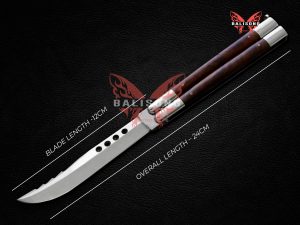
29cm open |
| Blade length |
14cm |
| Weight |
220g |
220g at 29cm makes this the heaviest of our Visayan knives. The stag horn versions run 200g at the same length, so this one carries noticeably more momentum through a rollover. Not better or worse, but you will feel it immediately if you already own one of the others.
High carbon needs more from you than D2 does
This is the important practical difference and it gets glossed over on most Damascus listings.
D2 carries enough chromium that people call it semi stainless. High carbon steel does not. It will develop a patina, and left damp it will develop rust rather than patina, and neither of those is a fault in the knife.
- Dry it every time it gets wet. Every time, not most times.
- Keep a light film of oil on the blade if it is being stored.
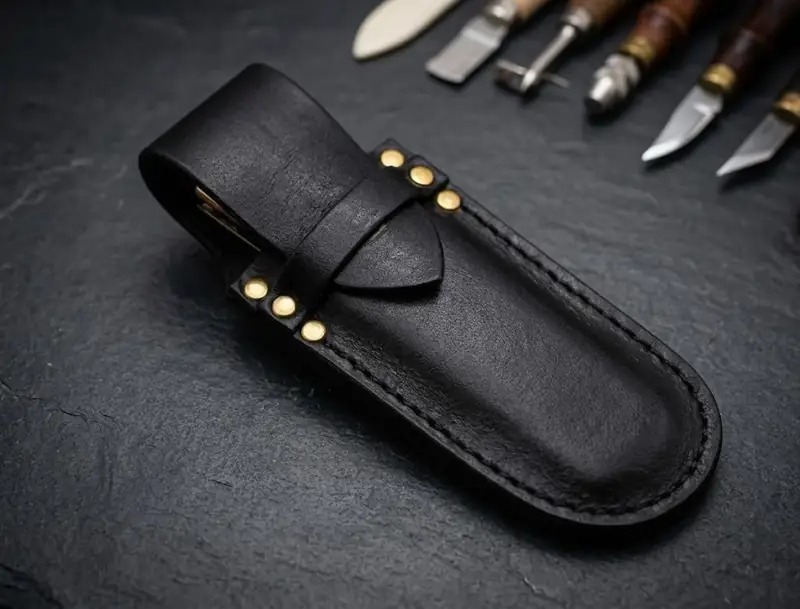
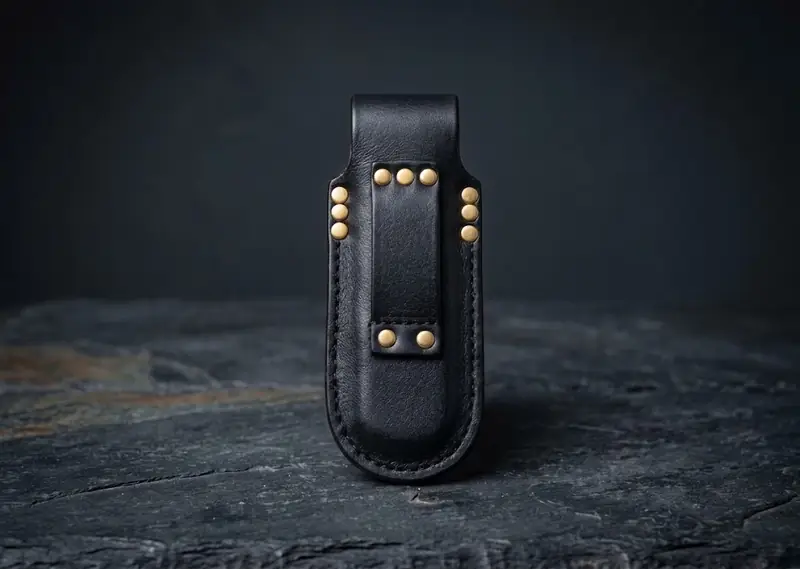
- Do not leave it in the leather sheath for months. Leather holds moisture.
- Fingerprints will show as marks on high carbon. Wipe it after handling.
- An even grey patina is protective and desirable. Orange is not. Learn the difference and you will never have a problem.
In exchange, high carbon takes a keener edge than most stainless steels and comes back on a stone far more willingly than D2 does. The finished billet is taken to 58-60 HRC, the same window as our D2 blades, so nothing about edge life is being traded away for that. Corrosion resistance is the only thing you give up. The knife care guide covers the routine.
Your pattern is yours
Nobody controls exactly how a folded billet will look once it is ground and etched. The layer count is deliberate; where those layers surface on your particular blade is not. Two knives from the same billet come out different, and the listing photograph is one example rather than a promise.
Trainer, sheath and shipping on this Damascus balisong
The unsharpened option is above Add to Cart, and on this knife it is worth thinking about, because a Damascus blade that has been through a learning phase carries the marks of it. The pattern lives in the surface, and deep scratches show more here than on a plain blade.
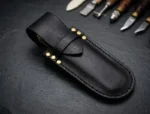
It arrives in a fitted leather sheath. US shipping costs nothing, worldwide is a flat $49. If the Visayan length is new to you, the BF-121 page explains what 29cm does in the hand.





Reviews
There are no reviews yet.