
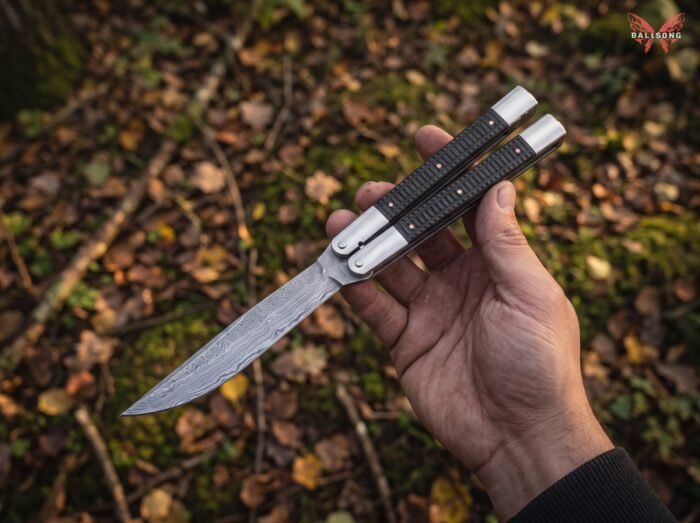
Alon Philippine Visayan Damascus Steel Blade Butterfly Balisong Knife USA Made Gift For Him With Beautiful Handle BF-123
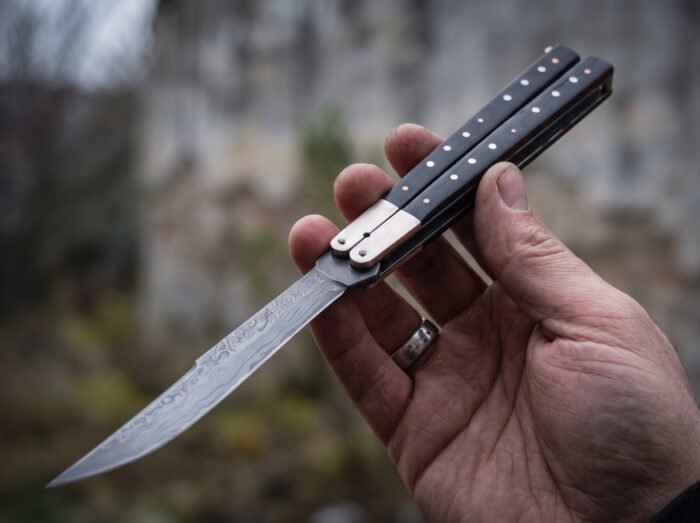
Batis Philippine Visayan Damascus Steel Blade Butterfly Balisong Knife USA Made Gift For Him With Beautiful Handle BF-127
The Visayan islands gave the balisong its second home, and the BF-127 is built to that regional read of the pattern - made entirely by hand.
Blade Materials – Damascus, layers of high carbon steel forge-welded and folded
Handle Materials – Brass with black micarta
Overall Length – 29cm
Blade Length -14cm
Weight – 220g
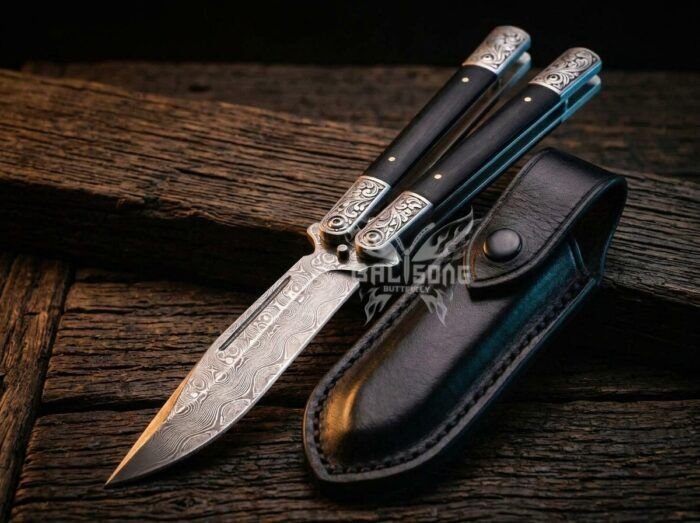
Bato Handmade Damascus Steel Balisong Knife| Micarta & Steel Engraved Bolsters Handle | Premium Butterfly Knife with Leather Sheath BF-146
Specifications:
Overall Length: 29 cm
Blade Length: 14 cm
Weight: 205 g
Blade Material: High-Performance Damascus Steel
Handle Material: Micarta with Steel Engraved Bolsters Handle
Personalise it: initials or short text engraving $19, custom logo engraving $29. Choose on this page before you add to cart. Free gift box included.
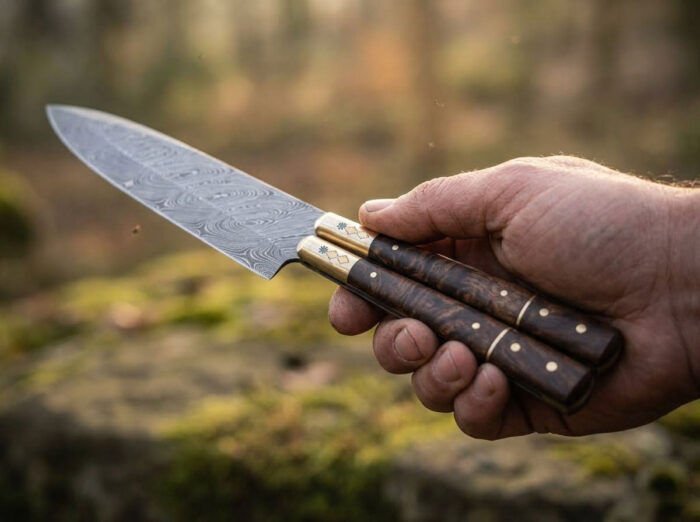
Buhawi Handmade Damascus Steel Balisong Kitchen Chef Knife | Walnut Burl Wood Handle with Brass Bolsters and Leather Sheath BF-168
Damascus on the blade, walnut burl on the handle. Two patterned surfaces on one knife, which is a decision that either works or looks like a mess. This page explains which and why.
Blade Material – Damascus Steel
Handle Material – Walnut Burl Wood with brass bolsters
Overall Length – 30.5 cm (12 in)
Blade Length – 18 cm (7 in)
Hardness – 58-60 HRC
Sheath – Fitted leather, included
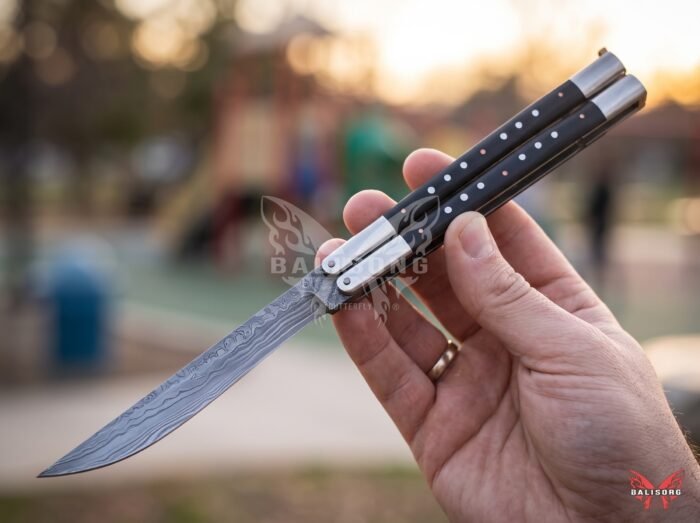
Bukal Philippine Visayan Damascus Steel Blade Butterfly Balisong Knife USA Made Gift For Him With Beautiful Handle BF-130
The Visayan islands kept their own blade traditions alongside Batangas, and the BF-130 follows that line with a layered pattern no two blades repeat.
Blade Materials – Damascus, layers of high carbon steel forge-welded and folded
Handle Materials – Brass with black micarta
Overall Length – 29cm
Blade Length -14cm
Weight – 220g
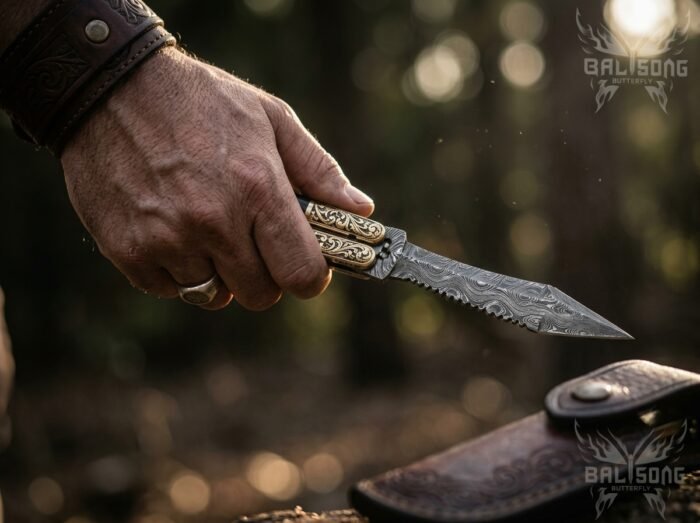
Bulkan Handmade Damascus Steel Balisong Knife| Black Horn & Brass Engraved Bolsters Handle | Premium Butterfly Knife with Leather Sheath BF-145
Specifications:Overall Length: 29 cmBlade Length: 14 cmWeight: 205 gBlade Material: High-Performance Damascus SteelHandle Material: Black Horn with Brass Engraved Bolsters Handle
Personalise it: initials or short text engraving $19, custom logo engraving $29. Choose on this page before you add to cart. Free gift box included.
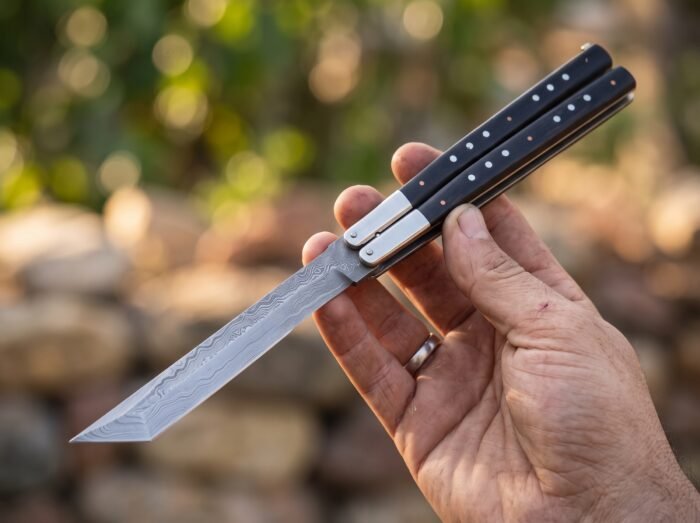
Dagat Philippine Visayan Damascus Steel Blade Butterfly Balisong Knife USA Made Gift For Him With Beautiful Handle BF-124
Damascus is folded and forge-welded, so the layering comes out differently on every blade and no two BF-124s are quite alike.
Blade Materials – Damascus, layers of high carbon steel forge-welded and folded
Handle Materials – Brass with black micarta
Overall Length – 29cm
Blade Length -14cm
Weight – 220g
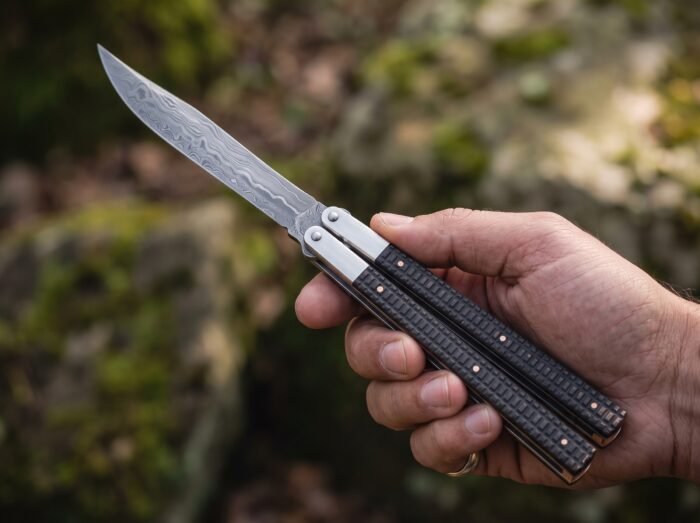
Dilim Philippine Visayan Damascus Steel Blade Butterfly Balisong Knife Black Micarta USA Made Gift For Him With Beautiful Handle BF-126
Part of our Limited Edition line, this Philippine Visayan balisong pairs a tempered high-carbon blade with a striking black micarta handle.
Blade Materials – Damascus, layers of high carbon steel forge-welded and folded
Handle Materials – Brass with black micarta
Overall Length – 29cm
Blade Length -14cm
Weight – 220g
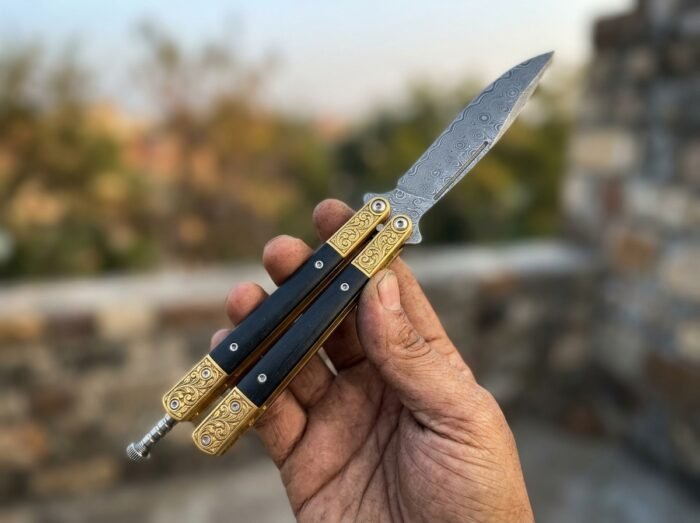
Ginto Handmade Damascus Steel Balisong Knife| Micarta & Brass Engraved Bolsters Handle | Premium Butterfly Knife with Leather Sheath BF-148
Specifications
-
Overall Length: 11.42 inches (29 cm)
-
Blade Length: 5.51 inches (14 cm)
-
Weight: 205 grams (7.23 oz)
-
Blade Material: Damascus Steel KnifeHandle Material: Micarta with Brass Engraved Bolsters Handle
-
-
Sheath: Premium Leather
Personalise it: initials or short text engraving $19, custom logo engraving $29. Choose on this page before you add to cart. Free gift box included.
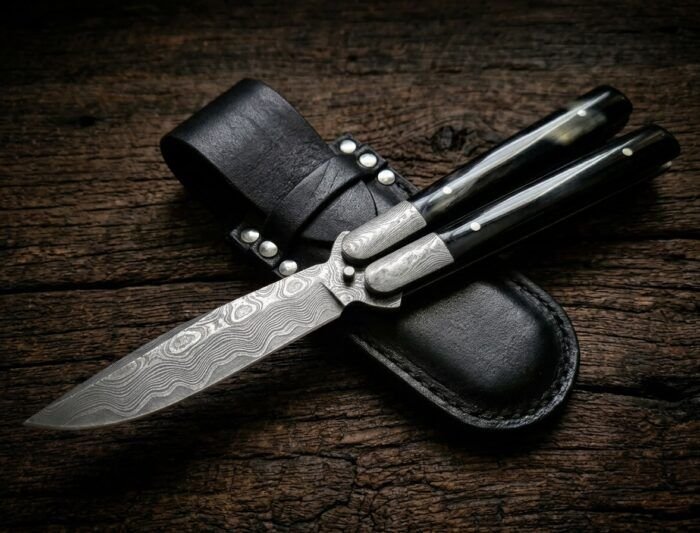
Hatinggabi Handmade Damascus Steel Balisong Knife | Black Horn & Damascus Steel Bolster Handle | Premium Butterfly Knife with Leather Sheath BF-162
The BF-162 showcases hand-forged Damascus steel patterning paired with a black horn handle and Damascus steel bolsters for a truly one-of-a-kind balisong.
Specifications
-
-
-
Overall Length: 29 cm
-
Blade Length: 14 cm
-
Blade Material: Damascus Steel Handle Material: Black Horn & Damascus Steel Bolsters Handle
-
-
-
Sheath: Premium Leather
Personalise it: initials or short text engraving $19, custom logo engraving $29. Choose on this page before you add to cart. Free gift box included.
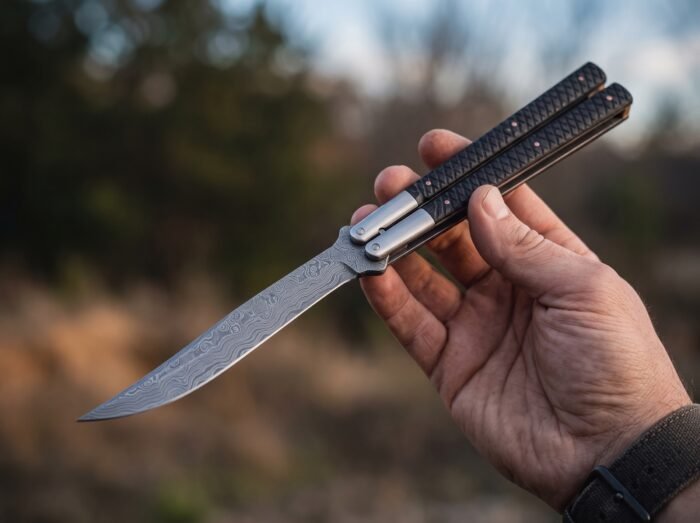
Ilog Philippine Visayan Damascus Steel Blade Butterfly Balisong Knife USA Made Gift For Him With Beautiful Handle BF-125
Folded steel leaves a pattern that runs the length of whatever you forge it into, and on this long Visayan frame those lines have room to stretch out.
Blade Materials – Damascus, layers of high carbon steel forge-welded and folded
Handle Materials – Brass with black micarta
Overall Length – 29cm
Blade Length -14cm
Weight – 220g
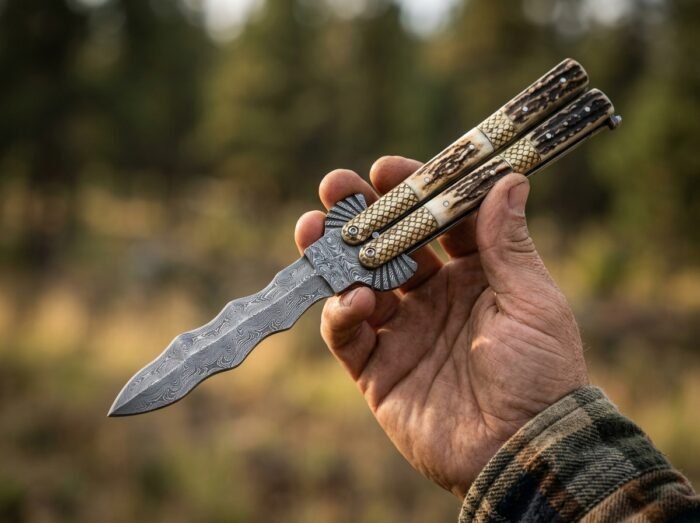
Kalaw Handmade Damascus Steel Balisong Double Edge Eagle Knife| Stag & Brass Engraved Bolsters Handle | Premium Butterfly Knife with Leather Sheath BF-144
Specifications:Overall Length: 29 cmBlade Length: 14 cmWeight: 205 gBlade Material: High-Performance Damascus Steel Double Edge KnifeHandle Material: Stag with Brass Engraved Bolsters Handle
Personalise it: initials or short text engraving $19, custom logo engraving $29. Choose on this page before you add to cart. Free gift box included.
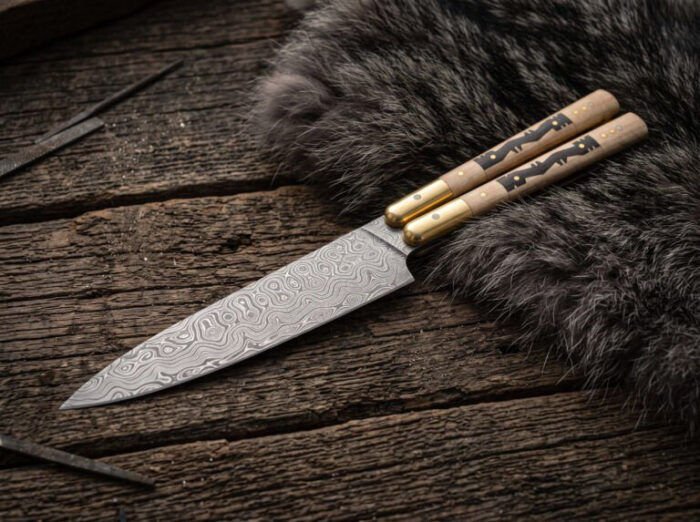
Kislap Handmade Damascus Steel Balisong Kitchen Chef Knife | Buffalo Bone Handle with Brass Bolsters and Leather Sheath BF-167
A 12 inch Damascus chef knife with buffalo bone panels and brass bolsters. Bone is the quietest handle material we work with, which is precisely why it sits well under a busy blade.
Blade Material – Damascus Steel
Handle Material – Buffalo Bone with brass bolsters
Overall Length – 30.5 cm (12 in)
Blade Length – 18 cm (7 in)
Hardness – 58-60 HRC
Sheath – Fitted leather, included
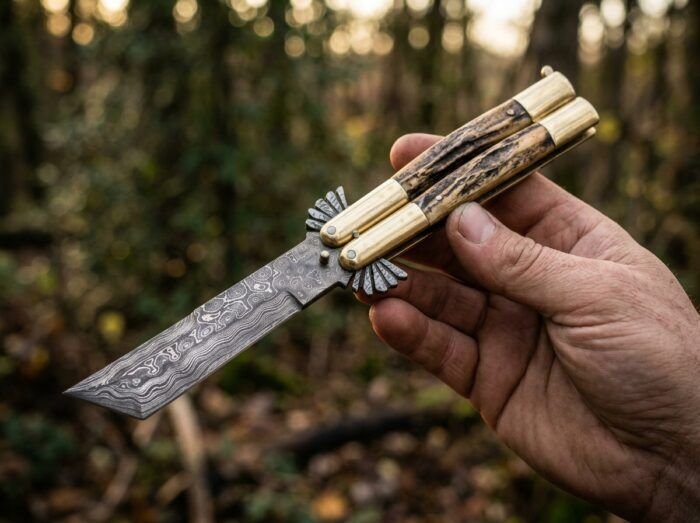
Lakas Handmade Damascus Steel Balisong Tanto Blade Knife| Stag & Brass Bolsters Handle | Premium Butterfly Knife with Leather Sheath BF-156
Specifications
-
-
-
Overall Length: 11.42 inches (29 cm)
-
Blade Length: 5.51 inches (14 cm)
-
-
-
Blade Material: Rain DropHandle Material: Stag & Brass Bolsters Handle
-
-
-
Sheath: Premium Leather
Personalise it: initials or short text engraving $19, custom logo engraving $29. Choose on this page before you add to cart. Free gift box included.
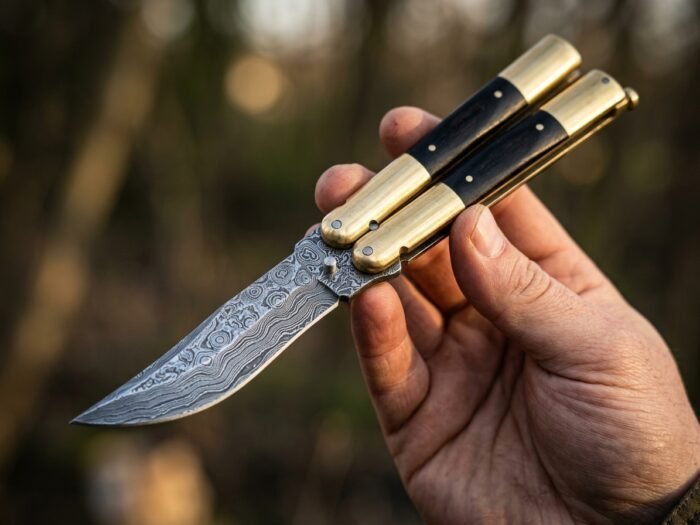
Mayon Handmade Damascus Steel Balisong Knife| Micarta & Brass Bolsters Handle | Premium Butterfly Knife with Leather Sheath BF-155
Specifications
-
Overall Length: 10 inches
-
Blade Length: 4 inches
-
Blade Material: Damascus SteelHandle Material:Micata & Brass Bolsters Handle
-
-
Sheath: Premium Leather
Personalise it: initials or short text engraving $19, custom logo engraving $29. Choose on this page before you add to cart. Free gift box included.
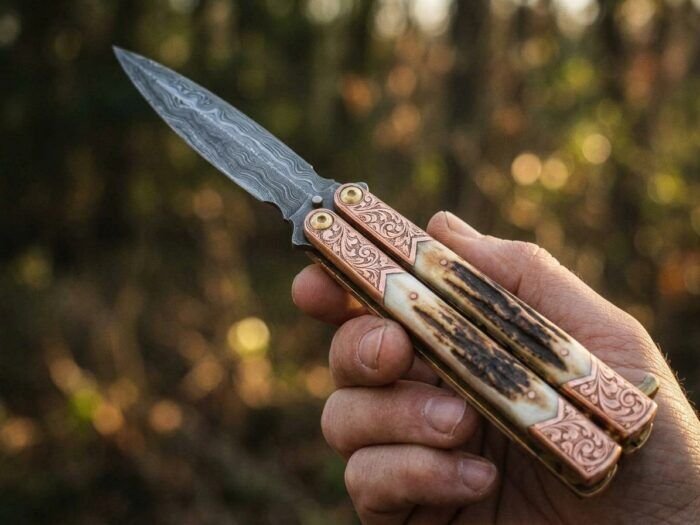
Pamana Handmade Damascus Steel Balisong Double Edge Knife| Stag & Copper Engraved Bolsters Handle | Premium Butterfly Knife with Leather Sheath BF-140
Specifications:
Overall Length: 29 cm
Blade Length: 14 cm
Weight: 205 g
Blade Material: High-Performance DamascusSteel Double Edge
Handle Material: Stag with Copper Engraved Bolsters Handle
Personalise it: initials or short text engraving $19, custom logo engraving $29. Choose on this page before you add to cart. Free gift box included.
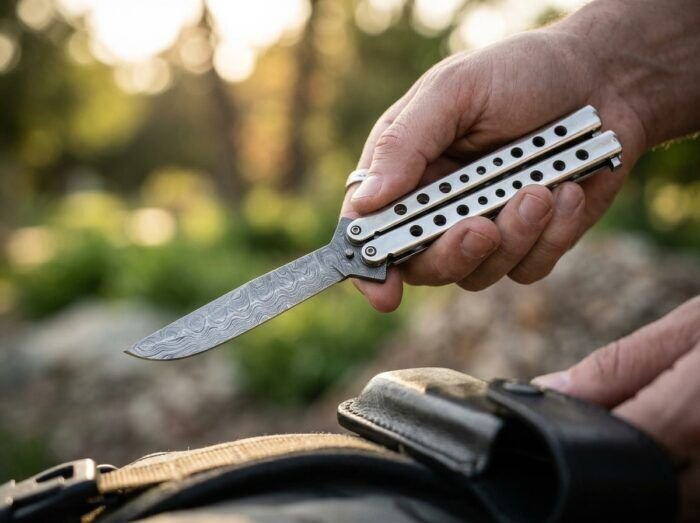
Pilak Handmade Damascus Steel Balisong Tanto Blade Knife| 410 stainless steel Handle | Premium Butterfly Knife with Leather Sheath BF-157
Specifications
-
-
-
Overall Length: 11.42 inches (29 cm)
-
Blade Length: 5.51 inches (14 cm)
-
-
-
Blade Material: Damascus Steel
Handle Material: 410 Stainless Steel Handle
-
-
-
Sheath: Premium Leather
Personalise it: initials or short text engraving $19, custom logo engraving $29. Choose on this page before you add to cart. Free gift box included.
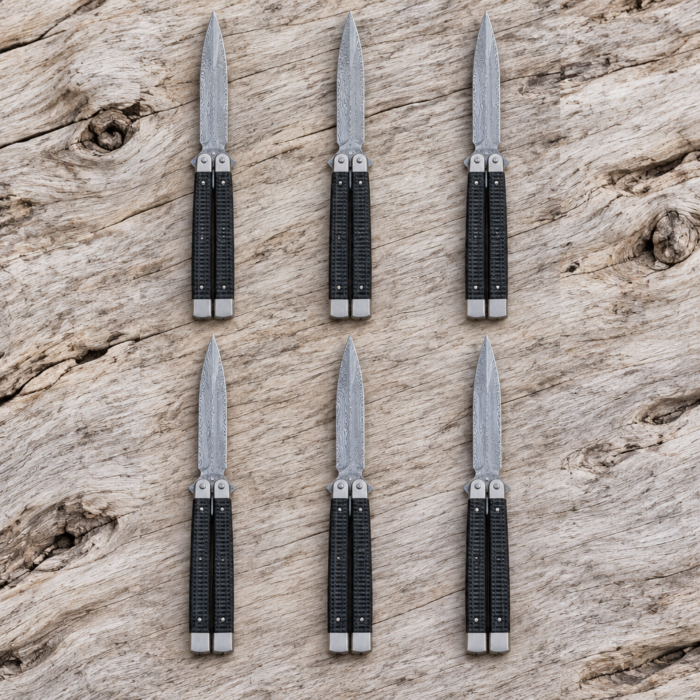
Set of 6 Alon Philippine Visayan Damascus Steel Blade Butterfly | Groomsmen Gift Set | BF-123-S6
Bulk set discount: 15% off. Buying this set of 6 costs 15% less than buying the same knives one at a time.
This set is 6 of the same balisong: Alon Philippine Visayan Damascus Steel Blade Butterfly. It is the same knife sold on its own single listing, packed together for groomsmen, a wedding party or a flipping crew. Every knife in the box is the same model.
Buying the set costs 15% less than buying 6 single knives. If you want names on them, tick text engraving, type one name per line and each name goes on its own knife.
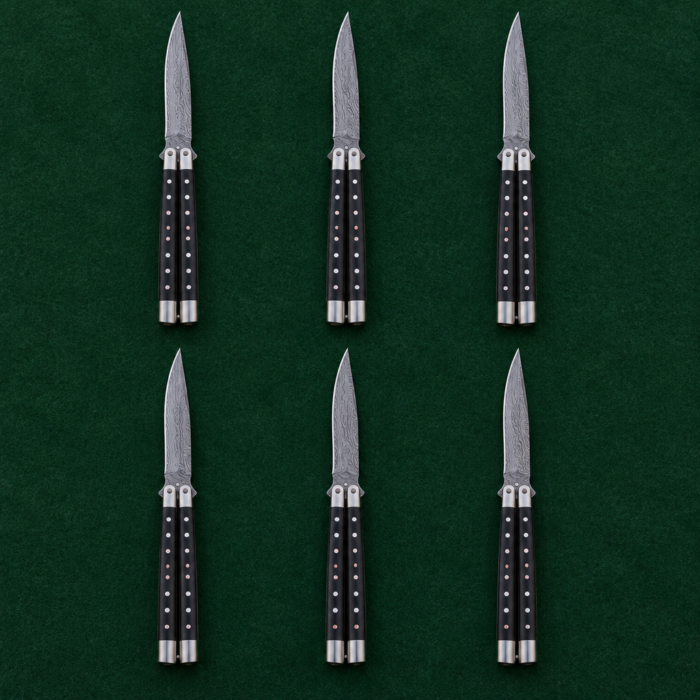
Set of 6 Bukal Philippine Visayan Damascus Steel Blade Butterfly | Groomsmen Gift Set | BF-130-S6
Bulk set discount: 15% off. Buying this set of 6 costs 15% less than buying the same knives one at a time.
This set is 6 of the same balisong: Bukal Philippine Visayan Damascus Steel Blade Butterfly. It is the same knife sold on its own single listing, packed together for groomsmen, a wedding party or a flipping crew. Every knife in the box is the same model.
Buying the set costs 15% less than buying 6 single knives. If you want names on them, tick text engraving, type one name per line and each name goes on its own knife.
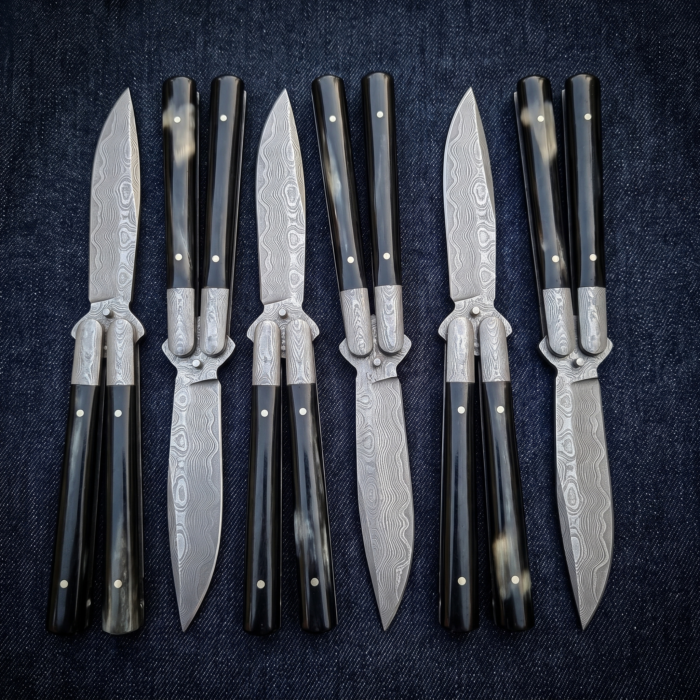
Set of 6 Hatinggabi Handmade Damascus Steel Balisong Knife | Groomsmen Gift Set | BF-162-S6
Bulk set discount: 15% off. Buying this set of 6 costs 15% less than buying the same knives one at a time.
This set is 6 of the same balisong: Hatinggabi Handmade Damascus Steel Balisong Knife. It is the same knife sold on its own single listing, packed together for groomsmen, a wedding party or a flipping crew. Every knife in the box is the same model.
Buying the set costs 15% less than buying 6 single knives. If you want names on them, tick text engraving, type one name per line and each name goes on its own knife.
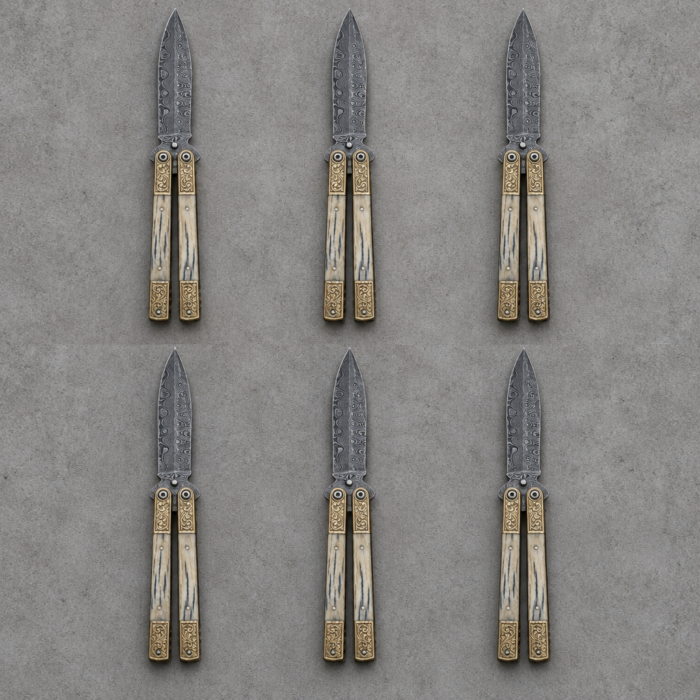
Set of 6 Sinauna Handmade Damascus Steel Balisong Double Edge Blade | Groomsmen Gift Set | BF-142-S6
Bulk set discount: 15% off. Buying this set of 6 costs 15% less than buying the same knives one at a time.
This set is 6 of the same balisong: Sinauna Handmade Damascus Steel Balisong Double Edge Blade. It is the same knife sold on its own single listing, packed together for groomsmen, a wedding party or a flipping crew. Every knife in the box is the same model.
Buying the set costs 15% less than buying 6 single knives. If you want names on them, tick text engraving, type one name per line and each name goes on its own knife.
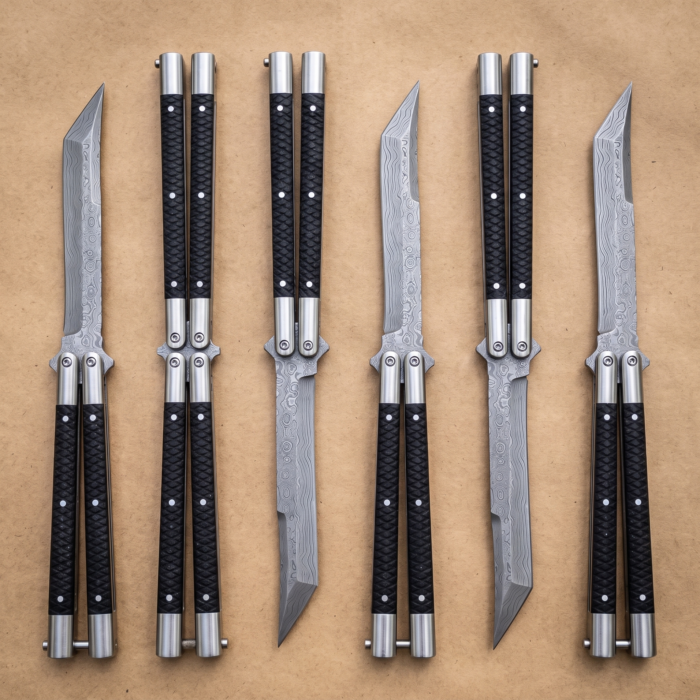
Set of 6 Tindalo Filipino Traditional Series Damascus Steel | Groomsmen Gift Set | BF-129-S6
Bulk set discount: 15% off. Buying this set of 6 costs 15% less than buying the same knives one at a time.
This set is 6 of the same balisong: Tindalo Filipino Traditional Series Damascus Steel. It is the same knife sold on its own single listing, packed together for groomsmen, a wedding party or a flipping crew. Every knife in the box is the same model.
Buying the set costs 15% less than buying 6 single knives. If you want names on them, tick text engraving, type one name per line and each name goes on its own knife.
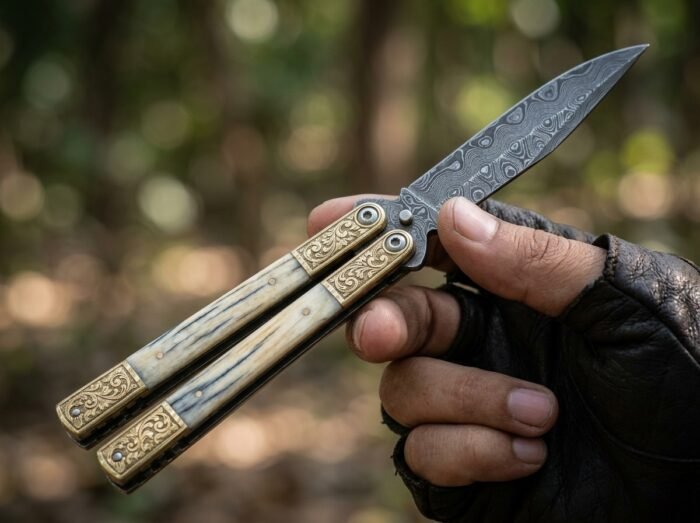
Sinauna Handmade Damascus Steel Balisong Double Edge Blade Knife| Mammoth Tooth & Brass Engraved Bolsters Handle | Premium Butterfly Knife with Leather Sheath BF-142
Specifications:
Overall Length: 29 cm
Blade Length: 14 cm
Weight: 205 g
Blade Material: High-Performance Rain Drop Damascus Steel Double Edge
Handle Material: Mammoth Tooth with Brass Engraved Bolsters Handle
Personalise it: initials or short text engraving $19, custom logo engraving $29. Choose on this page before you add to cart. Free gift box included.
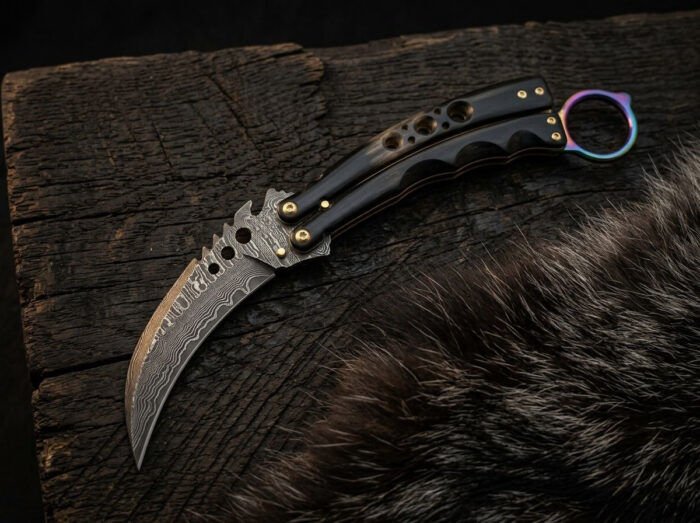
Singsing Handmade Damascus Steel Karambit Balisong Butterfly Knife | Buffalo Horn Handle with Brass and Titanium Ring and Leather Sheath BF-184
Damascus on a curve, which is the one place the pattern does something a straight blade cannot.
Blade Material – Damascus Steel
Handle Material – Buffalo Horn with brass fittings, anodised titanium finger ring
Overall Length – 24 cm
Blade Length – 12 cm
Hardness – 58-60 HRC
Sheath – Fitted leather, included
Damascus Steel Balisong Butterfly Knives
19 Damascus butterfly knives, from $154.00 to $549.45, median $228.25. This is the shelf people arrive at when they have decided the knife should be beautiful as well as functional.
Damascus steel is not one steel. It is two or more steels forge-welded together, folded, and drawn out. Usually a high carbon steel paired with a nickel-bearing steel so that the two etch to different depths in acid. What you see is a cross-section through those folds. The pattern is structural, not printed, and it runs all the way through the blade.
How to Tell Real Damascus From Etched Damascus
This is worth knowing before you spend money anywhere, including here. A great deal of what is sold as a Damascus butterfly knife is a plain stainless blade with a pattern laser-etched or acid-stencilled onto the surface. Three tests:
- The pattern should continue across the bevel and onto the edge, not stop at it. A printed pattern is applied to the flat and dies at the grind line.
- The pattern should be visible on the spine and, where accessible, in the tang.
- Resharpening should not erase it. If a few passes on a stone take the pattern off, it was never in the steel.
Our Damascus is forged, folded and etched: the pattern is the steel. Sharpen it as much as you like.
What Is on This Shelf
| Detail | |
|---|---|
| Knives available | 19 |
| Price range | $154.00 – $549.45 |
| Median price | $228.25 |
| Blade shapes | Classic Batangas, tanto, double edge, Visayan |
| Handles | Black horn, stag, micarta, 410 stainless, brass and Damascus bolsters |
| Sheath | Fitted leather included on the Prime models |
| Trainer option | Free on every knife |
Should You Buy Damascus?
An honest answer: not for performance. A $180 D2 balisong will out-cut a $400 Damascus one over a long working edge, because D2 is engineered for edge retention and Damascus is engineered for pattern. What Damascus gives you is a knife that is genuinely one of a kind: the fold pattern cannot be repeated, and that is the right reason to buy it. Gifts, collections, and knives you want to still enjoy looking at in twenty years.
The underlying steel in most Damascus is high carbon, so treat it as carbon steel: dry it, oil it, and do not store it wet in leather.
Common Questions
Is a Damascus butterfly knife worth the money? If you are buying for looks, collecting, or as a gift. Yes, and the pattern is unrepeatable. If you are buying for cutting performance per dollar, a D2 balisong at half the price will serve you better. Both are honest reasons to buy.
How can I tell if Damascus steel is real? The pattern must continue over the bevel and edge, not stop at the grind line; it should be visible on the spine; and sharpening must not remove it. Etched fakes fail all three.
Does Damascus steel rust? Yes. Most Damascus is layered high carbon steel, so it needs the same care. Wipe dry, keep a light film of oil, do not store it in a leather sheath long-term.
Does the Damascus pattern wear off with sharpening? Not on a forged blade. The pattern is the layered structure of the steel itself and runs through the full thickness. If sharpening removes it, the blade was surface-etched rather than forged.
Why do Damascus balisongs cost more than D2? Forge-welding, folding and drawing out a billet by hand is many hours of work before the blade is even ground. You are paying for the labour in the steel, not for a better cutting edge.
Can I get a Damascus balisong as a trainer? Yes, for the same price. The full Damascus blade with the edge left unsharpened, which is a reasonable way to own a knife this expensive if you intend to actually flip it.
What handle suits a Damascus blade? Black horn and stag are the traditional pairings and let the blade lead. Damascus bolsters on a Damascus blade are the maximal option. Micarta is the choice if the knife will be handled hard rather than displayed.
The Damascus shelf, cheapest first
A quick warning before the list. Damascus does not cut better. It is folded steel and the pattern is the point, so buy it because you want to look at it, not because someone on the internet told you it holds an edge longer. Ours is real, etched by hand, and it will need re-etching one day. Every one ships with a fitted leather sheath, your choice of trainer or live blade at the same price, and 58-60 HRC.
- BF-130 Philippine Visayan Damascus Steel Blade Butterfly Balisong Knife USA Made Gift For Him With Beautiful Handle - $165.00
- BF-128 Philippine Visayan Damascus Steel Blade Butterfly Balisong Knife USA Made Gift For Him With Beautiful Handle - $165.00
- Handmade Damascus Steel Balisong Knife| Micarta & Brass Bolsters Handle | Premium Butterfly Knife with Leather Sheath BF-155 - $192.50
- BF-127 Philippine Visayan Damascus Steel Blade Butterfly Balisong Knife USA Made Gift For Him With Beautiful Handle - $192.50
- BF-125 Philippine Visayan Damascus Steel Blade Butterfly Balisong Knife USA Made Gift For Him With Beautiful Handle - $192.50
- BF-126 Philippine Visayan Damascus Steel Blade Butterfly Balisong Knife Black Sheet USA Made Gift For Him With Beautiful Handle - $192.50
- BF-124 Philippine Visayan Damascus Steel Blade Butterfly Balisong Knife USA Made Gift For Him With Beautiful Handle - $192.50
- BF-123 Philippine Visayan Damascus Steel Blade Butterfly Balisong Knife USA Made Gift For Him With Beautiful Handle - $192.50
- Handmade Damascus Steel Balisong Knife| Micarta & Steel Engraved Bolsters Handle | Premium Butterfly Knife with Leather Sheath BF-146 - $228.25
- Handmade Damascus Steel Balisong Knife| Micarta & Brass Engraved Bolsters Handle | Premium Butterfly Knife with Leather Sheath BF-148 - $231.00
- Handmade Damascus Steel Balisong Tanto Blade Knife| 410 stainless steel Handle | Premium Butterfly Knife with Leather Sheath BF-157 - $242.00
- Handmade Damascus Steel Balisong Knife| Stag & Steel Engraved Bolsters Handle | Premium Butterfly Knife with Leather Sheath BF-147 - $247.50
- Handmade Damascus Steel Balisong Tanto Blade Knife| Stag & Brass Bolsters Handle | Premium Butterfly Knife with Leather Sheath BF-156 - $253.00
- Handmade Damascus Steel Balisong Double Edge Eagle Knife| Stag & Brass Engraved Bolsters Handle | Premium Butterfly Knife with Leather Sheath BF-144 - $286.00
Buying for a wedding party? The groomsmen butterfly knife sets come as six matched knives, 15% less than buying them singly, and each one can carry its own engraved name.
Damascus not quite right? Every steel we make is on the main balisong knives page.
About our balisongs
The balisong began in Batangas, in the Philippines, and every knife in this collection is made in that tradition. Our knives are made by Filipino artisans and metalworkers, many from families with generations of experience, now working in the United States.
Blades are ground in 440C stainless, D2 tool steel, VG10, high carbon and Damascus steel. Handles are fitted in kamagong ebony, carabao horn, Philippine deer horn and bone, and every knife ships with a fitted leather sheath. Both live blades and trainers are offered.
Before a knife leaves the bench it passes a four-step quality process: detailed hand inspection, smoothness and pivot testing, blade alignment checks, and durability and finish quality control. If a knife doesn't meet our standards, it never reaches our customers.
Most orders ship in 1 to 3 business days and arrive in 4 to 8 business days across the USA, or 8 to 14 business days internationally. Out of stock knives are handcrafted to order in 2 to 3 weeks, and every order ships worldwide with tracking.