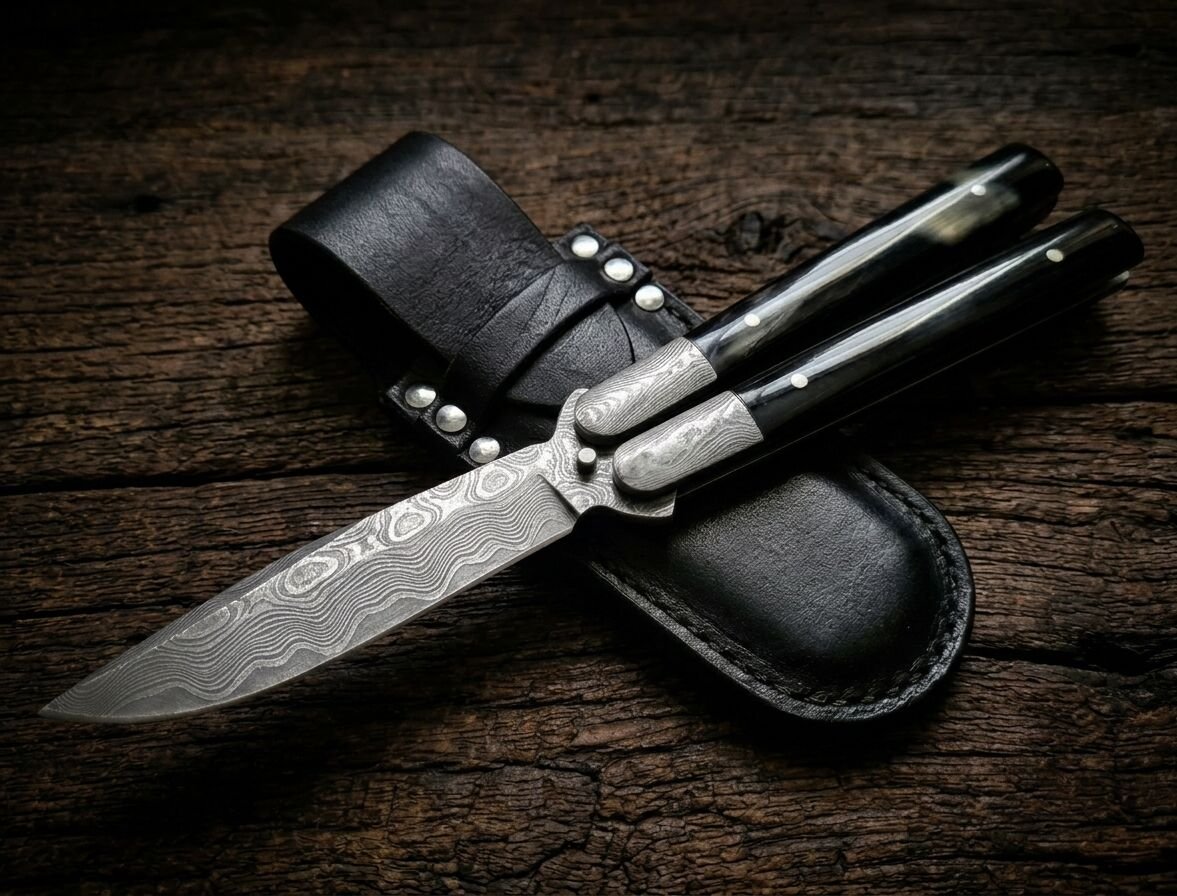
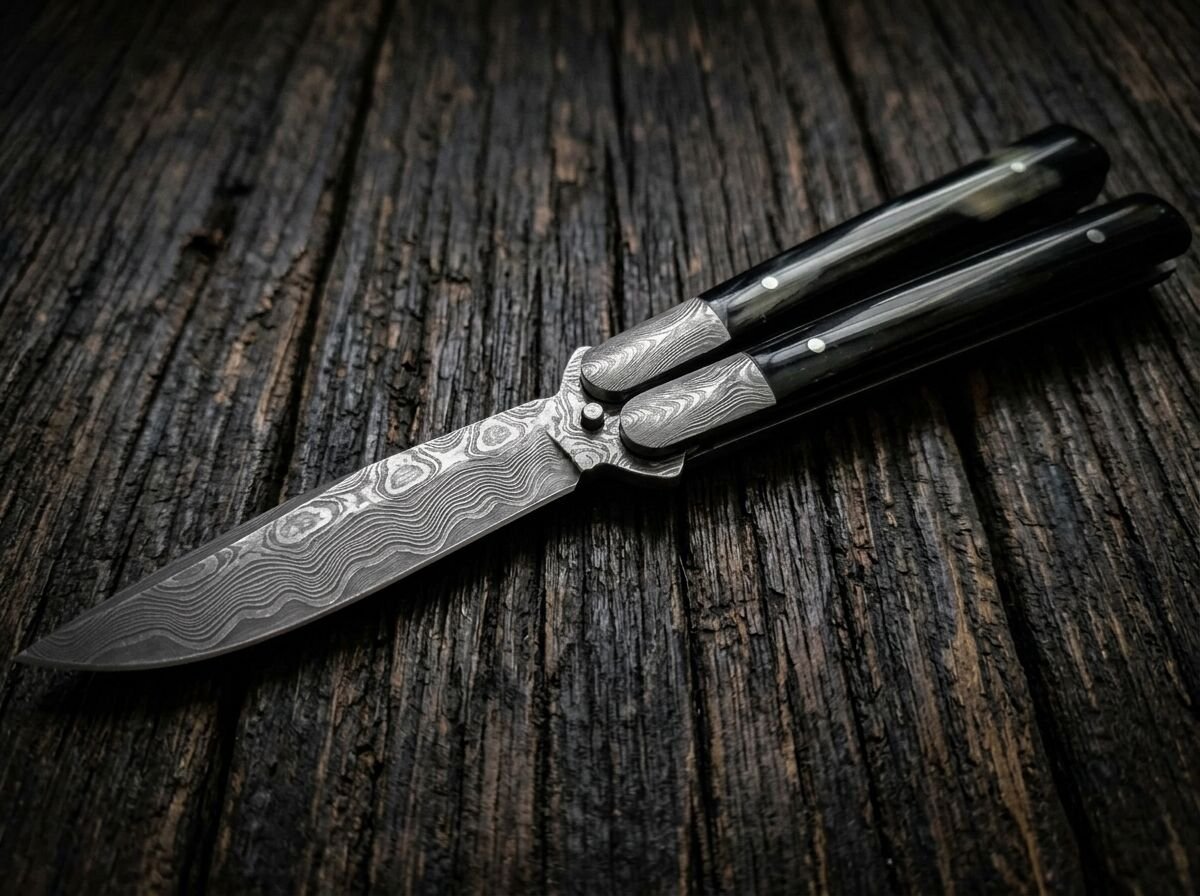
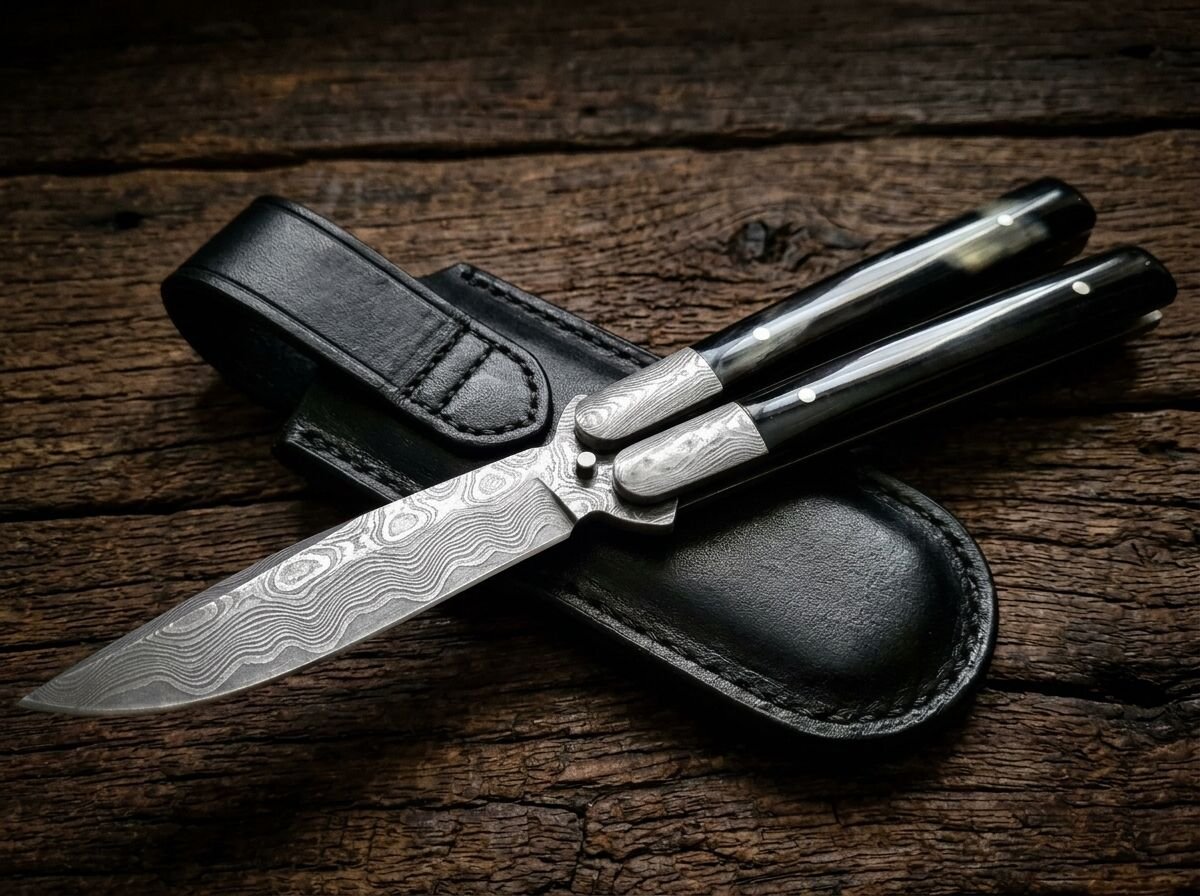
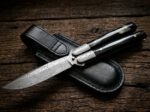
The BF-162 has a Damascus blade and Damascus bolsters, with black horn between them. Putting the same patterned steel in two places on one knife is a decision that can look magnificent or look like a mess, and the difference comes down to how the patterns relate.
The problem with repeating a pattern
A Damascus blade is busy. Light and dark layers moving across a large flat surface. Add a second patterned element and the eye now has two things competing for the same attention, with no quiet place to rest.
Done carelessly you get visual noise. Two patterns at similar scale, similar contrast and similar orientation read as one confused surface, and the knife looks cheaper than it is.
What makes it work here
- Scale. The bolsters are small. The same pattern across a much smaller area reads as fine texture rather than as pattern, so it supports the blade instead of arguing with it.
- Separation. Black horn sits between the two patterned elements. It is dark, near uniform, and it gives the eye somewhere to rest.
- Repetition as intent. Once the eye recognises the same material in two places, the knife reads as designed. Repetition is only noise when it looks accidental.
Why Damascus bolsters are uncommon
Because they are a lot of work for a small piece. Bolsters take the pivot and carry the structural load, so patterned steel used there has to be sound all the way through, with no weld flaws hiding anywhere. Any billet flaw that would be cosmetic on a blade becomes structural in a bolster.
They also have to be etched separately, matched to each other, and finished to sit flush against horn without the pattern being polished off at the edges. Most shops fit brass and move on.
The Damascus drop point blade
Two steels forge welded into a billet, folded to multiply layers, drawn out, ground and etched so the acid raises the pattern in relief. It runs through the full thickness, so sharpening will never remove it. Hardened to 58-60 HRC, a proper working hardness.
To be clear, as we are on every Damascus page here: this does not cut better than good mono steel. It performs like the tool steel it is. You are buying the pattern, which is a fine thing to buy.
Black horn as a balisong handle
Keratin, grown by a buffalo, cut and polished. Warm to the touch, light, quiet against steel and grippy when hands are damp. Held to a light it usually shows amber streaking, which is how you know it is not plastic.
Its only real enemy is prolonged extreme dryness, which can crack it along the grain. Handling prevents that on its own. If the knife lives in a case, wipe the panels with a trace of mineral oil once a year.
A note on our own listing
Earlier copy on this page described a D2 blade in one place while the title and specifications said Damascus. The Damascus is correct, in both the blade and the bolsters.
Who this is for
A collector. This is the most involved metalwork in the block, and it is a knife bought to be looked at more than carried.
Specifications for this Damascus black horn balisong
| Overall length |
29 cm |
| Blade length |
14 cm |
| Blade |
Damascus steel |
| Hardness |
58-60 HRC |
| Handle |
Black horn with Damascus steel bolsters |
| Sheath |
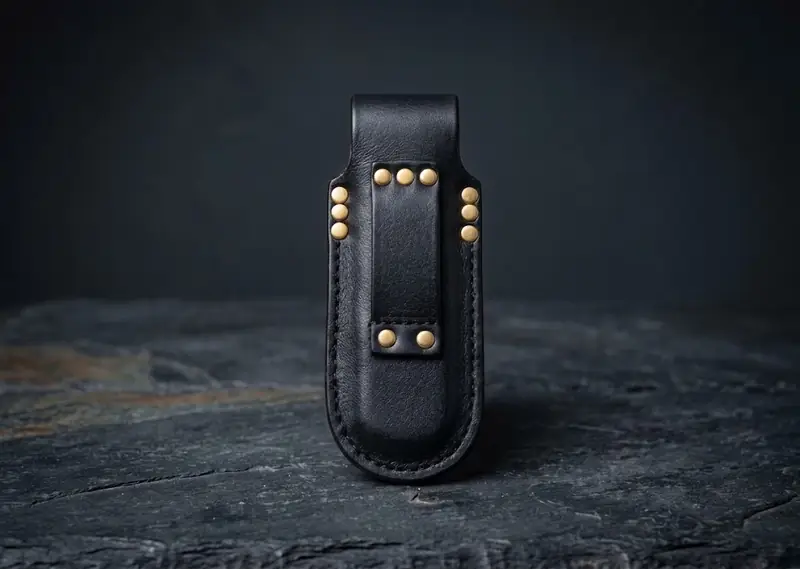
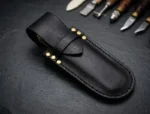
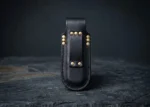
Fitted leather, included |
What you actually receive
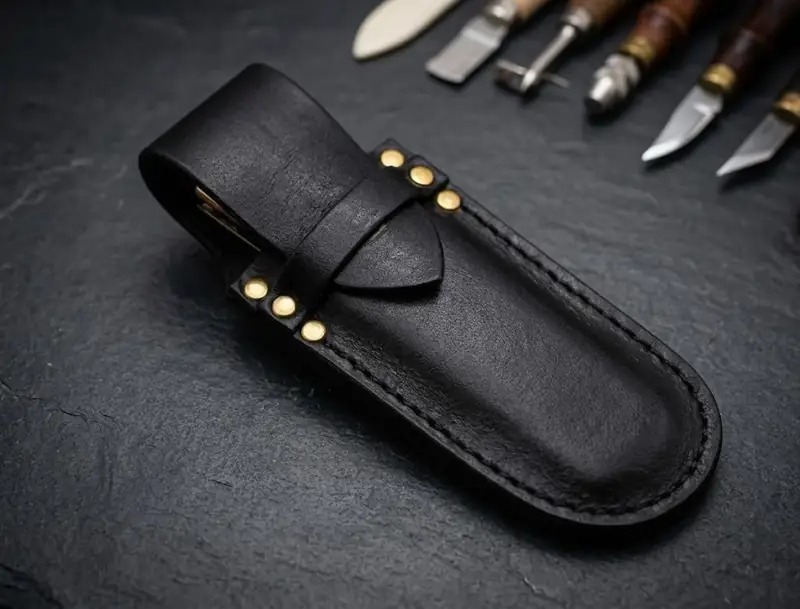
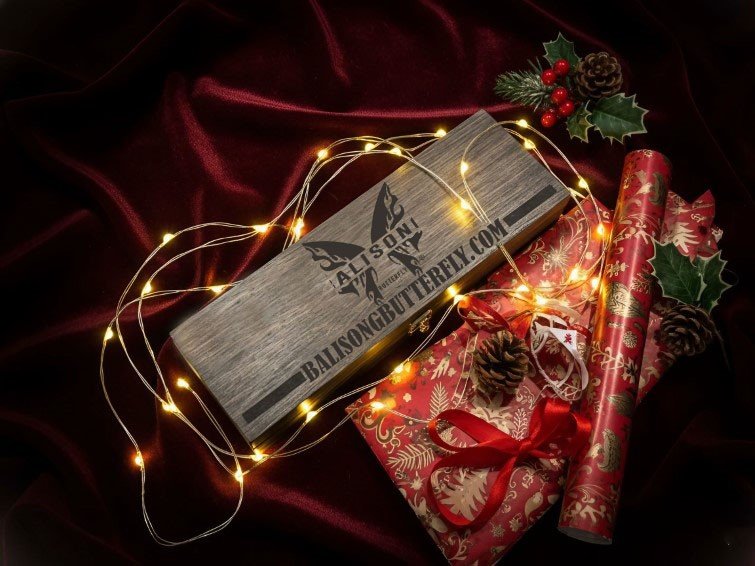
A knife that has been sharpened, tuned and checked by hand, a leather sheath cut for this frame, and a gift box.
Or take it as a trainer instead: identical frame and weight, no cutting edge, and the price does not move. Use it for anything you have not done a hundred times.
Engraving is $19 for initials or short text and $29 for a custom logo, chosen on this page. Shipping is free inside the United States and a flat $49 to everywhere else.
Black buffalo horn is covered alongside the other natural handle materials in our balisong handle materials guide, which explains why it stays grippy when your hands are damp. The Hatinggabi sits in our Damascus balisong collection. For the same pairing of black horn and etched Damascus steel carried into a curved blade, the Singsing brings the combination to a karambit balisong.
Buying for groomsmen? This balisong also comes as a matched set of 6, 15% less than buying six singly, and each one can carry its own engraved name.



Kenneth Martinez –
Nice pickup for the price. Nice that it’s US made with real Filipino balisong roots. Good product. Just not quite perfect.
Shane Smith –
Does the job but I wasn’t blown away. Action is okay but not as smooth as I hoped. Handle scales feel a bit plasticky for the price. Not bad, not amazing either.
Rafael Howard –
No regrets on this purchase at all. Blade came shaving sharp straight out of the box. Already planning my next pickup from this store.
Lisa Patel –
This showed up faster than expected and looked incredible. Comes with a nice pouch which is a nice touch. Bushings feel buttery smooth after just a bit of use. This flips cleaner than knives twice the price. Zero complaints from me on this purchase.
Alexander Anderson –
Bought this on a whim and it turned out to be one of my favorite pickups in a while. Bushings feel buttery smooth after just a bit of use. Can’t wait to see what else this seller has to offer.
Linda Cruz –
I collect balisongs and this one is rock solid. Bushings feel buttery smooth after just a bit of use. Balisong Butterfly’s attention to detail is honestly unmatched. Comes with a nice pouch which is a nice touch. Handles have a great grip even during fast flips. This is the kind of purchase that makes online shopping worth it.
Gregory Reed –
Photos don’t do this knife justice at all. Respect to the Filipino craftsmanship behind this, all made and shipped from the USA. Weight is perfectly balanced for flipping. This shop just earned a repeat customer.
Rebecca Martin –
This is the kind of balisong you show off without even meaning to. Pivots feel dialed in with zero blade play. Balisong Butterfly is quickly becoming my go to shop for balisongs. This flips cleaner than knives twice the price. Bushings feel buttery smooth after just a bit of use. Beyond happy with how this turned out.
Christine Hughes –
This balisong completely won me over the moment I flipped it. Already planning my next pickup from this company.
Jack Delacruz –
Phenomenal quality for the price point. Handles have a great grip even during fast flips. If you’re on the fence just get it. You won’t regret it.