
Blog
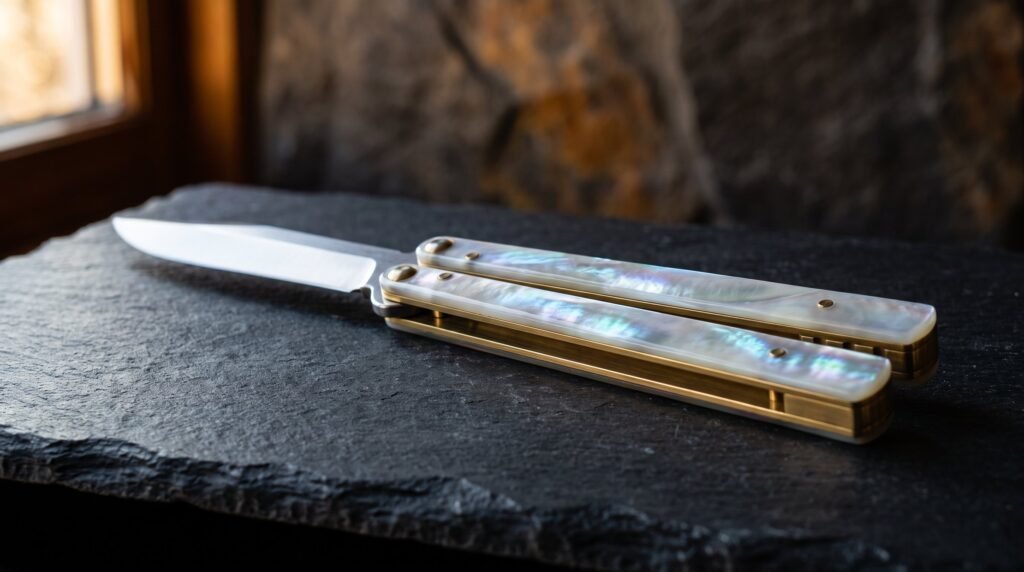
Handle material decides three things on a balisong: how heavy the knife is, how it feels rolling across your knuckles, and how much looking-after it needs. Water buffalo horn, bone and hardwoods like kamagong give you warmth, grip and tradition but move with humidity. Brass and stainless add mass and momentum. Titanium, G10, micarta, carbon fibre and aluminium keep things light and stable. Beginners are usually happiest on horn, wood or G10.
That is the short version. The longer version is that handle material is the single most under-discussed part of buying a balisong, because it is the part you touch for the entire life of the knife. Below we go through every material we actually work with in the shop, what it does to the knife in the hand, and which flipper it suits.
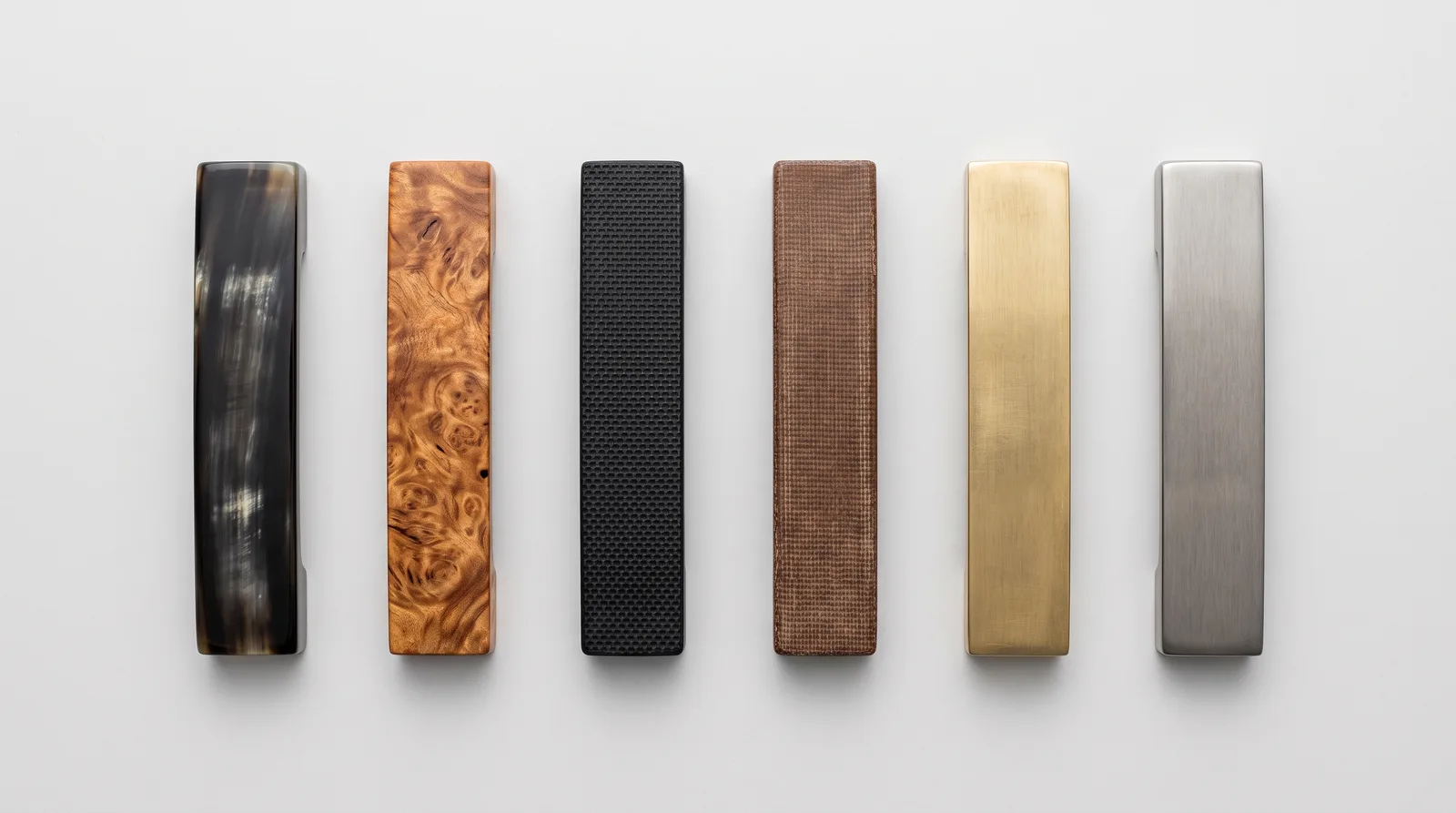
What the handle actually does on a balisong
On a fixed blade, the handle is a grip. On a balisong it is a moving part. It swings around the pivots, it strikes your palm on every catch, it carries roughly two thirds of the total mass of the knife, and it sets where the balance point sits. Change the handle material and you change the rhythm of the knife, not just the look of it.
Three properties matter, in this order:
- Density. This is the big one. Density decides mass, mass decides momentum, momentum decides how hard you have to work to start and stop a rotation.
- Surface friction. How much the material grips a dry palm, a sweaty palm and a cold palm. These are three different answers for the same material.
- Dimensional stability. Whether the material stays the size it was when it left the workshop. Natural materials do not. Composites and metals mostly do.
Handle materials at a glance
The densities below are typical published values for the material family, not measurements of any specific knife. Real handles are hollowed, skeletonised, pinned and bolstered, so use these to compare materials against each other, not as a spec for a finished balisong.
| Material | Approx. density (g/cm³) | Relative weight vs G10 | Maintenance | Moves with humidity? | Beginner friendly? |
|---|---|---|---|---|---|
| Canvas micarta | ~1.3–1.4 | 0.75x | Very low | Barely | Yes |
| Water buffalo horn | ~1.3 (keratin) | 0.7x | Low, occasional oil | Yes | Yes |
| Carbon fibre laminate | ~1.5–1.6 | 0.85x | Very low | No | Fair |
| G10 glass-epoxy | 1.80 | 1.0x | None worth mentioning | No | Yes |
| Kamagong / dense hardwood | ~0.64–1.27 for the ebony group | 0.35–0.7x | Low, occasional oil | Yes | Yes |
| Bone | ~1.8–2.0 (dry cortical) | ~1.05x | Low, keep it dry | Slightly | Fair |
| Aluminium (6061) | ~2.70 | 1.5x | Low | No | Yes |
| Titanium (6Al-4V) | ~4.43 | 2.5x | Low | No | Fair |
| Stainless steel | ~7.7–8.0 | ~4.3x | Low, wipe dry | No | No |
| Brass | ~8.4–8.7 | ~4.7x | Polish or accept patina | No | No |
Read the third column carefully. A pair of handles cut to identical dimensions weighs roughly four and a half times more in brass than in G10. That is not a small adjustment to the feel of a knife. That is a different knife.
Water buffalo horn and bone
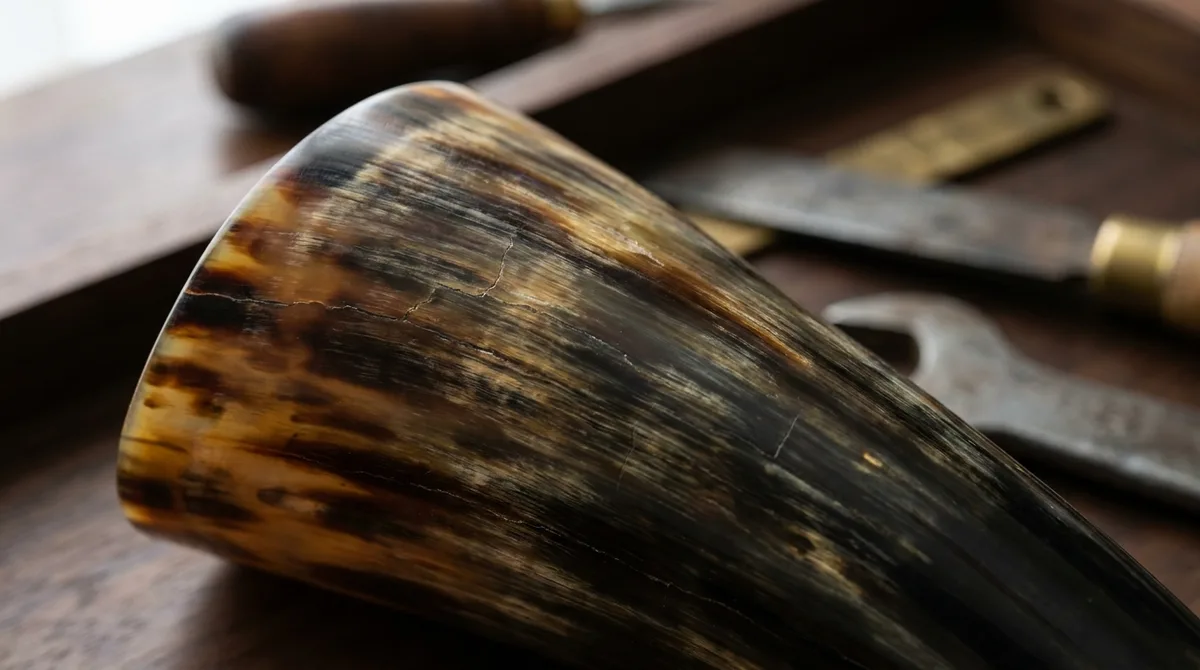
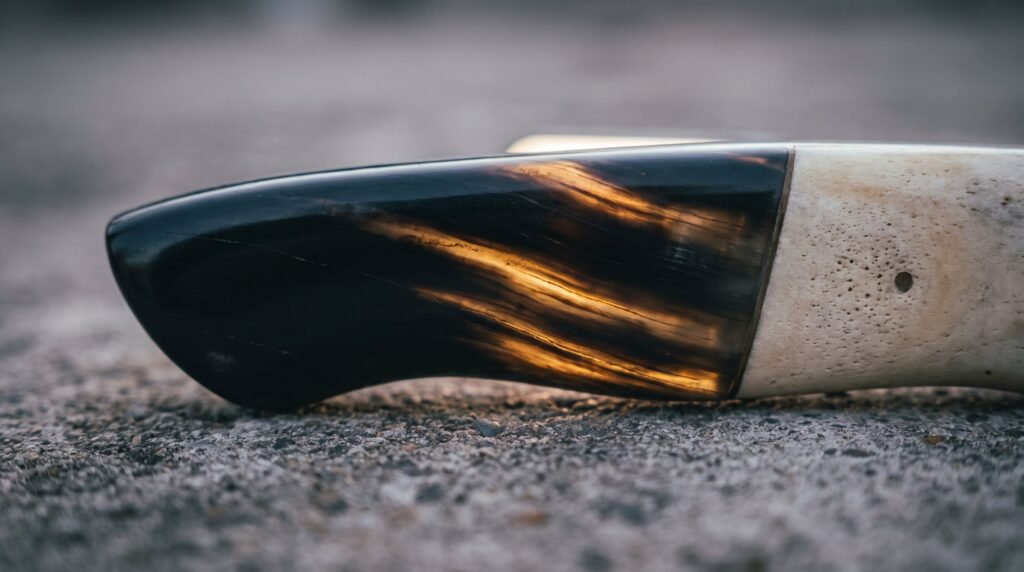
Carabao horn is what the original Batangas makers used, and it is still what we reach for on most traditional builds. It is keratin, the same protein family as your fingernails, so the density is close to that of hard plastic. It is warm to the touch within seconds of picking the knife up, which no metal handle will ever do.
In the hand it has a slightly waxy grip that improves rather than worsens when your palms are damp. That matters more than it sounds: most beginners lose a knife on a catch because the handle got slippery, and horn is one of the few materials that gets tackier with sweat rather than glassier.
The honest downside: horn is a natural material and it responds to its environment. It softens under heat, it can dry and check if you leave the knife on a sunny windowsill for a month, and it will take up and give off moisture with the seasons. Every piece is also different in colour, translucency and figure, so if you want two knives that match exactly, horn is not the material for that.
Kamagong and other dense hardwoods
Kamagong is Philippine ebony, from the Diospyros family. Published densities for the black and streaked ebony group run from roughly 640 to 1270 kg/m³ at 15% moisture content. That is a wide band because the group covers many species and because heartwood and sapwood differ sharply; the dark heartwood people want for knife handles sits at the heavy end. It is dense enough that offcuts often sink in water, which is the workshop test everyone knows.
Wood handles feel alive in a way composites do not. They are quieter on the catch, they warm quickly, and a well-oiled hardwood takes a patina from your hands that no factory finish reproduces. Kamagong holds tight, dense grain that resists the dings a dropped balisong picks up.
The same honesty applies as with horn: wood moves. Even stabilised wood moves a little. If you live somewhere that swings from monsoon humidity to air-conditioned dry, expect a wood-handled knife to feel marginally tighter in the wet season and marginally looser in the dry one. That is normal. It is not a defect and it is not a reason to over-tighten the pivots.
Bone turns up on older Filipino knives for the same reasons. Dry cortical bone is denser than horn, so bone handles feel slightly more substantial, and it polishes to a hard, cool, almost ceramic surface. It is also harder and more brittle: it grips less well when wet and can chip on a drop where horn would dent and recover. Excellent as a collector material, middling as a learn-to-flip one.
Brass and stainless steel: the heavyweights
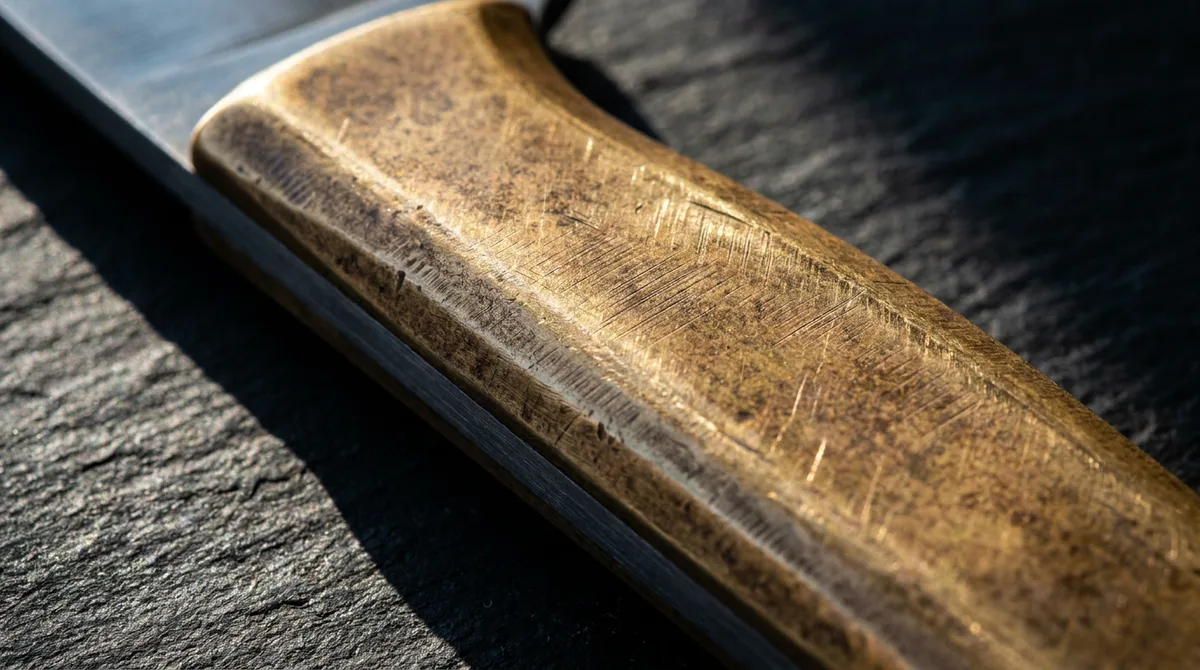
Brass is the traditional metal bolster and liner material on Filipino balisongs, and full brass handles turn up on more decorative builds. It is the densest thing on this list. A brass-handled knife has real authority in the hand and enormous rotational momentum, which is either exactly what you want or exactly what will hurt you.
Brass also oxidises, going from bright yellow to a warm brown patina within months of handling. Some people polish it back; most collectors let it darken and consider that the point. Neither is wrong. Just do not expect it to stay showroom bright without work.
Stainless handles are slightly less dense than brass and considerably harder, so they resist dings better. They are also the most slippery material on this list when your hands are damp. Steel-handled balisongs are a specialist taste: superb for slow, controlled manipulation work where you want the knife to keep moving on its own, poor for anything involving a fast aerial that you would rather not catch with your face.
Neither brass nor stainless is a sensible first balisong. A heavy knife punishes a bad catch about four times harder than a light one, and a beginner makes a lot of bad catches. Learn on something light, then graduate.
Titanium and aluminium
Titanium sits in the useful middle of the chart at roughly 4.43 g/cm³ for the common 6Al-4V alloy: heavier than any composite, a bit over half the weight of steel. It is corrosion-proof for practical purposes, takes anodising in colours no other material offers, and has a slightly grabby surface feel a lot of flippers like. It is also expensive to machine, which is why titanium-handled balisongs cost what they cost.
Aluminium is the lightweight metal option at around 2.70 g/cm³. It gives you a metal look and a cool touch without the mass penalty. The trade-off is hardness: aluminium is soft, so aluminium handles mark up quickly. If you flip over concrete, an aluminium-handled knife will look well-used within a month. Anodising helps the surface but does not change the metal underneath.
G10, micarta and carbon fibre
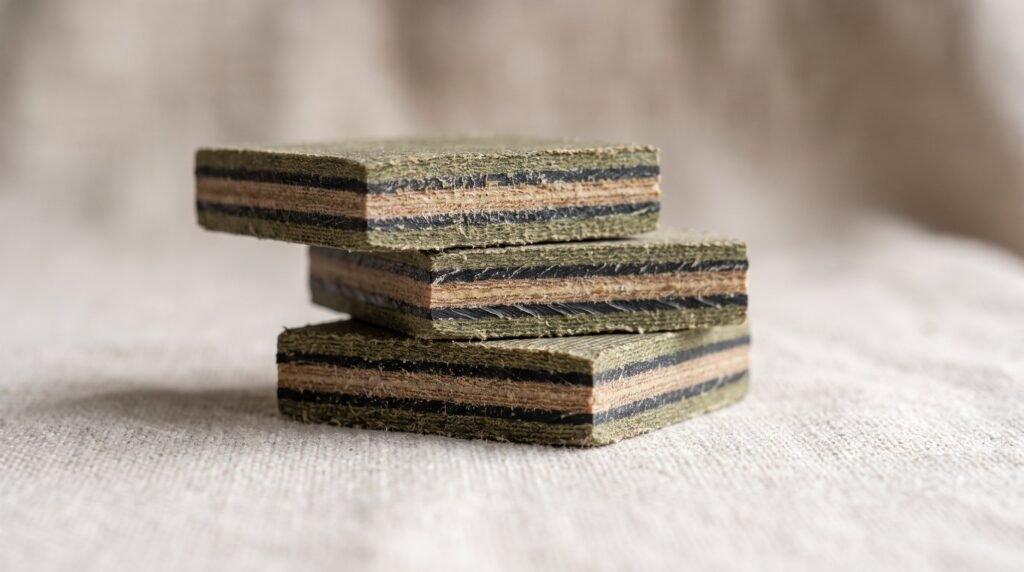
G10 is woven glass cloth in epoxy. Published density is 1.80 g/cm³ and 24-hour water absorption is around 0.1 to 0.17 percent, which is effectively nothing. That is the whole argument for G10 in one sentence: it does not care about weather. Textured G10 also has the most aggressive dry grip of any material here. It is our default recommendation for someone who wants to learn tricks and stop worrying about the handle.
Micarta is canvas, linen or paper in phenolic resin. Lighter than G10, warmer, softer, almost fabric-like in the hand. It is slightly more absorbent, so it darkens where you hold it and takes on a worn patina over years. Most owners consider that a feature.
Carbon fibre is carbon cloth in epoxy, typically around 1.5 to 1.6 g/cm³. It is the showpiece composite: deep, three-dimensional weave patterns, very light, very stiff. It is also the most fragile of the three in the specific sense that a hard edge impact can crack or delaminate a thin carbon fibre scale where G10 would just scuff. Beautiful, but not the material to learn horizontal aerials on.
The woods: rosewood and wenge
Rosewood
Rosewood is the sensible one. It is dense, naturally oily, warm to the touch immediately rather than after a minute of holding, and it darkens with handling into a deeper red brown that no finish can imitate. The oil content is the useful part: it makes the wood far more stable against humidity swings than an open pored timber, and it means the wood takes a hand rubbed finish and holds it.
It dents rather than chips, which is exactly the failure mode you want. A dent in rosewood after a bad drop reads as history. A chip in something brittle reads as damage. Rosewood also keeps the knife light enough that the balance stays near the pivot, which most flippers get on with well.
Wenge
Wenge is the dark, dramatic one, close to black with fine lighter streaks, and it has an open pore structure you can feel with a thumb. That texture is genuine grip, not decoration. It is harder and heavier than rosewood, so a wenge handled knife has a slightly more planted feel in the hand.
The trade off is that wenge is splintery to work and its open grain can lift if the knife is left soaking wet and then dried hard. It also has a habit of taking dark oil into the grain over time, which most owners consider an improvement and a few consider a nuisance. Wenge is the wood for someone who wants their knife to look serious.
Stag, and why no two knives match
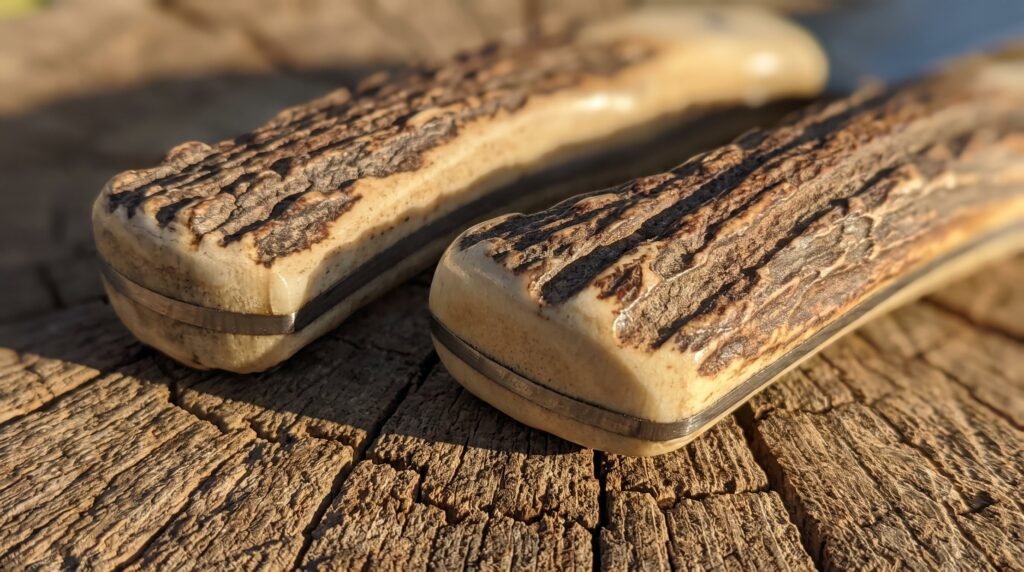
Stag is antler, and antler is grown by an animal that had no interest in your desire for a matched pair. Every piece has a different curve, a different bark texture on the outside, a different density of pith towards the centre. Matching two scales for one knife takes longer than shaping them, and even a good match is a match, never a duplicate.
In the hand it is the grippiest natural material we use. The ridged surface locks into a palm in a way smooth materials cannot, and it wears to a soft patina rather than a shine. It is also the material most likely to make two knives of the same model look like different products, which is the point of it.
Mother of pearl and the price of admission
Mother of pearl is nacre, laid down in microscopic layers, which is precisely why it throws colour differently depending on the angle you tilt it. No dyed or printed material has ever convincingly imitated it, because the effect is structural rather than pigmented. If you want to see nacre on something other than a balisong, Black Mamba Knives sells pearl handle knives that show how the material catches light.
It is also the most fragile material we fit. Nacre is brittle and it does not dent, it chips, and it will chip on the last pass of finishing after hours of work if the maker gets careless. On a knife that lives in a display case that is irrelevant. On a knife you intend to drop repeatedly onto a tiled floor while learning rollovers, it is a decision you will regret at speed.
Buy pearl for a knife you want to look at, hand over, and keep.
Which handle for which flipper
Total weight is only half the story. Where the material sits along the handle matters as much: a brass bolster at the pivot end with a light composite body behaves very differently from solid brass handles at the same total weight, because the mass sits near the axis of rotation instead of out at the tip. If your knife feels wrong and you cannot say why, read balisong weight and balance next. Meanwhile, here is the short version by flipper type.
| You are… | Best first choice | Second choice | Avoid for now | Why |
|---|---|---|---|---|
| Learning your first rollovers | G10 | Water buffalo horn | Brass, stainless | Light, grippy, forgiving of drops and damp hands |
| Flipping outdoors or in humid weather | G10 | Micarta | Wood, bone | Near-zero water absorption, no seasonal movement |
| Buying a traditional Batangas piece | Water buffalo horn | Kamagong | Carbon fibre | Correct materials for the tradition, and they age well |
| Collecting, display, gifting | Kamagong or horn | Brass with wood inlay | Aluminium | Natural figure and patina; every piece is unique |
| Doing slow, controlled manipulation | Brass or stainless | Titanium | Micarta | Momentum carries the rotation for you |
| Doing fast aerials | Titanium | G10 | Brass, stainless | Enough mass to feel, not enough to hurt on a miss |
| Wanting one knife for the next twenty years | Titanium | G10 | Bone | Dimensionally stable, corrosion-proof, hard to kill |
| On a tight budget | G10 | Hardwood | Titanium, carbon fibre | Best performance per unit of cost, by a distance |
The honest bit: natural materials move
Horn, bone and wood are organic, and they exchange moisture with the air for as long as they exist. A horn-handled balisong bought in a dry climate and shipped to a wet one will not be dimensionally identical when it arrives. In practice what you notice is small: a hair more or less handle play, a slightly different tap on the catch, occasionally a bolster pin standing a fraction proud after a very dry winter. That is the material doing what the material does, and it is the price of a handle with character instead of a moulded part.
What you should not do about it: crank the pivots down to remove seasonal play. Over-tightening a pivot to compensate for a handle that has shrunk half a hair will cost you the smooth swing and can gall the washers. Adjust in tiny increments, or leave it alone and let the next season put it back.
Maintenance by material
| Material | Routine care | How often | What kills it |
|---|---|---|---|
| Water buffalo horn | Wipe clean, thin coat of mineral or camellia oil | Every few months | Direct sun, radiators, soaking in water |
| Kamagong / hardwood | Wipe clean, light oil or wax | Every few months | Prolonged damp, hot cars, harsh solvents |
| Bone | Wipe dry, keep away from oils and dyes | As needed | Staining, hard impacts, moisture cycling |
| Brass | Polish for bright, or leave for patina | Your choice | Nothing much; it is close to indestructible |
| Stainless | Wipe dry after handling | After each session | Salt and prolonged damp on lower grades |
| Titanium | Wipe clean | Rarely | Very little; scratches are the only real issue |
| Aluminium | Wipe clean | Rarely | Impact marking, worn anodising |
| G10 | Soap and water if it gets grubby | Rarely | Almost nothing |
| Micarta | Soap and water; it will darken with use | Rarely | Nothing serious |
| Carbon fibre | Wipe clean | Rarely | Sharp edge impacts, delamination |
Whatever the handle, the pivots and blade need their own routine. Our knife care page covers that side of the job.
What we would tell a first-time buyer
Buy horn or G10. That is the entire recommendation.
Horn if you want the traditional Batangas article, made the way these knives have always been made, with a handle no two of which are identical. G10 if you want to learn tricks in the garden in July and never think about the handle again. Both are light enough to forgive the mistakes you are definitely going to make, and both grip when your hands are damp.
Come back for brass, stainless and carbon fibre once you can already flip. They are better knives for a flipper who has hands and worse knives for one still building them. If you want to specify the combination yourself, the custom balisong builder lets you pick handle material, steel and finish before we cut anything.
More reading: Balisong weight and balance explains what to do with all this mass once it is in your hand. Balisong latch types covers the other component that changes handle feel. Best steel for a balisong and D2 vs Damascus vs 440C handle the blade side. And our authentic Filipino balisongs show what these materials look like finished.
Frequently Asked Questions
What is the best balisong handle material for a beginner?
G10 or water buffalo horn. Both are light, both grip well when your hands are damp, and neither punishes a dropped knife badly. G10 needs no maintenance at all; horn needs a wipe of oil a few times a year and gives you the traditional Batangas look in exchange. Avoid brass and stainless until your catches are reliable.
Do horn and wood balisong handles really change with the weather?
Yes, slightly. Horn, bone and wood exchange moisture with the air, so they expand a little in humid conditions and contract in dry ones. What you notice is a small change in handle play or in the sound of the catch. It is normal behaviour for an organic material and not a manufacturing fault.
Are brass handles too heavy for flipping?
For a beginner, yes. Brass is roughly four and a half times denser than G10, so a brass-handled knife carries far more momentum and hits far harder on a missed catch. Experienced flippers who like slow, controlled manipulation often love brass for exactly that momentum. It is a second or third knife, not a first one.
Is titanium worth the extra cost on a balisong?
If you want one knife that will not corrode, will not move with humidity, and sits at a middleweight balance that suits aerials, then yes. Titanium is about half the density of steel and roughly two and a half times that of G10. It is expensive because it is difficult to machine, not because of branding. G10 performs nearly as well for far less.
What is the difference between G10 and micarta?
G10 is glass cloth in epoxy; micarta is canvas, linen or paper in phenolic resin. G10 is denser, harder, grippier when textured and absorbs almost no water. Micarta is lighter, warmer to the touch, softer in feel and darkens attractively with years of handling. G10 is the performance choice, micarta the comfort choice.
Does handle material affect the balance point?
Heavily. Handles carry most of a balisong’s mass, so switching from composite to metal handles pulls the balance point away from the blade and towards your hand. Where the material sits matters too: a brass bolster near the pivot behaves very differently from solid brass handles, even at similar total weight.
Can I oil a horn or kamagong handle with cooking oil?
Use a mineral oil, camellia oil or a purpose-made knife oil instead. Vegetable and cooking oils can go rancid over months and leave a sticky, smelly film on the handle. A thin coat wiped on and buffed off every few months is all horn or hardwood needs. Do not soak the knife.
Is carbon fibre stronger than G10?
Stiffer, yes; tougher in the way that matters for a balisong, no. Carbon fibre is lighter and more rigid, but a thin carbon fibre scale can crack or delaminate on a hard edge impact where G10 would only scuff. For a knife that gets dropped while you learn tricks, G10 is the more sensible choice.
Why do traditional Filipino balisongs use brass bolsters with horn or wood?
Because the combination works. Brass adds mass and wear resistance exactly where the handle takes the most abuse, at the pivot end, while the lighter horn or wood body keeps total weight sensible and keeps the handle warm in the hand. It is also the look the Batangas tradition settled on generations ago.
Should I buy a trainer with the same handle material as my live knife?
Ideally yes. The point of a trainer is to build muscle memory that transfers, and handle material changes grip, weight and balance. If your live knife will be horn-handled, learning on a horn-handled trainer transfers better than learning on a light aluminium one. A trainer will not make you a flipper faster, but it will stop you needing stitches.