Blog
Buy one knife, not two. Choose a balisong you actually want, order it as a trainer, learn on it blunt, and buy the sharp version once your hands know what they are doing. For a first live blade, 440C or VG10 in a medium weight with grippy handles is the sensible answer. Most first purchases here land between roughly $107 and $170.
That is the short version. What follows is how to choose rather than what to buy: which specifications genuinely change the beginner experience, which ones are marketing, what the real price bands on this site look like, and the four categories of knife that make poor first purchases even when they look impressive.
Trainer first, and what that actually means here
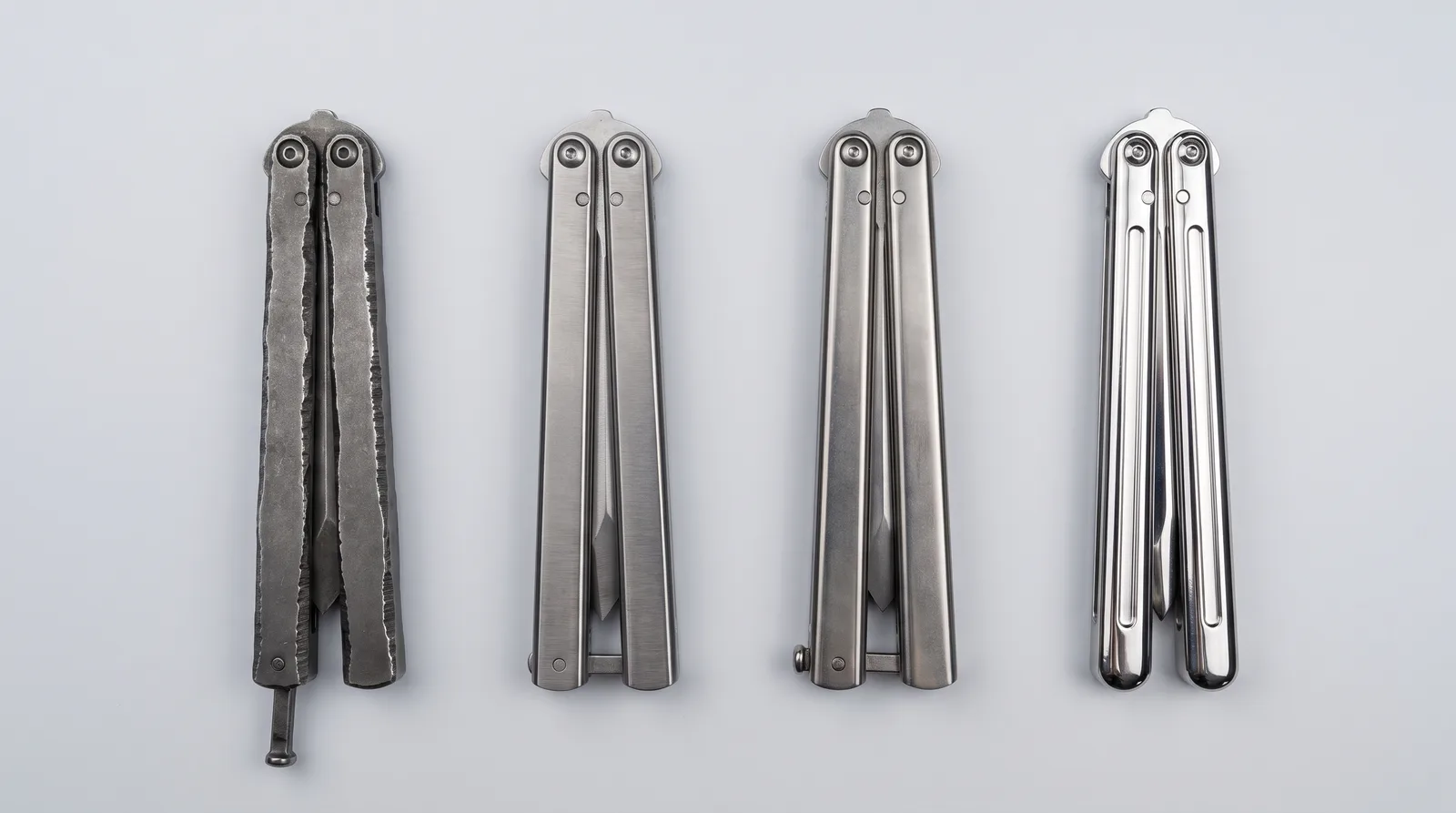
Every serious flipper learned on a blunt blade. That is not caution, it is efficiency. Fear makes you tense, tense hands flip badly, and badly flipped knives get dropped. A trainer removes the fear and leaves the physics intact.
The thing worth knowing before you shop is that a trainer on this site is not a separate cheap product. It is the same knife as the sharp version, same steel, same handles, same hand-tuned pivots, with the final sharpening pass left off. You pick Sharp or Trainer on the product page and the price is identical.
That is a worse sales pitch than the alternative and it is still the honest one. Plenty of shops would rather sell you a $30 practice knife now and a real one later. Here you are choosing which single knife you receive, so the decision is not “cheap one first”. It is “the knife I want, blunt, until I have earned the edge”. Details are on the trainer butterfly knives page, and the reasoning is in the trainer knives guide.
What actually matters on a first balisong
Beginners tend to shop for steel. Steel is the least important variable in your first three months, because you are not cutting anything. What you are doing is swinging two handles around two pivots several thousand times.
| Factor | How much it matters at first | Why |
|---|---|---|
| Pivot quality and tuning | Very high | An uneven swing teaches you to compensate for a fault instead of learning the move |
| Balance | High | Blade-heavy knives accelerate faster than a new wrist can time |
| Handle grip | High | Slick handles cause drops, and drops cause the injuries |
| Weight | Medium | Too light feels vague, too heavy ends sessions early through fatigue |
| Latch quality | Medium | A sticky latch interrupts swings part way through |
| Blade steel | Low at first | You are not cutting. It matters when you start using and sharpening the knife |
| Blade finish and pattern | Low | Purely a decision about what you want to look at |
| Blade shape | Low | Affects sharpening and use, not flipping |
Steel for a first knife
Five steels are used across the range: high carbon, 440C, D2, VG10 and Damascus. Here is what each means for someone buying their first one.
| Steel | Published hardness | Corrosion behaviour | Ease of sharpening | Good first choice? |
|---|---|---|---|---|
| 440C stainless | 58 to 60 HRC | Genuinely stainless | Easy on ordinary stones | Yes. The default sensible answer |
| VG10 | Not published on this site | Stainless | Moderate | Yes, and it is the lowest-priced group here |
| D2 | 58 to 62 HRC | Semi-stainless, wants light oiling | Slow; diamond or ceramic helps | Fine if you accept the sharpening effort |
| High carbon | Not published on this site | Will patina and can rust if neglected | Easiest of all | Yes if you enjoy maintenance, no if you do not |
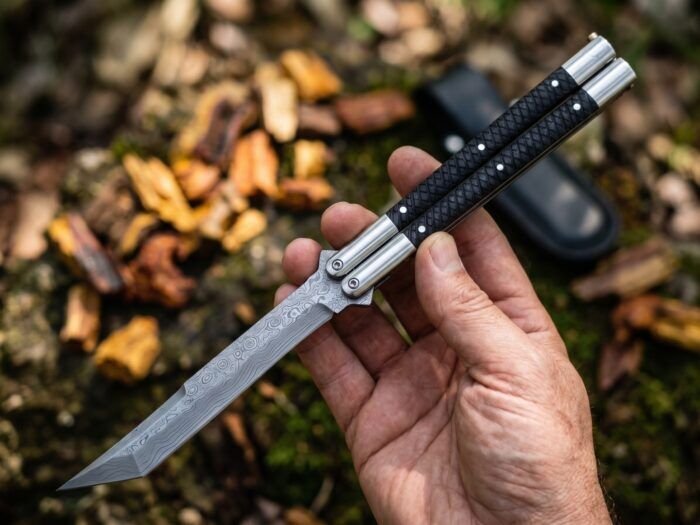
| Damascus (1095 and 15N20) | 58 to 60 HRC | Carbon-based, needs care | Easy to moderate | Buy it for the pattern, not as a first learner |
Two honest notes. We do not publish a hardness figure for VG10 or for our plain high carbon, so any specific number you see quoted for them elsewhere is unverified. And most “Damascus” sold cheaply on general marketplaces is acid-etched print rather than folded steel, which is one reason genuine pattern-welded blades sit at the top of the price range rather than the bottom. The full comparison is in our steel comparison guide and best steel for a balisong.
Size and weight
There is no single correct size, but there is a sensible range for learning. Most of the traditional range here is built to one of two sizes: about 24 cm open with a 12 cm blade, or about 29 cm open with a 14 cm blade. The BF-100, for example, is 24 cm overall with a 12 cm D2 tanto blade and weighs 200 g.
Practical guidance:
- Length. The 24 cm size is the easier of the two to learn on. The 29 cm knives have more presence and more reach, and they are correspondingly more tiring across a long practice session.
- Weight. Around the 150 g to 220 g region is comfortable for most people. Heavier knives feel authoritative and end sessions early through forearm fatigue. Individual weights are on the product pages, and if a figure is not listed, ask rather than assume.
- Balance. Neutral or slightly handle-forward is the friendliest for beginners. Blade-heavy knives swing faster than an untrained wrist can catch.
Handle materials
| Material | Grip when dry | Grip when sweaty | Durability under drops | Beginner verdict |
|---|---|---|---|---|
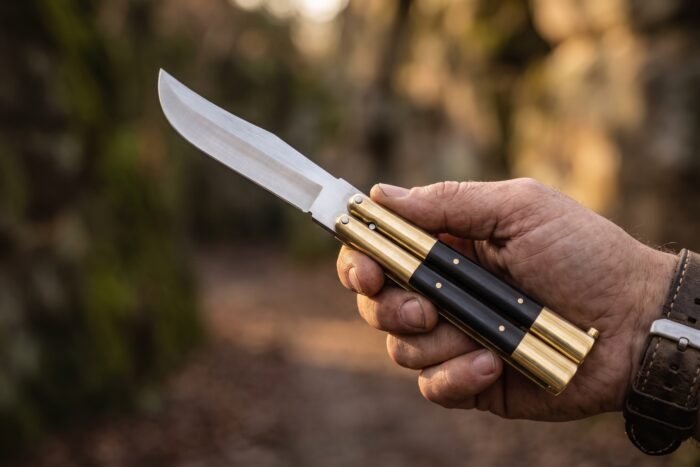
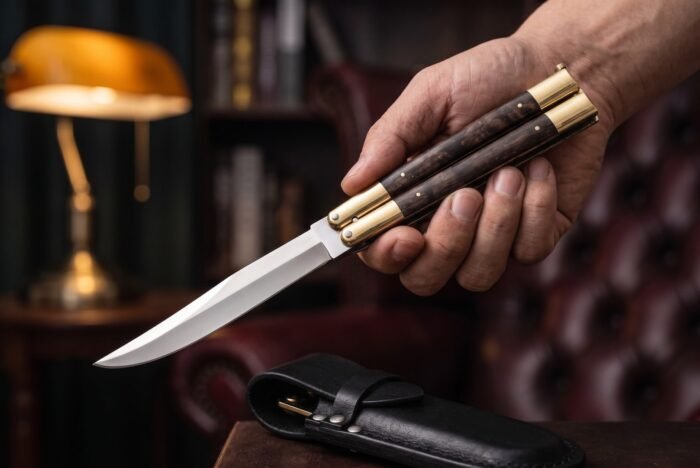
| Micarta | Very good | Very good | Excellent | The best all-round first choice |
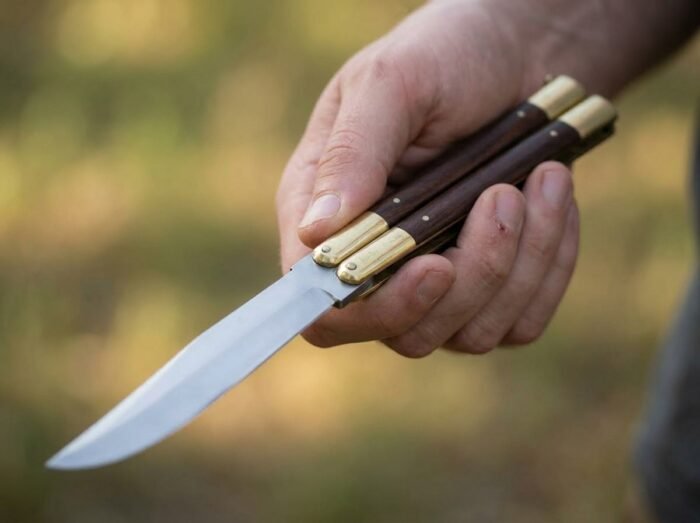
| Hardwoods (rosewood, walnut, wenge) | Good | Moderate | Good, will mark | Solid, and the traditional look |
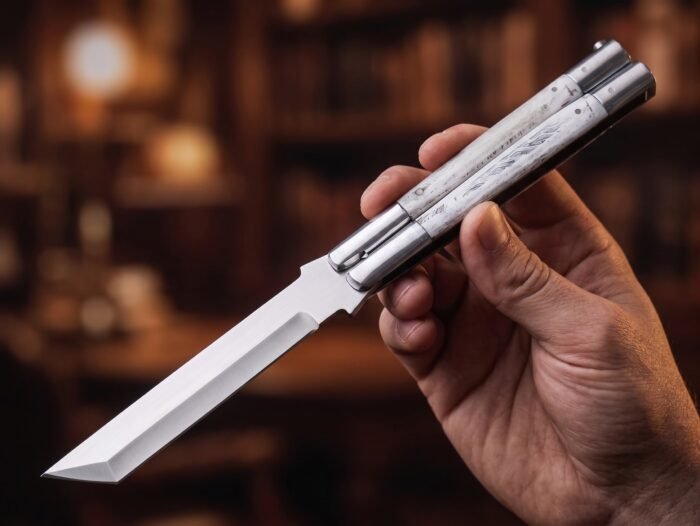
| Buffalo horn or bone | Good | Moderate | Good, can chip | Handsome; treat drops more carefully |
| Brass or copper frames | Moderate | Slippery | Excellent, will dent and patina | Adds weight and character, less grip |
| Skeletonised steel | Moderate | Slippery | Excellent | Durable, but cold and slick early on |
| Mother of pearl and exotic inlays | Moderate | Poor | Fragile | A collector’s choice, not a learner’s |
Budget bands, using the real numbers
These are pulled from the live catalogue rather than invented for the article. Across 185 published products the price range runs from $50 to $535, but the $50 entry is a custom design review deposit rather than a knife. Actual balisongs start at about $107. The catalogue’s 25th percentile is $131, the median is $166 and the 75th percentile is $220.
| Band | What sits here | Typical median | Who it suits |
|---|---|---|---|
| About $107 to $130 | Entry VG10 and 440C models | VG10 median $127 | A first balisong. Nothing is missing except decoration |
| About $130 to $170 | 440C and mid high carbon | 440C median $134, catalogue median $166 | The sweet spot for most first buyers |
| About $170 to $230 | Upper high carbon, entry custom builds, entry karambit balisongs | High carbon median $158, custom builds from $169 | A second knife, or a first if you know what you want |
| About $230 to $340 | Damascus, karambit balisongs, most custom work | Damascus median $236, karambit median $229 | Collectors and flippers past the beginner stage |
| About $340 to $535 | The top of the custom and Damascus range | Ceiling $535 | Display and commission pieces |
The useful conclusion: you do not need to reach the median to get a good first knife. Spending more buys pattern-welded steel, exotic handle materials and more hand time, none of which make a rollover easier. If you want to see how the pricing is structured across the market rather than just here, the butterfly knife price guide covers it.
What a beginner should not buy first
Four categories, all of which look like the obvious choice and are not.
- A Damascus or pattern-welded showpiece. A blade you are afraid to drop is a blade you will flip badly. Buy one when your hands are quiet.
- A karambit balisong. The curved blade and finger ring change the geometry of every standard move. On this site they also start higher, around $210. Learn on a straight-bladed knife and come to the karambit balisongs later.
- A full custom build. Our custom balisong builder is genuinely good, but specifying a knife requires knowing what you like. You will not know that in month one. Every choice you make now is a guess you will pay for.
- Cheap import balisongs with loose pivots. The false economy that actually matters. Uneven handles and sloppy tolerances teach you to correct for a fault, and the correction stops working the day you pick up a good knife.
One more thing not to buy first: engraving. It is a paid add-on, text at $19 and your own logo at $29, and it is worth having on a knife you intend to keep. It is not worth having on the one you are about to drop on a tile floor two hundred times.
The decision table
| If this is you | Buy this | Roughly | Why |
|---|---|---|---|
| Never held a balisong | 440C or VG10, medium weight, micarta or wood handles, ordered as a trainer | $107 to $150 | Everything that matters, nothing you will resent damaging |
| Flipped a friend’s knife a few times | Same, but pick the one you actually like the look of | $110 to $170 | You will practise more with a knife you enjoy holding |
| Want one knife for years | 440C or D2, sharp, with a trainer option considered first | $130 to $250 | Stainless or semi-stainless survives being carried and used |
| Buying it mainly to look at | Damascus or a custom build | $150 to $535 | Pattern-welded steel and hand time are what the money buys |
| Bought a cheap import and hated it | Entry VG10 or 440C from a maker who tunes pivots by hand | $107 to $135 | The difference you noticed was hardware, not steel |
| Learning aerials | Trainer, without exception | Same price as sharp | Aerials are where the serious injuries happen |
| Buying for someone else | Trainer, and let them choose the sharp one later | Same price as sharp | You cannot guess their hands, and a blunt gift is a kind one |
Checks to make before you commit
- Confirm the steel is named. A listing that says “stainless steel” without a designation is telling you it does not want to say. Ours name the steel.
- Look for a hardness figure or its honest absence. Published numbers are useful; invented ones are worse than none.
- Check whether the pattern is real. Genuine pattern-welded Damascus shows the pattern continuing through the edge bevel and on both sides in different registration. A printed pattern stops at the bevel.
- Read the handle material properly. “Wood” is not a material, “wenge” is.
- Decide sharp or blunt before you check out, because it is a choice made on the product page, not afterwards.
- Check your local law. Butterfly knife laws vary by state, county and city, so check your local law before buying or carrying one.
When the knife arrives, open it slowly with two hands, identify the bite handle, mark it, and start with the three moves in our opening guide.
If the two handles still look the same to you, our guide to bite handle vs safe handle gives three quick checks that settle it.
More reading: how to open a butterfly knife, butterfly knife safety for beginners, the balisong trick names glossary, best steel for a balisong, and the butterfly knife price guide.
Frequently Asked Questions
Should my first balisong be a trainer or a live blade?
A trainer, and on this site that does not mean a cheaper knife. You choose Sharp or Trainer on the product page of whichever knife you want, at the same price, and the trainer is the identical knife with the final sharpening pass left off. Learn on it blunt, then decide about an edge.
What is the best steel for a first butterfly knife?
440C is the usual sensible answer. It is genuinely stainless, published at 58 to 60 HRC, easy to sharpen on ordinary stones, and it survives the drops that come with learning. VG10 is a good alternative and sits in the lowest price band here, with a median of about $127.
How much should I spend on my first balisong?
Somewhere between about $107 and $170 covers a properly made knife with hand-tuned pivots. The catalogue median is $166 and the 25th percentile is $131, so a first purchase in that region is not a compromise. Spending more buys pattern-welded steel and exotic handles, not easier flipping.
Is a karambit balisong a good first knife?
No. The curved blade and finger ring change the geometry of nearly every standard move, so you would be learning two unfamiliar things at once. They also start higher, around $210 here. Learn on a straight-bladed balisong and add a karambit once your fundamentals are automatic.
How heavy should a beginner balisong be?
Roughly 150 g to 220 g suits most people. Lighter knives feel vague and give you little feedback; heavier ones are satisfying but end practice sessions early through forearm fatigue, and fatigue is what produces sloppy repetitions. Check the weight on the individual product page rather than assuming.
What handle material should I choose first?
Micarta if you want the most forgiving option, because it grips well dry or sweaty and shrugs off drops. Hardwoods such as rosewood, walnut and wenge are the traditional look and perform well. Avoid mother of pearl and other fragile inlays until you have stopped dropping the knife.
Should I order engraving on my first knife?
Probably not. Engraving is a paid add-on, $19 for text and $29 for your own logo, and it is worth having on a knife you plan to keep for years. Your first learner knife is going to acquire marks, so save the personalisation for the one after it.
Is a custom build a bad idea for a beginner?
Not bad, just premature. Specifying a custom balisong means choosing steel, handle material, weight and finish, and in your first month you have no basis for those preferences. Learn on a stock knife, work out what you actually like about it, then commission something with real information behind it.
How can I tell real Damascus from a printed pattern?
Look at the edge bevel. On genuine pattern-welded steel the layers continue through the bevel and the pattern differs slightly between the two sides. A printed or acid-etched pattern typically stops where the bevel begins and matches suspiciously well side to side. Price is also a clue.
Do I need a second knife once I improve?
Not necessarily, but most flippers end up with a blunt one and a sharp one, because new tricks are still learned blunt long after the basics are automatic. If you are buying twice anyway, buy the knife you want first and change the edge state second.