
Blog
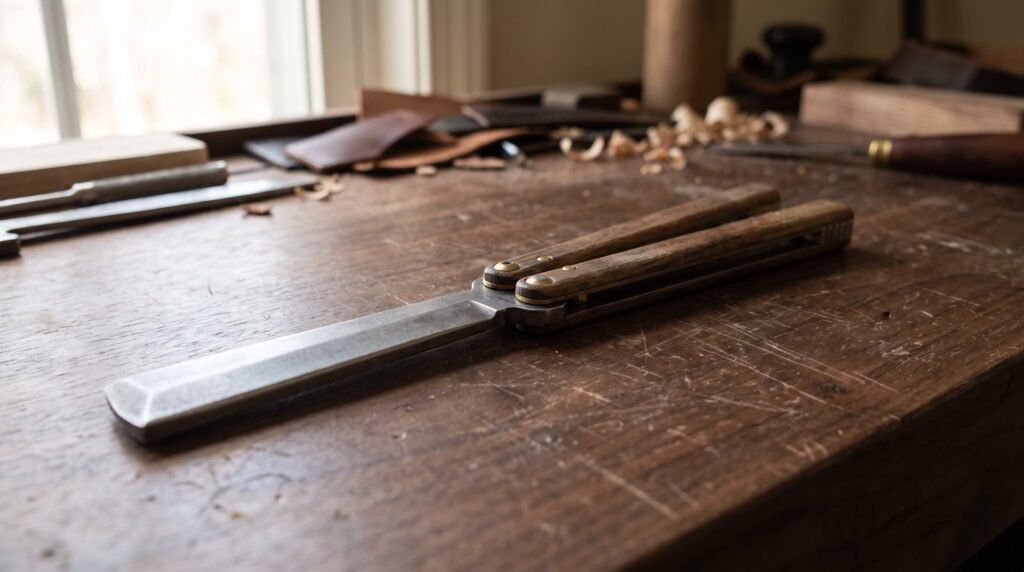
A balisong trainer is the same knife as a live blade with the cutting edge left unsharpened. It has the same steel, the same handle material, the same weight and the same hand-tuned pivot action. It simply cannot cut you. Every flipper worth listening to will tell you the same thing: learn the trick on a trainer until it is boring, then take it to the sharp knife. Aerials and rollovers begin their life as dropped knives, and a dropped live blade is how people lose the tips of their fingers.
- A trainer is not a cheap replica. On a good maker’s bench it is the identical knife, stopped before the final sharpening pass.
- Trainers exist so that failed tricks cost bruises instead of stitches.
- Learn on the same knife you intend to carry; balance and weight do not transfer between a cheap aluminium trainer and a hand-forged balisong.
- Trainers are still weighted steel on a hinge. Safer, not safe.
- Legality follows the mechanism, not the edge, in most jurisdictions. Do not assume a trainer is automatically legal where a live blade is not.
What Exactly Is a Balisong Trainer or Practice Butterfly Knife?
A balisong, or butterfly knife, opens by rotating two handles around the tang of the blade. That motion is the whole appeal, and it is also the whole risk: in the middle of a flip, one of those handles is riding along the sharp edge. The handle that closes onto the edge is called the bite handle for a reason.
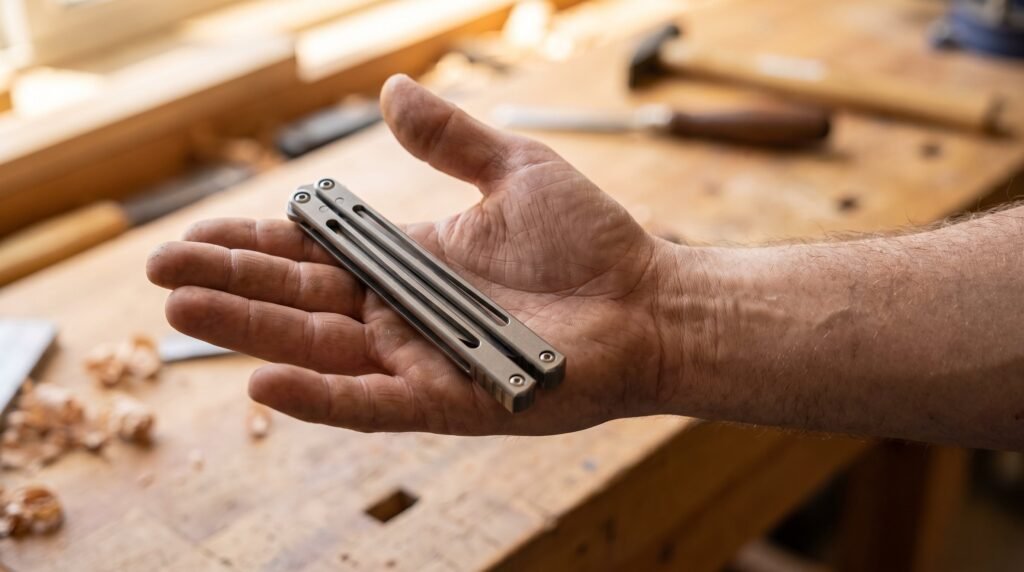
A trainer removes the edge from the equation. The blade is forged, ground, shaped and finished exactly as a live blade would be, and then the final sharpening is simply not done. What is left is a flat, dull edge on a blade that is otherwise indistinguishable from the real thing.
This is different from the moulded plastic and hollow aluminium “butterfly trainers” sold in bulk online. Those are shaped like a balisong. They do not weigh like one, they do not pivot like one, and the muscle memory they build does not survive contact with a real knife.
Practice Butterfly Knife vs Live Blade at a Glance
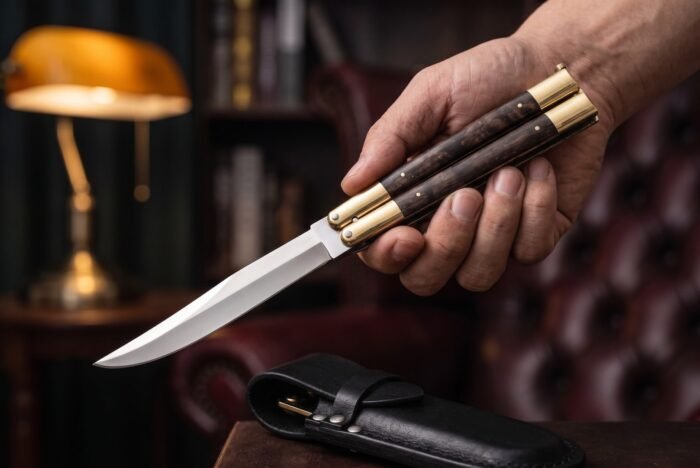
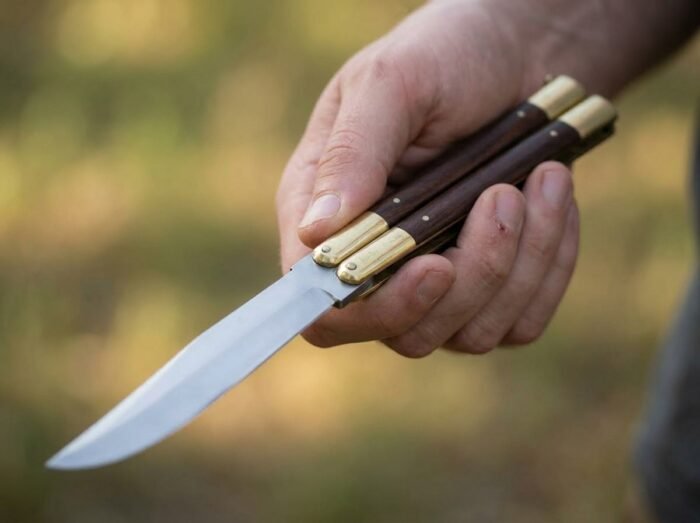
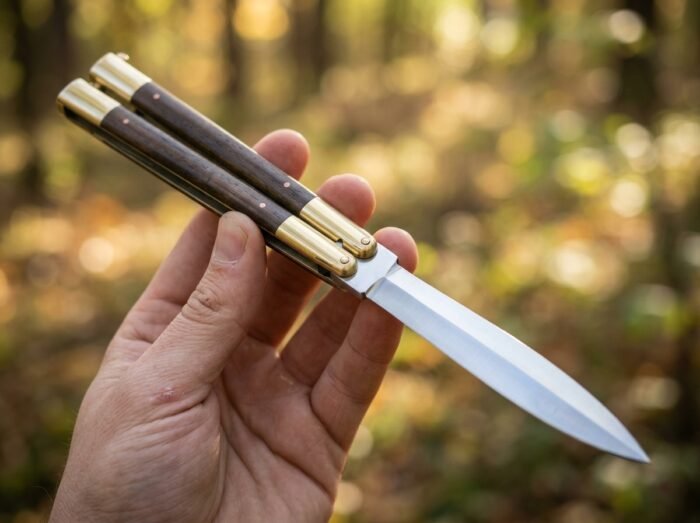
| Trainer | Live blade | |
|---|---|---|
| Edge | Blunt, unsharpened | Sharpened by hand |
| Steel | Same. 440C, D2, VG10, high carbon or Damascus | Same |
| Weight and balance | Effectively identical | Effectively identical |
| Best for | Learning, daily practice, gifts for new flippers | Carry, collection, working use |
| Risk while learning | Bruised knuckles | Cuts, sometimes serious |
| Our price | Same as sharp | Same as trainer |
Why Every Flipper Starts on a Practice Balisong
Balisong flipping is learned the way skateboarding is learned. By failing a movement several hundred times until it stops being a movement and starts being a reflex. There is no shortcut and no amount of watching videos substitutes for the reps.
The basic openings, the basic open and basic close, are forgiving. Everything past them is not. A rollover asks you to let the knife rotate around your thumb. An aerial asks you to let go of it entirely. A Y2K rollover asks you to do both at once. Each of those tricks will be dropped, badly, many times before it is clean.
The community rule of thumb: a trick is ready for the live blade when you can land it ten times in a row on the trainer without thinking about it. Not when you can land it. When you can land it while bored.
How to Practise With a Training Butterfly Knife Without Wrecking Your Hands
- Practise over something soft. A bed, a couch, a folded towel. Concrete chips handles and dents bolsters.
- Start with the basic open and close. Slow, deliberate, both hands. Speed is a by-product of accuracy, never the goal.
- Keep the safe handle in your palm. Learn which handle is which by feel, in the dark, before you try anything with a rotation in it.
- Stop when your hands tire. Almost every bad drop happens in the last ten minutes of a long session.
- Move to the live blade one trick at a time. Not one session at a time. One trick.
Choosing Your First Practice Butterfly Knife
Weight is the thing that matters most and the thing beginners think about least.
Around 150g
Quick and lively. Rewards precise hands, punishes sloppy ones. Better as a second knife than a first.
Around 175g
The sweet spot for learning. Enough mass to swing predictably through a full rotation, light enough for hour-long sessions.
200g and up
Slow, heavy, forgiving on timing but tiring on the wrist. Good for people with large hands.
Handle material
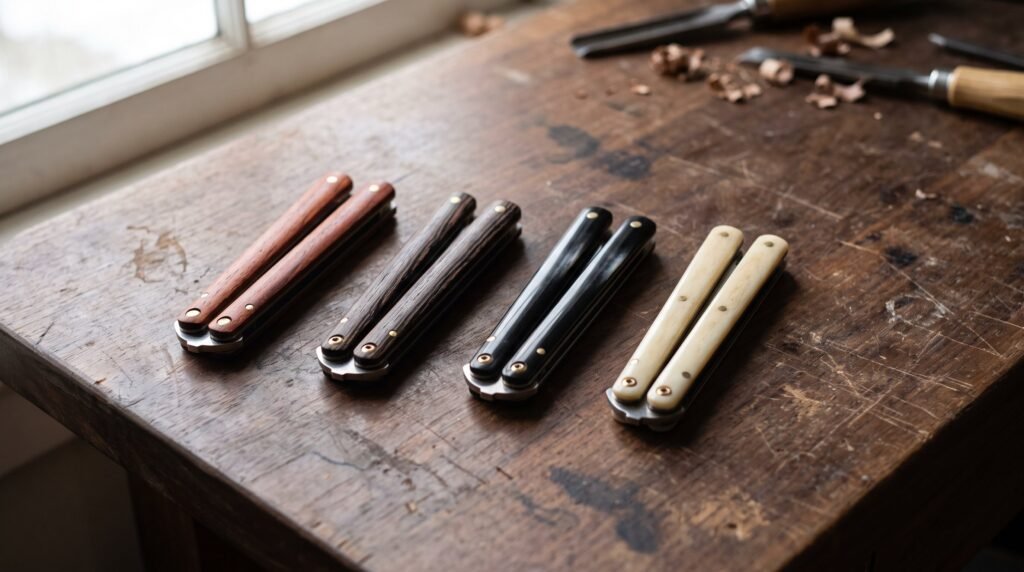
Brass bolsters with kamagong, horn or micarta give grip and weight where you want it. Avoid anything slick until your grip is reliable.
Latch or no latch is personal. A latch keeps the knife shut in a pocket; it also clicks against the handle during flips, which some people find satisfying and others find maddening. Either is fine to learn on.
Are trainers legal?
Usually the law names the mechanism, not the edge. Where balisongs are restricted, a blunt one is often restricted too, because the legislation is written around a folding knife with counter-rotating handles rather than around sharpness. Some jurisdictions do treat unsharpened trainers more leniently, and some make no distinction at all.
Check your own state, country and city before ordering. Our state-by-state legality guide is a starting point, not legal advice, and the rules change.
Looking After a Practice Balisong
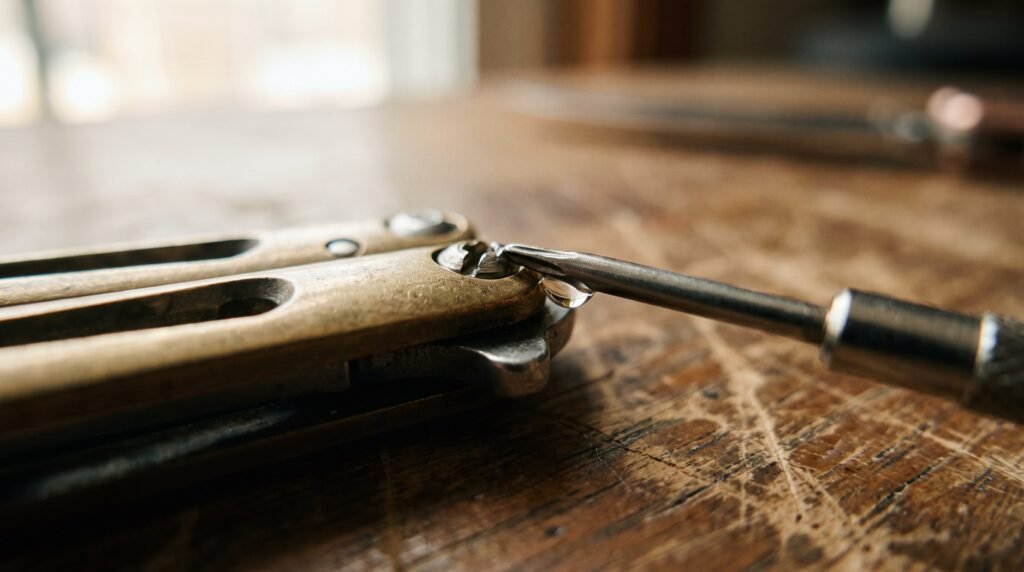
A trainer rusts exactly like a live blade, because it is one. Wipe it down after a session. Hands leave salt on steel. A drop of light oil on each pivot every few weeks keeps the action smooth and stops the squeak. Store it in its sheath rather than loose in a drawer where the handles can knock against each other.
One quirk: a flat, unsharpened edge holds onto grime more than a sharpened one, which sheds it. Run a cloth down the edge occasionally. Our knife care guide has the full routine.
Personalising a trainer
Engraving is cut into the bolster, not the edge, so it works on a trainer exactly as it does on a live blade. Initials, a name, a date or a short line of text is a flat $19, and you choose the font on the product page. A logo, emblem or company mark is $29, with the artwork file uploaded at checkout.
Trainers are the most commonly engraved knives we ship, because so many of them are first balisongs bought as gifts. Worth knowing before you order: engraving is permanent, so engraved knives are final sale. The engraving page covers placement, fonts and timing.
Every knife in the collection can be built sharp or blunt, at the same price. Choose your blade above Add to Cart.
How Much Butterfly Knife Practice Do You Actually Need?
Shorter sessions, more often. Twenty minutes a day beats three hours on a Sunday, and it is not close. Flipping is fine motor control, and fine motor control consolidates in the gaps between sessions rather than during them. Ten minutes before work and ten in the evening will take you further in a fortnight than a single weekend marathon.
A rough shape for the first month of practice with a training balisong:
| Week | What to drill | Session length |
|---|---|---|
| 1 | Basic open and close, safe handle only. Get the latch out of your way. | 10–15 min, twice daily |
| 2 | Rollovers and the basic aerial. Expect drops. This is why you are on a practice butterfly knife. | 15–20 min, twice daily |
| 3 | Chaplins and behind-the-hand. Start using the bite handle deliberately. | 20 min, once or twice |
| 4 | Link two tricks into one flow. Slow first, speed later. | 20–30 min |
Stop when your hands get tired rather than when you get bored. Tired hands are when knives get dropped and knuckles get split, and a practice balisong is blunt, not weightless.
Frequently asked questions
Is a balisong trainer cheaper than a sharp one?
Not here. It is the same knife with the last step of the process left off, so it costs the same. Elsewhere you will often find purpose-built trainers made from cheaper materials, which is a different product entirely.
How long before I can move to a live blade?
There is no timeline, only a standard: ten clean repetitions in a row, without concentrating. For the basic open that might take an evening. For an aerial it might take months.
Can a trainer still hurt me?
Yes. Bruised knuckles are routine, and a knife that gets away from you at speed can chip a tooth or crack a knuckle. It removes the cutting risk, not the impact risk.
Can I sharpen a trainer later?
Yes: the blade geometry is already ground, so a competent sharpener can put an edge on it. If you know you want a sharp knife, though, order it sharp.
Is a trainer a good gift?
It is the best balisong gift there is for anyone who has not flipped before, particularly with their initials engraved on the bolster. You are giving them the knife they will actually learn on.
What is a practice butterfly knife?
A butterfly knife with the cutting edge left unsharpened, made for learning flips. It is also called a practice balisong, a training balisong or a butterfly knife trainer. All the same object. Here it is the identical hand-forged knife as the live blade, at the identical price.
How long does it take to learn butterfly knife tricks on a practice balisong?
Basic opening and closing takes a few days. Rollovers and a clean aerial take two to four weeks of short daily sessions. Linking tricks into a flow is months, not weeks. Everyone drops it constantly at the start, which is exactly the argument for practising blunt.
Should I practise butterfly knife tricks with a live blade?
Not while you are learning one. The convention across the balisong community is to drill the trick on a training butterfly knife until it is boring, then take it to the sharp blade. Even experienced flippers go back to a trainer for a new trick or a new knife.
How much practice does a beginner need each day?
Ten to twenty minutes, twice a day, beats one long weekly session. Fine motor skills consolidate between sessions rather than during them. Stop when your hands tire. That is when drops happen.
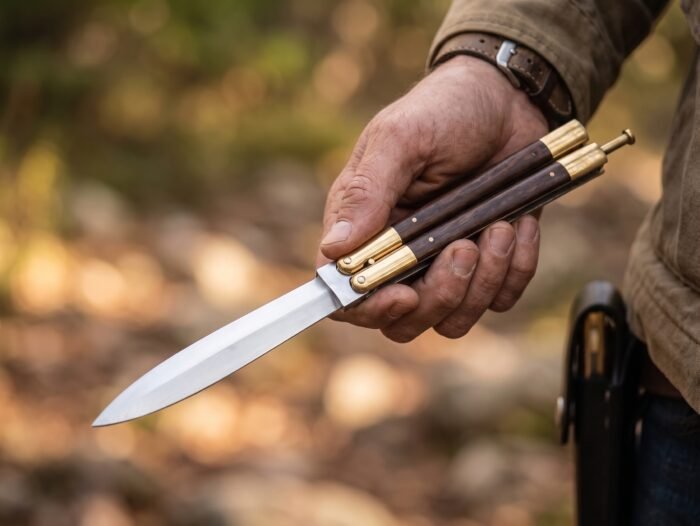
Every knife here also comes as a blunt Trainer. Choose Trainer on the product page.
Shop all High Carbon Balisong Butterfly