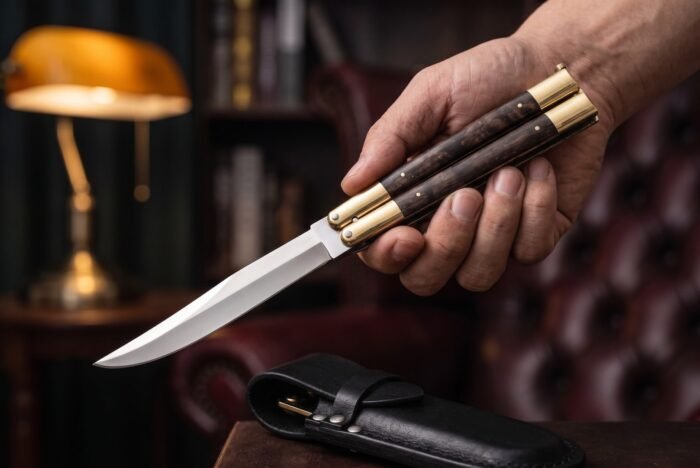
Blog
If your balisong feels wrong, the balance point is usually the reason, not the weight. Handle-heavy knives sit back in your palm and start easily but stall in long rotations. Blade-heavy knives carry themselves through a spin and hit harder on a miss. Neutral knives sit near the pivots and do a bit of everything. Find your balance point with a pencil before you blame the knife.
That is the short version. The longer version is that most people who say a balisong feels wrong have bought a knife balanced differently from the one they learned on, and their hands are objecting to the change rather than to a fault. Here is how to work out which knife you actually have, and what it is good at.
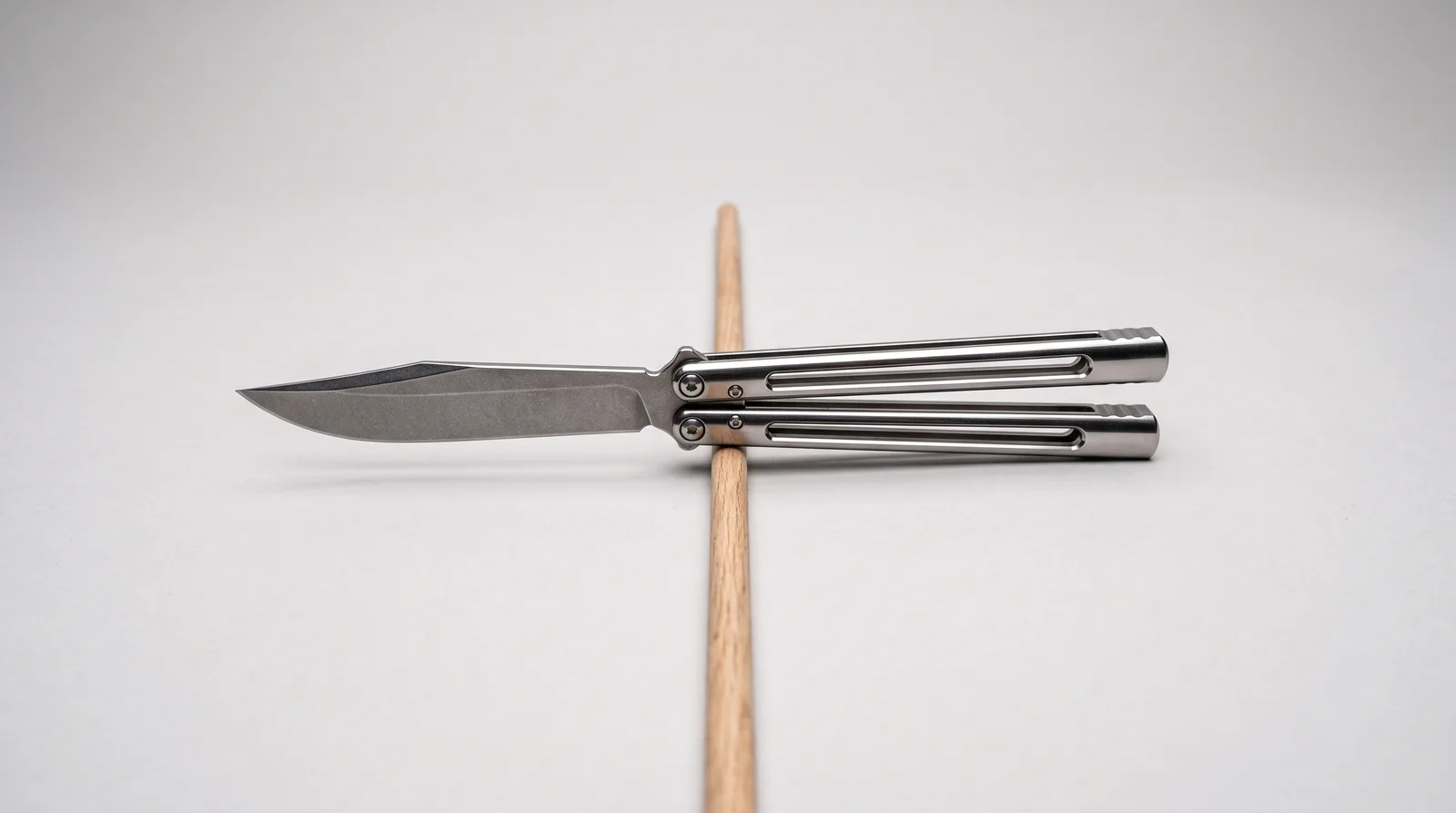
What balance means on a balisong
Balance is where the mass sits relative to the pivots. That is it. A balisong rotates around two pivot pins, so the useful question is how much mass sits outside those pivots on the blade side versus the handle side, and how far out it sits.
The second part of that sentence matters more than people expect. Mass has more effect the further it sits from the axis of rotation, so a small brass insert at the butt of a handle changes the swing more than a much larger amount of steel near the pivot. This is also why two knives that read the same on a kitchen scale can feel like entirely different objects.
The practical effects come in pairs. A knife with mass concentrated out at the ends takes more effort to start rotating and more effort to stop, but once it is moving it holds its rhythm and forgives a lazy wrist. A knife with mass close to the pivots changes direction instantly and does exactly what your fingers ask, which is wonderful when your fingers are right and unhelpful when they are not.
How to find your knife’s balance point
You need a pencil and thirty seconds.
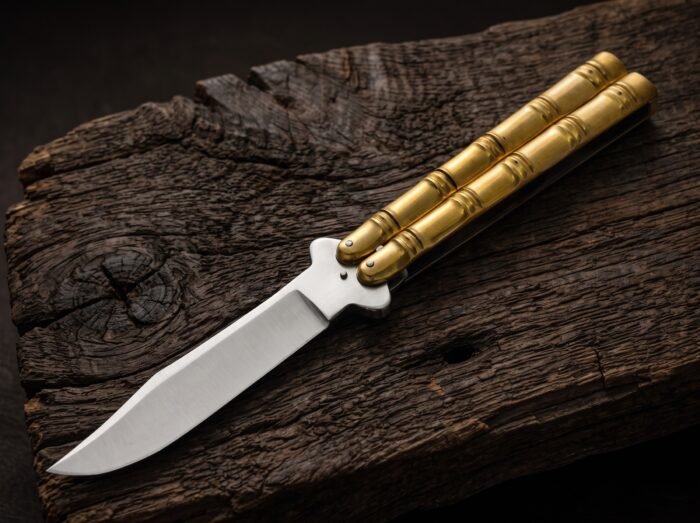
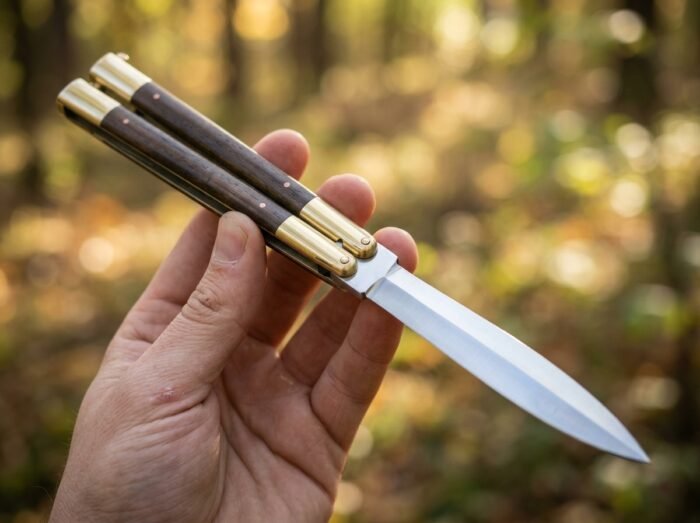
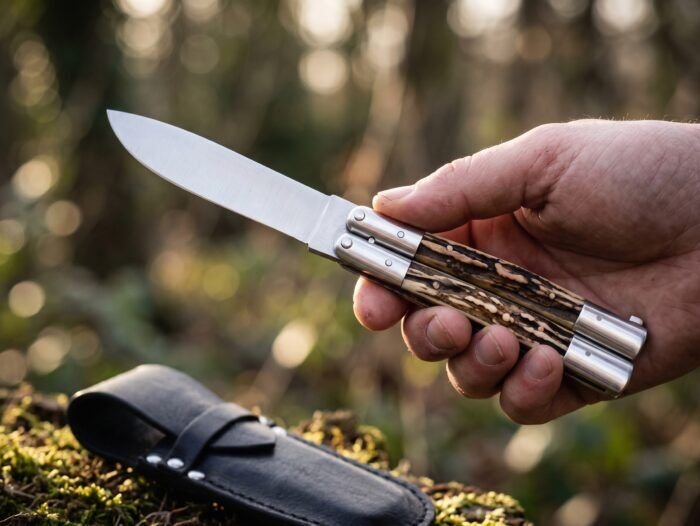
- Close and latch the knife. A closed balisong is a single rigid object, which is the only state you can measure meaningfully.
- Lay it across a round pencil set on a table, blade axis perpendicular to the pencil.
- Slide the knife along until it sits level and stays there. That point is your balance point.
- Note where it lands relative to the pivot pins. Not in millimetres, in relation to the pivots: blade side of them, handle side, or on them.
- Repeat with the blade open and the handles held together. This tells you how the knife behaves in the deployed position, which is a different feel entirely.
The result you care about is one of three answers, and they line up with how the knife will behave in your hand.
The three balance types
| Balance | Balance point sits | Feels like | Strong at | Weak at | Suits |
|---|---|---|---|---|---|
| Handle-heavy | Behind the pivots, towards the handle butts | Anchored in the palm; the blade end feels light | Fast direction changes, tight twirls, control work | Long continuous rotations, which stall | Flippers who like precision and speed over flow |
| Neutral | On or very near the pivots | Even, quiet, no obvious pull either way | Almost everything, without excelling | Nothing in particular; a jack of all trades | Beginners, and anyone who wants one knife for all of it |
| Blade-heavy | Forward of the pivots, into the blade | The knife wants to keep going once it starts | Aerials, big flowing rotations, momentum tricks | Quick reversals; slow to stop and slow to start | Flippers who already have solid catches |
None of these is better. They are three different instruments. A handle-heavy knife in the hands of someone who wants long aerial flow will feel dead, and a blade-heavy knife in the hands of someone doing fast finger work will feel like it is arguing with them.
What actually shifts the balance point
Handle material. The biggest single lever, because handles carry most of a balisong’s mass. Swapping composite handles for brass or stainless of the same dimensions can multiply handle mass several times over, which drags the balance point firmly backwards. Our guide to balisong handle materials has the density comparison in full.
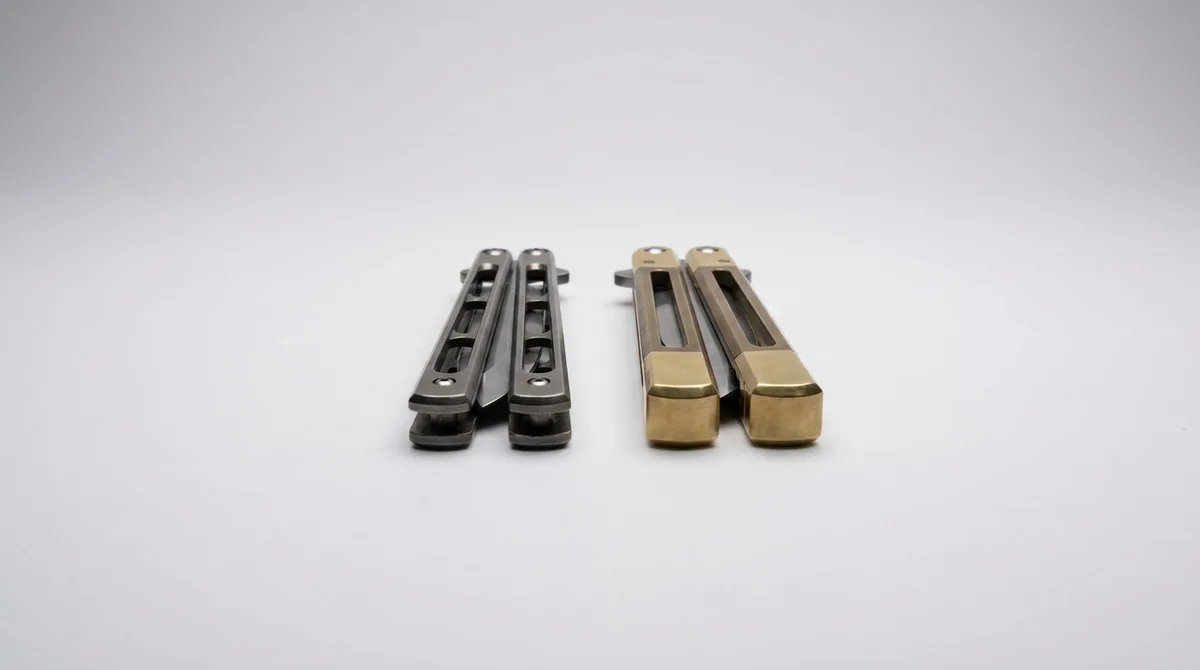
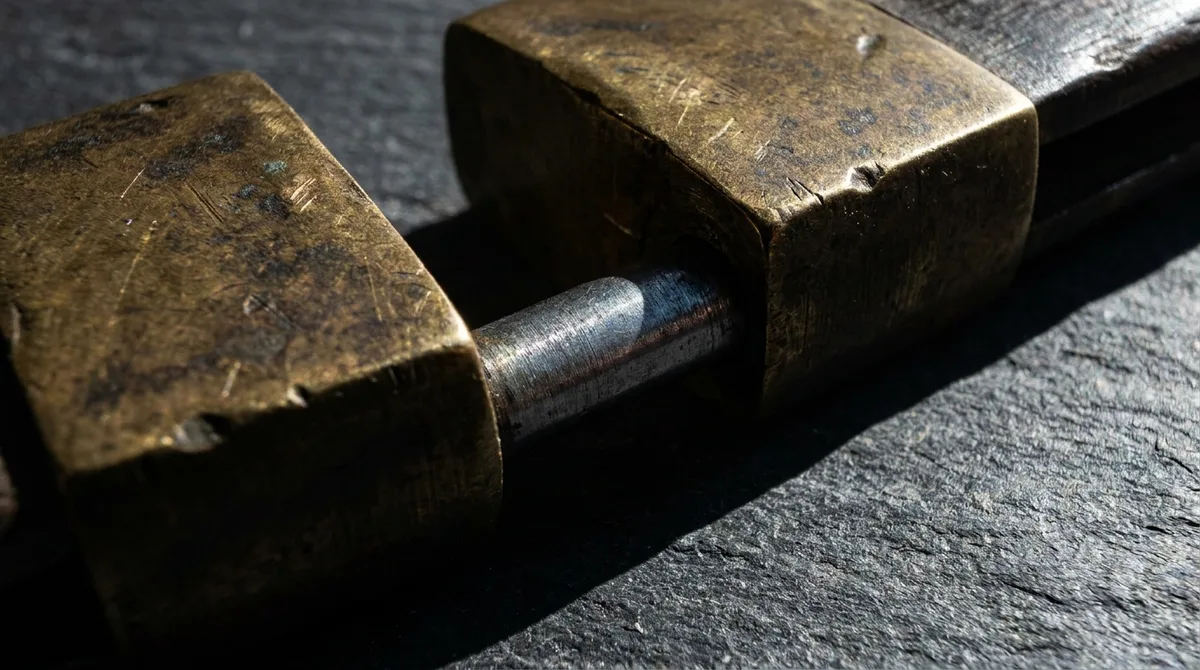
Bolsters. A bolster is a block of denser material, usually brass or steel, set into the handle. Where it sits decides what it does. A bolster at the pivot end adds mass close to the axis, so it adds weight without moving the balance much. A bolster at the butt end adds mass at maximum leverage and pulls the balance point hard towards the handle. Two knives with identical bolsters in different positions balance differently.
The blade itself. Length, thickness, grind and how much steel has been removed. A thin hollow grind on a short blade is a much lighter front end than a thick flat-ground dagger, and double-edge dagger grinds often feel more forward-balanced than the single-edge blade you are used to.
The latch. Small mass, maximum leverage, mounted on one handle only. It will not change the balance category, but it does make the two handles slightly unequal. See latch types for what else it changes.
Spacers, standoffs and pivot hardware. All sit near the pivots, so they change total weight far more than they change balance.
Which balance suits which flipping
| What you want to do | Best balance | Why | What to avoid |
|---|---|---|---|
| Basic openings and closings | Neutral | Predictable, no momentum to fight or feed | Heavily blade-forward knives |
| Rollovers | Neutral to slightly handle-heavy | Starts and stops on demand, sits still in the palm | Anything that wants to keep spinning |
| Twirls and fast chaotic work | Handle-heavy | Low blade-end inertia means instant direction changes | Blade-heavy, which lags behind your hand |
| Aerials | Blade-heavy or neutral | Carries its own rotation predictably through the air | Very handle-heavy knives, which tumble unevenly |
| Slow, controlled manipulation | Blade-heavy | Momentum keeps the movement going for you | Very light knives, which need constant input |
| Cutting and everyday use | Handle-heavy | Mass behind the hand, blade feels agile | Nothing; balance matters least here |
| Learning from scratch | Neutral | Teaches habits that transfer to any other knife | Anything extreme in either direction |
Total weight is a different question
Weight and balance get talked about together and they are not the same thing. Weight is how hard the knife hits when you miss a catch. Balance is how it behaves while you are not missing.
Most full-size live balisongs land somewhere in a broad range of roughly 100 to 200 grams. Treat that as a typical range rather than a specification: individual knives vary a lot with steel, handle material and construction, and the weight on a given knife is the number on its own product page, not a number you can infer from a category. If a listing does not state a weight and the weight matters to you, ask.
The practical rule is that heavier knives are less forgiving of mistakes and more rewarding once the mistakes stop. A light knife lets you drill a new trick a hundred times without your forearm complaining. A heavy knife has presence and momentum and will bruise a knuckle properly. Beginners should be light. Everyone else should own what they enjoy.
Diagnosing a knife that feels wrong
| Symptom | Most likely cause | Check this | Fix |
|---|---|---|---|
| Knife stalls halfway through a rotation | Too handle-heavy for the trick | Balance point sits well behind the pivots | Drive the rotation more, or use a more neutral knife |
| Knife overshoots and slaps your hand | Blade-heavy, more momentum than you expected | Balance point forward of the pivots | Slow your input. This one is your hands, not the knife |
| Feels sluggish and dead | Total weight high, or the pivots are too tight | Does it swing freely when you drop a handle? | Loosen pivots a fraction; clean and re-oil |
| Feels twitchy and uncontrollable | Very light and neutral, so nothing damps your input | Compare against the knife you learned on | Practice, or move to something with more mass |
| One handle behaves differently from the other | Latch mass on one side, or uneven pivot tension | Spin each handle separately and compare | Match pivot tension; accept the latch asymmetry |
| Knife was fine, now it is not | Pivot tension drifted, or handles moved with humidity | Handle play; grit in the pivots | Clean, re-oil, adjust pivots in tiny increments |
| Rattles and clacks more than it used to | Latch, or worn washers | Hold the latch still and repeat the motion | Latch gate, or replace washers |
| Every knife you own feels wrong | Almost certainly not the knives | How long since you flipped daily? | Pick one knife and drill it for two weeks |
Pivot tension is the first thing to check on any of these, because it is free and it changes the feel of the knife more than most people expect. Our knife care guide covers doing it without ruining the action.
What you can change and what you cannot
You can change pivot tension, washers, the latch, and on many knives the spacers and hardware. Those alter friction, sound and total weight far more than they alter balance.
You largely cannot change the balance point of a finished knife. Balance comes from the blade and the handles, and those are the knife. People do add weights to handles, and it works in the crude sense that it moves the balance point, but it is fiddly, it can rattle, and it usually produces a knife heavier than either of the ones you were choosing between.
The honest answer is that balance is a purchase decision, not an adjustment. If you know you want a blade-heavy knife, buy one, or specify the handle material and bolster arrangement yourself with the custom balisong builder before we cut anything.
The honest bit: wrong is usually just unfamiliar
We get messages about knives that feel wrong, and the great majority resolve the same way. The owner learned on one knife, bought a second with different handle material or a different blade, and their hands are still running the old timing. Two weeks of daily flipping on the new knife fixes it. Nothing was broken.
Real faults feel different from unfamiliarity, and they are worth separating. A fault is something you can point at: a handle with visible play that was not there last month, grit you can feel through the pivots, a tap in the rotation that repeats at the same point every time. Unfamiliarity has no location. It is a general sense that the knife is not cooperating, and it goes away with repetition.
So before you conclude that a knife is badly balanced, give it fourteen days of actual practice. If it still fights you after that, it is genuinely the wrong balance for how you flip, and that is useful information for the next purchase rather than a defect in this one.
More reading: Balisong handle materials is where most of your knife’s mass comes from, latch types covers the small mass at the far end of one handle, and double-edge vs single-edge explains why a dagger grind sits further forward. For technique, see how to flip a balisong and the trainer guide.
Frequently Asked Questions
How do I find the balance point of my balisong?
Close and latch the knife, lay it across a pencil resting on a table, and slide it until it sits level. That point is the balance point. Note whether it lands ahead of the pivot pins, behind them, or right on them. Repeat with the blade open, since the deployed knife balances differently.
Is handle-heavy or blade-heavy better for flipping?
Neither, they suit different flipping. Handle-heavy knives change direction instantly and excel at fast twirls and control work but stall in long rotations. Blade-heavy knives carry their own momentum, which makes aerials and slow flowing manipulation easier and quick reversals harder. Neutral sits in the middle and is the sensible default.
What balance should a beginner buy?
Neutral, and on the lighter side. A neutral knife teaches habits that transfer to anything else you buy later, and a lighter one lets you drill the same movement two hundred times without your forearm giving up. Extreme balance in either direction teaches you compensations you will have to unlearn.
How much does a balisong weigh?
Most full-size live balisongs fall in a broad range of roughly 100 to 200 grams, but treat that as a typical range rather than a specification. Steel, handle material and construction all move it, and knives within one category vary widely. For any specific knife, use the weight on its own product page.
Why do two knives that weigh the same feel so different?
Because weight tells you nothing about where the weight is. Mass sitting far from the pivots has much more effect on how a knife swings than the same mass near the pivots. A knife with brass at the handle butts and one with brass at the pivot end can weigh identically and behave nothing alike.
Do bolsters change the balance point?
Yes, and their position matters more than their size. A bolster at the pivot end adds weight while barely moving the balance point. The same bolster at the butt end of the handle sits at maximum leverage and pulls the balance firmly towards the handle. Ask where the bolsters sit, not just whether there are any.
Can I change the balance of a knife I already own?
Not really. Balance comes from the blade and handles, and those are the knife. You can add weights to the handles, but it is fiddly, prone to rattling and usually ends up heavier than either option you were choosing between. Balance is a buying decision rather than an adjustment.
My knife suddenly feels wrong. What changed?
Check pivot tension first, then look for grit in the pivots, then check for handle play. Natural handle materials like horn and wood also move slightly with humidity across seasons. If nothing is loose, dirty or worn, the change is probably in your hands rather than the knife.
Does pivot tension affect balance?
It does not move the balance point, but it changes the feel a great deal, which is why people confuse the two. Over-tight pivots make a knife feel dead and sluggish; over-loose ones make it feel rattly and vague. Adjust in very small increments and test after each one.
How long before a new balisong stops feeling wrong?
About two weeks of daily practice for most people. Genuine faults have a location you can point at, like play that appeared recently or a tap at the same point in every rotation. Unfamiliarity has no location and fades with repetition. Give a new knife fourteen days before judging it.