Blog
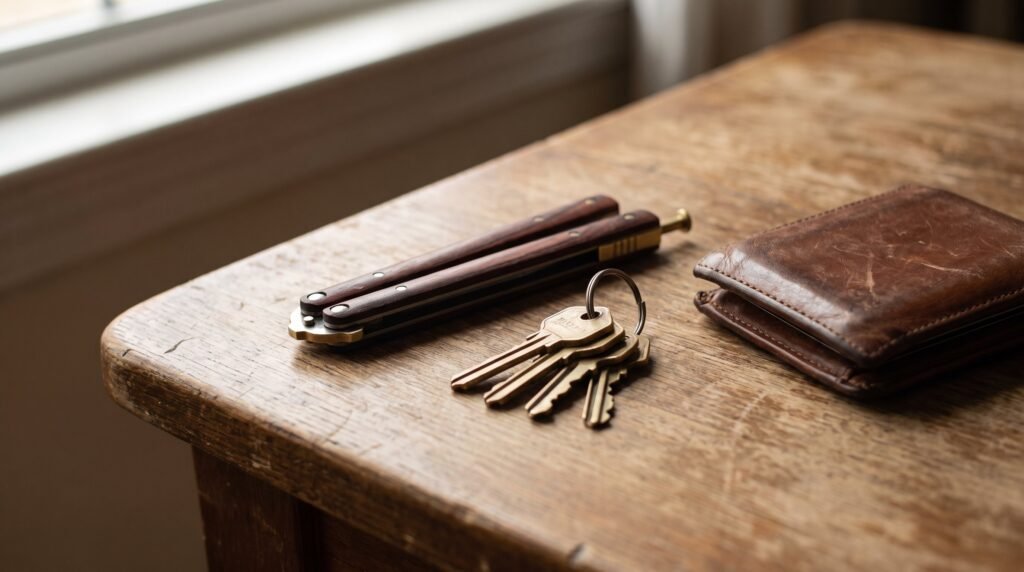
Sometimes. That is the honest answer, and anybody giving you a flat yes is selling something. A balisong cuts as well as any other knife with the same blade and the same steel, deploys fast in trained hands, and works one handed without a lock to fail. It also collects pocket lint like a magnet, needs more attention than a folder, and opens in front of other people with all the social subtlety of a fire alarm.
Quick answer: a balisong is a good everyday carry knife for someone who has put the practice in, who works somewhere the knife will not cause a scene, and who does not mind a five minute clean every couple of weeks. It is a poor choice for someone who wants to open a parcel at a client’s desk without discussion. The cutting is never the problem. The problem is everything around the cutting: lint, upkeep, local law, and the reaction of the person standing opposite you.
What everyday carry actually asks of a knife
A pocket knife in normal life opens parcels, cuts cable ties, breaks down cardboard, cuts tape, trims a loose thread, cuts an apple and occasionally defeats a blister pack. That is the list. It is not a thrilling list.
What the list demands is: it must be there, it must open quickly, it must cut, and it must not become an incident. A balisong is excellent at three of those four. The fourth is where all the interesting arguments live.
Where the balisong genuinely wins
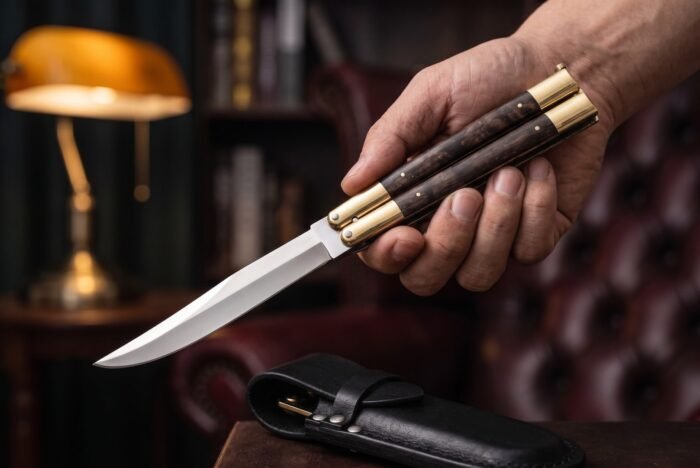
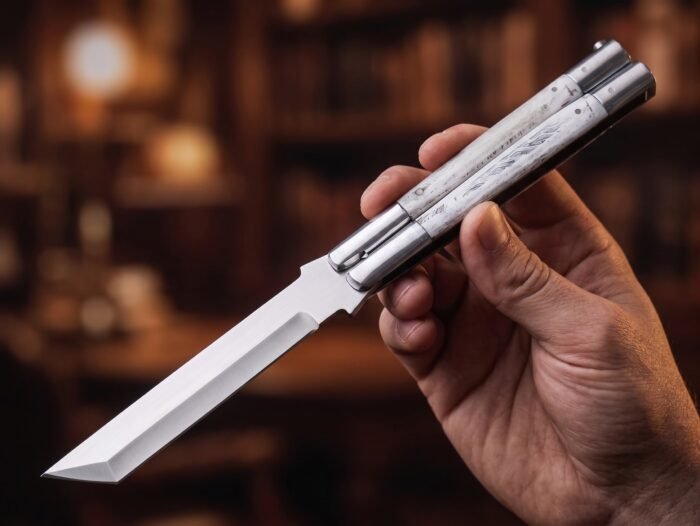
Deployment speed, once you have earned it
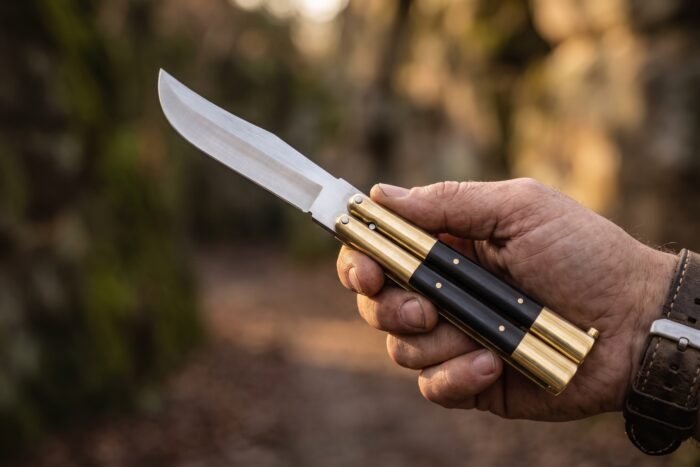
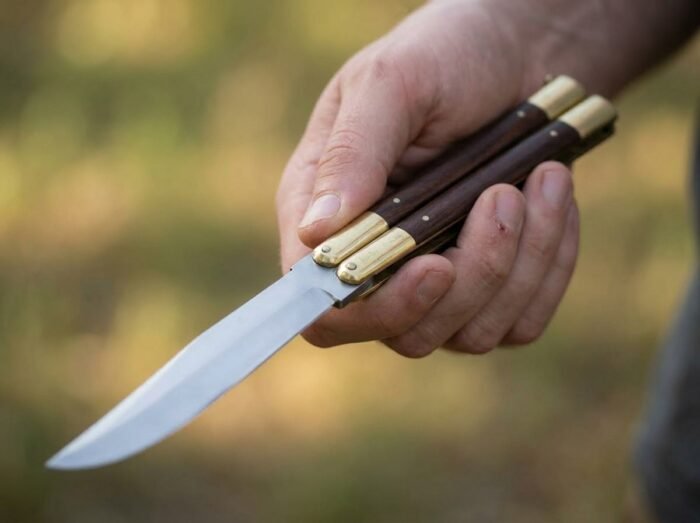
A trained flipper opens a balisong faster than most people open a thumb-stud folder, and considerably faster than anybody messing with a nail nick. It is one motion, both directions, and it works the same coming back: closing a balisong is as fast as opening it, which is not true of a folder where you have to find the lock bar with a thumb while the blade is still out.
The word “trained” is carrying the whole sentence. On day one a balisong is the slowest knife you have ever owned.
One handed, both hands, no lock to break
A balisong is naturally ambidextrous. There is no clip to move, no lock to reverse, no thumb stud on the wrong side. Left handers who have spent years being sold “ambidextrous” folders that are nothing of the sort tend to notice this within about ten seconds.
And there is no lock, which means there is no lock to fail. When a liner lock wears, the failure is the blade closing on your fingers under load. A balisong holds the blade open with the latch and with the handle you are gripping, and the thing keeping it open is your hand. Hands do not develop lock rock.
It is fixable at the kitchen table
Take the screws out and a balisong becomes a small pile of understandable parts: two pivots, washers, tang pins, a latch, two handles. Nothing is riveted shut, and no bearing races will fire across the room and disappear under the fridge, which is a specific and personal grievance. A knife you can fully service yourself is a knife you will still be carrying in ten years.
The sandwich handle problem, or, a brief history of your pocket
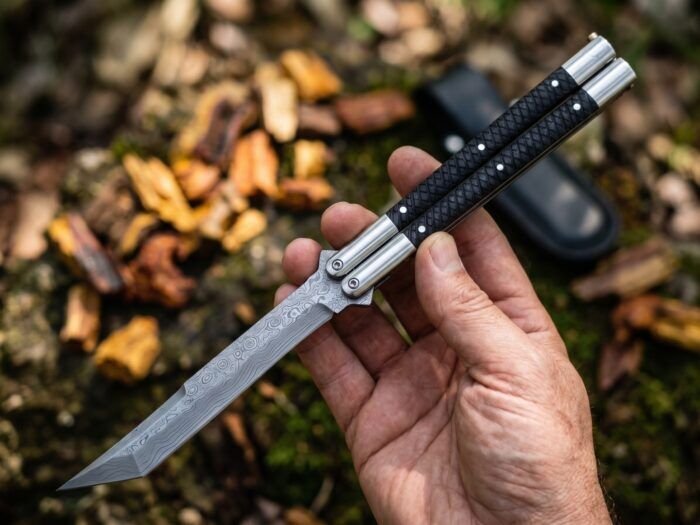
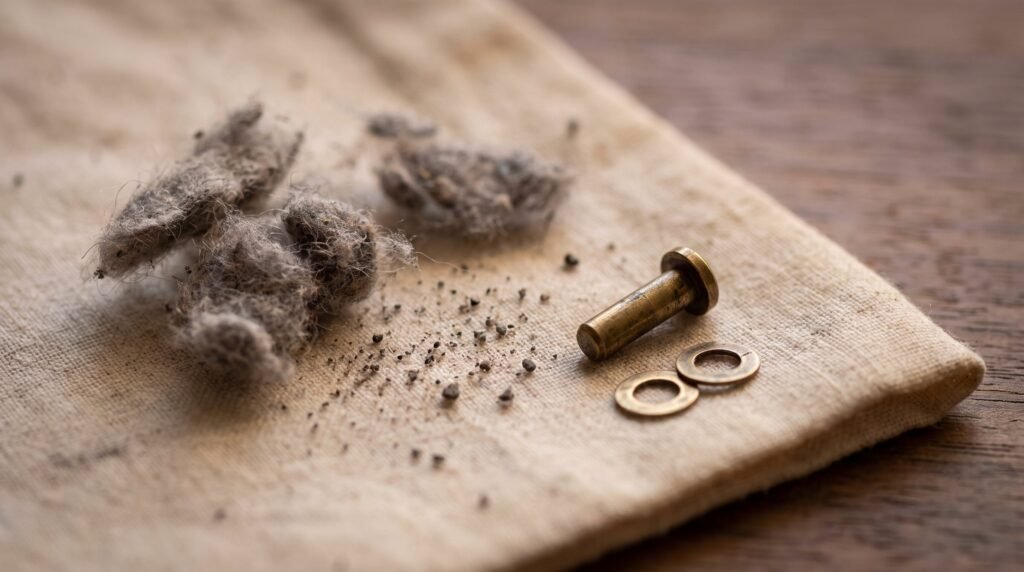
Here is the thing nobody puts in the marketing. A balisong handle is a channel, open along its length, and that channel is where the blade lives. It is also, functionally, a scoop.
Everything in your pocket ends up in there. Lint, mostly, packed into the corners in grey felted wedges. Then crumbs, sand from a beach day, sawdust, dog hair, the fibrous dust that comes off the inside of a denim pocket, and if you are a smoker, tobacco. We have opened up customer knives sent back for a service and found things in the channels that I could not identify and did not want to.
This matters for two reasons. Lint packed against the pivot changes how the knife rolls, and you will feel it as a knife that has gone sluggish for no obvious reason. And lint holds moisture against the tang, which on a high carbon blade means rust in the one place you cannot see it. A folder with closed slabs simply does not do this to the same degree.
The fix is five minutes with compressed air and a cotton swab, which is not a hardship, but it is a recurring five minutes that a folder does not ask of you. Our knife care guide covers the routine.
The maintenance load, honestly stated
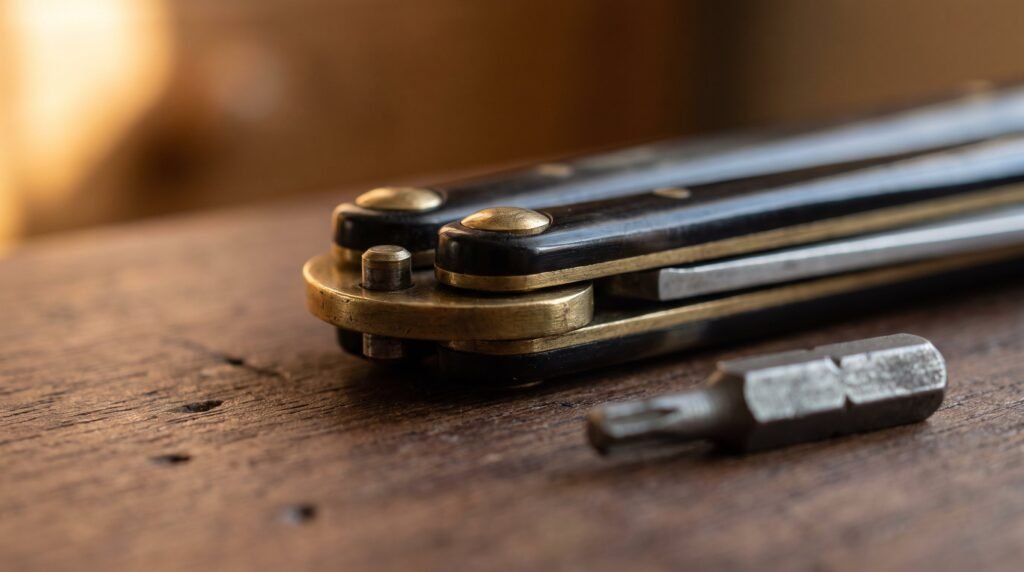
A balisong has more moving parts than a folder and every one of them is doing work every time you flip it. Pivots loosen. Washers wear. A knife that was tuned perfectly in March will want a quarter turn in June if you flip it daily.
None of this is difficult. It is a driver, thirty seconds and a habit. But if your relationship with maintenance is that you have never once oiled anything you own, be honest about that before you buy. A neglected balisong develops handle slop, and handle slop is how the blade starts kissing the inside of the channel and how you get a knife that bites at inconvenient moments.
Steel choice changes the workload
440C and VG10 are the low-maintenance options, and a stainless balisong carried through a humid summer will mostly forgive you. D2 is a semi-stainless that holds an edge beautifully and will spot if you leave it wet. High carbon takes the sharpest edge of the lot and demands the most attention, and if it lives in your pocket against your leg all day, that is a lot of salt. All the steels we use are hardened to 58 to 60 HRC, and the differences are laid out in our steel comparison guide.
Handle material matters too. Micarta does not care about anything. Rosewood and wenge are fine with a wipe and an occasional bit of oil. Buffalo horn, stag and mother of pearl are beautiful and they are not pocket materials, because pocket means sweat and sweat means salt, and salt does not do organic materials any favours over ten years.
The legal friction, which is the part with no jokes in it
This is the section where the humour stops.
Carrying a balisong in public is not the same legal question as owning one, and it is not the same question as flipping one at home. In some places a balisong is treated like any other pocket knife. In others it sits in a restricted category, sometimes because of genuinely old legislation written when the balisong was a film prop rather than a tool. Cities and counties add their own rules on top of state law, and those are the ones people miss.
Read your own current state and local law before you carry, and read it again if you move or if you commute across a boundary. Do not take a forum post as authority, do not take a video comment as authority, and do not take this page as authority either. Laws are amended regularly, in both directions, and we are knife makers, not lawyers. This is not legal advice.
We have written up what we understand of the picture in our guide to balisong laws by state, and the honest instruction attached to it is: use it as a starting point, then verify against primary sources for where you actually are. If the answer where you live is unclear, a trainer lets you keep the skill without the edge. On everything we make it is trainer or live blade, same price, chosen above the Add to Cart button.
The social cost, which is real and which nobody warns you about
You are at a colleague’s desk. There is a parcel. You produce a knife and open it with a rotating motion that takes about a second and a half and involves the blade passing near your own fingers several times.
Your colleague’s face will tell you everything about whether a balisong is a good EDC knife in your specific life.
A folder reads as a tool. A balisong reads as a demonstration, however briefly, and however unfair that is. This is not a legal point, it is a human one, and it costs you nothing to think about it in advance. Some people work in trades where nobody would blink. Some people work in an office where it will be discussed at lunch. Both are fine. Knowing which one you are in is the useful part.
The workaround most long-term carriers land on is the slow open: hold the safe handle, rotate the bite handle open in one unhurried movement, cut the thing, close it just as slowly. It is a perfectly good way to open a knife and it looks like nothing at all. The flipping is for your own time.
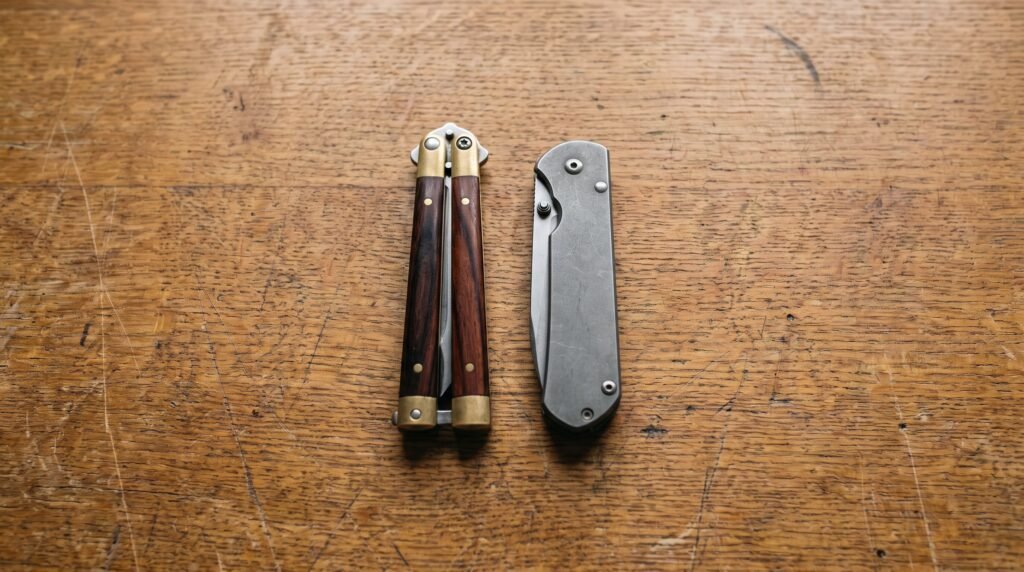
Balisong versus a normal folder
| Balisong | Standard folder | |
|---|---|---|
| Deployment, untrained | Slow and clumsy | Fast on day one |
| Deployment, trained | Very fast, both directions | Fast out, slower to close |
| One handed closing | Yes, and quickly | Usually fiddly |
| Ambidextrous | Completely, by design | Depends on the clip and stud |
| Lock failure risk | No lock to fail | Wear, lock rock, lock slip |
| Pocket debris | Collects everything | Mostly sealed |
| Cleaning frequency | Every week or two if carried daily | Occasionally |
| User serviceable | Fully, with one driver | Often, sometimes with lost bearings |
| Pocket clip | Rare, usually pocket or sheath carry | Standard |
| Legal friction in public | Higher in many places, check locally | Generally lower, still check |
| Reaction from strangers | Noticeable | None |
| Enjoyment of ownership | Considerable | Modest |
Who should carry one
Carry a balisong if you have flipped for a while and the motion is automatic, if you like maintaining things, if your work and your local rules make it unremarkable, and if you would rather own one knife you actually enjoy than three you feel nothing about. The enjoyment is not a trivial factor. A knife you like is a knife that is in your pocket, and a knife in your pocket is worth more than a better knife in a drawer.
Who should carry something boring
Carry a plain folder if you open forty parcels a day at work, if you are still learning and would rather not learn on your own fingers, if your local rules are murky, or if you simply want to open a box in front of a client and continue the conversation. There is no shame in a boring knife. Boring knives get a great deal of work done. If you would like your boring knife to be a nice one, Black Mamba Knives has a range of handmade pocket knives worth a look.
The obvious third option is both. A cheap folder in the work trousers and a proper balisong for everything else is what a lot of people we sell to actually do, and it neatly removes the argument.
If you are going to carry one, set it up for carry
Pick stainless or D2 rather than high carbon. Pick micarta or a dense hardwood rather than horn or pearl. Keep the blade length modest and the shape practical: a Drop point or a Traditional Batangas earns its keep at a desk in a way a Dagger does not, and our guide to blade types explains why. Every knife we make ships with a fitted leather sheath, which for a lot of people is a better carry solution than trying to make a clip work.
More reading. Carry size is half the question, so read balisong sizes and weight and balance before you commit to one. The other half is where you live: start with balisong laws by state.
Frequently asked questions
Is a balisong practical as a work knife?
For most trades, yes, provided the flipping is second nature and the site allows it. For anything involving gloves, grit or being watched by clients, a folder is usually less friction. The cutting performance is identical for the same blade and steel.
How often do I need to clean a carried balisong?
Every week or two for a daily carry, which is compressed air, a swab of isopropyl and a drop of oil on each pivot. Less if it lives on a desk. More if you have been anywhere with sand.
Does a balisong hold an edge as well as a folder?
Edge retention is a function of the steel, the heat treat and the geometry, not of the opening mechanism. Our blades run 58 to 60 HRC, and a D2 balisong will out-hold most budget stainless folders comfortably.
Will the handles loosen up in my pocket?
Screws loosen over time with use, not with sitting still. A quarter turn every month or two on a daily carry is normal. If you are tightening it weekly, use a drop of removable thread locker rather than tightening harder, because over-tightening is how pivots get worn oval.
Is a trainer a sensible thing to carry?
It is a good thing to carry if you want to practise on breaks without an edge in play, but understand that it does not cut, so it is not a tool. Some people carry a trainer and a plain folder and call it a solved problem. Local rules still apply to trainers in many places, so check.
What about a karambit balisong for carry?
The curved blade is superb at pulling cuts, cardboard and cordage above all, and considerably less good at the flat push cuts and food tasks a straight blade handles without thinking. It is a specialist. Our karambit butterfly knife page covers where the shape earns its place.
Is a heavier balisong better for carry?
Heavier knives roll more smoothly and are more forgiving of imperfect technique, which helps. They are also heavier, which after nine hours in a trouser pocket stops being an abstract point. Mid-weight with a dense hardwood handle is the sweet spot most daily carriers settle on.
How much should I spend on a knife I am going to carry?
Enough that the pivots are properly fitted and the steel is a named grade with a stated hardness, because those are the two things that determine whether it is still good in five years. Our price guide breaks down what the money is actually buying at each level.
If you have decided a balisong is going in your pocket, choose it for the pocket rather than the display cabinet. Have a look through the butterfly knife range, all made to order by hand, each one offered as trainer or live blade at the same price, chosen above the Add to Cart button.