
Blog
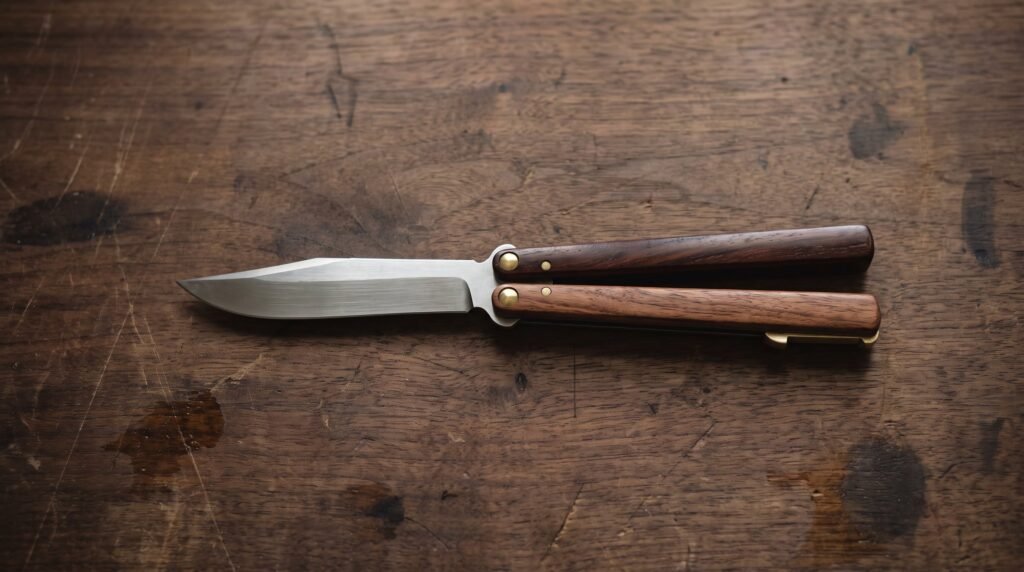
The bite handle is the one joined to the sharp edge of the blade. The safe handle is the one joined to the spine. Close a balisong onto the bite handle and the edge comes home into your palm, which is exactly as pleasant as it sounds. Every flip you will ever learn is built on knowing which handle is which without looking.
Quick answer: with the knife shut and the latch facing you, the handle the latch is attached to is the bite handle, and the edge of the blade is buried in that same channel. The other handle, the one the latch closes onto, is the safe handle. Open the knife and the safe handle is the one you keep in your hand. On a trainer there is no edge, so both handles are harmless, but you should still call them by their real names while you learn.
What the two handles actually are
A balisong is one blade and two handles rotating on two pivots. The blade sits between them. When the knife is closed, the edge is hidden inside one handle channel and the spine is hidden inside the other. That is the whole of it. The handle hiding the edge is the bite handle, sometimes called the live handle. The handle hiding the spine is the safe handle.
The names come from what happens when you get it wrong at speed. Close the knife onto the safe handle and the spine taps a piece of wood or micarta. Close it onto the bite handle and the edge taps the web of your thumb. Filipino flippers have used some version of this vocabulary for a very long time, and the English words stuck because they are blunt and accurate.
One detail people miss: the bite handle is not a fixed property of a handle in isolation. It is a relationship between that handle and which way the blade is currently facing. Rotate the blade 180 degrees relative to the handles and the roles swap. That is why a knife can bite you in a trick you have done a thousand times, if you accidentally started from the wrong side.
How to identify each handle in the hand, every time
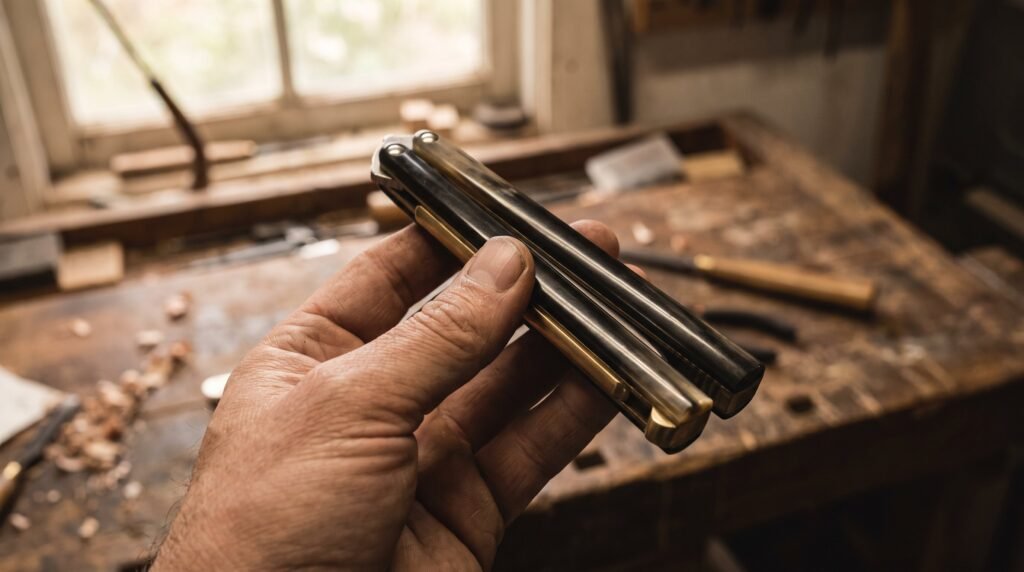
Three checks, in order of speed. Learn all three, because in poor light you will want more than one.
Check one: the latch
On a latched balisong, the latch is riveted to the bite handle in the overwhelming majority of builds, including everything we make. Feel for the latch with your thumb. That handle is the bite handle. This is the fastest check and works blind, in a pocket, in the dark.
Check two: crack it open a centimetre
Open the knife just enough to see daylight between the handles and look at which side of the blade is tapered. The edge side is thinner and catches light differently. The spine side is a flat, square band. If you cannot see it, run a fingernail down the channel. Do not run a fingertip.
Check three: the tang pins
Most balisongs have tang pins that stop the blade rotating past the handle. On many builds the pins sit slightly off centre, and the geometry of the kicker or tang pin on the edge side has to be cut a fraction deeper so the edge clears the channel floor. Once you have handled the same model for a week your thumb finds that asymmetry on its own.
The habit worth building is a one second check before every session. Open, look, name it out loud if you are new. It feels absurd for about three days and then it becomes something you do without noticing, like checking a car is in neutral.
The two handles side by side
| Property | Bite handle | Safe handle |
|---|---|---|
| Joined to | The sharp edge | The spine |
| Latch mounted here | Yes, on almost every latched build | No, the latch closes onto it |
| Held during basic flipping | No | Yes |
| Held in the closing move | Only in advanced or deliberate tricks | Yes, for every beginner trick |
| Typical weight | Slightly heavier when latched, the latch and its rivet add mass at the butt | Slightly lighter, cleaner swing |
| What contacts your hand on close | The edge, through the channel opening | The spine, blunt and forgiving |
| Risk on a live blade | High if closed into the palm | Low, bruising rather than cutting |
| Risk on a trainer | None, both channels hold a blunt bar | None |
| Sound on tang tap | Often a touch duller, the latch damps the handle | Brighter, more ring |
That last row is not folklore. A latch adds a few grams of steel and a rivet to a hollow handle, and hollow handles ring. Tap a latched knife closed on both sides and you can hear the difference across a quiet workshop bench.
Why the latch sits on the bite handle
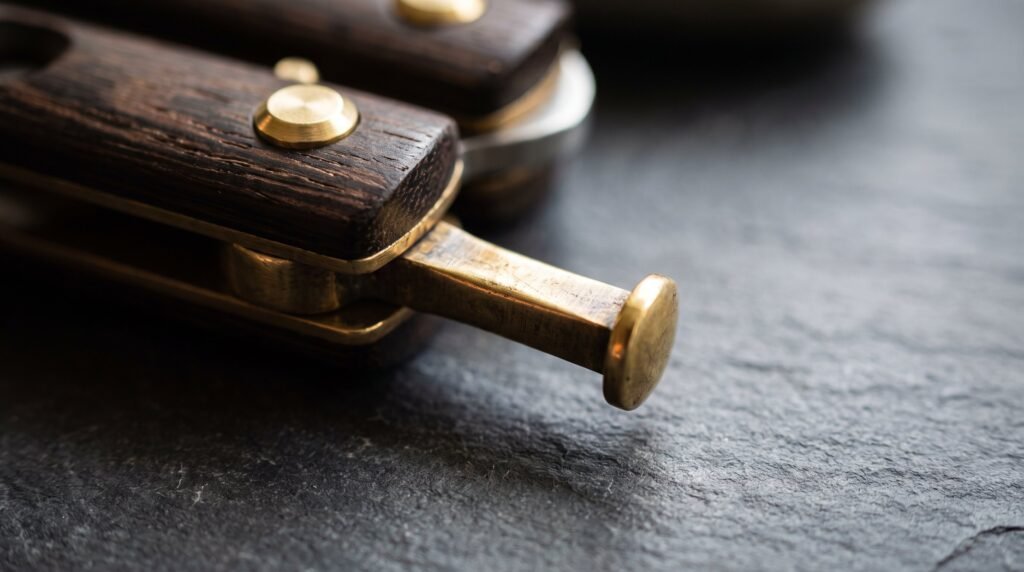
The latch has to hold the knife shut. If you mounted it on the safe handle, the latch would swing over and clamp the handle that is already hiding the spine, which does nothing useful, and it would sit on the handle you are meant to be holding. Putting it on the bite handle means the latch closes across the gap and traps the handle you are not holding.
There is a second reason, and it is the one flippers care about. In a closed carry position, the latch on the bite handle keeps the edge locked away from the opening. In the classic Batangas latch design the latch also gives you the wrist flick opening, where the knife swings open from the latch under its own weight. That only works cleanly with the mass and the pivot relationship you get from a bite handle mount.
A small maker detail. When we fit a latch, the rivet head has to sit flush or slightly proud on the inside face, never proud enough to touch the blade tang at full swing. A latch rivet that kisses the tang gives you a tick you can feel through the handle every rotation, and once you have felt it you cannot unfeel it. It is a two minute job at the bench and a permanently irritating fault if it is skipped.
What changes when you switch grips
Beginners are taught to hold the safe handle for everything, and that is correct for the first few weeks. Then the tricks start asking for more.
In a standard grip you hold the safe handle and the bite handle does the travelling. Aerials, rollovers and the whole basic rotation family live here. In a reverse or chaplin style grip the knife is inverted and the handle relationship inverts with it, so the handle you thought was safe now closes edge first if you finish the move the way you started it.
Zen rollovers, twirls and any trick that closes on the bite handle are the point where flippers start collecting scars. There is nothing wrong with closing on the bite handle. Serious flippers do it deliberately, with the blade fully controlled and the palm out of the channel line. The problem is closing on the bite handle by accident because a rotation carried further than you expected. Our advice is boring and correct: learn every closing trick on a trainer until you can do it half asleep, then move it across. The tricks learning path orders them so the bite handle tricks arrive after your hands have the reflexes to survive them.
“Safe” is a relative word on a live blade
We want to be direct about this, because there is a lot of casual nonsense online. The safe handle is not safe. It is the safer of two options on an object with a hardened edge swinging through an arc near your fingers.
A balisong closed on the safe handle can still hit your knuckles with the spine hard enough to bruise deeply. A blade that leaves your hand mid rotation does not care which handle you were holding. A loose pivot lets the blade wander in the channel, and a blade that wanders can present the edge where your hand expects the spine. The vocabulary describes edge geometry, not outcomes.
Wear nothing loose on your wrists, flip over a soft surface until the trick is reliable, and stop when your grip is tired rather than when you have finished the set. Fatigue is what puts an edge in a palm, not ignorance.
How the distinction behaves on a trainer
A trainer has the same steel, the same weight distribution, the same pivots and the same tang geometry as the live version, with an unsharpened bar instead of a ground edge. Both handles are equally harmless because there is no edge for either of them to hide.
That does not mean the distinction stops mattering. It means the opposite. A trainer is the only place you can practise bite handle tricks with your full attention on the mechanics instead of on your fingers. If you train without naming the handles, you build muscle memory that does not transfer, because the moment you pick up the live version your brain has no map of which side is which.
So we mark them. Practise as though the bite handle bites. Say it, or scratch a witness mark into the trainer’s bite handle butt if that helps. Every model we build is offered as a trainer or a live blade, same price, chosen above the Add to Cart button, so the trainer you learn on has the geometry of the knife you will end up carrying. The full range of blunt builds sits on the trainer hub.
How blade shape moves the bite line
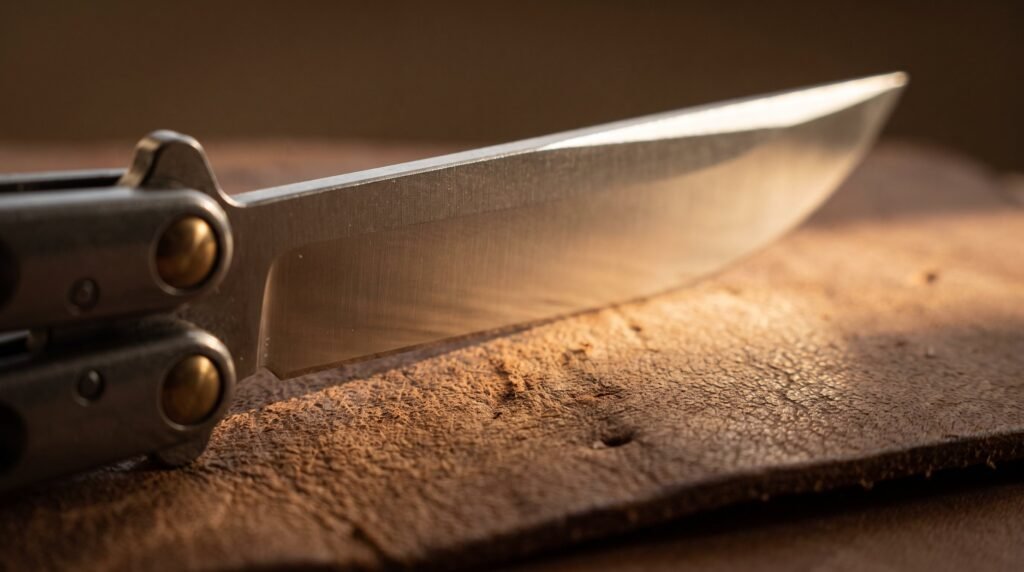
The edge does not always run the full length of the tang side. On a Traditional Batangas the edge runs long and close to the tang, so the bite channel is live almost the whole way down. On a Tanto the edge is straight along most of its length with the point set high, which changes where the sharp section sits when the knife is half closed. On a Double edge, both channels are live, and the words bite and safe stop meaning anything useful at all.
That last case is worth saying plainly. On a Double edge there is no safe handle. Flippers who move to one from a single edge model often carry over habits that assume a blunt spine, and the knife corrects them quickly. If you are curious about how each of the shapes we grind behaves in the hand, the blade shapes guide covers all eight, and the karambit balisong is its own case again, since a curved inside edge presents differently through the whole rotation.
Mistakes that put the bite handle where you did not want it
- Assuming every knife is built the same way round. Latch position is near universal but not absolutely universal, and a cheap import may have been assembled by someone who did not care. Check the knife in front of you, not the knife you remember.
- Reassembling after cleaning without checking blade orientation. This is the big one. Strip a balisong, put the blade back in flipped, and the bite handle is now the handle you have spent months treating as safe. Always dry fire it closed a few times before flipping.
- Trusting a pocket clip or a sheath to tell you. The care routine we publish includes an orientation check for exactly this reason.
- Loose pivots. Side play lets the blade sit off centre in the channel, and an off centre blade in the bite channel can contact the channel wall or your hand earlier than the geometry says it should.
- Flipping a knife you just sharpened without re checking. A fresh edge is sharper than the one you built the habit on. Same handle, more consequence.
More reading. The bite handle is one part of a larger vocabulary, all of it in balisong anatomy. Once you can name it every time, work through your first three moves and the habits in flipping safely. Learn all of it on a trainer.
Frequently asked questions
Is the bite handle always the one with the latch?
On our knives, yes, and on the large majority of balisongs made anywhere. It is close enough to universal that it is a reliable first check, but confirm it by looking at the blade the first time you handle any new knife.
Can you flip holding the bite handle?
Yes, and experienced flippers do it constantly. Whole trick families are built on it. The rule is that you choose it deliberately and control where the closing arc ends, rather than arriving there because a rotation ran long.
Do trainers have a bite handle?
They have a bite side in terms of geometry, since the blank matches the live blade’s tang and channel layout, but neither handle can cut you. Keep using the names while you practise so the habit transfers to a live blade.
Which handle should a beginner hold?
The safe handle, for everything, until basic openings and closings are automatic. The beginner flipping guide works through the first moves in that order.
Does the bite handle feel heavier?
On a latched knife, slightly. The latch and rivet add mass at the far end of the handle, which is the worst place to add mass if you want a neutral swing. Some flippers prefer that extra momentum, others find it makes rollovers lazy.
What happens on a double edged blade?
Both handles are bite handles. There is no safe side. Treat the knife accordingly and do not carry over closing habits from a single edge model.
Can the bite and safe handles swap over?
Only if the blade is reinstalled the other way round during a strip down, which is a genuine risk if you clean your own knife. Check orientation every time you reassemble, before the first flip.
Does a spring or magnetic latch change any of this?
It changes how the knife holds shut and how it sounds, not which handle is joined to the edge. The bite handle is defined by blade geometry, and no latch design alters that.
If you want a knife where the bite and safe channels are cut to the same tolerance and the blade actually sits centred in both, start with the butterfly knives we make and pick your trainer or live blade above the Add to Cart button. If you would rather choose the steel, handle material and blade shape yourself, build a custom balisong and we will grind it to order.