
Blog
Short version: if you want a real Filipino balisong, buy it from the people who forged it. If you want a production flipper, buy it from a specialist knife retailer. Everywhere else you are paying a stranger for a photograph.
Somewhere right now, someone is unboxing a $29 “Damascus” butterfly knife and discovering that the pattern comes off under a thumbnail. We would like to help you not be that person. This is the guide we wish existed when we started answering the same six emails every week.
Where can you actually buy a balisong?
There are five real options. Most people only ever consider two of them, and one of those two is the reason this article exists.
| Where | Good for | Typical price | The catch |
|---|---|---|---|
| Direct from the maker | Hand-forged traditional balisongs, custom work, actual provenance | $70 – $300 | Smaller catalogue. You are buying one workshop’s hand, not a warehouse |
| Specialist knife retailers (Blade HQ, BladeOps, KnifeCenter, Blade City) |
Production brands, huge model choice, painless returns | $60 – $500+ | Nobody in that building forged anything. They are very good shops. They are shops |
| The brand’s own site (Benchmade, Squid Industries, Nabalis, Kershaw) |
Newest models, warranty handled by the people who made it | $60 – $450 | One brand, one house style. Mostly CNC flippers rather than traditional balisongs |
| General marketplaces (Amazon, eBay, and the cheap import sites) |
Beater trainers, spare hardware | $8 – $40 | Unnamed steel, no accountability, and a clone rate that would embarrass a handbag stall |
| Batangas, in person | The real thing, at the source, at the price locals pay | ₱500 – ₱4,000 | You have to physically be in the Philippines. Also, customs exists |
Row one is where the knives on this site come from. Row five is where they came from before that.
What “authentic” actually means, since everyone uses the word
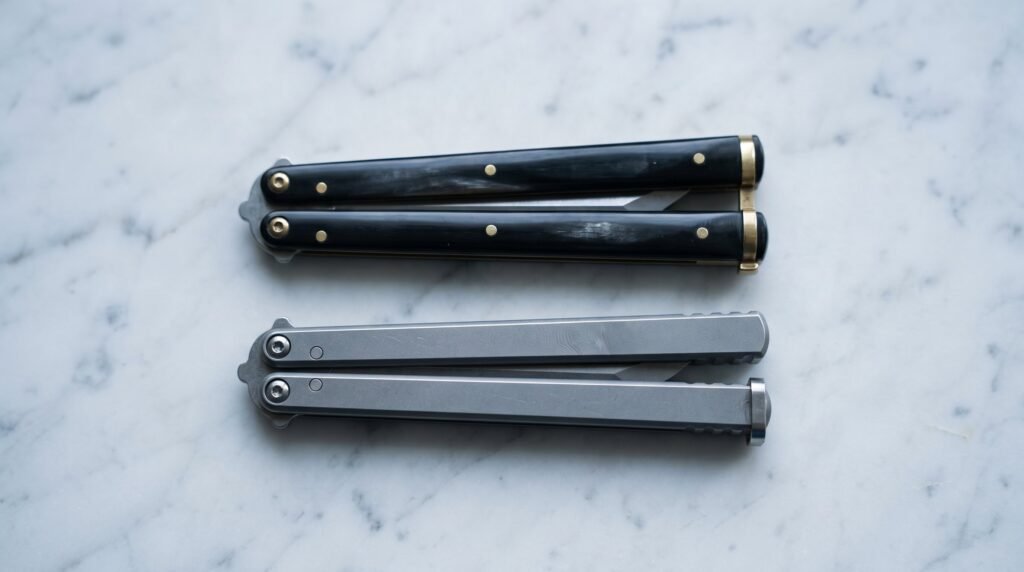
“Authentic” appears in roughly nine out of ten butterfly knife listings, including the ones stamped out four thousand at a time. So here is the difference in terms you can check, most of which announce themselves within about ten seconds of the knife being in your hand.
| Hand-forged Filipino balisong | Mass-produced butterfly knife | |
|---|---|---|
| Blade | Forged, ground and heat-treated by a smith, one at a time | Stamped or laser-cut from sheet, finished in batches |
| Steel | Named on the page: 440C, D2, high carbon, VG10, Damascus | “Stainless steel.” That is the whole answer you get |
| Damascus | Layers genuinely forge-welded. The pattern runs through the steel | Pattern etched or printed on the surface. It wears off |
| Handles | Carabao horn, kamagong, rosewood, brass bolsters, fitted by hand | Injection-moulded, or anodised aluminium in whatever colour is trending |
| Pivots | Fitted and tuned individually. A short break-in is normal | Bearing washers, perfectly uniform, occasionally loose out of the box |
| Two of the same model | Never identical. Grain and pattern do what they want | Identical. That is the entire point of a factory |
| What you are paying for | A person’s hours | A factory’s tooling |
To be clear, neither one is wrong. A Squid Industries Krake Raken is a genuinely superb instrument and no traditional smith in Batangas is lying awake trying to out-engineer it. But if you searched for an authentic balisong, you probably were not picturing a CNC-milled titanium flipper. You were picturing the knife the entire category is named after.
The Batangas test
The traditional balisong comes from an unusually small place. The knife is named after Barangay Balisong, a district of Taal in Batangas province, a couple of hours south of Manila. The local reading of the name is baling sungay. Roughly “folding horn”. After the carabao horn that handles were made from. Perfecto de Leon is credited with establishing balisong production there in the early 1900s, and the barangay grew into a street of family workshops that are still forging today.
The classic full-size pattern is still called veinte y nueve. Twenty-nine, because it measures 29 centimetres open, tip to handle. Nobody who actually makes these forgets that number.
Ask a seller which tradition their knife comes out of. If they cannot tell you, they are reselling. That is not a crime, but it does mean the word “authentic” in their product title is decorative.
What your money actually buys
| Price | What you get | Buy it if |
|---|---|---|
| $8 – $40 | Import trainer or novelty knife. Unnamed steel, loose pivots, printed patterns | You want to learn basic flips and genuinely do not mind if it dies |
| $50 – $80 | A proper budget trainer from a real brand. Aluminium handles, honest tolerances | You are learning and want something that survives the learning |
| $70 – $300 | Hand-forged traditional balisong. Named steel, real horn or hardwood, a maker behind it | You want the knife itself, not only the movement |
| $150 – $500 | Premium production flipper. Titanium, bearings, tolerances measured in microns | Flipping performance is the entire point for you |
| $500+ | Custom and collector work | You already know why. You did not need this table |
The trap sits between $20 and $50. That band is full of knives photographed like the $200 tier and built like the $10 tier. If a listing shows a beautiful watered Damascus pattern at $29, the pattern is on the surface, and the surface is not a long-term commitment.
Six questions that make a bad seller sweat
Ask these before you pay. A good seller answers all six in one reply and does not get defensive about any of them. We answer them roughly forty times a month and it has never once been annoying.
- What exact steel is this, and at what hardness? “Stainless” is not an answer. “440C” is. “D2 at 59–60 HRC” is a better one.
- Is that photo the knife I will receive, or a stock image? For handmade work, one-of-one photos are the baseline, not a favour.
- Is the Damascus forge-welded or etched? Ask it plainly. Anyone who makes real Damascus enjoys being asked.
- Live blade or trainer, and can I pick? Any serious balisong seller offers both.
- Where does it ship from, and what does tracking look like? A real dispatch point and a real tracking number eliminate most drop-shippers on the spot.
- What happens if the pivot loosens in month three? This one tells you whether a human being stands behind the knife.
Red flags
- No steel grade anywhere on the page
- The same stock photograph appears on four other stores, sometimes with a different brand printed on the blade
- “Damascus” under $40
- No address, no phone, no named humans
- Reviews that are all five stars, all one line, all posted in the same fortnight
- A shipping policy that ignores knife law entirely
That last one matters more than people expect. A seller who will ship anything anywhere is a seller who has not read the law, and it is your parcel that gets opened, not theirs.
Where to buy a balisong in Batangas
Almost nobody writes this part down, so here it is properly.
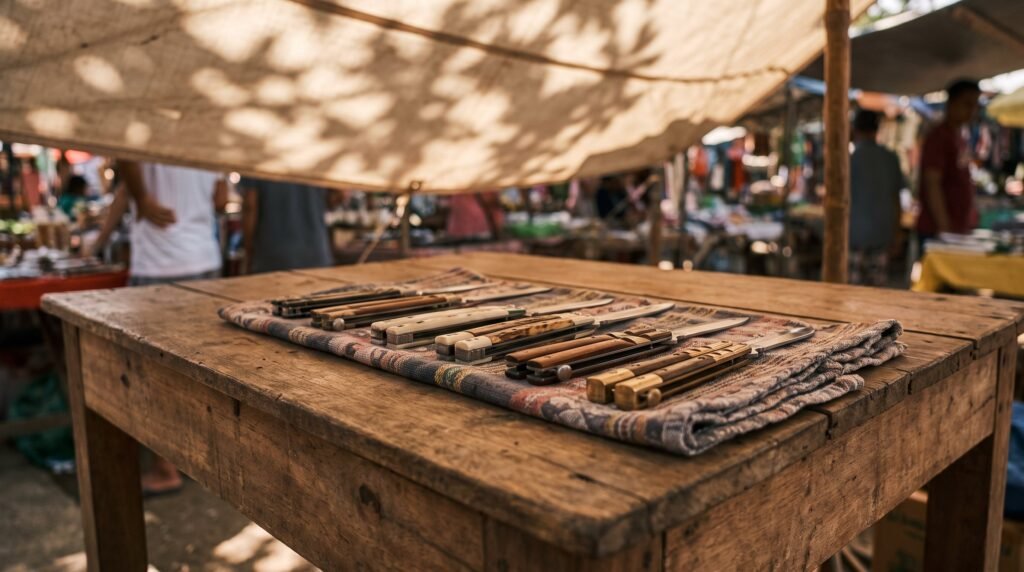
The workshops are in and around Taal, Batangas, roughly two to three hours south of Manila depending on how the traffic feels about you that day. Barangay Balisong is the historic centre, and several family shops still forge, grind and fit on site. At the source, prices run from a few hundred pesos for a simple working knife to a few thousand for horn-handled or Damascus work.
Four things worth knowing before you go:
- Buy from the workshop, not the roadside stall. The stalls resell. The workshops make. Ask to see the forge. Nobody who has one minds showing it.
- Handle it before you pay. A well-fitted balisong has no side-to-side blade play, and the latch seats without you persuading it.
- Ask which handle material it actually is. Carabao horn, kamagong and rosewood look near enough identical under a shop bulb and wear completely differently over ten years.
- It does not go in your hand luggage. Checked bag, declared, and check your destination’s import rules first. Several countries and several US states restrict butterfly knives regardless of where you bought them.
If you cannot make the trip, buying from a workshop that ships is the same knife minus the airfare and the sunburn.
Trainer or live blade?
A trainer is the same knife with an unsharpened blade. It is not a toy and it is not a lesser purchase. It is how essentially everybody learns, and how most sensible people practise for their first few months.
- Learning to flip? Trainer. You are going to drop it a great many times in week one, and your fingers will thank you for the foresight.
- Carrying it as a tool? Live blade, and only where carrying one is legal.
- Collecting? Live blade, usually. The edge is part of the smith’s work.
One tell: a seller who charges extra for the trainer is charging you more for less work. Any maker worth your money prices them the same.
Before you buy: the legal part
This section is not the place for jokes.
Butterfly knife law in the United States is set state by state, and it changes. Some states permit ownership but restrict carry. A few restrict both. Trainers are treated separately in some states and identically in others. Possession rules and carry rules are two different questions, and you need the answer to both.
Check your own state before you order. We keep a state-by-state breakdown in our guide to butterfly knife laws by state. If you are ordering from outside the United States, check your country’s import rules as well as its possession rules. Customs is where most orders actually fail, not checkout.
Buying direct from us
Fair warning: this is the part where we talk about ourselves. You have read enough to judge whether we know what we are talking about.
We forge in the Filipino tradition our makers were trained in. Families generations deep in the craft, now building in the United States. Every knife is hand-tuned before it ships, by someone whose name we know.
| Catalogue | 159 knives, each one made individually |
| Steels | 440C, D2, high carbon, VG10, Damascus. Always named on the page |
| Trainer option | Every model, same price as the live blade |
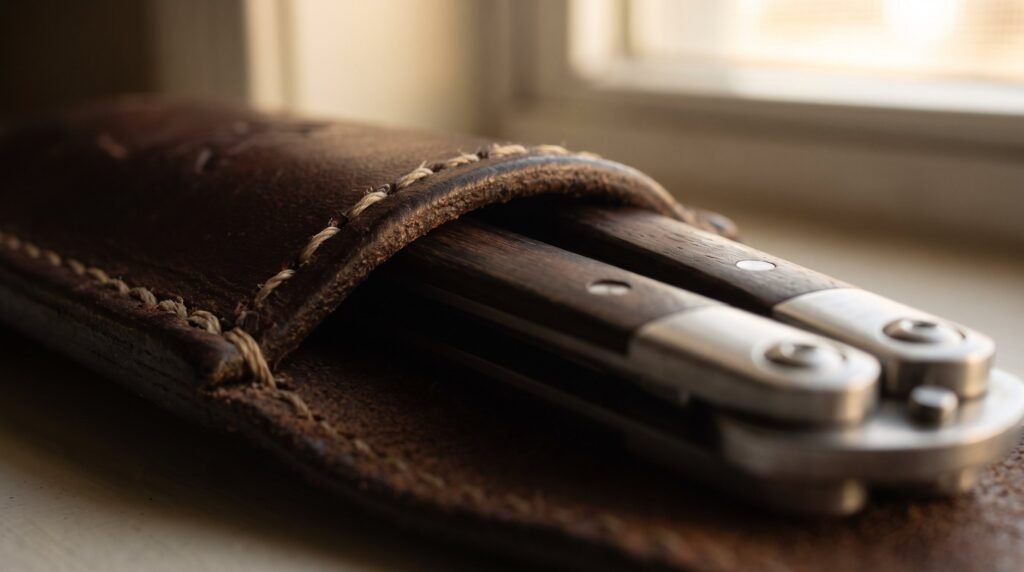
| Included | Fitted leather sheath |
| Ships from | Austin, Texas, 1–3 days, with tracking |
| Reviews | 4.79 / 5 across 650 customer reviews |
| Since | 2020 |
Start with the authentic Filipino balisong collection, or the original Batangas pattern if it is specifically the traditional shape you are after. If you want a name, a date or a mark on it, that is personalised work.
Never held one before? Read what a balisong knife is first. Parts, types and history, without the mythology.
Frequently asked questions
Where is the best place to buy a balisong?
Direct from the maker if you want a traditional hand-forged balisong. A specialist knife retailer if you want a production flipper. Both beat general marketplaces, where the steel is unnamed and nobody is standing behind the knife once it ships.
Can you legally buy a butterfly knife in the US?
In most states, yes. But ownership and carry are regulated separately and the rules vary by state, so check both for your own state before ordering.
Where can I buy a balisong in Batangas?
In and around Taal, Batangas. Barangay Balisong is the historic centre and several family workshops still forge on site. Buy from a workshop rather than a roadside stall, and check your destination’s import rules before you fly home with it.
How much should a good balisong cost?
A dependable budget trainer starts around $50–$80. Hand-forged traditional balisongs run roughly $70–$300 depending on steel and handle material. Premium production flippers run $150–$500. Anything under $40 claiming Damascus is not Damascus.
How can I tell if a balisong is authentic?
Named steel grade, photographs of the actual knife, a stated workshop or tradition, forge-welded rather than etched Damascus, and no two pieces identical. A seller who cannot tell you what steel it is did not make it.
Should I buy a trainer first?
Yes. Almost everyone learns on one, and it is the same knife without the edge. If a seller charges more for the trainer than the live blade, buy somewhere else.
Do balisongs need breaking in?
Hand-fitted pivots often do. A little stiffness in the first few weeks is normal and settles with use. Persistent side-to-side blade play is not break-in. That is a fault, and it is worth an email.
What is the difference between a balisong and a butterfly knife?
Nothing at all. Same knife. “Balisong” is the Filipino name and “butterfly knife” the English one. You will also see “fan knife” and “Batangas knife”, which are also it.
Related guides
If you want to buy straight from the makers, here are all our balisong knives.