
Balisong For Sale: Handmade Filipino Butterfly Knives
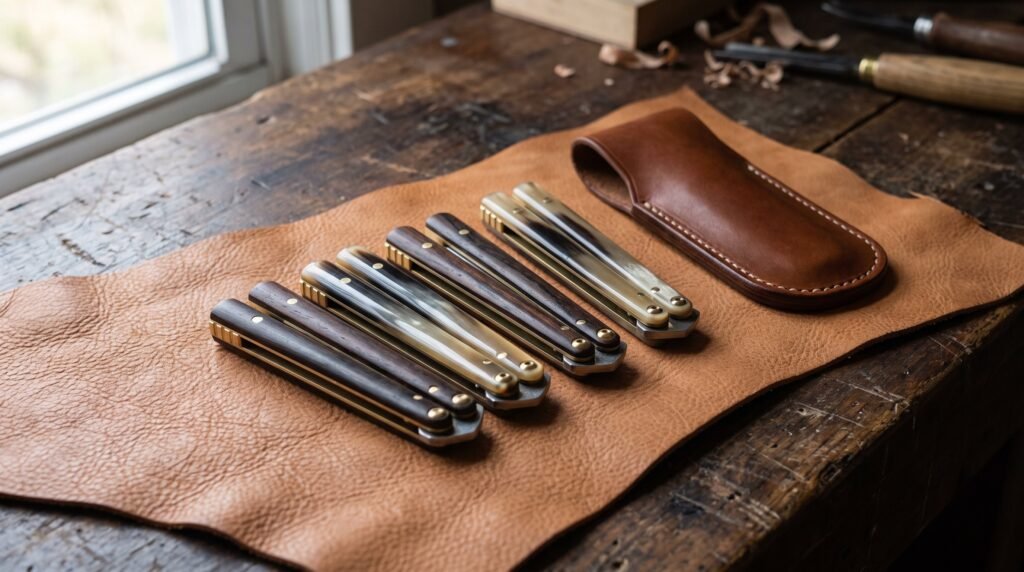
Short version: a balisong worth buying costs between $80 and $250 for a solid production knife with a named steel, and more once a person fits the handles by hand. Below $30 you are buying a keychain that happens to open sideways. If you have never flipped, the cheapest thing here is still the smartest: a trainer, which we sell at the same price as the live blade on every model.
We make these knives, so this is not a neutral market survey. They are hand forged in Austin, TX with select materials imported from the Philippines. It is what we would tell you across the counter.
What does a fair price actually look like?
Price tracks three things: hand labour in the handles, whether the steel has a name and a real heat treat, and whether the pivots were fitted or just screwed together. The rest is marketing.
| Tier | What you are actually buying | Who it is right for |
|---|---|---|
| Under $30 | Unnamed “stainless steel”, stamped handles, pivots loose in a week, a Damascus pattern etched on rather than forged in. | Nobody. Buy a trainer for the same money. |
| $30 to $80 | Real steel sometimes, mystery steel usually. Decent geometry, poor finishing. | Finding out if you enjoy flipping at all. |
| $80 to $180 | Named steel, hardened properly, washers instead of metal on metal, handles that line up closed. | Most buyers. The honest middle. |
| $180 to $350 | Hand-fitted handles, natural materials, a pivot tuned by whoever flipped it before boxing it. | One knife, and you want it to be the one. |
| $350 and up | Custom work, forged Damascus, horn picked piece by piece, longer waits. | Collectors, and anyone buying to hand down. |
Anything under $40 claiming Damascus is not Damascus. Real pattern-welded steel takes hours of forge time before anyone touches a grinder, and nobody does that for the price of a pizza.
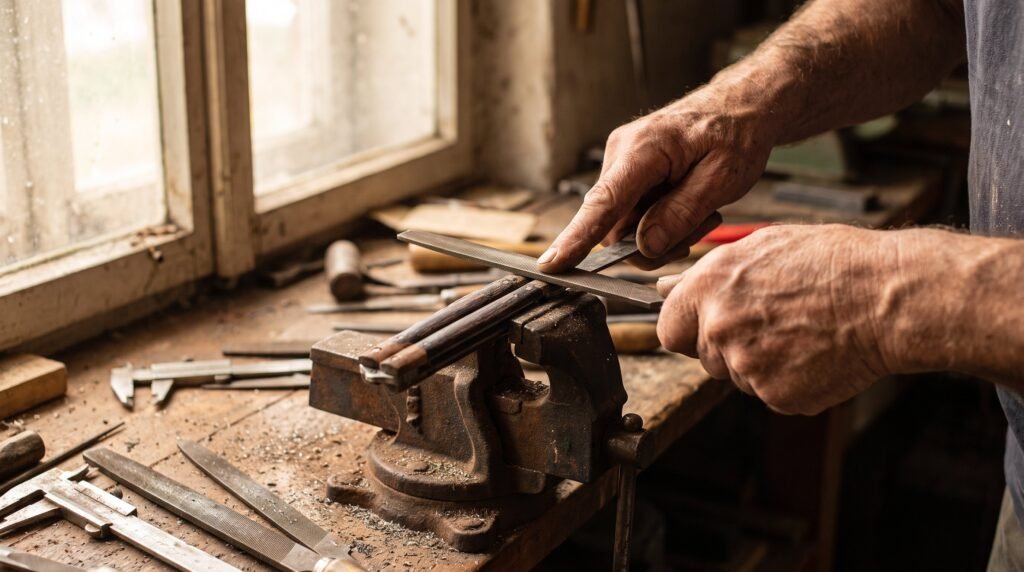
How do you tell a handmade balisong from a CNC production one?
Look at the handles, not the blade. On a production knife the two halves are identical to the thousandth, because a machine cut them from one program, which is what machines are for.
On a handmade knife they are the same shape but not the same object. Run a thumb along the closed seam and you will feel where a person took the edges down. Two pieces of carabao horn are never identical, so a horn-handled listing with one stock photo is showing you a knife you will not receive.
Then the pivot. Factory knives arrive at one tension for every unit. A hand-fitted knife was opened, adjusted and set where it wants to sit, and you feel that in the first ten flips. The bite handle drops with weight behind it instead of flopping.
Last tell: the tang stop. Cheap knives run a pin through both handles and let it hammer the tang flat. Better ones use a zen pin or a stop built to take the hit. Ask a seller which. Makers answer in a sentence, drop-shippers change the subject.
What does the steel really change for you?
Less than forums claim, more than the listing admits. We harden every blade to 58-60 HRC, the window where a balisong holds an edge without chipping when the tang smacks the handle for the four-hundredth time.
| Steel | Edge holding | Rust resistance | Sharpening at home | Buy it if |
|---|---|---|---|---|
| 440C | Good | Very good | Easy | You want a knife you can ignore. |
| D2 | Very good | Fair, it spots if you sweat on it | Harder, wants diamond | You cut with it and wipe it after. |
| High carbon | Very good | Low, it will patina | Easiest of all | You like a blade wearing its history. |
| VG10 | Excellent | Very good | Moderate | You want the sharpest edge here. |
| Damascus | Core dependent | Core dependent | Moderate | You are buying it to look at. Fine reason. |
The part sellers leave out: if you are flipping, steel barely matters, because a flipper’s blade lives closed and cuts nothing. Put the money in the pivot and handles. If the knife is going in a tackle box, buy 440C and stop reading charts.
What do handle materials cost, and why?
Steel and titanium scales are cut, finished, done, and titanium buys lightness rather than strength. G10 is cheap, grippy and honestly excellent, which is why serious flippers use it and nobody brags.
We do not make titanium handles. If you are weighing one up anyway, titanium balisong handles sets out what the extra money buys and what it does not.
Natural materials work differently. Horn, stag and hardwood are cheap; the selection is not. We go through a pile to find two pieces matching in colour and grain, so that neither one looks like an apology next to the other. That sorting, plus the fitting, is most of what you pay for.
Horn moves with humidity over the years, which is why the Taal makers used it. The name comes from baling sungay, folding horn, and it has been in this knife since Perfecto de Leon was working in Batangas in the early 1900s. Wipe it with oil now and then, and keep it out of hot cars.
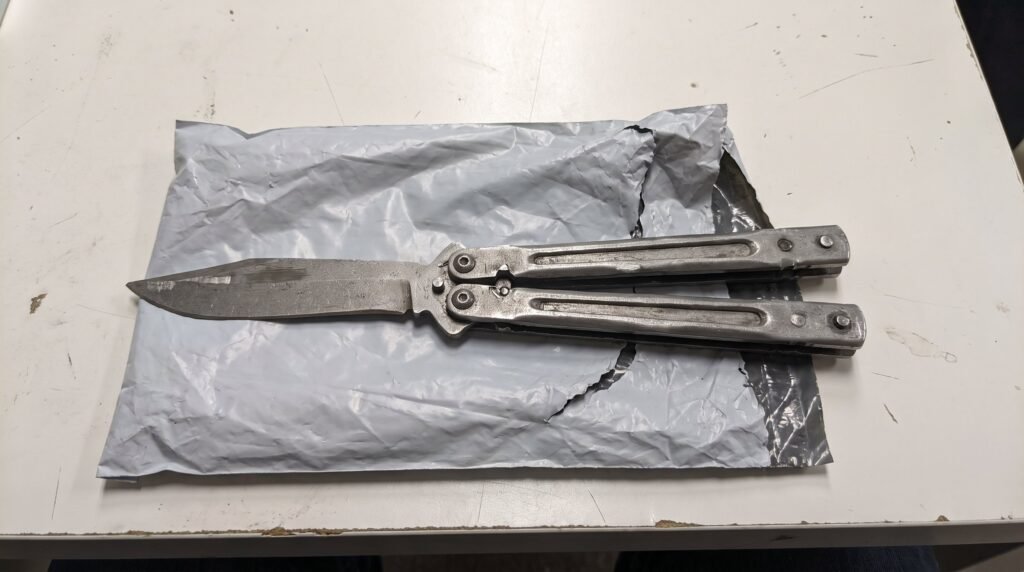
Why are the marketplace ones so cheap?
Because every cost above has been removed. One factory making a dozen brands under a dozen names, unlabelled steel because labelling invites questions, no washers, a pin instead of a stop, no sheath, and a listing photo of another maker’s knife.
The tell is the description. A listing that says “stainless steel” with no grade is 3Cr13 or worse. Grades are free to type. The only reason to omit one is that writing it down loses the sale.
When is the cheaper knife the right knife?
Often. We would rather say so than sell you the wrong thing.
Never flipped? Buy a trainer. You will drop it a hundred times in the first fortnight, and a dull trainer costs pride where a live blade costs a thumb. Ours is the same price as the live version on every model, so this is not an upsell.
Want a beater for camping? A $90 440C knife does everything a $300 one does, minus the handle material you were going to scratch anyway. Buying a gift for display? Spend on the handles, not the steel. It will never cut anything harder than a birthday ribbon.
The expensive knife wins in one case: you are keeping it. Then the tuned pivot and matched scales are the point, and they are the two things you cannot add later.
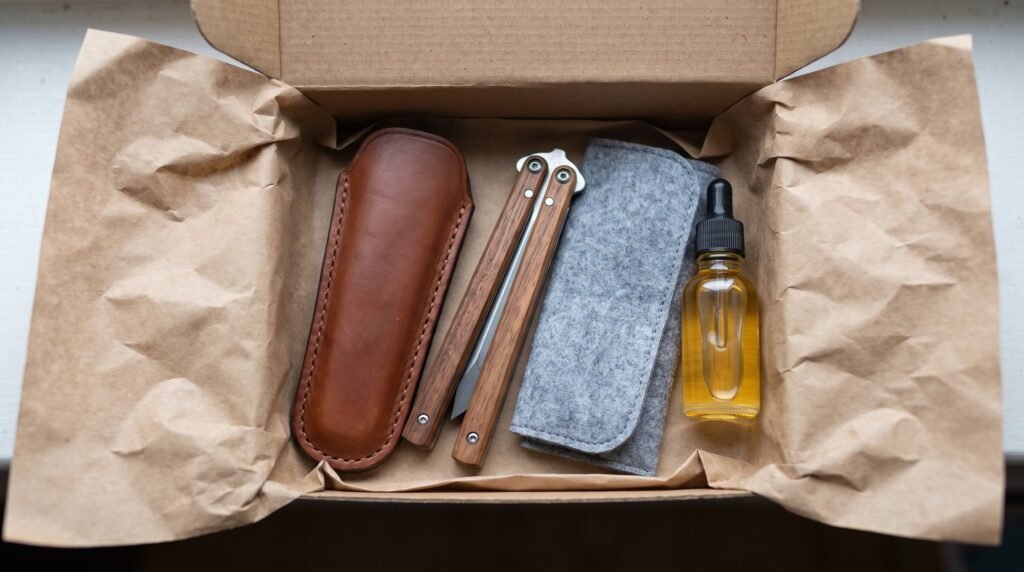
What should arrive in the box?
A sharpened knife with the edge protected, a fitted leather sheath cut for that model not a generic pouch, and spare pivot hardware, because those screws walk. Every knife we ship carries its own sheath, free to US addresses and a flat $49 anywhere else.
What should you check when the knife arrives?
Do this in the first ten minutes, closed, over a table, before you flip it once. A live blade does not care how confident you feel.
- Look down the closed seam. The handles should meet flush, and the edge should sit between them without touching either. A visible step means nothing was fitted, and if the pivots will not centre the blade, it is bent.
- Test both pivots. Open it, hold the blade, wiggle each handle sideways. A whisper of movement is normal. A rattle is not.
- Look at the tang stop and the latch. On a new knife, no peening, no bright marks where metal is already deforming, and a latch that releases without dragging on the blade.
- Inspect the edge under a light with a fingernail, never a fingertip. You are feeling for chips, not testing sharpness.
- Try the sheath and the screws. The knife goes in closed and comes out without a fight, and screws sit snug rather than cranked. Overtightening a pivot ruins a good action faster than anything else.
If anything fails, tell us before you flip it. A knife that arrived wrong is a different conversation to one dropped fifty times.
FAQ
How much should I spend on my first balisong?
Trainer first, then $80 to $180 on the live blade once you flip clean. Spending $400 before you can do a basic aerial means practising on something you are scared to drop.
Are butterfly knives legal to buy where I live?
It depends on your state or country, and it changes. Most knife law pages online are copy-paste jobs from years ago, so check your own jurisdiction against a current source before ordering. We ship where it is lawful; local law is the buyer’s responsibility.
What is the difference between a trainer and a live balisong?
The blade. Same weight, pivots, handles and balance, unsharpened edge. Everything you learn transfers.
How do I know the seller actually makes the knives?
Ask something specific. Which steel, what hardness, what stops the tang. A maker answers straight away because they chose those things. A reseller sends a paragraph about quality.
How long does shipping take and what does it cost?
Free in the US, flat $49 everywhere else regardless of order size. Custom and hand-fitted pieces take longer than stock, and we say which is which before you pay.
Do you sell traditional Filipino patterns?
Yes. The authentic Filipino balisong range follows the Batangas pattern, including the veinte y nueve at 29 cm open, the size the Taal makers settled on a century ago.
Pick one and we will get it sharp
159 knives in the catalogue, 650 approved reviews averaging 4.79 out of 5, trading since 2020. Start with 440C to carry and forget, VG10 for edge holding, or custom for a say in the handles.
Not sure? Tell us what you plan to do with it and we will point you at one knife instead of five. Sometimes it is the cheapest one. We will still say so.