Blog
Quick answer: A butterfly knife is a balisong, and the thing that actually changes between one and the next is the blade. Eight shapes on this site carry a name of their own: the traditional Batangas blade, the Visayan, the tanto, the double edge, the dagger, the drop point, the shark and the mini. Most of the catalogue is the standard Batangas pattern without a shape name attached, and a few knives sit in more than one group, so treat the counts below as what is on the shelf under each name rather than as a tidy division of all 161. The traditional blade is what most people should buy. The others exist because different people want different things out of a knife that spins.
Below is what each shape does, what it costs, and which one to pick. No shape is better than the others in the abstract. Anyone who tells you otherwise is selling you the one they have too many of.
What a Butterfly Knife Actually Is
Two handles, one blade, two pivot pins, and a latch. The handles rotate around the tang of the blade in opposite directions, which is why it opens the way it does and why it looks like a butterfly opening its wings. That is the whole mechanism. It has not changed in a hundred years.
“Butterfly knife” is the English name. “Balisong” is the Filipino one, and it is older. The word comes from Taal in Batangas province, where the pattern was made and refined by hand for generations, and where the makers we work with still live. Both words describe the same knife. If a shop sells you a “balisong” and a “butterfly knife” as two different products at two different prices, walk out.
What people usually mean when they ask about types of butterfly knives is the blade. So that is what this page is about.
The Eight Blade Shapes We Make
| Blade | In stock | Price from | Buy it if |
|---|---|---|---|
| Traditional Batangas | 27 | $154.00 | You want the real pattern, and you want to spend your money on the blade rather than a shape |
| Visayan | 10 | $137.50 | You like a deeper belly and a knife that feels older than it is |
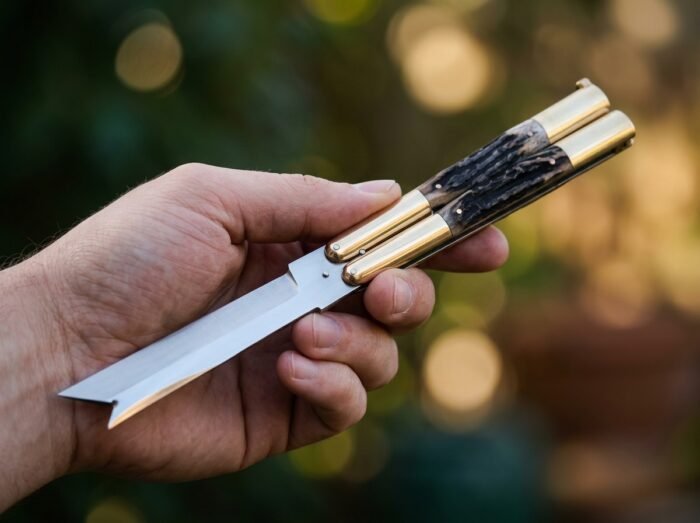
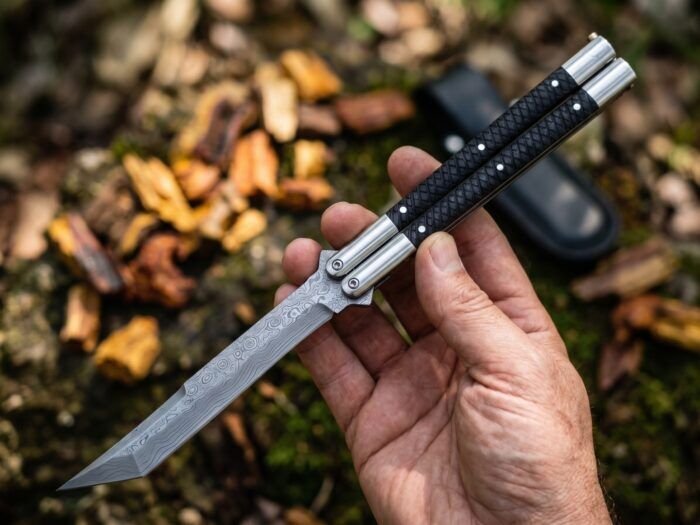
| Tanto | 9 | $154.00 | You want a strong tip and you do not care about slicing |
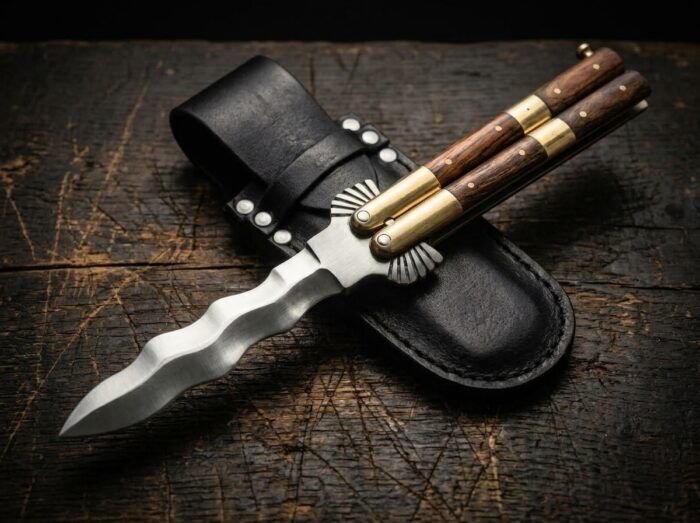
| Double edge | 9 | $235.40 | You are collecting, and you understand what two edges mean for your fingers |
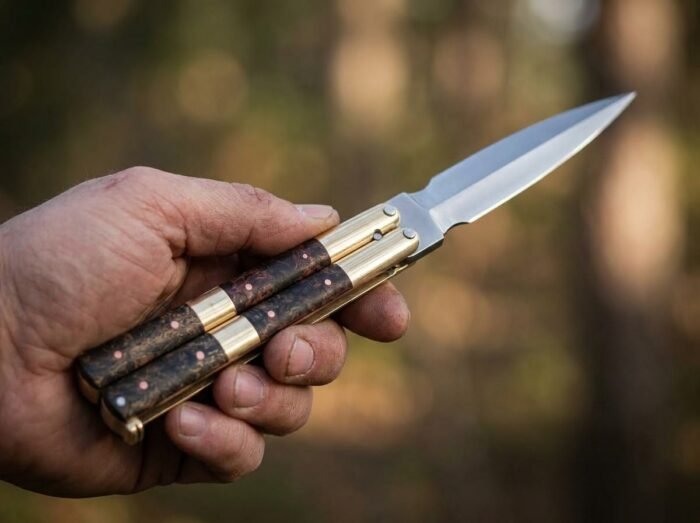
| Dagger | 7 | $167.75 | You want symmetry and a fine point, mostly for display |
| Drop point | 1 | $176.00 | You actually intend to use the knife for knife things |
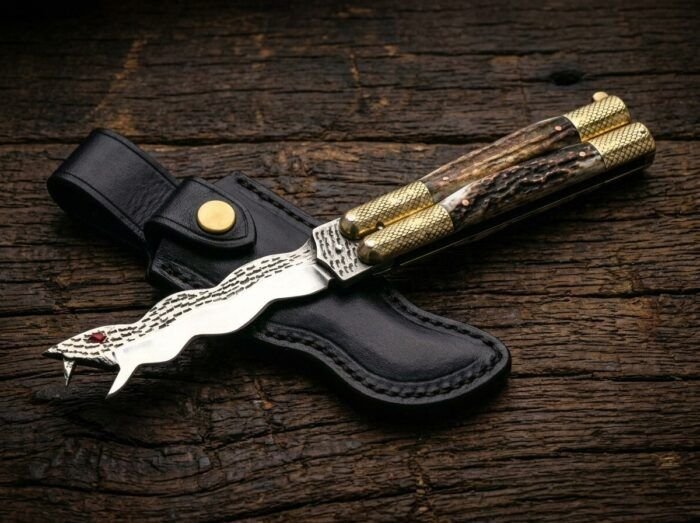
| Shark | 1 | $192.50 | You want something nobody at the meetup has |
| Mini | 1 | $137.50 | Your hands are small, or 24cm is more knife than you want in a pocket |
Traditional Batangas
The long, slim, slightly upswept blade that the whole category is named after. Pinned bolsters, handles cut so the knife closes flush, forward weight bias so it swings without you working for it.
This is the one to buy. Not because it is fancy, but because the proportions were arrived at by people who made nothing else for their entire working lives, and every other shape on this list is a departure from it. Learn what a knife is supposed to feel like on this blade first. Then go be creative.
Visayan
From the central Philippines rather than Batangas, and it shows. Deeper belly, more curve through the edge, a slightly heavier feel in the hand. It cuts better than the traditional blade and flips a fraction slower.
Ten of these in stock, starting at $137.50, which makes it the cheapest way into a knife with real regional character rather than a shape someone drew.
Tanto
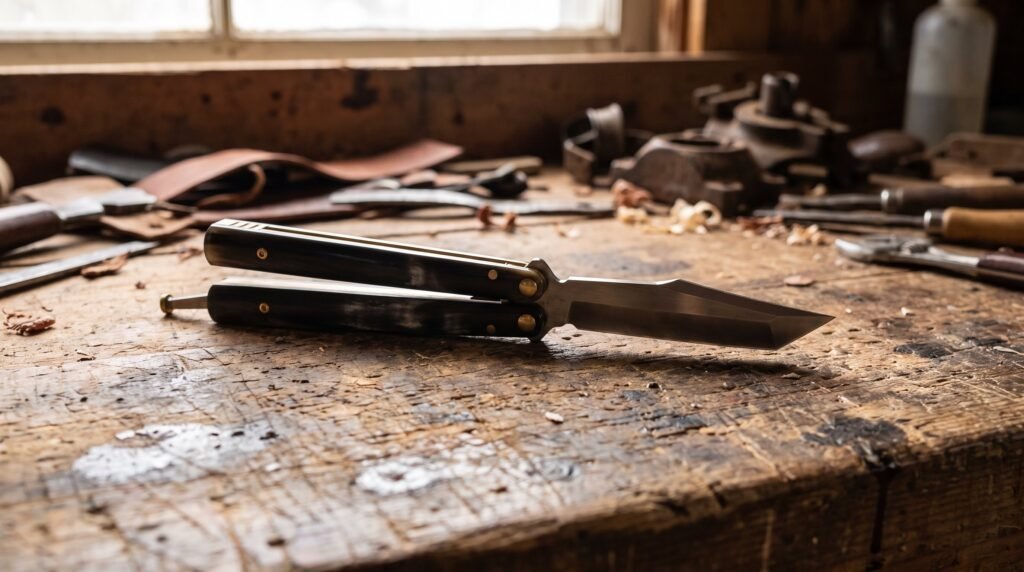
A flat primary edge that meets a second short edge at an angle, giving you a very strong point. Japanese in origin, adapted onto a Filipino knife, which purists find irritating and everybody else finds handsome.
The honest case for a tanto: the tip will not snap if you do something stupid with it. The honest case against: that angled tip is bad at everything a curve is good at, which is most cutting. Nine in stock from $154.00.
Double Edge
Sharpened on both sides. This is the most expensive shape we make, $235.40 to $549.45, and it is the one we are most careful about selling.
Understand what you are buying. On a balisong, one handle is the bite handle and one is the safe handle. That distinction exists because the edge is on one side. Sharpen both sides and there is no safe handle any more. Every flip is a live flip. Experienced flippers know this and want it anyway. If you are not there yet, buy this one as a trainer and enjoy it without the education.
Dagger
Symmetrical, tapering to a fine point, usually with a central spine. Seven in stock from $167.75. Beautiful on a shelf, balanced in the hand, and not a great cutter, because a dagger was never designed to be one.
Drop Point
The shape almost every practical folding knife in the world uses, on a balisong. Convex spine dropping to the tip, generous belly, controllable point. We have exactly one, at $176.00.
If you want a butterfly knife that is genuinely a working knife rather than an object that flips, this is the shape. It is also the shape the fewest people ask for, which tells you something about why most people buy balisongs. If the work you have in mind is skinning game, a fixed blade will do it better than any balisong, and Ransack Viking sells handmade Damascus skinning knives for that job.
Shark
A dramatic swept profile with a pronounced upward hook toward the tip. One in stock, $192.50, in D2 with a stag horn handle. It exists because a maker wanted to make it. That is a good enough reason.
Mini
Same knife, shorter. Our standard balisong is 24cm open. The mini is meaningfully less, at $137.50. Worth considering if you have smaller hands or if the full-size knife sits awkwardly. Not a toy and not a beginner’s compromise, just a different size.
Which Blade Should You Actually Buy?
Three sentences cover most people.
- First balisong: traditional Batangas blade, in 440C or VG10 stainless, ordered as a trainer. Around $110 to $140.
- You already flip and want a real knife: traditional or Visayan, in D2. Around $150 to $200.
- You are buying a gift or starting a collection: tanto or double edge in Damascus, with stag horn or mother of pearl. $235 and up.
Notice that the blade shape is the last variable in all three. Steel matters more, handle matters more, and whether you ordered it blunt matters most of all while you are learning. Shape is what you choose once the important decisions are made.
Blade Shape Is Not the Same as Steel
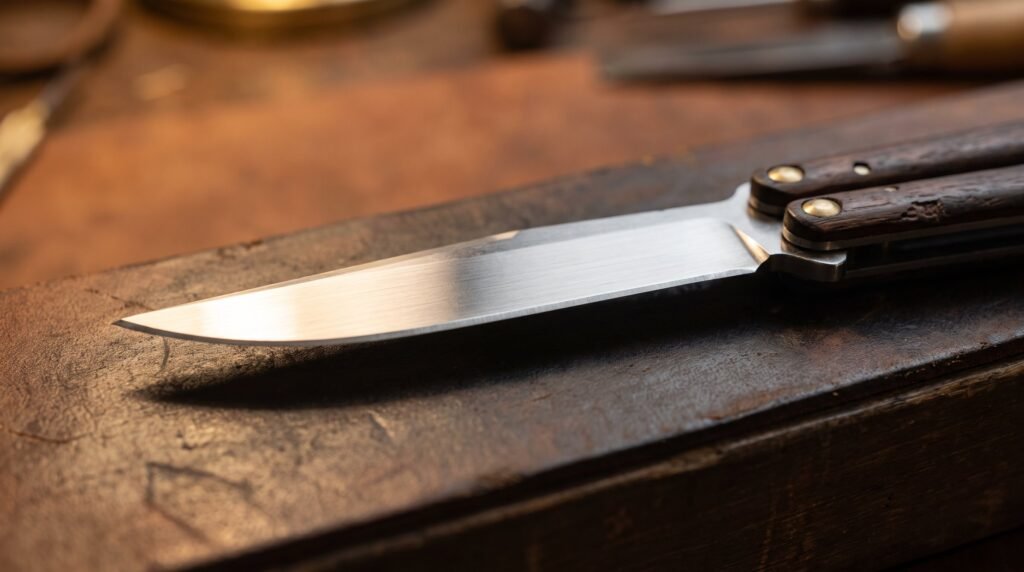
People conflate these constantly. The shape is the outline. The steel is what the outline is cut from, and it is the thing that decides whether your knife still cuts in a year.
| Steel | Knives | From | What it is good at | What it costs you |
|---|---|---|---|---|
| D2 tool steel | 47 | $121.00 | Edge retention, hard use | Harder to sharpen, will spot if left wet |
| High carbon | 89 | $110.00 | Takes the keenest edge, sharpens fastest | Rusts if you neglect it |
| Damascus | 19 | $154.00 | Looks, collecting, gifts | Pays for pattern, not performance |
| VG10 stainless | 30 | $109.45 | No maintenance, humid climates | Slightly harder to bring back sharp |
| 440C stainless | 22 | $110.00 | Easy to sharpen, tough when dropped | Softer edge than D2 |
A traditional Batangas blade in 440C and the same shape in Damascus are the same knife to look at and completely different knives to own.
Every Shape Comes Blunt at the Same Price
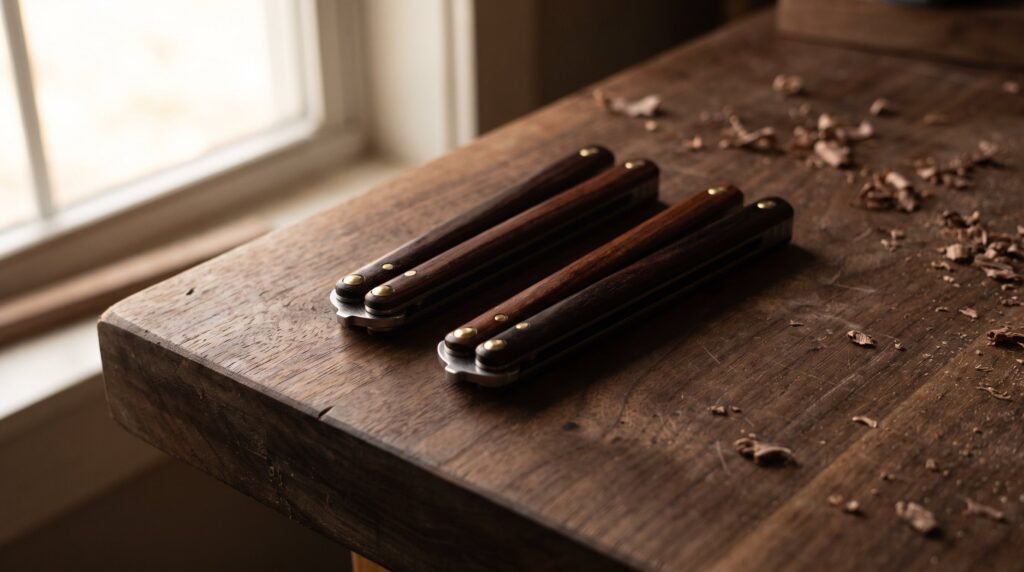
Whichever blade you pick, you can order it as an unsharpened trainer. Same steel, same handle, same weight, same price. You choose Sharp or Trainer on the product page before you add to cart.
This matters more on some shapes than others. A double edge trainer is the only sensible way to learn on a double edge. A tanto trainer will not put its very strong point through your palm. We would rather you learned on the exact knife you intend to carry than on an aluminium blank that balances nothing like it.
What About the Handle?
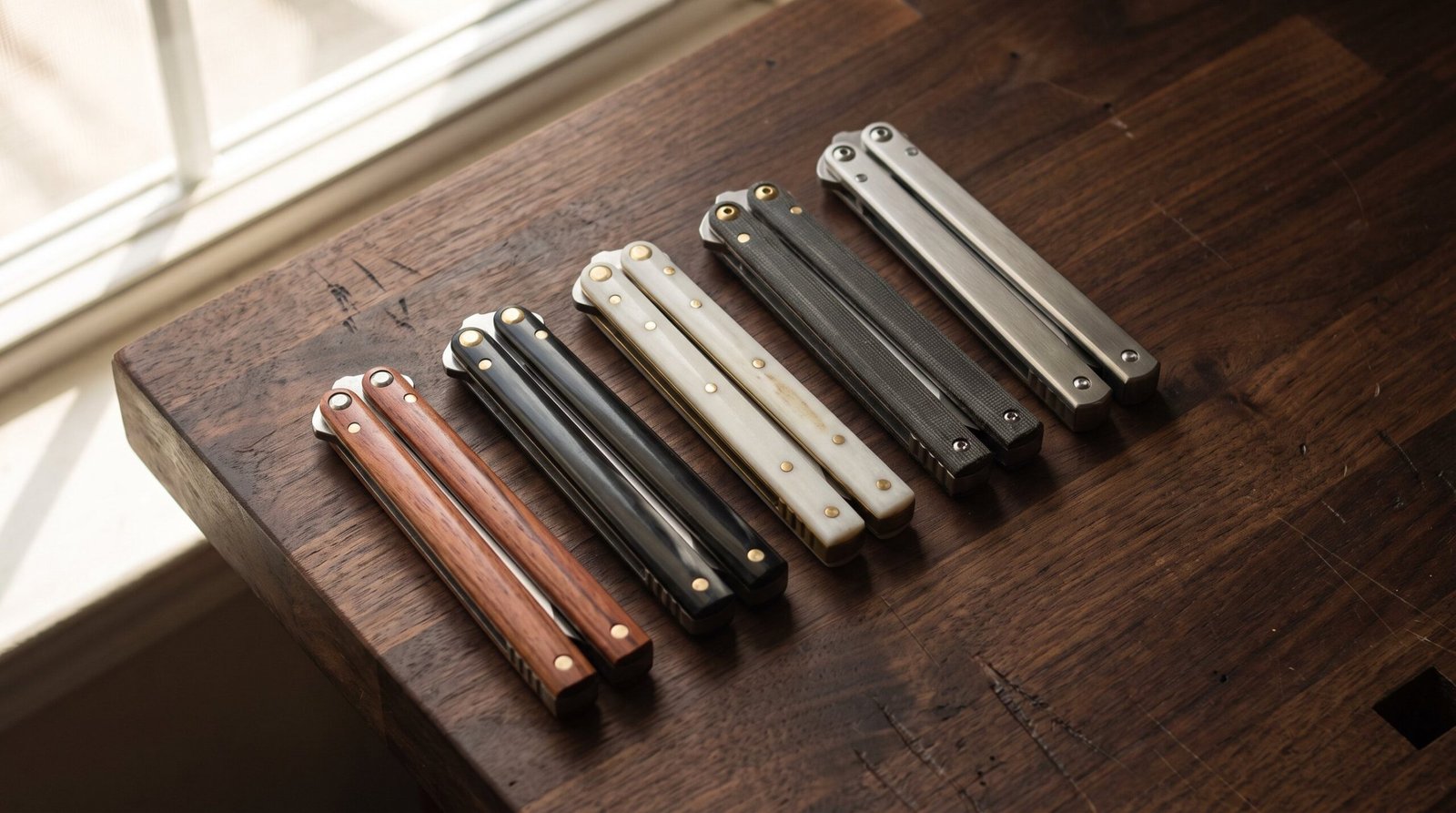
Two knives with the same blade can sit $200 apart, and the handle is almost always why. Stag horn and mother of pearl have to be selected and matched individually, so no two pairs are alike. Kamagong and narra are stable and warm. Micarta is what you want if the knife is going to get wet. Brass and steel bolsters add weight at the pivot end, which is where a flipper wants it.
None of that changes what the blade does. It changes what the knife feels like, which is not the same question and is often the more important one.
A Note on the Law
Blade shape rarely affects legality. Most statutes name the handle mechanism rather than the edge, which is why a blunt trainer is not automatically legal where a live blade is not. Butterfly knife law varies by state, by county and sometimes by city. Check yours before you order.
Common Questions
How many types of butterfly knives are there?
Blade shapes are effectively unlimited, because any blade shape can be fitted to the mechanism. In practice you will meet eight or so regularly, and we make all eight: traditional Batangas, Visayan, tanto, double edge, dagger, drop point, shark and mini. Everything else is a variation on one of those.
What is the difference between a butterfly knife and a balisong?
Nothing. Balisong is the Filipino name and the older one. Butterfly knife is the English description of how the two handles open. Same knife, two words.
What is the best butterfly knife blade shape for a beginner?
The traditional Batangas blade, ordered as a trainer. It is the pattern every other shape departs from, so learning on it tells you what the departures are actually doing. Save the tanto and the double edge for when you know what you like.
Is a tanto butterfly knife better than a traditional one?
Better at not breaking its tip. Worse at cutting anything that requires a curve, which is most things. It is a preference, not an upgrade, and anyone selling it as an upgrade is guessing at what you want.
Are double edge butterfly knives legal?
That depends entirely on where you live, and the number of edges is rarely what the statute cares about. Most legislation names the opening mechanism. Check your state and your city before ordering, and read our laws guide as a starting point rather than as advice.
What is a Visayan balisong?
A balisong made in the Visayan pattern from the central Philippines rather than the Batangas pattern. Deeper belly, more curve through the edge, slightly heavier in the hand. Ten in stock from $137.50.
Does blade shape change how a butterfly knife flips?
Less than people expect. Weight distribution does the work, and that comes mostly from the handle and the bolsters. A heavier blade shape shifts the balance forward a little, which most flippers prefer, but you would notice a handle change long before you noticed the blade profile.
Can I get any blade shape in any steel?
Not from stock, no. Each knife is made as a specific combination. If you want a particular shape in a particular steel with a particular handle, that is a custom order, and it takes two to three weeks.
Related guides
Shop balisong knives by blade
Now that you can tell a tanto from a spear point, see how each shape looks in hand. All our balisong knives are on the homepage, and the Filipino balisong collection covers the traditional Batangas blades.