Blog
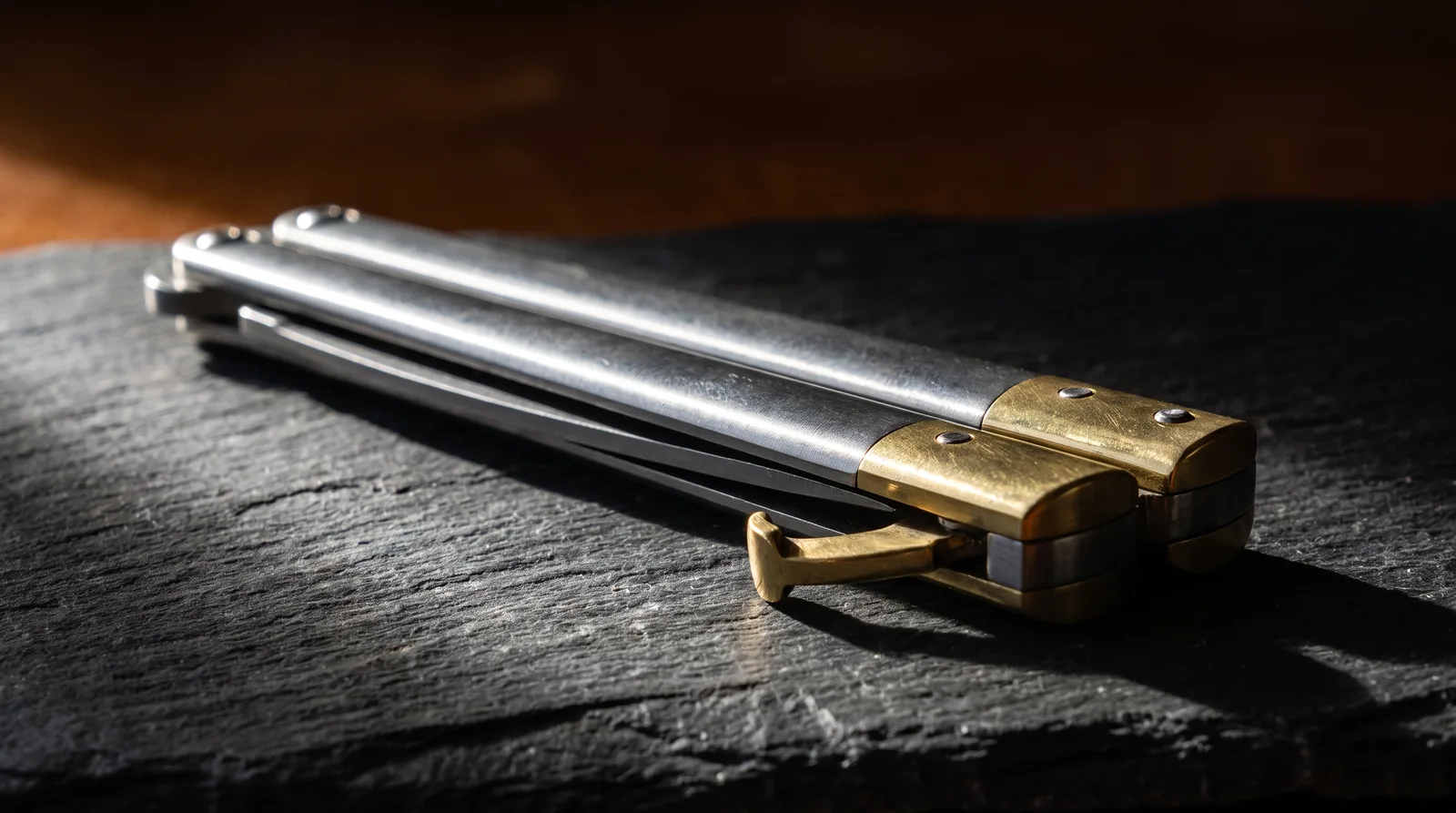
A balisong latch is the small catch that holds the handles together so the knife stays shut in a pocket, and on most designs holds them shut again when the blade is open. The traditional Batangas latch is a simple T-shaped piece pinned to the bite handle. Spring latches pop open when you squeeze. Magnetic latches use a magnet instead of a hook. Latchless knives skip it entirely, which many flippers prefer.
That is the short version. The longer version matters because the latch is a surprising amount of the personality of a balisong: it is extra mass on the end of one handle, it makes noise, it can mark your blade, and it rules a handful of tricks in and a handful out. Here is what each type actually does.
What a latch is actually for
Two jobs, in this order.
Closed retention. A balisong with no latch is two handles held together by friction at the pivots. That is fine on a bench and less fine in a bag, where the handles can drift apart and let the blade swing. The latch stops that.
Open retention. On a knife with a Batangas-style latch, the latch also reaches across and holds the handles closed around the tang when the blade is deployed, which stops the knife folding on your fingers if you push hard on the spine. This is the job people forget the latch does, and it is the reason a latch is genuinely useful on a knife you intend to cut with rather than only flip.
What the latch is not for is locking the blade in the cutting sense. It holds the handles to each other. A balisong is not a locking folder and does not pretend to be.
Latch types compared
| Latch type | How it works | Holds knife open? | Noise | Added weight | Best for |
|---|---|---|---|---|---|
| Batangas (T-latch) | Simple hooked bar pinned to the bite handle, moved by thumb | Yes | Clacks unless gated | Small, at handle end | Traditional knives, cutting use, carry |
| Manila latch | Same hardware, mounted on the safe handle instead | Yes | Clacks unless gated | Small, at handle end | People who want the latch away from the edge side |
| Spring latch (integrated) | A spring above the latch throws it clear when handles are squeezed | Yes | Quieter, springs back | Small, plus the spring | Fast one-handed opening |
| Spring latch (sprung by shape) | No literal spring; the latch is shaped to pop out, but does not recoil on its own | Yes | Moderate | Small | Simplicity with some of the pop |
| Magnetic | A magnet in one handle holds the other closed | Usually closed only | Near silent | Very small | Quiet carry, clean lines |
| Latchless | Nothing. Friction and pivot tension only | No | None | None | Dedicated flipping and trainers |
The Batangas latch, and its Manila cousin
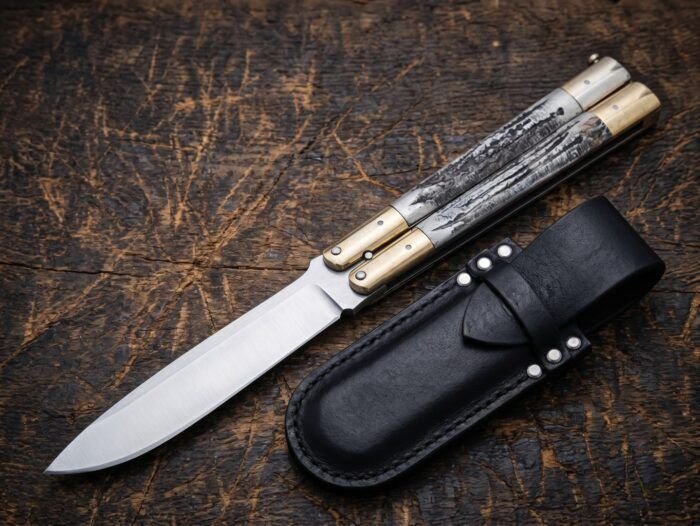
This is the original and still the most common. A short bar, often close to a capital T in profile, pinned near the butt of the handle so it swings out to hook over the other handle. No springs, no magnets, nothing to break. You flick it with your thumb.
The naming convention people use is straightforward. A Batangas latch is mounted on the bite handle, the one on the same side as the sharpened edge. A Manila latch is the same hardware mounted on the safe handle instead. That is the whole difference, and it changes which hand position feels natural for unlatching and which handle carries the extra gram of latch mass.
Because the latch is not always on the bite handle, do not use it as your only cue. Our guide to bite handle vs safe handle covers how to check a new knife before you trust it.
The Batangas latch is what our knives are built around, because it is what the tradition is built around. It also survives being dropped on concrete, which is more than can be said for most cleverer mechanisms. If you want the background on why the Batangas pattern became the pattern, our guide to the original Filipino balisong covers it.
Spring latches
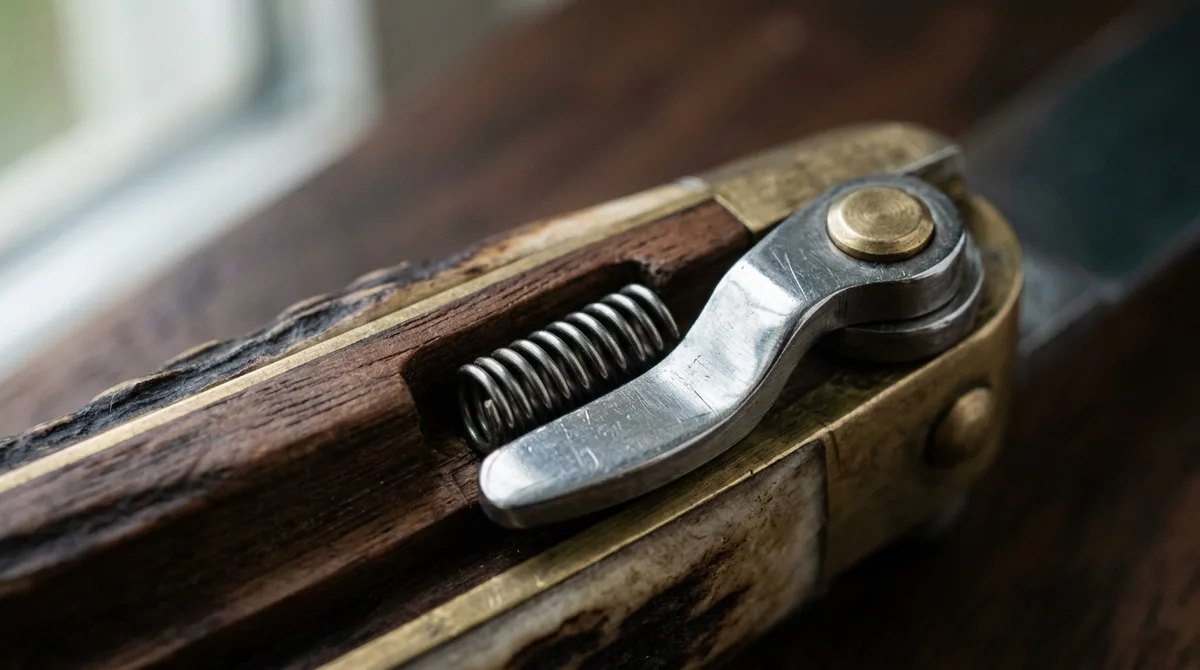
A spring latch adds a spring so the latch throws itself clear when you squeeze the handles together. Squeeze, the latch pops, the knife opens. On a well-made one it is genuinely quick and quite satisfying.
There are two things sold under this name. The first has an actual spring sitting in the handle above the latch, giving both the pop-out and a recoil that returns the latch. The second has no spring at all: the latch is shaped and fitted so that squeezing pushes it clear, but it will not spring back on its own. Both get called spring latches. If it matters to you, ask which one you are buying.
The trade-off is parts. A spring is a wear item and a small thing to lose. A T-latch has nothing to fail. In fifty years of Batangas knives, the plain latch is the one that keeps turning up still working.
Magnetic latches
Magnets are used occasionally in place of a mechanical latch. A small magnet set in one handle holds the other handle closed. There is nothing to flick, nothing to catch on a pocket, and no clacking.
The honest assessment is that magnetic retention is good at the closed job and poor at the open one. A magnet strong enough to hold handles shut when a knife is tumbling in a bag would also be strong enough to fight you every time you flip. Most magnetic setups therefore hold the knife closed and leave the open position to pivot tension. If you cut with your balisong regularly, that is a real limitation. If you flip and display, it is not.
Magnets also attract steel dust and can lose strength if they take repeated hard impacts or high heat. Neither is likely in normal use, but they are the failure modes to know about.
Latchless balisongs
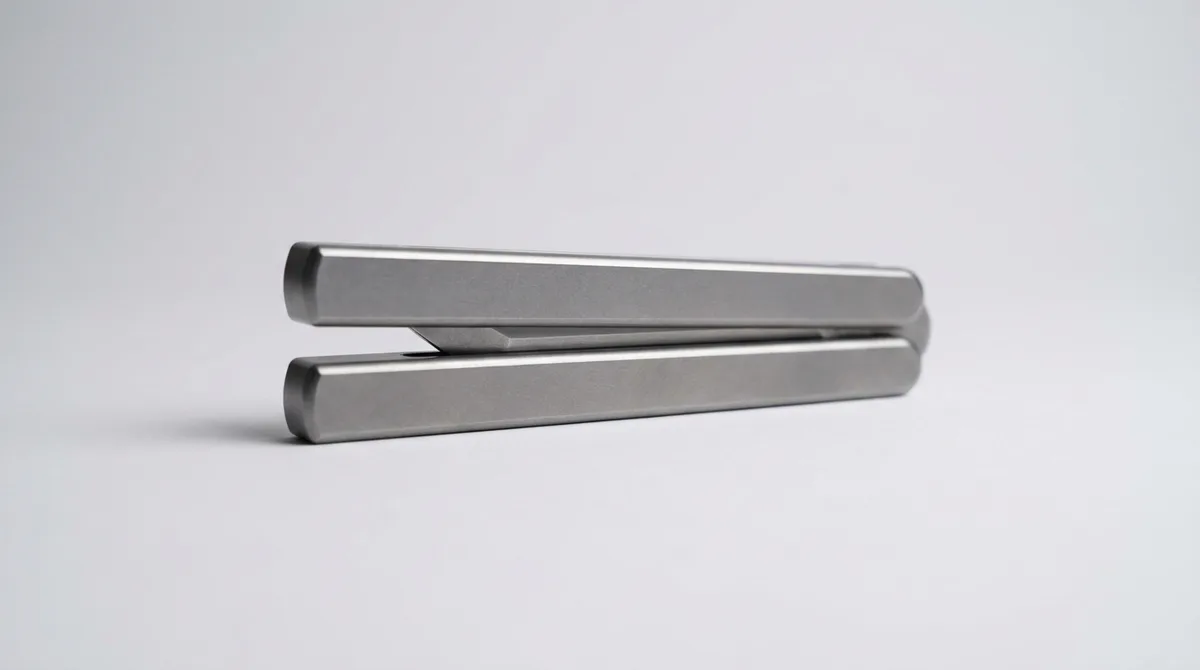
A large share of serious flippers remove the latch, or buy a knife that never had one. The reasoning is consistent across the community: a latch bangs around during a routine, it makes noise, it marks up the handles, and on some knives the latch and blade tip meet and leave a witness line on the blade over time.
Take the latch off and the knife gets quieter, marginally lighter, and symmetrical in a way that makes some rotations cleaner. You also lose two things: pocket security, and the open retention that stops the handles folding under pressure on the spine.
You do not lose the tricks. Latch drops, which are the obvious thing you would think need a latch, are commonly performed on latchless knives by using a handle hole or by pinching the end of the handle instead. Most butterfly knife tricks either never involved the latch or have a latchless variant.
Our own view: keep the latch on a knife you carry or cut with, take it off a dedicated flipper if the noise bothers you, and never take it off a knife you are still learning on, because the latch is a useful reminder of which handle is which.
Latch gates, and why flippers fit them
A latch gate is a small piece fitted inside the bite handle that stops the latch from swinging far enough to contact the blade. That is the whole idea, and it solves two problems at once.
The first is cosmetic and cumulative. On an ungated knife, every time the blade slams home against the bite handle the latch can come down onto the blade. Over a few thousand repetitions that leaves a visible line on the blade and rounds off the latch. The second is noise and feel: an ungated latch rattles inside the channel through every rotation, which sounds cheap and adds a small unpredictable mass swinging on its own schedule.
Gates are sometimes machined into the handle from the factory and sometimes fitted afterwards by the owner, in materials from machined metal to a shaped piece of polymer. Whether a specific knife has one is a per-model question rather than something that follows from the latch type, so check before assuming. We would not call a knife without a gate defective, but we would call a knife with one better thought through.
How the latch changes balance and trick selection
A latch is not heavy in absolute terms, but it is mounted at the far end of one handle, which is the position where a given gram has the most effect on how the knife swings. The result is a knife that is very slightly asymmetric: one handle carries a fraction more mass than the other, and that mass sits at maximum distance from the pivot.
What that feels like in practice:
- Rollovers and basic openings: almost no difference. The latch is too small to matter at these speeds.
- Fast twirls and chaotic work: the latch is the loudest and most noticeable thing on the knife, and an ungated one will occasionally swing out mid-rotation and change the feel of a catch.
- Aerials: the mass difference between handles is small enough to ignore, but a latch that swings out mid-flight is something you can catch on. This is the strongest argument for a gate or for going latchless.
- Latch drops and latch-based flourishes: obviously easier with a latch, and possible without one using a handle hole.
If you want to understand the bigger picture of how mass placement changes a knife, our guide to balisong weight and balance covers balance points properly, and handle materials covers where most of the mass actually comes from.
Latch problems and fixes
| Symptom | Likely cause | What to do | When to stop and ask |
|---|---|---|---|
| Latch rattles constantly while flipping | No latch gate, or a worn one; loose latch pin | Fit or replace the gate; check the latch pin for play | If the pin hole itself has elongated |
| Witness line appearing on the blade near the tip | Latch dropping onto the blade on close | Fit a gate. The mark is cosmetic and will not spread once gated | If the latch is actually contacting the edge |
| Latch will not stay closed | Worn hook, bent latch, or handles slightly out of alignment | Check handle alignment first; a bent latch can often be gently trued | If the hook itself has worn round |
| Latch too tight to flick open | Latch pin over-tightened, or debris in the pivot area | Clean, then back the pin off a fraction at a time | If it is still stiff when clean and loose |
| Latch flops out on its own during aerials | Latch pin too loose; no gate to control travel | Snug the pin very slightly; add a gate | If tightening enough to hold it makes it hard to flick |
| Spring latch lost its pop | Spring fatigued, dislodged or gummed with old oil | Clean and re-oil; springs are replaceable on most designs | If the spring is broken or missing |
| Magnetic latch weaker than it was | Steel dust on the magnet face, or impact damage | Wipe the magnet face clean and retest | If it is still weak after cleaning |
| Handles marked where the latch sits | Ungated latch hammering the handle over time | Gate it. The existing marks are permanent | Never urgent, purely cosmetic |
None of this is difficult work, but all of it involves taking a sharp thing apart. Our knife care guide covers disassembly and pivot adjustment without ruining the action.
Which latch should you choose
If you are buying a traditional Filipino balisong, you are buying a Batangas latch, and you should. It is the correct hardware for the pattern, it does both retention jobs, and there is nothing in it to fail.
If you are buying a knife purely to flip, latchless or gated Batangas are the two sensible answers, and which you pick comes down to whether you want the pocket security. If you are buying a first knife, take the latch, and take a trainer alongside it while you learn which handle bites.
Spring and magnetic latches are worth having if you specifically want the behaviour they give: fast squeeze-to-open in the first case, silence in the second. Neither is an upgrade in the general sense, and both add something that can go wrong to a knife whose great virtue is that almost nothing can.
More reading: Balisong handle materials covers the other half of what the handle is doing, balisong weight and balance explains why a few grams at the handle end matter, and double-edge vs single-edge balisongs matters here because a double edge removes the safe handle the latch convention is built around. For the basics, start with what is a balisong knife and how to flip a balisong.
Frequently Asked Questions
What is the difference between a Batangas latch and a Manila latch?
Only where it is mounted. A Batangas latch sits on the bite handle, the one on the same side as the sharpened edge. A Manila latch is the same hardware mounted on the safe handle instead. The mechanism, the feel and the job are identical; what changes is which handle carries the extra mass and which thumb position feels natural.
Do I need a latch on a balisong at all?
Only if you carry the knife or cut with it. A latch keeps the handles together in a bag and, on Batangas-style knives, holds them shut around the tang when the blade is open so the knife will not fold under pressure. For pure bench flipping, plenty of experienced flippers remove the latch and never miss it.
What is a latch gate and do I need one?
A latch gate is a small piece inside the bite handle that stops the latch swinging far enough to touch the blade. It prevents the witness line that ungated latches leave on a blade over thousands of repetitions, and it stops the latch rattling through every rotation. If you flip a lot, yes, you want one.
Are spring latches better than plain T-latches?
Faster to open, not more reliable. A spring latch pops clear when you squeeze the handles, which is quick and satisfying. A plain T-latch has no spring and therefore nothing to fatigue, dislodge or lose. If you value speed, take the spring. If you value a knife that still works in thirty years, take the T.
Can you still do latch drops on a latchless balisong?
Yes. Flippers perform latch-drop style moves on latchless knives by using a hole in the handle or by pinching the end of the handle instead. You lose the specific feel of a latch catching, but the family of tricks survives. Very few flourishes genuinely require a latch to exist.
How much weight does a latch add?
Not much in absolute terms, but it sits at the far end of one handle, which is the position where mass has the most influence on how the knife swings. That makes the knife slightly asymmetric between handles. Most people never notice it during rollovers; it becomes perceptible during fast aerials.
Why does my latch rattle so much?
Almost always because there is no latch gate, so the latch swings freely inside the handle channel during every rotation. A worn or loose latch pin makes it worse. Fitting a gate is the fix. Tightening the latch pin alone usually just trades a rattle for a latch that is stiff to flick open.
Does a magnetic latch hold the knife open as well as closed?
Usually not. A magnet strong enough to secure the handles in the open position would fight you on every flip, so most magnetic designs handle the closed position only and leave the open one to pivot tension. If you use the knife for cutting rather than flipping, that is a genuine limitation worth knowing about.
Will removing the latch damage or devalue my balisong?
Removing it usually does no harm mechanically, and it can generally be refitted. On a traditional hand-made Filipino balisong, though, the latch is part of the pattern, and a collector buying it later will want it present and original. Keep the parts if you take it off.
Should a beginner buy a latched or latchless knife?
Latched. Beyond the practical retention, the latch is a permanent marker of which handle is the bite handle, and that is genuinely useful while your hands are still learning. Learn on a trainer first regardless. A trainer will not make you a flipper faster, it will just stop you needing stitches.