
Butterfly Knife Tricks: A Real Learning Path, Beginner to Aerials
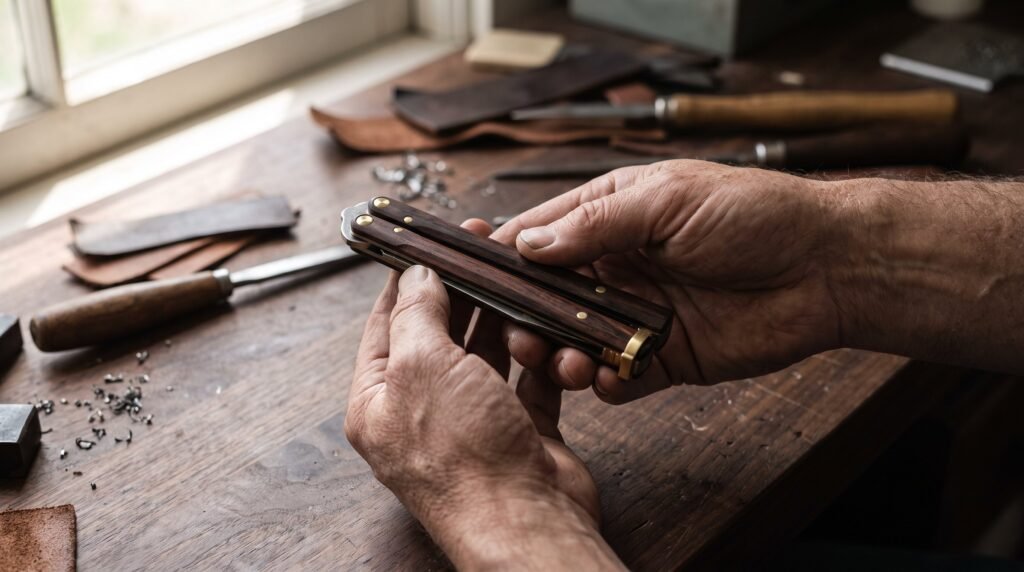
Quick answer: learn butterfly knife tricks in this order, grips and vocabulary, then the basic opening and closing, then rollovers, then aerials. Learn all of it on a trainer with an unsharpened blade. Roughly 80 percent of what looks impressive on video is built from four movements you can learn in a fortnight. The other 20 percent takes months and mostly exists to be filmed.
We make these knives, so we watch a lot of people flip them. The pattern is always the same. Someone learns a twirl in a weekend, films it, then stalls for six months because nobody told them the boring part comes first. This guide is the boring part, followed by the good part.
What are the parts of a balisong called?
You cannot follow a tutorial without this vocabulary, and half of them online use it wrongly anyway. Get it straight now and the rest becomes readable.
- Bite handle. The handle attached to the sharp edge. When the knife closes on your hand, this is the one that bites. Hence the name, which is not subtle.
- Safe handle. The handle attached to the spine. This is the one you hold while flipping.
- Latch. The little clasp holding it shut. On a Batangas-style knife the latch sits on the bite handle, on a Manila style it sits on the safe handle.
- Kicker or tang pin. The stop that keeps the edge off the inside of the handle. If your blade is chewing its own channel, this is what failed.
- Zen pin. A pin in the handle instead of a kicker, which changes how the knife sounds and how it stacks.
- Choil. The unsharpened notch just ahead of the pivot. Your finger finds it eventually, invited or not.
Two grips cover almost everything. Standard grip, blade tip pointing up out of the top of your fist. Ice pick grip, tip pointing down out of the bottom. A trick that looks brand new is often a familiar trick performed in the other grip, which is a useful thing to know before you pay for a tutorial series.
Do you really need a trainer first?
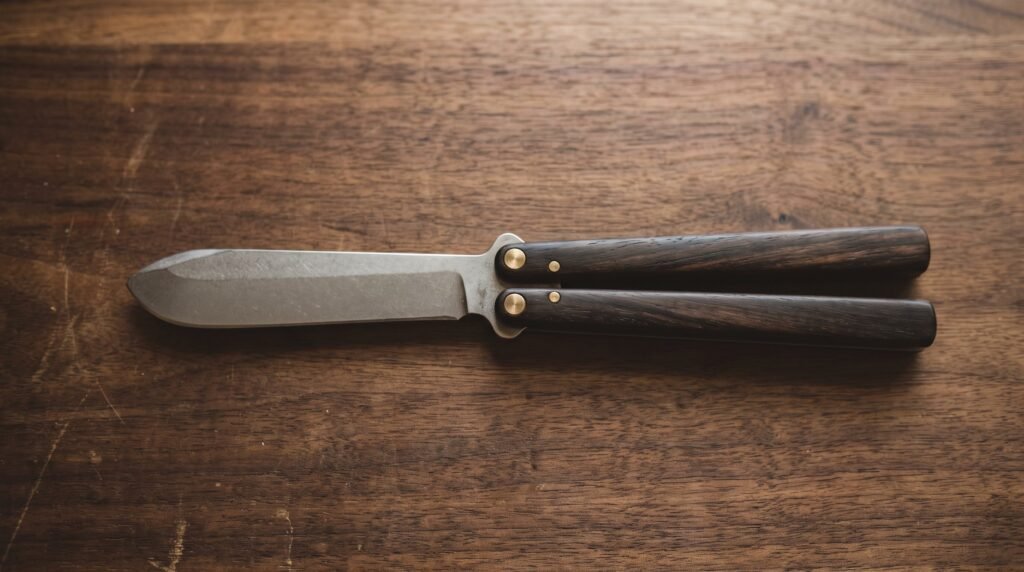
Yes. Learn on a trainer, with no exceptions for how careful you think you are.
The reason is mechanical, not moral. Every trick here rotates the knife through a position where the bite handle passes across the back of your fingers, and every beginner drops it dozens of times a session while the timing is still landing. On a trainer that is a bruise and a noise. On a live blade it is a cut across a knuckle or a fingertip, and fingertip wounds heal slowly.
Flippers who have been doing this for years still practise new tricks on a trainer before taking them to a sharp knife. That is the normal workflow, not a beginner concession. We offer a trainer version of every model at the same price as the live blade for exactly this reason, so the practice knife weighs and balances the same as the one you actually own.
Two practical points. Practise over a bed or a rug, since dropping a knife onto tile chips the handle tips. And check your local law before carrying anything, live or trainer, because some jurisdictions do not distinguish between the two. Our state by state legality guide covers that.
The four foundation movements
Everything else is a combination of these. Learn them in order and do not skip ahead, because each one teaches the wrist a specific thing the next one assumes you already have.
1. The basic opening
Hold the safe handle. Let the bite handle fall away, catch it against the back of your fingers, then rotate your wrist and bring the blade over the top into your palm. Slow is correct. Speed is a side effect of repetition, not something you add deliberately.
2. The basic closing
The same movement reversed, and the one people neglect. If your closings are ugly, every combo you ever build will end badly, because the close is the last thing the viewer sees.
3. The vertical or lazy opening
Same idea, no wrist rotation, the knife swings in a flat plane in front of you. This one teaches you to control the knife with your fingers rather than by throwing your whole arm at the problem.
4. The Zen rollover
The bite handle rolls over the top of your index finger and back. This is the first trick that feels like flipping rather than opening, and it is the entrance to most of the intermediate catalogue. Expect a week of it feeling completely wrong, then one session where it suddenly does not.
Butterfly knife tricks by difficulty
Times below assume 20 to 30 minutes of daily practice on a trainer. Some people are faster. Nobody is meaningfully faster at aerials.
| Trick | Level | Typical time to clean | What it actually teaches |
|---|---|---|---|
| Basic opening and closing | Beginner | 1 to 3 days | Grip pressure and the fall of the bite handle |
| Vertical (lazy) opening | Beginner | 2 to 4 days | Finger control without wrist help |
| Zen rollover | Beginner | 1 to 2 weeks | Rotation around a single finger |
| Twirl / fanning | Beginner | 1 to 2 weeks | Continuous rhythm, mostly visual |
| Y2K rollover | Intermediate | 2 to 4 weeks | Rollover with a handle change |
| Behind the 8 ball | Intermediate | 3 to 5 weeks | Working the knife behind the hand, blind timing |
| Chaplin | Intermediate | 3 to 6 weeks | Gripless rotation between fingers |
| Backhand and finger twirls | Intermediate | 4 to 8 weeks | Isolating individual fingers |
| Basic aerial | Advanced | 2 to 3 months | Release, spin and recatch on a known axis |
| Helix | Advanced | 3 months plus | Multi-plane rotation, the real test of control |
| Ricochet | Advanced | 3 months plus | Bouncing the knife off the hand mid-flight |
| Whip / Tsunami | Expert | 6 months plus | Chained aerials with no reset between them |
Which tricks build control and which are just showing off?
Both categories are fine. Pretending they are the same thing wastes people’s first year.
Control builders: basic openings and closings, vertical openings, Zen rollovers, Chaplins, and anything done slowly in the ice pick grip. These teach your hand where the knife is when you are not looking at it. They are also the tricks that transfer to a live blade first, because they never require you to let go.
Showing off: fast twirls, aerials, ricochets, anything with a spin count in the name. Nothing wrong with any of it. A twirl looks fantastic and takes a fortnight, which is a very good exchange rate. But it is one movement repeated, and it will not make your rollovers cleaner. Learn it because you want to, not because you think it is progress.
Here is the honest test. Turn away from the mirror and do the trick with your eyes shut. Control tricks survive that. Show tricks mostly do not, and the moment you notice that difference is the moment your flipping starts improving quickly.
How to practise so you actually improve
Short sessions beat long ones. Twenty minutes daily builds hands faster than three hours on a Sunday, because motor learning consolidates overnight.
Work one trick until it is boring. Boring means clean. People collect half-learned tricks the way some collect half-read books, and end up with thirty that all look slightly wrong.
Film yourself. Not vanity, diagnostics. You will see the small pause before the catch that you cannot feel while it is happening.
And keep the knife tuned. A pivot too tight fights you, a pivot too loose lets the knife wander mid-rotation and you will blame your hands for the knife’s fault. The screws want to be tight enough that the handles fall under their own weight without flopping.
When can you move to a live blade?
Move a trick to a sharp knife when you can do that specific trick fifty times in a row on a trainer with no drops. Not the trick before it, and not roughly fifty.
Move them over one at a time. Openings and closings first, rollovers next, aerials last or never. Plenty of long-term flippers keep aerial work on a trainer permanently and use the live blade for clean openings.
Blades on our knives run 58 to 60 HRC, which means the edge holds well and does not care in the slightest about your reaction time. Every knife ships in a fitted leather sheath, and that is where the live blade belongs while you are still learning something new on the trainer.
Which knife should you learn on?
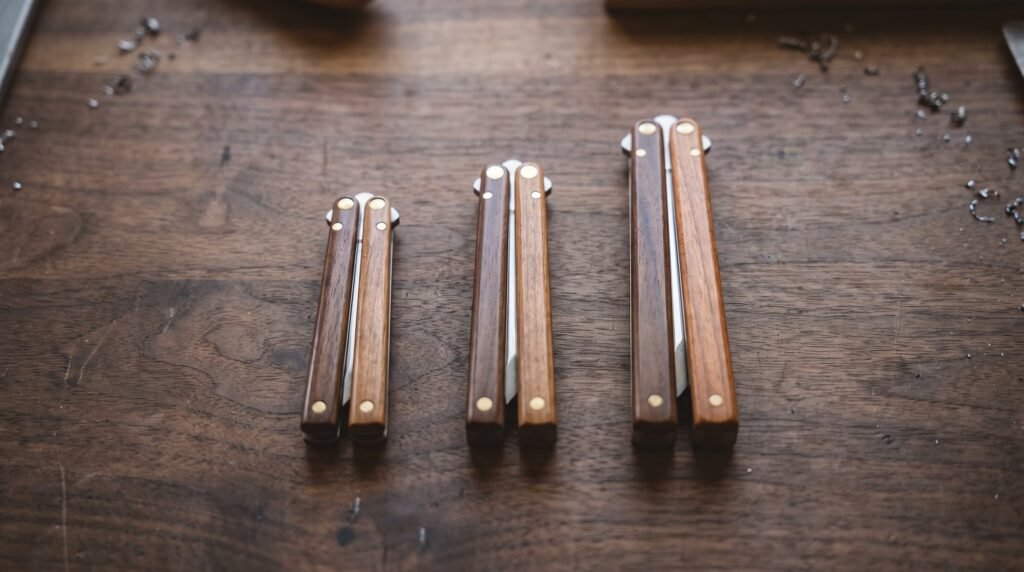
A knife in the 120 to 160 gram range with smooth pivots and channel or sandwich construction, and honestly the specific steel does not matter for learning because you will be flipping a trainer.
What matters is that your trainer matches your live knife. Same weight, same handle shape, same pivot feel. Learning on a light novelty trainer and then picking up a heavier knife means relearning the timing of every trick, which is why we build the trainer on the same model rather than as a cheap separate line. For a starting point, the 440C models are the easiest to live with day to day, and the authentic Filipino balisongs are where to look if you want the Taal, Batangas lineage in your hand rather than just in a description. If you are new to the whole category, start with what a balisong actually is before you buy anything.
Frequently asked questions
How long does it take to learn butterfly knife tricks?
Basic openings and closings, a few days. A clean twirl and Zen rollover, two to three weeks. Intermediate combos, two to three months. Aerials, six months and upwards. Daily short practice is what moves those numbers, not talent.
Can you learn balisong tricks without a trainer?
You can, and this is how people get cut. Beginners drop the knife constantly while the timing settles, and a live blade turns those drops into stitches. Use a trainer.
What is the easiest butterfly knife trick?
The basic opening. Then the vertical opening, which looks harder than it is and is a better use of your first week than anything with a name that sounds cool.
Why does my knife keep hitting my knuckles?
Usually you are gripping too tightly and stopping the handle rotating freely, or your wrist is doing the work your fingers should be doing. Slow the movement down by half and the knuckle contact tends to disappear on its own.
Do I need to loosen the pivots to flip well?
A little. The handles should swing under their own weight without side to side play. Too loose and the blade wanders off-plane, too tight and every trick feels like work.
Are butterfly knife tricks dangerous?
On a trainer, no more than any other hand skill. On a live blade before you are ready, yes. The risk is entirely about which tool you choose for the stage you are at.
Is a trainer legal where a live balisong is not?
Sometimes, and not reliably. Some jurisdictions define the knife by its mechanism rather than its edge, which catches trainers too. Check your own state or country rather than trusting a forum post from 2019.
Pick the model you actually want, order it with the trainer at the same price, and learn on the one that cannot hurt you. Start with the trainers here.
Where to start
Tricks are easier on a balisong with a solid frame and smooth pivots. Browse the authentic Filipino balisong collection, or see the full range on the Balisong Butterfly homepage.
Balisong knives to learn on
Tricks go smoother on a knife that was actually tuned before it shipped. Browse our balisong knives for sale or the Filipino balisong collection for the Batangas made ones.