
Blog
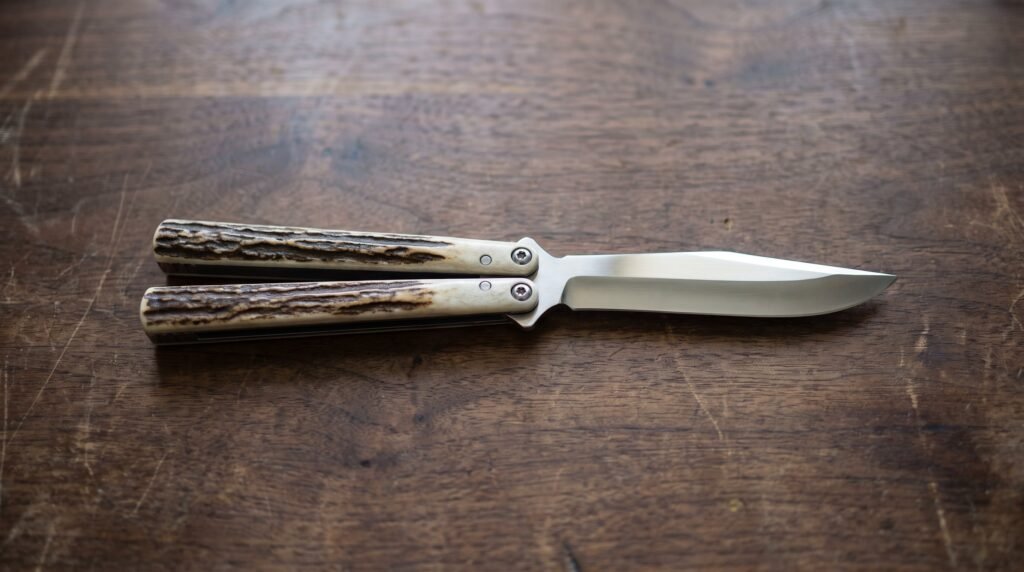
A balisong, also called a butterfly knife or fan knife, is a folding pocket knife from the Philippines with two handles that counter-rotate around the tang, so the blade is concealed inside the handles when closed. Opening it is a quick flick of the wrist, which is why the balisong became famous both as a practical everyday blade in Batangas province and as the centerpiece of the modern flipping community.
If you are working out which blade shape to buy, we have a separate guide to butterfly knife blade types covering all eight shapes we make.
That is the short answer to “what is a balisong.” The longer answer takes in more than a century of Filipino craftsmanship, a clever piece of engineering, and a knife culture that now spans collectors, flippers, and everyday-carry enthusiasts worldwide. This guide covers the definition, the history, every major part of the knife, the main types, and how balisongs are actually used today.
- The balisong (butterfly knife) is a Filipino folding knife with two handles that counter-rotate around the blade’s tang, born in Batangas province.
- It takes its name from Barangay Balisong in Taal, and the classic full-size “veinte y nueve” measures 29 cm when open.
- The bite handle closes over the sharp edge; the safe handle closes over the spine, flippers always hold the safe handle.
- Main types split by construction (channel vs. sandwich), latch (latched, latchless, spring latch), and live blade vs. trainer.
- Balisongs are used for everyday carry, flipping, collecting, and Filipino martial arts, but laws vary widely, so always check local regulations.
Balisong Knife: Quick Facts
| Attribute | Detail |
|---|---|
| Other names | Butterfly knife, fan knife, Batangas knife, “veinte y nueve” |
| Origin | Batangas province, Philippines (town of Taal) |
| Mechanism | Two handles rotating on separate pivot pins around the blade’s tang |
| Classic size | Around 29 cm (11.4 in) fully opened. Hence the nickname “veinte y nueve” |
| Main uses | Everyday carry, flipping (manipulation as a skill/sport), collecting |
| Traditional materials | Hand-forged steel blades; handles of carabao horn, bone, hardwood, or brass |
The Filipino History of the Balisong
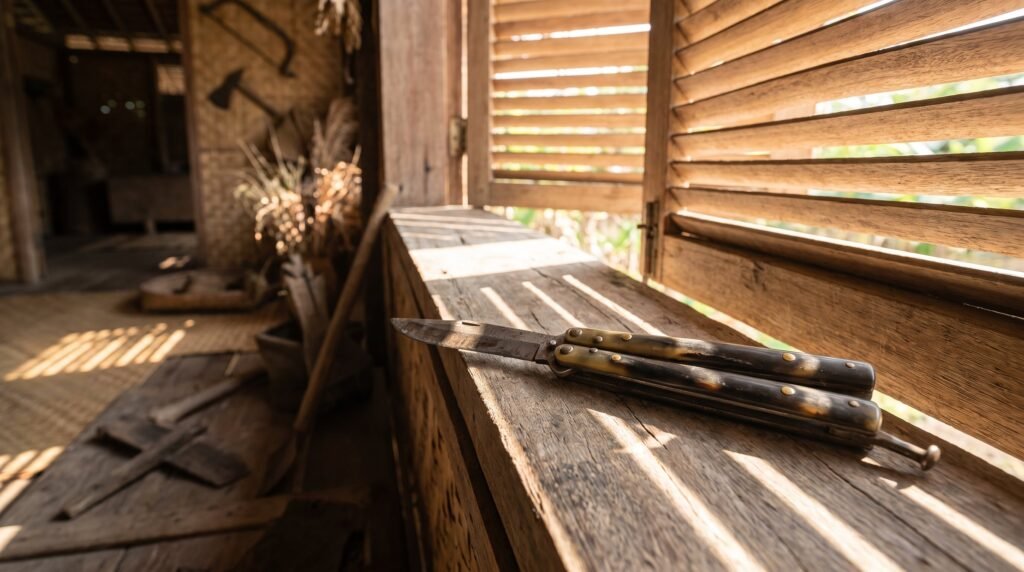
The balisong is inseparable from Batangas, a province south of Manila where knife-making has been a family trade for generations. While a popular legend dates the design to around 800 AD, historians have found little documentation for that claim; a competing theory points to a European folding measuring tool (the French “Pied du Roi”) as a possible ancestor. What is well documented is that Filipino smiths in Batangas turned the design into something entirely their own, and made it world-famous. For a deeper dive, see our full history of the balisong.
Taal, Batangas: The Balisong’s Hometown
The knife takes its name from Barangay Balisong, a district of the town of Taal in Batangas. In the local language, the name is often traced to “baling sungay,” roughly “broken (or folding) horn”: a nod to the carabao (water buffalo) horn traditionally used for the handles. Local accounts credit craftsman Perfecto de Leon with pioneering balisong production in Taal in the early 1900s, and the barangay grew into a street of family workshops where blades are still forged, ground, and fitted by hand.
The “Veinte y Nueve”
In the Philippines, the classic balisong is nicknamed “veinte y nueve”. Spanish for twenty-nine. Because the traditional full-size knife measures 29 centimeters from tip to handle when open. It was a working tool and a personal-defense blade for Batangueños long before it became a collector’s item abroad.
Going Global
American servicemen stationed in the Philippines around World War II encountered the balisong and brought examples home, seeding interest in the United States. From the 1980s onward, production knives, martial-arts exposure, and eventually online flipping videos turned the butterfly knife into a global phenomenon. Yet the heart of the tradition remains where it started: small Batangas workshops producing authentic Filipino balisong knives one at a time.
Parts of a Balisong Knife
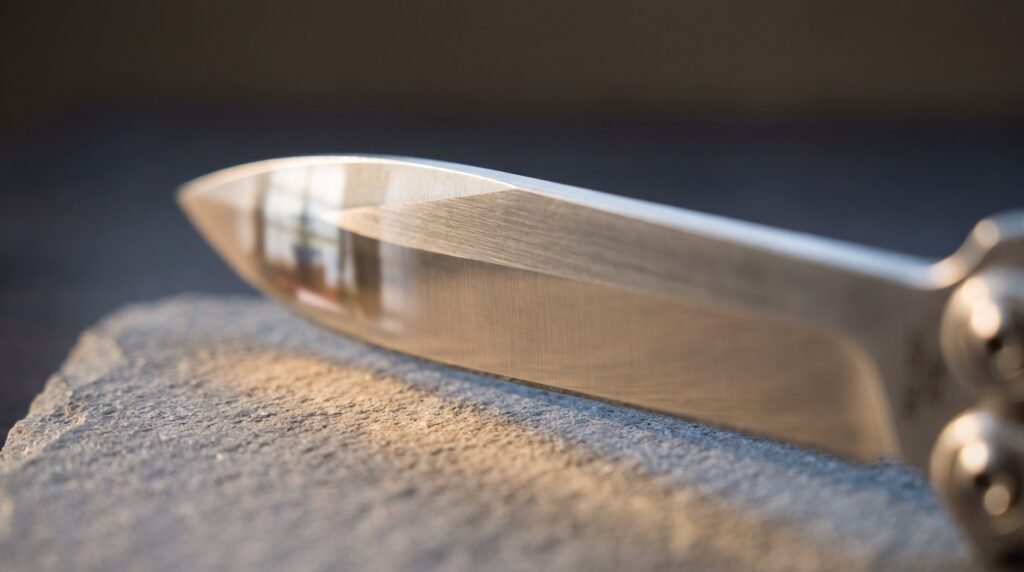
A balisong looks simple: a blade and two handles, but each component has a specific name and job. If you imagine a labeled diagram, these are the parts you would see, from the tip of the blade down to the latch:
- Blade: the cutting portion. Traditional Filipino balisongs are hand-forged; common profiles include clip point, drop point, tanto, and double-edge daggers.
- Tang: the base of the blade that extends between the handles and carries the two pivot holes. The whole knife rotates around this junction.
- Pivot pins: the two pins (or screws) that connect each handle to the tang. Smooth, even pivots are the difference between a knife that flips fluidly and one that fights you.
- Bite handle: the handle that closes over the sharp edge of the blade. If your fingers wrap this handle during a careless flip, the edge can “bite” you. Hence the name.
- Safe handle: the handle that closes over the spine (the unsharpened back) of the blade. Flippers hold the safe handle so the edge always swings away from their fingers.
- Latch: the small locking arm, usually mounted on the bite handle, that holds the knife closed (and on many designs, locked open). A latch on the bite handle is often called a Batangas latch; on the safe handle, a Manila latch.
- Kicker (or kick): a small projection on the blade near the tang that stops the sharp edge from touching the inside of the handle when closed, protecting the edge.
- Zen pins / tang pins. Small pins that set the blade’s alignment and stop-points as the handles rotate (used on many modern designs in place of a kicker).
- Spacers. Pieces between the handle liners that set handle thickness and often carry the latch hardware.
- Choil: a small unsharpened notch at the base of the edge, making sharpening cleaner.
Bite Handle vs. Safe Handle: The Detail That Matters Most
If you remember one thing about balisong anatomy, make it this: the bite handle closes over the edge, the safe handle closes over the spine. Every flipping tutorial begins with “hold the safe handle.” On latched knives, the latch is usually your landmark. On traditional Batangas-style knives it sits on the bite handle, telling you at a glance which handle to avoid gripping during manipulation.
Tang, Pivots, and Latch: The Engineering
The balisong’s genius is the double-pivot tang. Because each handle rotates on its own pin, the knife opens with one hand, has no spring to weaken over time, and. When latched shut. Encloses the blade completely in solid handle material. A well-made balisong locks up with no blade play, which in a handmade knife comes down to precise hand-fitting of the tang, pins, and handle channels.
Types of Balisong Knives
By Construction
- Channel construction. Each handle is machined or forged from a single piece of material with a groove for the blade. Traditional and typically very strong.
- Sandwich construction. Each handle is built from layered plates fastened around spacers. Easier to adjust and rebuild.
By Latch
- Latched: the classic arrangement; the latch secures the knife closed for carry.
- Latchless. Favored by some flippers because there is no latch to manage mid-manipulation.
- Spring latch: a latch under spring tension that pops clear when the handles are squeezed.
Live Blade vs. Trainer
A live blade is a sharpened, functional knife. A trainer (or “balitrainer”) has an unsharpened dummy blade, usually with cutouts or bright markings, and exists purely for learning flipping techniques safely. Serious flippers often own both: a trainer for new tricks, a live blade for the real thing.
By Blade Steel and Materials
Modern handmade balisongs span a wide range of materials. Hand-forged Damascus steel balisongs show the layered, watery pattern created by folding two steels together. Every blade’s pattern is unique. Tool steels like D2 offer excellent edge retention for working knives. Handles range from traditional carabao horn and stag to rosewood, Micarta, brass, and mother of pearl. As a real-world example from our own Batangas-tradition workshop, the Handmade Damascus Steel Balisong with Black Horn Handle (BF-162) pairs a forged Damascus blade with horn scales and a leather sheath ($275 at the time of writing), while the D2 Steel Balisong with Stag and Brass Bolsters (BF-159) is a classic working configuration ($181.50 at the time of writing).
Handmade Damascus Steel Balisong, Black Horn Handle (BF-162)
$275
Forged Damascus blade with horn scales and a leather sheath.
D2 Steel Balisong, Stag and Brass Bolsters (BF-159)
$181.50
A classic working configuration in D2 tool steel.
What Is a Balisong Used For?
Everyday Carry (EDC)
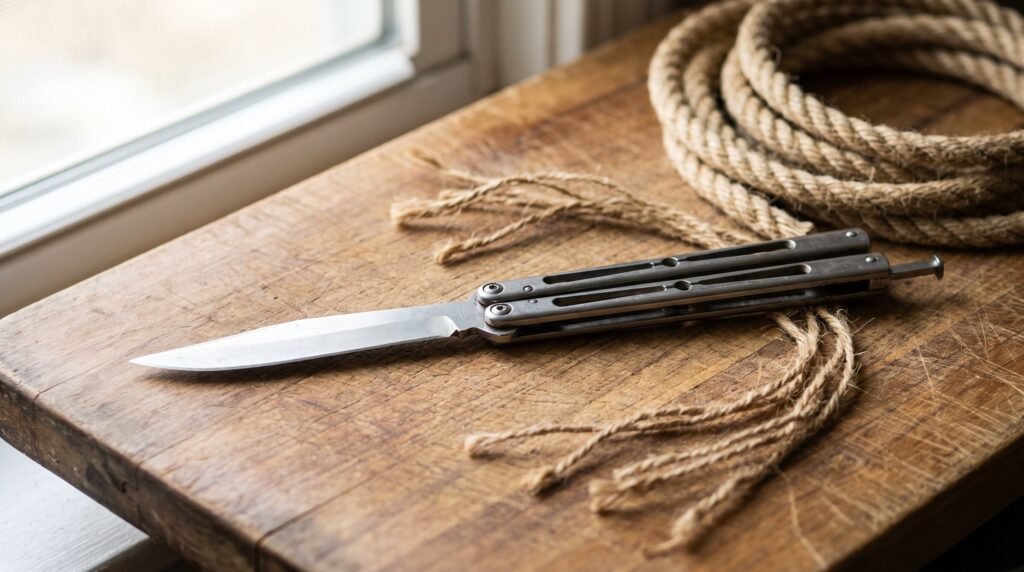
At its roots, the balisong is a utility knife. It opens with one hand, locks solidly, and when closed the edge is fully enclosed by the handles. Arguably safer in a pocket than many folders. Batangueños carried them for farm work, food prep, and general cutting tasks for over a century, and modern owners use them the same way where local law permits carry.
Flipping
Flipping. Manipulating the knife through aerials, twirls, and transfers. Is what most people picture today. It has grown into a genuine skill hobby with a worldwide community, competitions, and a deep trick vocabulary.
Beginners should start with a trainer, learn to grip the safe handle, and progress slowly.
Collecting
Handmade balisongs are functional art. Collectors prize forged Damascus patterns, horn and stag handles, engraved bolsters, and the knowledge that a particular knife was shaped by one craftsman’s hands rather than stamped out by the thousand. Many collectors also commission personalized butterfly knives with custom engraving to mark occasions or build a signature piece.
Martial Arts Heritage
The balisong appears in Filipino martial arts (FMA) traditions such as arnis/eskrima knife work, part of the same Batangas culture that produced the knife itself. We cover this heritage alongside other traditional Filipino weapons in our collection.
Handmade Filipino Balisongs vs. Mass-Produced Butterfly Knives
Most butterfly knives sold today are factory products. Consistent, but anonymous. A handmade balisong in the Batangas tradition is different in ways you can feel: the blade is individually forged and ground, the tang and pivots are hand-fitted for smooth, play-free action, and natural materials like horn, stag, and rosewood are shaped to the individual knife. No two are identical, and each carries a living Filipino craft tradition rather than a production run number. If you want to compare styles, steels, and price points side by side, browse the full balisong butterfly knife shop, and once you own one, a few minutes of simple knife care (cleaning, oiling the pivots, and dry storage) will keep a hand-forged blade in service for decades.
A Note on Legality and Safety
Balisong laws vary widely. In the United States, some states treat butterfly knives like any other folding knife, while others restrict ownership, carry, or blade length, and city ordinances can differ from state law. Always check your local laws before buying or carrying a balisong, and never flip a live blade until you are fully confident with a trainer.
Nothing in this article is legal advice.
If you want the provincial detail rather than the overview, we go deeper on where these knives actually come from in our guide to the Batangas balisong, the original Filipino butterfly knife.
Frequently Asked Questions
Why is it called a butterfly knife?
When the two handles are fanned open mid-flip, the knife’s silhouette resembles a butterfly’s wings. “Balisong” is the original Filipino name, taken from Barangay Balisong in Taal, Batangas, where the knives have been made by hand for over a century.
What is the difference between the bite handle and the safe handle?
The bite handle closes over the blade’s sharpened edge, so gripping it during a flip can cut (“bite”) you. The safe handle closes over the blade’s unsharpened spine, which is why flippers always manipulate the knife by the safe handle.
Are balisong knives legal in the US?
It depends on where you live. Some US states allow butterfly knives with few restrictions, others regulate carry or blade length, and a few restrict them heavily. Laws also change, so always verify your current state and local laws before purchasing or carrying one.
What is a balisong trainer?
A trainer is a balisong with a blunt, unsharpened dummy blade used to learn flipping tricks without risk of cuts. It handles and balances like a live blade, making it the recommended starting point for anyone new to flipping.
How much does a handmade balisong cost?
Handmade Filipino-tradition balisongs cost more than mass-produced knives because each blade is individually forged and fitted. In our shop, handmade 440C, D2, and Damascus steel balisongs currently range from about $109 to $549 depending on steel, handle materials, and detailing, with most pieces between roughly $120 and $250 at the time of writing.
How do I take care of a balisong?
Keep the blade clean and dry, add a drop of oil to the pivot pins periodically, avoid storing natural handle materials like horn or stag in extreme humidity, and store the knife in its sheath in a dry place. Our knife care guide walks through the full routine.
Hold a Piece of Batangas Tradition
Every balisong in our shop is hand-forged and hand-fitted by Filipino craftsmen in the Batangas tradition. No two are alike.
Related guides
If you are ready to pick one, every balisong knife we make is in one place, sorted by steel, series and handle.