Blog
Short version: the balisong as the world knows it comes from Taal, Batangas, in the Philippines, and the trail of evidence runs back to the early 1900s. Not 800 AD. The 800 AD story is everywhere online and there is nothing behind it. Everything else on this page is the part of the story that can actually be supported, told by people whose suppliers are the grandchildren of the men in it.
We forge balisongs for a living. That means we get asked about the history constantly, usually by someone who has just read a blog post claiming the knife is twelve hundred years old and was used to fight off twenty-nine bandits. We would love both of those to be true. One of them is a nice story told in Batangas kitchens. The other is an internet invention that got copied so many times it started to sound like a fact.
So here is the honest version, including the parts where the answer is “nobody knows.”
What is a balisong, in one line
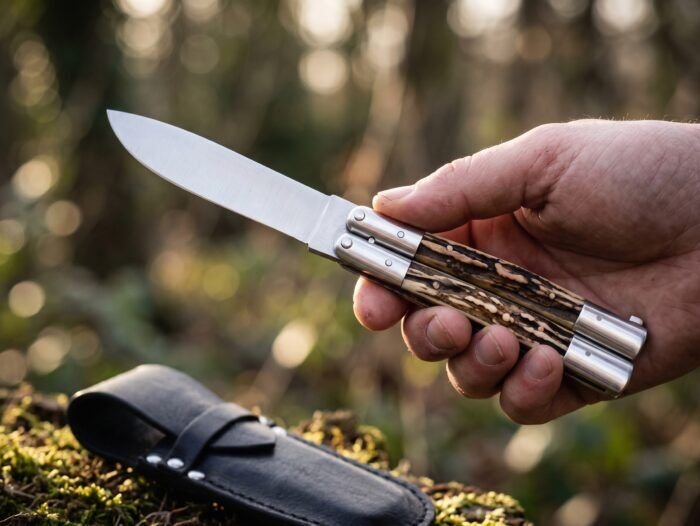
A balisong is a folding knife with two handles that counter-rotate around the blade’s tang, so the blade hides inside the handles when closed. No lock, no spring, no button. Gravity and geometry do the work, and your wrist does the rest.
That is the balisong definition in its shortest useful form. If you want the full anatomy, the bite handle versus safe handle business, and the different types, we wrote that separately in what is a balisong knife. This page is about where the thing came from.
The 800 AD story, and why we will not repeat it
Somewhere around the mid 2000s, a claim appeared online that the balisong was invented in the Philippines in 800 AD. It usually arrives with a suspiciously precise detail attached, something about a Batangas craftsman or an early Filipino weapon, and it gets repeated on knife forums, product pages, and roughly half the “history of the balisong” articles currently ranking.
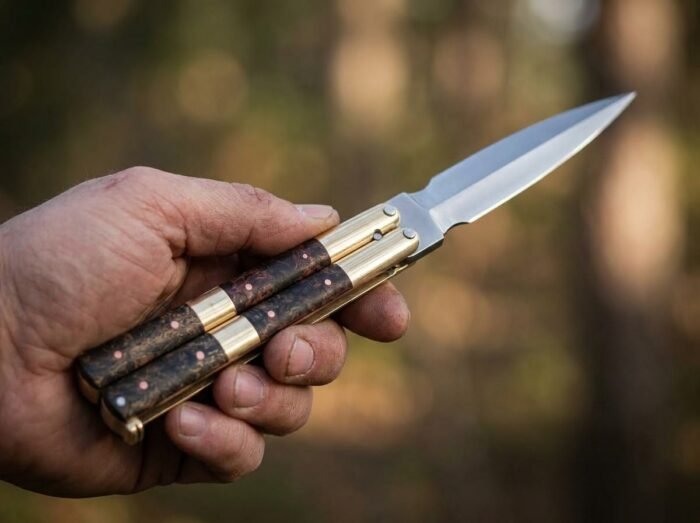
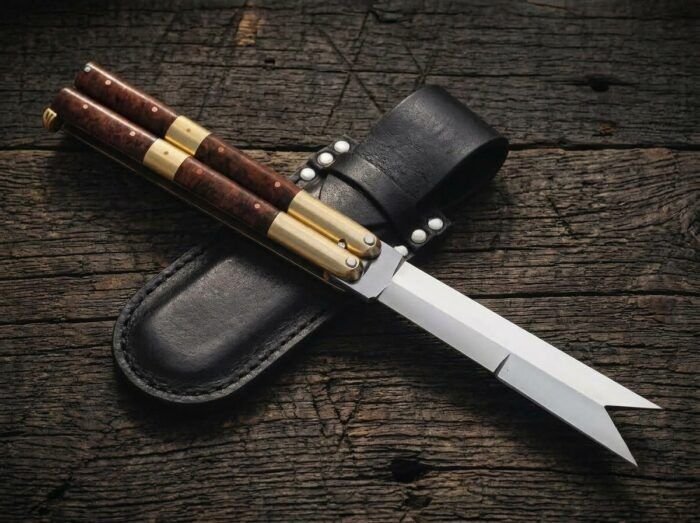
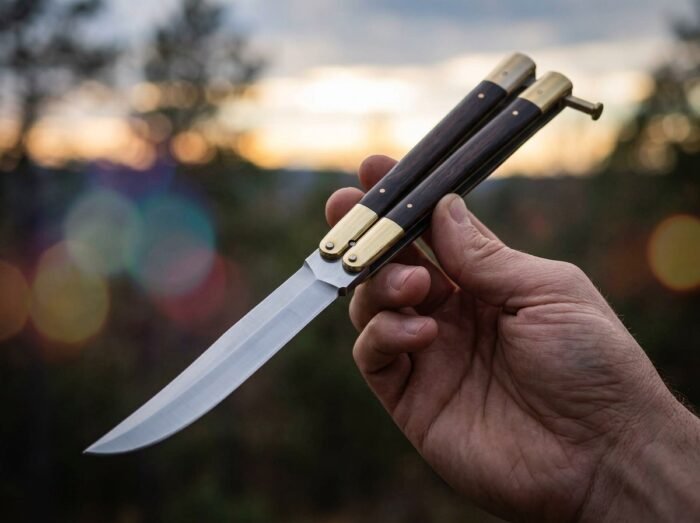
There is no primary source for it. No archaeological find, no colonial-era inventory, no Spanish record, no surviving 9th century example in any museum. The Philippines in 800 AD had genuinely sophisticated metalwork, that part is not in question. What is missing is any evidence connecting it to a two-handle counter-rotating folding knife.
Here is the practical objection, and it is the one that matters to us: a balisong needs two pivot pins holding tight tolerances, a tang shaped to seat in both handles, and handle channels that stay parallel under load. We make these. It is fiddly work with modern tooling. It is not the kind of thing that gets built once in the 9th century, then leaves no trace for a thousand years, then reappears fully formed in a village in Batangas.
Every site that repeats the 800 AD date is copying another site that repeated it. We know because we followed the chain once, out of irritation, and it dead-ends in a forum post with no citation. If a page tells you the balisong is 1,200 years old and does not tell you where that came from, you have learned something about the page and nothing about the knife.

What the record does support: Taal, Batangas, early 1900s
Drive south out of Manila and you eventually hit Taal, Batangas. In Taal there is a barangay called Balisong. The village and the knife share a name, which is either the most convenient coincidence in blade history or, more likely, exactly what it looks like.
Next door is Barangay Pandayan, from panday, the Tagalog word for blacksmith. Two neighbouring villages, one named after the knife and one named after the trade. That is the geographic centre of the whole story, and it is a stretch of road you can still walk down today with blades in glass cases on both sides.
Local tradition credits a craftsman named Perfecto de Leon with establishing balisong production in Taal in the early 1900s. That is the earliest point where the account gets specific enough to be useful. It is oral history rather than a filed patent, so treat it as the community’s own record of itself, which is a reasonable thing to trust and a different thing from a document.
What happened after that is not in dispute at all. The craft spread through Taal household by household. Families took it up, split the work between forging, grinding, and fitting, and passed it down. By the middle of the century, balisong making was a livelihood for a large part of the town, and the knife had a regional identity strong enough that Filipinos still call it a Batangas knife.
We buy from that lineage. Our makers learned the trade the way it has always been taught in Batangas, which is standing next to someone older who is not going to explain anything twice. Their work is in our authentic Filipino balisong collection, and the older-pattern pieces sit in traditional balisong knives.
Where the name comes from
Two explanations, and they do not cancel each other out.
The geographic one is simple: the knife is named after Barangay Balisong, the village that made it famous. Knives get named after places all the time. Nobody argues that Sheffield steel was named after a poem.
The linguistic one is baling sungay, usually translated “folding horn,” sometimes rendered “broken horn,” and it points at the carabao horn that traditional handles were built from. Ask a Batangueño and this is often the first answer you get. Ask a linguist and you get a longer pause. It is plausible, it is old, and it has never been properly documented.
We use the folding horn reading because it matches the object. A balisong folds and the handle scales were horn. But we are not going to pretend the etymology is settled, because it is not, and there are two versions in circulation that a careful reader will run into eventually.
The veinte y nueve
In Batangas the classic full-size balisong is the veinte y nueve. Spanish for twenty-nine. The practical explanation is the one we believe: the traditional knife measures about 29 centimetres, roughly 11.4 inches, fully open. That measurement became the benchmark pattern and stuck so hard that the nickname now gets used for balisongs generally.
The other explanation is the good one at parties. A Batangueño, cornered by a crowd, is said to have fought off twenty-nine attackers with a single balisong. We have never found a name, a date, a place, or a newspaper. It is folklore, and folklore is allowed to exist without paperwork, but we are not going to file it under history.
The 29 cm figure is real and you can measure it. We still build to it. A full-size traditional pattern opens to that length because that is what the proportion has always been, and shortening it changes how the knife rolls in the hand more than people expect.
The European cousin: the pied du roi question
Here is the argument that actually deserves a hearing. A French folding measuring tool called the pied du roi, meaning “foot of the king,” used a two-handle rotating design and existed in Europe somewhere between the 1500s and the late 1700s. Some researchers argue the concept travelled to the Philippines through Spanish colonial contact and was then rebuilt as a working blade.
It is not a crazy idea. Spain was in the Philippines for over three centuries and plenty of things moved in both directions. What is missing is the middle of the chain. There is no evidence of a pied du roi arriving in Batangas, no transitional object, nothing between a French ruler and a Filipino knife.
So the honest position is: possible, unproven, and less important than people make it. A measuring tool that folds and a fighting-and-working blade that folds are not the same invention just because they share a hinge count. Whatever the oldest ancestor was, Batangas is where this became a knife, a trade, and a tradition with its own vocabulary. The rest is a hinge.
Our neighbouring guide, Batangas balisong: the original Filipino butterfly knife, goes further into the town itself and how to tell a genuine Batangas piece from something that only looks like one.
What the early knives were actually made of
This is the part of the history we can speak to directly, because the materials logic has not changed as much as you would think.
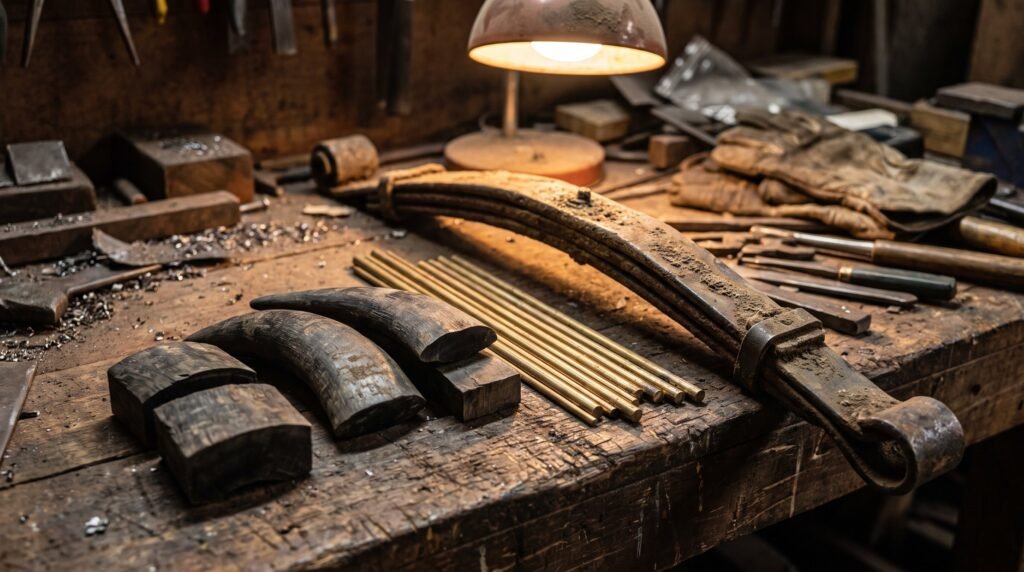
Early Batangas makers used whatever good steel they could get, and the Philippines was not exactly swimming in bar stock. Worn vehicle leaf springs were the classic source. So were old files, bearing races, and salvaged railroad steel. This was not romantic. It was a high-carbon steel supply chain assembled out of things other people had thrown away, and it worked because leaf spring is genuinely decent knife steel if you know what to do with it.
Handles were brass channels with inserts of carabao horn, horse bone, deer horn, or native hardwood, kamagong most often. Brass because it was workable and did not rust in a climate that rusts everything. Horn because there were carabao.
| Era | Blade steel | Handle | Who it was for |
|---|---|---|---|
| Early 1900s Taal | Salvaged high carbon: leaf spring, files, bearing steel | Brass channel, carabao horn, bone, kamagong | Farmers, fishermen, tradesmen |
| Mid century | Same, more consistent supply | Same, with regional decorative styles | Everyday carry across Batangas |
| 1980s onward, USA | Stainless bar stock, machined | Aluminium, G10, titanium | Flippers and collectors |
| Handmade today | 440C, D2, VG10, high carbon, Damascus | Horn, stag, bone, kamagong, brass | Collectors and traditionalists |
The through-line is that a traditional balisong was a working object made from available material by someone who was not being paid much. Every design decision in the old knives has a reason and most of the reasons are economic. That is worth remembering the next time somebody sells you a “ceremonial ancestral” balisong for $400. If you want to go deeper on the modern options, we compared them in 440C vs D2 vs Damascus.
How the balisong left the Philippines
The standard account is that American servicemen stationed in the Philippines around the Second World War encountered balisongs, bought them, and brought them home. It is repeated everywhere including by us, and it is almost certainly broadly true, because the timing of American interest lines up and Batangas workshops were producing at volume.
We will flag that it is anecdotal. There is no shipping manifest of butterfly knives. What exists is a lot of veterans’ accounts and a lot of old balisongs in American collections with no paperwork, which is suggestive rather than conclusive.
What happened next is much better documented:
- 1970s and 1980s: American manufacturers started producing machined balisongs to tight tolerances. One of them trademarked the hyphenated spelling “Bali-Song,” which is why some brands write it that way and most do not.
- 1980s and 1990s: action films put the flipping motion on screen, the knife acquired a reputation it mostly did not earn, and a wave of US state-level restrictions followed. Those laws are still a mess and we cover them in butterfly knife laws by state.
- 2000s onward: video sharing turned flipping into a global skill hobby. Named tricks, competitions, trainers, the whole scene. The balisong stopped being primarily a tool and became primarily a thing you do with your hands.
That last shift is the biggest one in the knife’s history and almost nobody frames it as history, because it happened recently. A knife that spent a century as farm equipment in Batangas is now mostly bought by people who will never cut anything with it. We are fine with that. It is still the same geometry, and it still rewards the same skill, and if you are learning we would rather you did it on a blunt one first: how to flip a balisong.
A timeline you can actually defend
| When | What | How solid is it |
|---|---|---|
| 800 AD | Claimed Filipino invention of the balisong | Unsupported. No source, no artefact. Do not repeat it. |
| 1500s to 1700s | Pied du roi folding measuring tool exists in Europe | The tool is real. The link to the Philippines is not evidenced. |
| Early 1900s | Perfecto de Leon establishes balisong production in Taal | Local tradition, consistently told, no filed document. |
| Early to mid 1900s | Craft spreads through Taal and Barangay Balisong | Well attested. Living trade with living families. |
| 1940s | American servicemen carry balisongs home | Widely reported, anecdotal rather than documented. |
| 1970s to 1980s | US machined production, “Bali-Song” trademark | Documented commercial history. |
| 1980s to 1990s | Film exposure, then US legal restrictions | Documented. |
| 2000s onward | Global flipping community | Documented, ongoing, and noisy. |
What the history looks like from inside a workshop
Historians work from documents. Makers work from objects, and objects carry their own record.
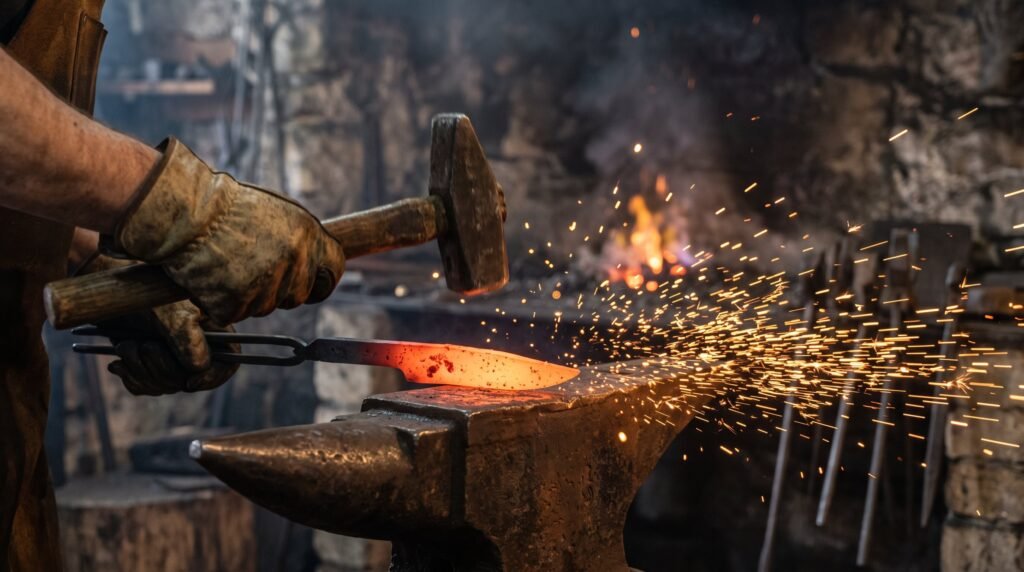
Pick up an old Batangas balisong and you can read a fair amount off it. The grind lines tell you it was done on a wheel by hand. The pin peening tells you whether the maker was in a hurry. Horn scales that have shrunk slightly away from the brass tell you the knife has lived somewhere with seasons. Two handles that do not weigh exactly the same tell you the maker was working to a feel rather than a caliper, which is how the old knives were made and part of why they roll the way they do.
We see the same fingerprints in current work, because the method did not change much. No two horn scales match. Stag is worse, or better, depending on your temperament: every piece of stag is a different shape and a different density, and a maker fitting stag is negotiating with an antler rather than machining a part. That is the actual continuity with 1910. Not a legend about the 9th century. A person, a wheel, and a piece of horn that does not want to be symmetrical.
What we could not verify, and therefore did not claim
We would rather lose the ranking than pad this page with things we cannot stand behind. So, plainly:
- Any pre-1900 date. We found nothing usable. If a firm earlier date exists in a Philippine archive, we have not seen it and neither has anyone quoting 800 AD.
- The exact Perfecto de Leon dates. “Early 1900s” is as precise as the tradition gets. We are not inventing a year.
- The twenty-nine attackers. Great story. No name, no date, no record.
- The baling sungay etymology. Widely believed, never documented, and translated two different ways.
- Whether the pied du roi ever reached the Philippines. Nobody has shown the chain.
- Whether Taal’s volcanic history shaped the trade. The town’s relocation after the 1754 eruption is documented, but we found nothing tying it to knifemaking, so we left it alone rather than build an atmospheric paragraph on it.
That is a shorter page than we could have written. It is also one we can defend line by line, which is the trade we chose.
Frequently asked questions
When were butterfly knives invented?
The balisong as a distinct Filipino knife dates to the early 1900s in Taal, Batangas, where local tradition credits craftsman Perfecto de Leon with establishing production. Claims that butterfly knives were invented in 800 AD circulate widely online and have no primary source behind them. A related two-handle folding design, the French pied du roi measuring tool, existed in Europe earlier, but no evidence links it to the Philippines.
When was the butterfly knife invented, exactly?
There is no exact date, and anyone giving you one is guessing. The defensible answer is the early 1900s in Taal, Batangas. That is when balisong production is first consistently recorded in the community that has made them ever since. Everything earlier is either folklore or a European tool with no traceable connection.
What is a balisong?
A balisong is a Filipino folding knife with two handles that counter-rotate around the blade’s tang, concealing the blade inside the handles when closed. It uses no lock, spring, or button. It is called a butterfly knife in the West because the handles fan open like wings.
What is the balisong definition in one sentence?
The balisong definition: a two-handled folding knife of Filipino origin whose handles rotate on separate pivot pins around the tang, so that opening and closing is a wrist motion rather than a mechanism.
Where does the butterfly knife name come from?
The butterfly knife name comes from the shape the two handles make when they fan open mid-flip, which looks like a pair of wings. The original Filipino name, balisong, comes either from Barangay Balisong in Taal where the knives were made, or from baling sungay, usually translated “folding horn,” referring to the carabao horn handles. Both explanations are old and the second one has never been formally documented.
Who invented the balisong?
No single inventor can be documented. Local tradition in Taal credits Perfecto de Leon with establishing balisong production there in the early 1900s, which is the earliest specific attribution that survives. The design as we know it was developed by a community of Batangas smiths rather than by one person filing a patent.
Is the history of the balisong Filipino or European?
The history of the balisong is Filipino. A European folding measuring tool with a similar two-handle layout existed earlier, and some researchers suggest a colonial-era transfer, but the chain of evidence is missing. What is not in question is that Batangas turned the concept into a knife, a trade, a name, and a living craft tradition.
Was the balisong really invented in 800 AD?
No. The 800 AD claim appears on many websites and traces back to uncited forum posts rather than to any archaeological find, museum piece, or historical record. Pre-colonial Filipino metalworking was genuinely advanced, but nothing connects it to a counter-rotating two-handle folding knife.
Buy one from the tradition, not from a story
Every balisong we sell is forged and fitted by hand by Filipino makers working in the Batangas method: real named steel, natural handle materials, and the classic 24 cm and 29 cm patterns. Each one can be ordered as an unsharpened trainer built to the same steel, handle and balance for the same price as the live blade, ships with a fitted leather sheath, and can be personalised with custom engraving.
Start with the authentic Filipino balisong collection, or go straight to the older patterns in traditional balisong knives. Questions about shipping, laws, or which pattern suits your hand are answered in our shop FAQ, or you can just ask us.