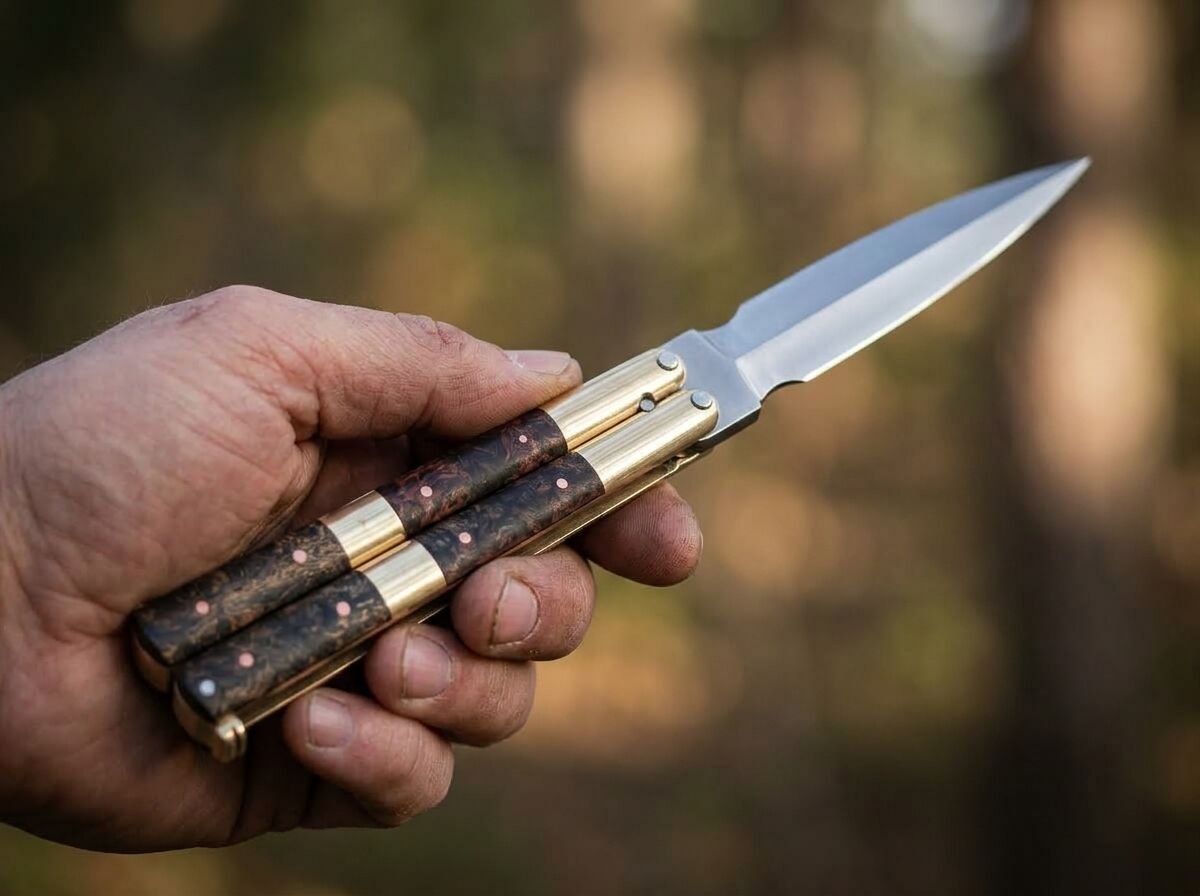
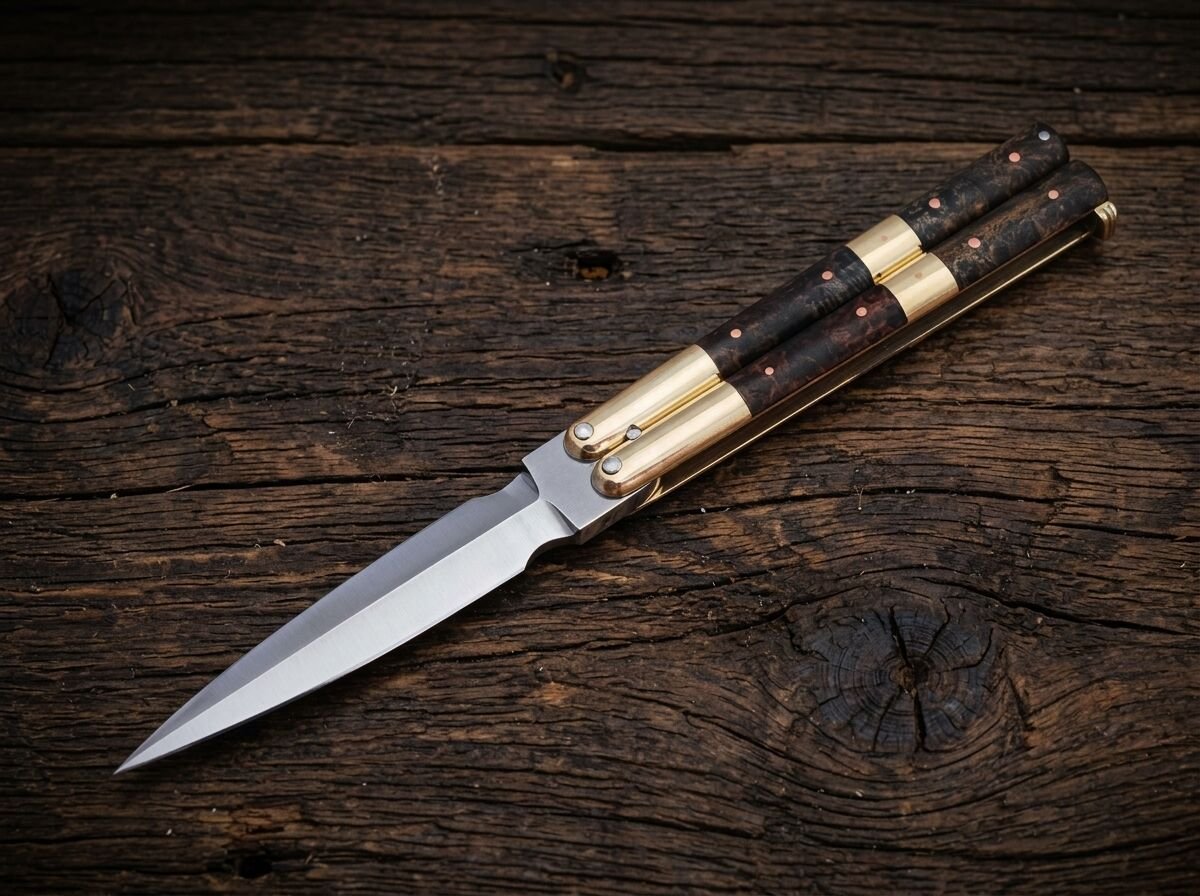
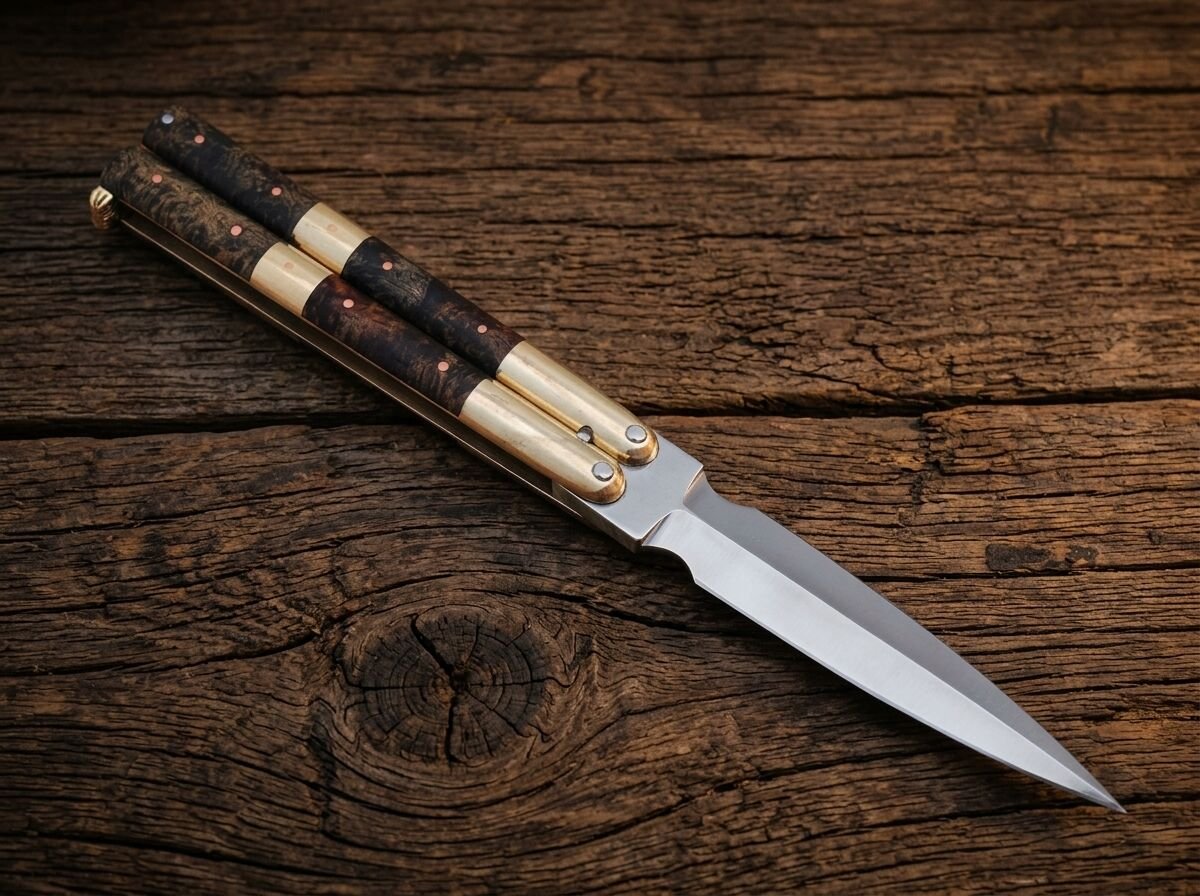
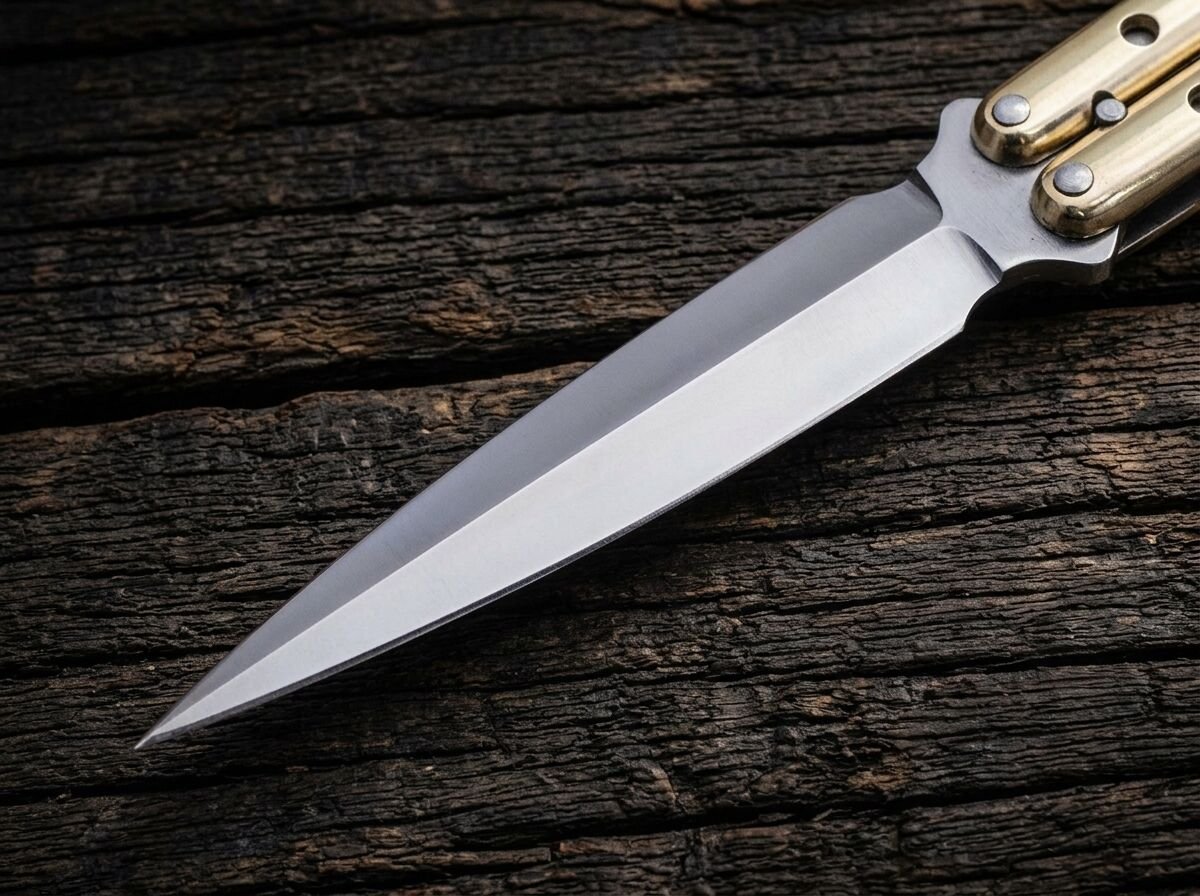
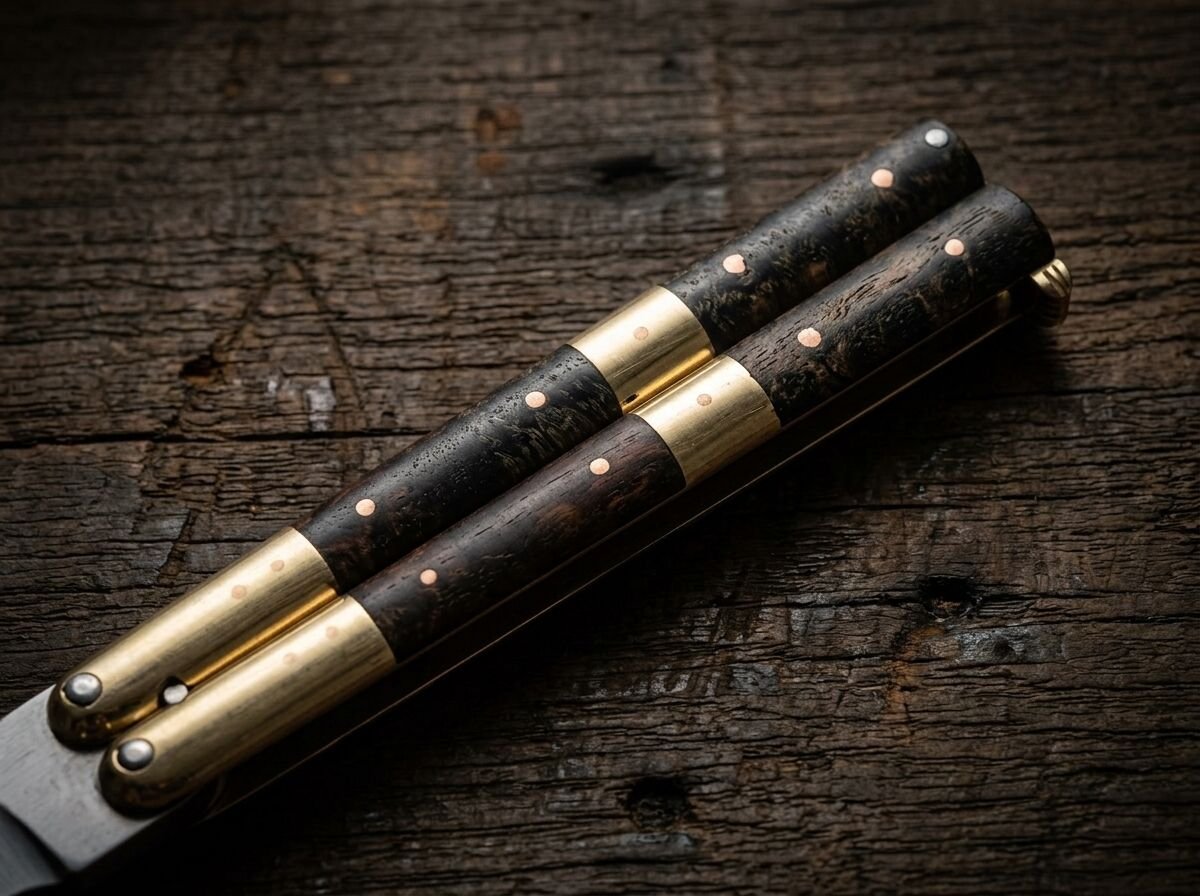
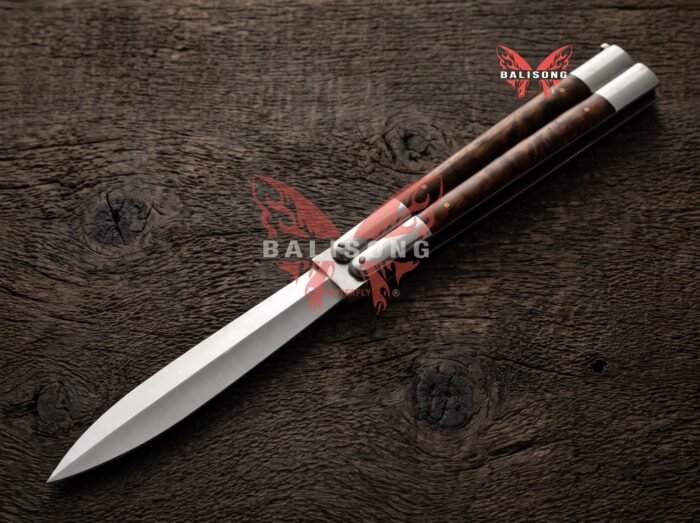
The BF-111 is a dagger-bladed Filipino Traditional balisong: 24cm open, a 12cm D2 blade, 220g, brass with rose wood. When it arrives there are a handful of things worth checking in the first five minutes, and nobody ever tells you what they are.
The five minute check on a new butterfly knife
Do this over a table, with the knife closed, before you start flipping.
- Open it slowly by hand. Not a flip. Watch the blade come out of the channel and note whether it swings cleanly without catching on either handle.
- Close it slowly. The blade should sit centred in the channel, not touching either side. A hair of offset is normal on a handmade knife. Rubbing is not.
- Check the tang pin stop. Open it fully. It should arrive with a definite stop rather than a soft one, and the blade should not be able to rotate past it.
- Drop test each handle. Hold one handle horizontal and let the other fall. It should drop freely under its own weight and stop within its arc.
- Wobble check. Hold the closed knife and try to move the handles sideways against each other. A very small amount of play is normal. Enough to see across a room is not.
- Look at the insert seams. Run a fingernail along where the wood meets the brass. It should catch on nothing.
What is normal and what is ours to fix
| Normal on a handmade knife |
Tell us |
| Wood colour different from the photograph |
A crack in an insert |
| The two handles not perfectly matched in grain |
An insert you can move with a thumbnail |
| Stiff action for the first hundred rotations |
Gritty or grinding action from new |
| A faint witness line where brass was worked |
Blade rubbing the channel when closed |
| A hair of side to side play |
Play you can see from across the room |
| Tiny variation between the two bevels |
A blade that does not stop at the tang pin |
The left column is what a knife made by a person looks like. The right column is a fault and we will sort it out. Email us with a photograph before you try to fix anything yourself, because most attempted fixes make a small problem into a larger one.
The first thing not to do
Do not adjust the pivots. Almost every knife that feels tight from new is simply not broken in, and a hundred slow rotations will free it up further than a spanner will. If you still want to adjust after that, go an eighth of a turn at a time and flip between each one. People overshoot this constantly and then conclude the knife is faulty.
The dagger, honestly
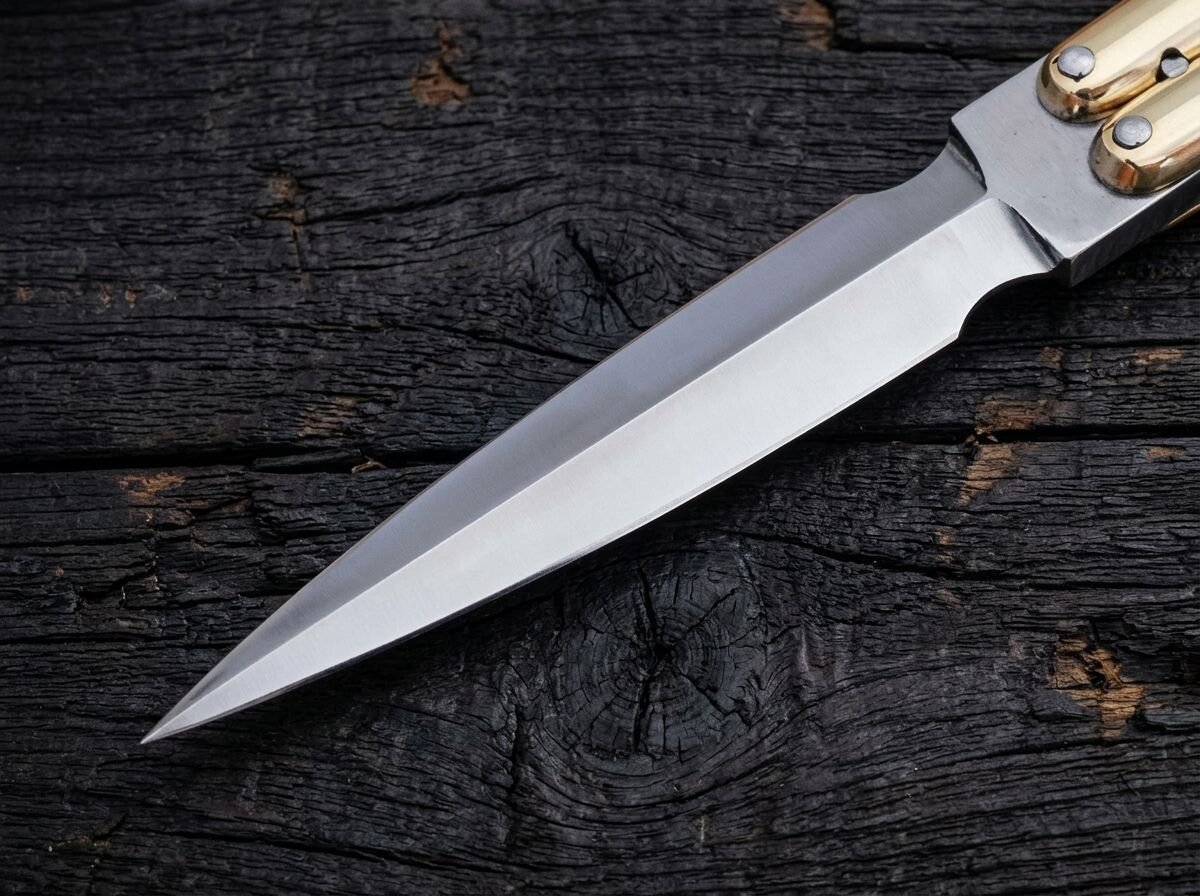
Symmetrical, point on the centreline, so the knife handles identically whichever way it opens. On a balisong that is genuinely useful because the blade arrives in an orientation you did not fully choose.
What it costs you: no spine to rest a thumb on, poor drawing cuts, and twice the sharpening because there are two bevels meeting on a centreline with no reference to work from. And double-edged blades are treated differently from single-edged ones under the law in a number of places, sometimes regardless of length. Read the rule at your own address before ordering.
D2 steel, rose wood handle, 220 grams
D2 is an air-hardening tool steel: about one and a half percent carbon and eleven to twelve percent chromium, which is just under the threshold for stainless. Best edge retention we sell, stubborn to sharpen, wants a diamond plate roughly twice a year. Heat treated to 58-60 HRC so it rolls rather than chips when the knife meets a floor.
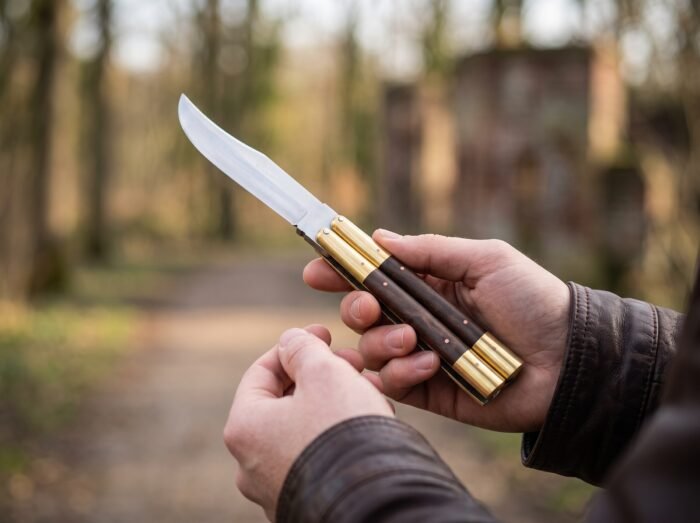
Rose wood is dense, warm brown, regular in the grain, and it darkens quietly over the years. The brass goes brown alongside it and that is not damage.
Two hundred and twenty grams is the heavier of the two weights in this series. The rotation carries itself and gives you time to correct, at the cost of changing direction more slowly.
Ordering this D2 dagger balisong
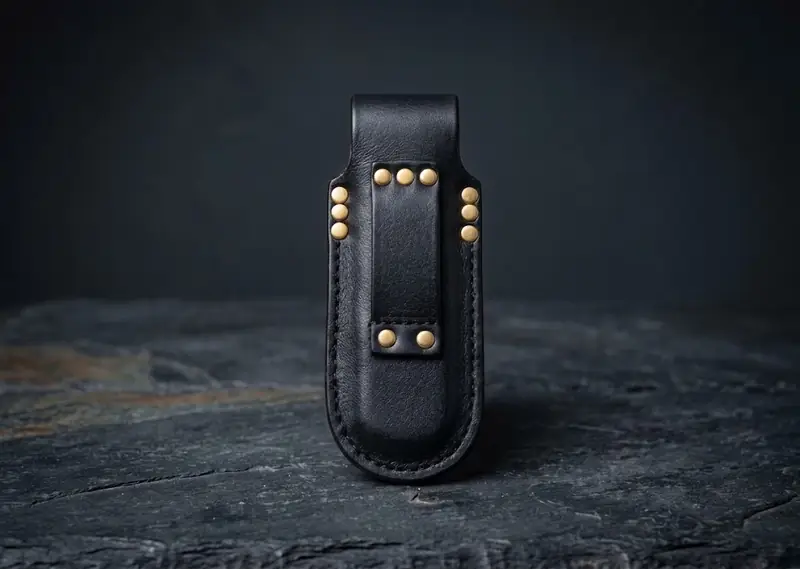
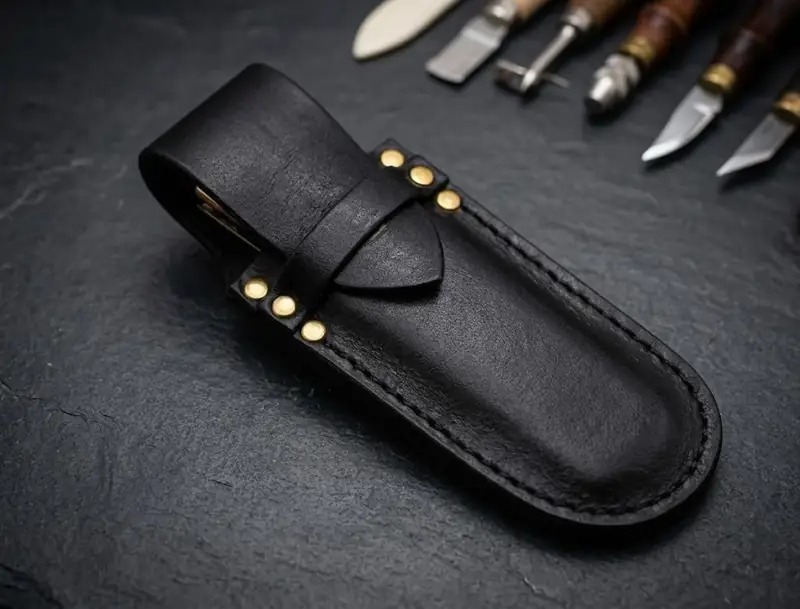
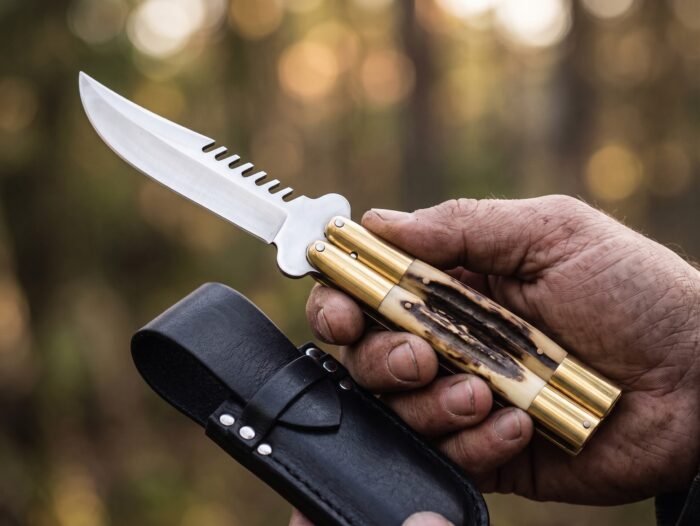
Unsharpened trainer, chosen above Add to Cart, and everything on this page applies to it identically. The leather sheath is cut to this frame and travels with the knife. We do not charge for US delivery and everywhere else is $49 for the order.
New owners are usually better off leaving a stiff pivot to break in rather than reaching for a tool, and the checks worth running on any new balisong are laid out in our how to tune a balisong guide. The Bagani sits in the D2 Tool Steel Butterfly range alongside the rest of the Traditional line. Its dagger profile and stag horn cousin, the Lingkis, is worth a look if you want the same symmetrical blade with a different handle.





Reviews
There are no reviews yet.