
Blog
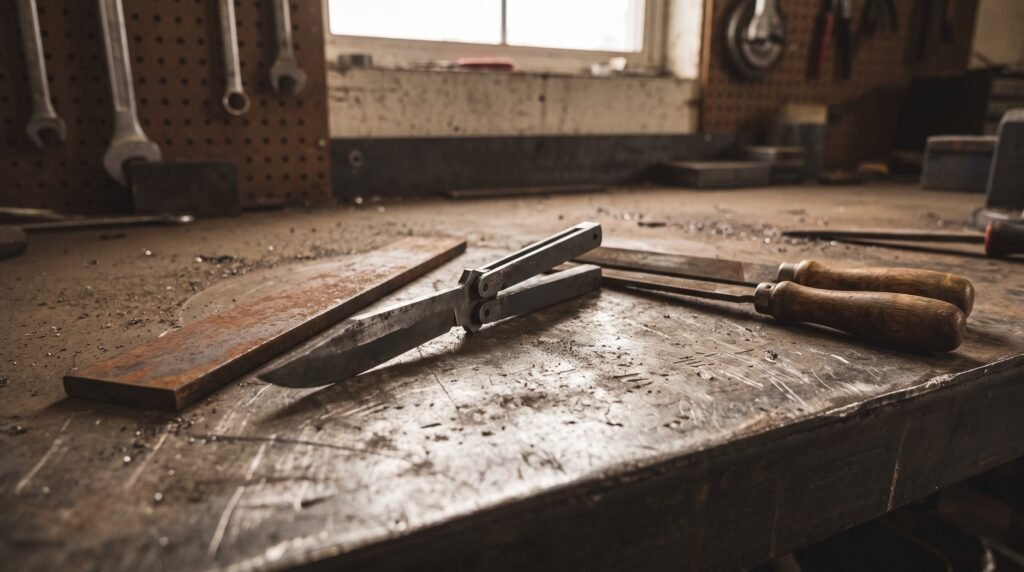
A balisong is made by cutting or forging a blade blank from steel, profiling it, hardening and tempering it, grinding the bevel, then building two handles with a channel that the blade folds into. The handles are fitted with scales, the pivots are pinned or screwed and peened, a tang pin and latch are fitted, and the whole knife is tuned by hand until it swings true. In a Batangas workshop that is roughly forty separate operations.
That is the short version. The long version is more interesting, because almost every stage involves a decision that a machine would make identically a thousand times and a maker makes slightly differently each time. Below is the real sequence, in order, as it happens on a bench rather than as a marketing page imagines it.
Where the steel comes from
The romantic version is true and mostly historical. Traditional Batangas blades were made from whatever good steel the province could recycle. Published accounts of the Taal knife trade consistently describe blades cut from vehicle leaf springs and automotive bearing steel, and some add railway track steel. Leaf spring is the one that stuck, because it is genuinely good material: a medium-to-high carbon steel already chosen by an engineer to flex, take shock and return to shape.
The catch is that recycled leaf spring is unknown steel. You do not get a certificate with a scrapyard. A maker working from a spring learns the material by feel and by test pieces, and two springs from two vehicles can behave differently in the quench. That is why modern workshops, including ours, mostly buy known bar stock now: high carbon steel, 440C, D2, VG10, or laminated billets for Damascus. Known steel means a repeatable heat treat, and a repeatable heat treat is the difference between a knife that holds an edge and a knife that is a nice-looking souvenir. If you want the trade-offs between those steels in detail, the steel guide and the D2 vs Damascus vs 440C comparison cover it properly.
Forging or stock removal
There are two honest ways to get from a bar of steel to a blade shape, and both are used in Batangas.
Forging means heating the steel above its recrystallisation point and moving it with a hammer. The maker draws out the tang, spreads the blade, and sets the rough distal taper while the steel is orange. Forging is how the old shops worked because it turns a small amount of expensive steel into a larger blade, and because when your stock is a curved leaf spring you have to straighten it anyway.
Stock removal means starting with flat bar of the right thickness and grinding away everything that is not a blade. Less romantic, more precise, and how most modern high-performance blades are made. Damascus is a special case: the billet is forge-welded, then the blade is usually cut from the finished billet by stock removal.
Neither method makes a better knife on its own. A badly heat-treated forged blade is worse than a well heat-treated stock-removal blade every single time. Anyone who tells you forged automatically beats ground is selling the process, not the knife.
Profiling the blank
Profiling is where the blade gets its outline and the tang gets its geometry. On a balisong the tang matters as much as the blade does, because the tang carries the two pivot holes and the tang pin, and those three holes set everything about how the knife moves. Pivot holes that are a fraction out of alignment produce a knife that binds on one side, sits crooked when closed, or bites the handle at one end of the swing.
This is the stage where a maker drills or reams the pivot holes, cuts the tang pin seat, and files the tang shoulders that will eventually stop the blade against the handle. Everything downstream inherits the errors made here, which is why an experienced hand spends longer on a piece of steel that does not yet look like a knife than on the part that does.
Heat treat and temper
This is the invisible stage, and it is the one that decides whether the knife is any good.
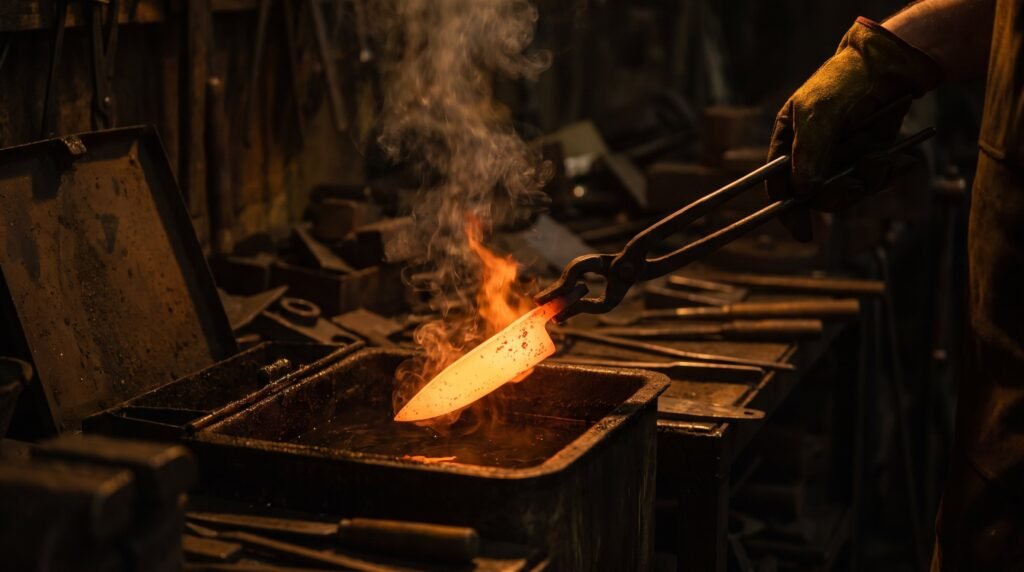
The blade is heated to its austenitising temperature, held there long enough for the structure to change through, then quenched in oil, water, brine or air depending on the steel. It comes out of the quench glass-hard and glass-brittle. Then it is tempered: reheated to a much lower temperature, usually a few hundred degrees, for a controlled period, which trades a little hardness for a great deal of toughness.
The numbers we run are the ones stated on the product pages and we do not fudge them: 1095 and 15N20 Damascus at 58 to 60 HRC, D2 at 58 to 62 HRC, 440C at 58 to 60 HRC. Those are not arbitrary. Below that band a balisong edge rolls the first time it meets anything hard. Above it the tip chips, and a balisong tip meets the floor more often than any other knife tip in the world.
Traditional Batangas shops judged heat by colour, in low light, by eye. Some still do, and the good ones are frighteningly accurate. It is still a skill measured against an oven’s thermometer, not a substitute for one.
Grinding the bevel
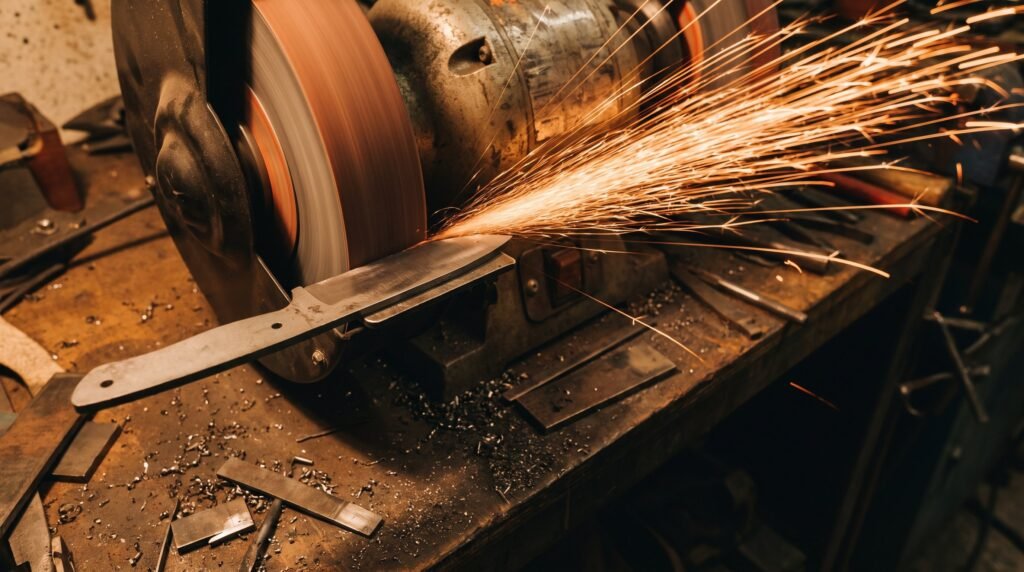
The bevel is ground after heat treat on most modern blades, which is slower and harder on abrasives but keeps the geometry from moving during the quench. The maker sets the plunge line, walks the grind up the blade, and keeps both sides even. On a symmetric blade an uneven grind is visible from a metre away. On a chisel or a dagger-profile blade the rules change and the maker has to hold a different reference on each side.
Grinding also sets how thick the blade is behind the edge, the single most important number for cutting performance and the one almost nobody publishes. Thin cuts beautifully and chips. Thick survives abuse and wedges. A balisong sits deliberately toward the tough end of that scale.
Handle work: channels, frames and scales
Balisong handles are built one of two ways.
Channel construction starts with a single piece of material — brass, steel, titanium — and the blade channel is milled, folded or cast into it. There is no seam down the spine of the handle. It is the stronger of the two and it is what most traditional Batangas frames use.
We do not build titanium frames ourselves, and our guide to titanium balisong handles explains why, along with what the metal genuinely does well.
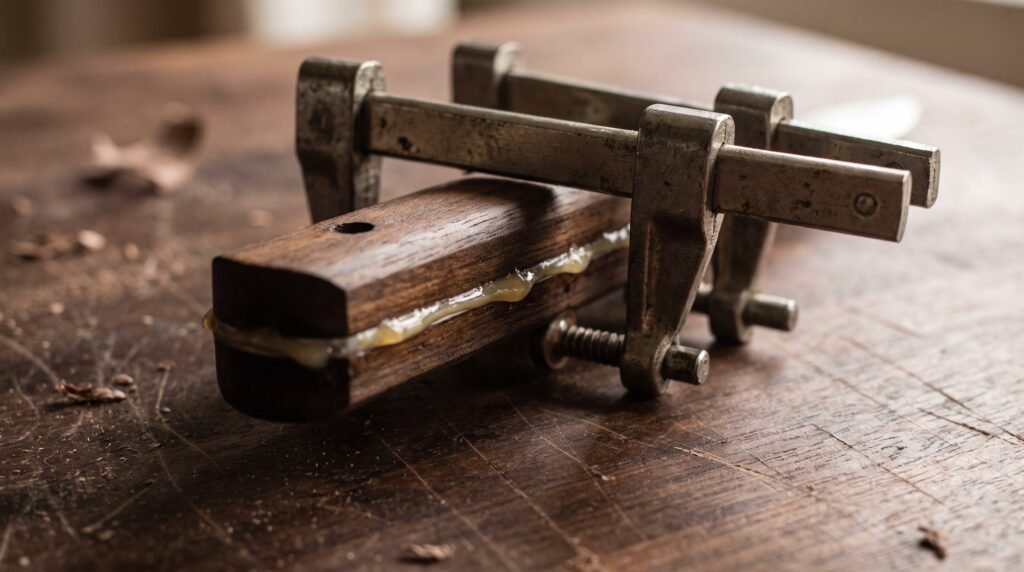
Sandwich construction builds each handle from layers pinned or screwed together, with spacers setting the gap the blade sits in. It is easier to adjust and easier to repair, and it is how a great many production balisongs are built.
Then the scales or inserts: carabao horn, bone, kamagong and other Philippine hardwoods, and modern synthetics. Each is fitted to its own pocket, not stamped to a pattern, so the maker works to the piece rather than to a drawing and no two are the same colour. Horn moves with humidity over decades, one of the tells covered in the vintage identification guide.
Pivots, peening and the tang pin
The pivots are the two axles the handles rotate on, and they are the heart of the knife.
Traditionally they are pins: a rod through the handle and tang, cut slightly proud, then peened — hammered so the ends spread into a rivet head that will not pull through. Peening is a genuine skill. Too little and the knife develops play. Too much and you crush the assembly tight and the handle will not swing. The maker peens a little, tests the swing, peens a little more, tests again. That loop is why hand-made pivots vary.
Modern builds often use screws with washers or bearings instead, which the owner can tension themselves. Screws are more serviceable; peened pins are more permanent and, done well, never loosen. Neither is objectively correct, but it is worth knowing which you are buying.
The tang pin is the small pin through the tang that stops the blade over-rotating and slamming into the handle. Fitting it is fussy: it has to stop the blade exactly where the edge is safely nested and the handle faces sit flush. A tang pin a fraction of a millimetre out gives you a knife that either rattles or has an edge sitting proud of the handle, which you will discover with your fingers.
The latch
The latch is brass on most traditional Batangas knives, and it is hand-cut and hand-bent. It has to clear the opposite handle, close under light spring pressure, and hold without needing to be forced. Which handle it lives on is one of the identifying features collectors use: latch on the bite-handle side and latch on the safe-handle side are both established layouts, and neither is a defect.
A latch that is filed slightly differently on two knives of the same model will feel different in the hand and click differently. That is normal for hand work.
Final tuning, sharpening and finishing
Tuning is the stage nobody films. The maker works the knife open and closed hundreds of times, feeling for where it drags, then fixes it: a stroke of a file on a tang shoulder, a fraction more peening on one pivot, a shim, a burr knocked off a channel edge. It is what turns an assembled knife into one that swings. Sharpening comes last, so the edge is not damaged during assembly and the maker is not handling a live edge for the whole build. Finishing means satin, mirror, forced patina or etch, depending on the steel.
| Stage | What actually happens | What goes wrong if it is rushed |
|---|---|---|
| Steel selection | Known bar stock, or recycled leaf spring in the older tradition | Unknown alloy that will not respond predictably to heat treat |
| Forging or stock removal | Blade shape roughed out hot, or cut from flat bar | Overheated steel with coarse grain; cracks that appear at the quench |
| Profiling | Outline cut, tang shaped, pivot and tang pin holes drilled and reamed | Misaligned pivots; the knife binds or sits crooked forever |
| Heat treat | Austenitise, quench, then temper to the target hardness band | Soft blade that rolls, or brittle blade that chips at the tip |
| Bevel grinding | Plunge set, bevel walked up the blade, both sides matched | Uneven grind, overheated edge, blade too thin or too thick behind the edge |
| Handle channel or frame | Channel milled or folded; sandwich handles pinned with spacers | Channel too tight and the blade rubs; too loose and it rattles |
| Scale and insert fitting | Horn, bone or wood fitted to its own pocket and levelled | Proud edges, gaps, inserts that lift later |
| Pivot assembly | Pins fitted and peened, or screws and washers torqued | Too tight to swing, or play that gets worse with use |
| Tang pin | Pin fitted so the blade stops with the edge safely nested | Edge sits proud of the handle; blade slams the frame |
| Latch fitting | Brass latch cut, bent and adjusted to clear and hold | Latch that will not close, or one you have to fight |
| Tuning | Hundreds of open-close cycles, then filing and adjusting the drag points | A knife that works but never feels smooth |
| Sharpening and finish | Edge set last; satin, mirror, patina or etch applied | Burnt edge, uneven finish, rust before it ships |
Why two knives of the same model are never identical
Because eleven of the twelve stages above involve a person making a judgement call, and because horn and bone are not manufactured.
Two knives from the same batch, same model, same steel, will differ in swing weight, pivot friction, the click of the latch, the grain of the inserts and the exact line of the plunge grind. Side by side, one usually feels very slightly faster in the roll.
People sometimes read that as a quality problem. It is the opposite: it is evidence that a person tuned the knife rather than a jig. A production line exists to eliminate that variation, and it does so by removing the person. What it also removes is the tuning pass.
The honest caveat is that variation only counts as character when it sits inside a tolerance. Different swing weight is character. A blade that scrapes the channel is a fault, and it should be fixed before the knife leaves the bench. Judge a hand-made knife on whether it works, not on whether it is a clone.
Hand-made against mass-produced
| Aspect | Hand-made Batangas-tradition build | Mass-produced import balisong |
|---|---|---|
| Blade shaping | Forged or ground individually; profile varies slightly between pieces | Stamped or CNC cut; effectively identical every time |
| Heat treat | Small batches, tested; hardness stated per steel | Batch process; at the cheap end, sometimes barely hardened at all |
| Handle inserts | Natural horn, bone or hardwood, fitted to each pocket | Moulded synthetic or anodised aluminium, dimensionally identical |
| Pivots | Peened pins or fitted screws, tuned by hand | Machine-set screws or press-fit pins, untuned |
| Tuning pass | Yes, by the maker, before it leaves the bench | Rarely; the buyer does it or lives with it |
| Consistency between units | Deliberately close, never identical | Very high |
| Repairability | Peened pins need a maker; screwed builds are owner-serviceable | Often not designed to be opened |
| What you are paying for | Labour hours, known steel, hand fitting | Tooling amortised over thousands of units |
Neither column is a moral position. A cheap production balisong is a fine thing to learn on, and better than learning on a knife you are afraid to drop. But the two are made by different processes to different ends, and the price gap is mostly labour, not markup. The price guide breaks that down with real numbers.
One traditional test, and why we do not recommend it
Filipino martial arts sources describe an old authenticity test in which the knife is driven point-first into a one-peso coin, on the theory that a properly hardened tip will not damage. That claim is repeated in several published accounts, and we cannot verify where it originated or how widely it was ever practised. Treat it as folklore, not a specification, and do not try it on a knife you like. The tip is the most fragile part of any blade. Better tests: the file test on the spine, the swing, the fit of the handles, and asking the seller what hardness they run and getting a straight answer.
More reading: the history of the balisong, the Batangas balisong explained, what the numbers mean in Batangas sizing, practical balisong sizes, and if you want to specify a build yourself, the custom balisong builder.
Made to order, and what that means for your wait
Nothing sits in a warehouse. When you choose a steel, a blade shape, a handle material and whether you want a trainer or a live blade, that combination gets made. Trainer or live blade, same price, chosen above the Add to Cart button, because the work is identical apart from whether the bevels get taken to an edge.
The practical effect is that you wait longer than you would for something already boxed in a distribution centre, and you get a knife that was tuned by hand for you rather than tuned on average for nobody. If you want to specify the whole thing yourself, that runs through our custom build page. US shipping is free, worldwide is a flat rate, and the leather sheath is cut for the knife it ships with.
Frequently Asked Questions
How long does it take to make one balisong by hand?
It depends entirely on the model, the materials and how many stages a workshop runs in parallel. A simple traditional knife takes a skilled shop a matter of hours of actual bench time spread over days, because heat treat and finishing are not continuous work. A complex custom with inlays and fitted Damascus takes considerably longer. Anyone quoting a single universal figure is guessing.
Are balisongs still made from leaf springs?
Some are, and it is a genuine part of the Batangas tradition documented in several published accounts of the Taal knife trade. Most serious modern production has moved to known bar stock, because recycled spring is an unknown alloy and unknown alloys cannot be heat treated to a repeatable hardness. Leaf spring makes good knives in experienced hands and unpredictable ones otherwise.
Is forged better than stock removal for a balisong?
No. Heat treatment decides blade performance far more than forming method does. A well heat-treated stock-removal blade outperforms a badly heat-treated forged one every time. Forging matters for Damascus, where the pattern is created by forge-welding, and it matters historically because it let makers get a blade out of a small piece of recycled steel.
What is peening and why does it matter?
Peening is hammering the ends of a pivot pin so they spread into a rivet head that cannot pull through. It is how traditional balisong pivots are secured. Done well it never loosens. Done badly it either crushes the joint so the handle will not swing, or leaves play that gets worse. It also means the pivot is not user-adjustable later.
Why do two knives of the same model feel different?
Because a person fitted each one. Hand peening, hand-filed tang shoulders, hand-cut latches and natural horn or bone inserts all introduce small differences in swing weight, friction and balance. Within tolerance that is character. Outside tolerance — a blade that scrapes, a latch that will not close — it is a fault and should be corrected before the knife ships.
Why is the tang pin so important?
The tang pin stops the blade rotating past its intended position when the knife closes. It sets where the edge sits relative to the handles. Fitted correctly, the edge nests safely inside the channel and the handles close flush. Fitted a fraction out, either the knife rattles or the edge sits proud, and you will find that out with your fingers.
Should I buy a knife with peened pins or screws?
Screws if you want to tension the pivots yourself, clean inside the handles and replace washers. Peened pins if you want the traditional construction and are happy to send the knife to a maker for any pivot work. Both are correct. It is a serviceability preference rather than a quality ranking, so decide which one matches how you like to maintain things.
Does hand-made mean no machines are used at all?
No, and any workshop claiming otherwise is stretching it. Batangas shops use grinders, drills, belt sanders and ovens. Hand-made in this context means each knife is shaped, fitted and tuned individually by a person making judgement calls, rather than assembled from interchangeable machine-made parts to a fixed jig. The tools are modern; the fitting is not automated.
What is the hardest stage to get right?
Heat treat, because it is invisible. A poor grind or a rough scale is obvious on inspection. A blade tempered a hundred degrees too hot looks perfect and fails the first time you use it. That is why hardness figures matter and why a seller who cannot tell you the hardness of their steel probably does not control it.
How do I keep a hand-made balisong in good condition?
Keep it dry, wipe it down after handling, and oil the blade and pivots lightly. High carbon steel will develop patina and will rust if neglected, which is normal for the material rather than a defect. Sharpen it properly rather than aggressively. The knife care page and the sharpening guide cover the routine.