Blog
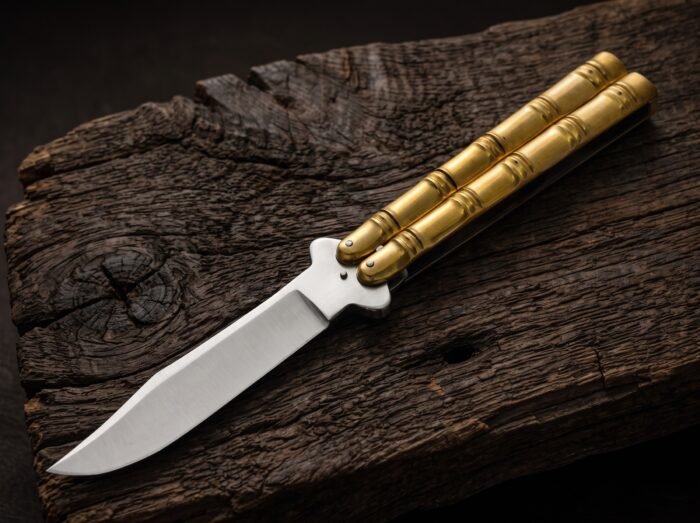
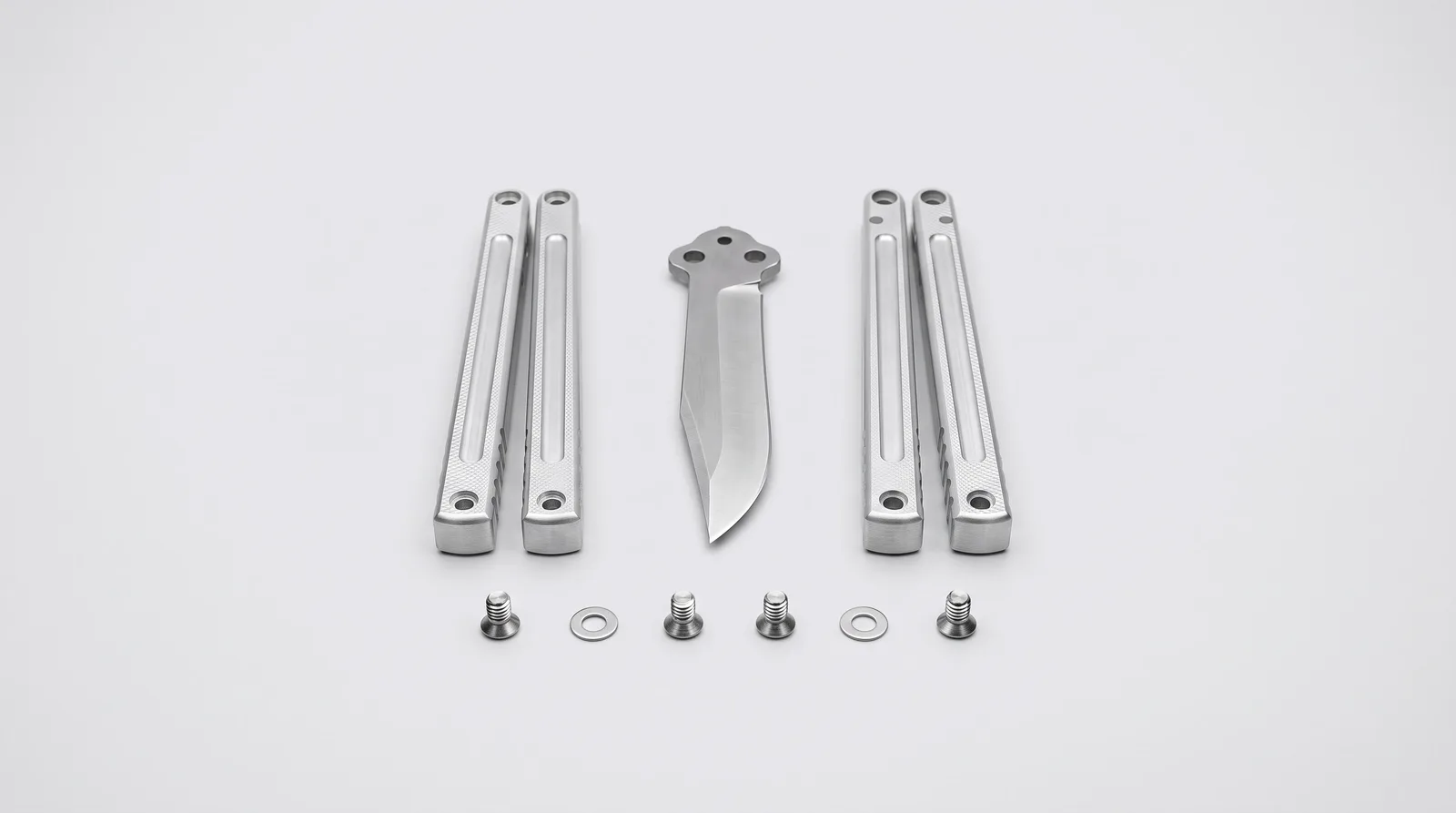
A balisong is two handles that rotate around a blade, and almost every part has a name. The blade group is the blade, its edge and its tang, plus the tang pins or zen pins that stop the handles slapping shut. The handle group is the two handles, their bolsters, spacers and the latch. Between them sit the pivots, and whatever the maker put around them: washers, bearings, or a bushing.
That is the short version. Below is every named part on a butterfly knife, what it actually does, and what goes wrong with it. This is the reference the rest of our guides point back to, so it is deliberately complete rather than short.
The Two Halves: Blade Group and Handle Group
A balisong is two assemblies that share two holes. The blade group is the blade, its tang, and anything permanently fitted to the tang. The handle group is the two handles, the hardware inside them, and the latch. The pivots are the only place the two groups meet, which is why nearly every problem a balisong develops is a pivot problem in disguise.
On a traditional Batangas knife the two groups are joined with peened pins and can never be separated without destroying the pins. On most modern flipping knives they are joined with screws and come apart in about ninety seconds. Neither is better. They are different repair philosophies, and we cover the consequences in the pivot systems guide.
The Blade and Its Tang
The edge is the sharpened portion. The spine is the unsharpened back. Where a maker grinds a secondary bevel along the spine to slim the tip, that bevel is a swedge. It is normally left unsharpened.
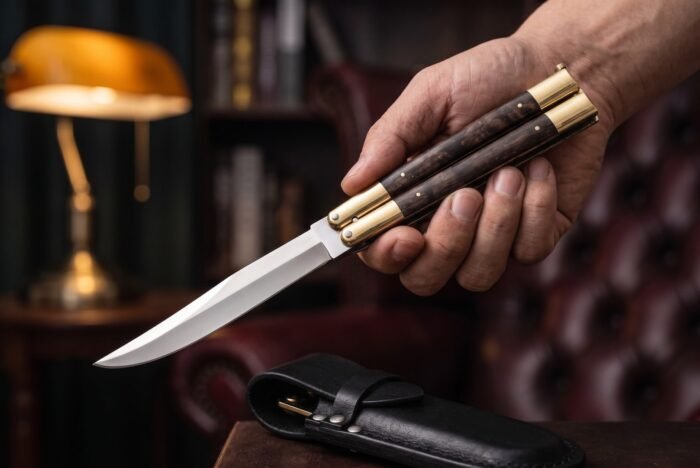
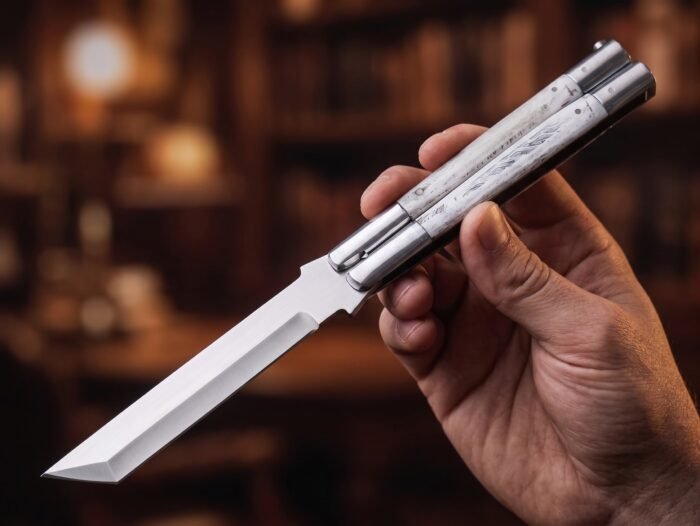
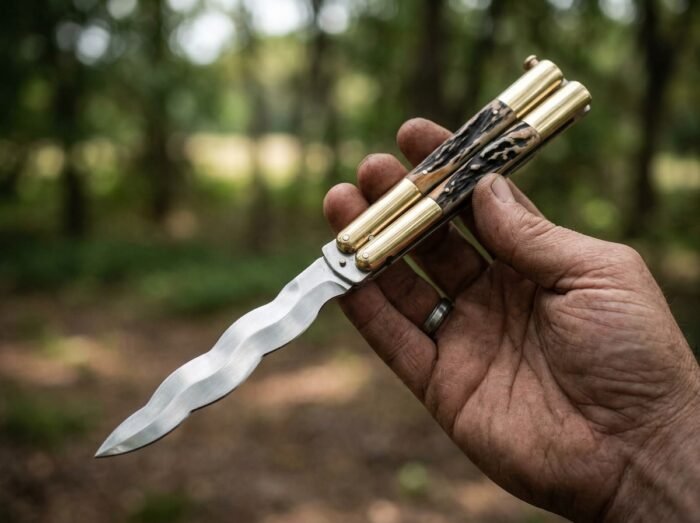
The choil is the small unsharpened notch or scoop at the very base of the edge, where the sharpened section stops. It exists so a sharpening stone has somewhere to run out to. Without one you get a stubborn unsharpened stub near the tang that never quite comes to an edge. Our sharpening guide deals with that in detail.
The tip is the point, and on a balisong it is the part most likely to be destroyed: a dropped butterfly knife lands on its tip surprisingly often. Shapes vary widely, and we break them down in the blade types guide.
The tang is the rear section of the blade that sits between the handles and carries the two pivot holes. It is not a passive lump of steel. Its shape decides where the handles stop, how the knife sounds, and how much of the blade is exposed while you flip.
Tang geometry is the biggest single difference between a knife that feels dead and one that feels alive. A tang a fraction too narrow lets the blade rattle between the handles; a fraction too wide and it binds. Hand-fitting that tolerance is the part of balisong making that takes years to learn.
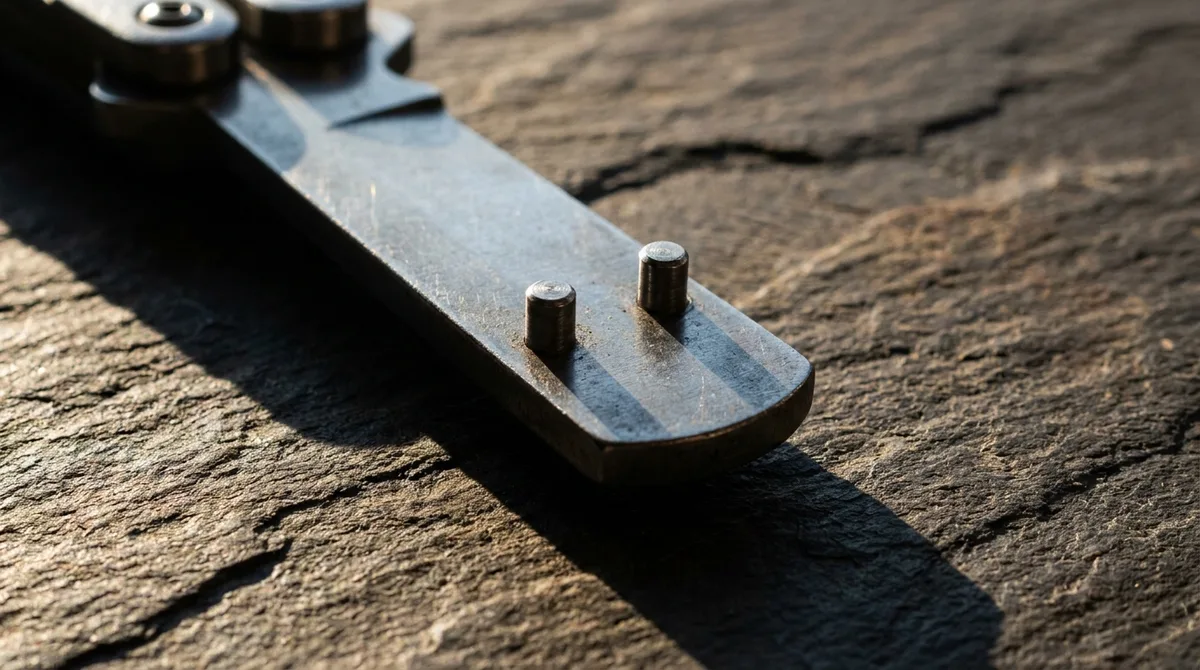
Tang Pins, Zen Pins and Kickers
Something has to stop the handles from closing onto the blade’s edge and onto each other. There are three common solutions and they are not interchangeable.
- Tang pins. Small pins pressed into the tang itself, sticking out on both sides. The handles hit the pins and stop. Simple, strong, very traditional, and they leave two visible bumps on the tang.
- Zen pins. The same job done from the other direction: the pin lives inside the handle and contacts a raised feature or a machined recess on the tang, sometimes called a tang nipple or a zen slot. The advantage is a clean, uninterrupted tang line. The cost is more parts, and zen pin screws are notoriously easy to strip.
- Kicker. A shaped protrusion machined into the tang that performs the stopping job without any separate pin at all. Fewest parts, nothing to loosen, but the geometry has to be right at the grinding stage because you cannot adjust it later.
Pivots: Peened Pins vs Pivot Screws
The pivot is the axle the handle turns on. Two approaches dominate.
A peened pin is a solid pin driven through the handle and tang and then hammered at both ends so it mushrooms and cannot come out. This is the traditional Batangas method described in our Batangas balisong guide. It is permanent, it has nothing to work loose, and it is set by hand at the bench. If it ever needs adjusting, it needs a smith, not a screwdriver.
A pivot screw is a two-part fastener, usually a male screw threading into a female barrel. It lets you tune, disassemble, clean and replace parts. It also lets you overtighten a knife into uselessness, and it will loosen with flipping. That is not a defect, it is the trade you accepted. The tuning guide deals with it.
What Sits Around the Pivot: Washers, Bearings and Bushings
Between the flat of the tang and the inside of the handle there is usually a friction-reducing part.
- Washers are thin flat discs. Phosphor bronze is the common premium material; PTFE and nylon washers turn up on lighter and cheaper builds.
- Bearings are small ball bearings, usually held in a ring-shaped cage, that let the handle roll rather than slide.
- A bushing is a precision sleeve sitting in the tang hole, very slightly wider than the tang itself. Because the bushing sets the spacing, you can tighten the pivot screw fully and still have a free swing.
Which to buy is a real question with a real answer, and it depends on what you want from the knife. We go through it properly in washers vs bearings.
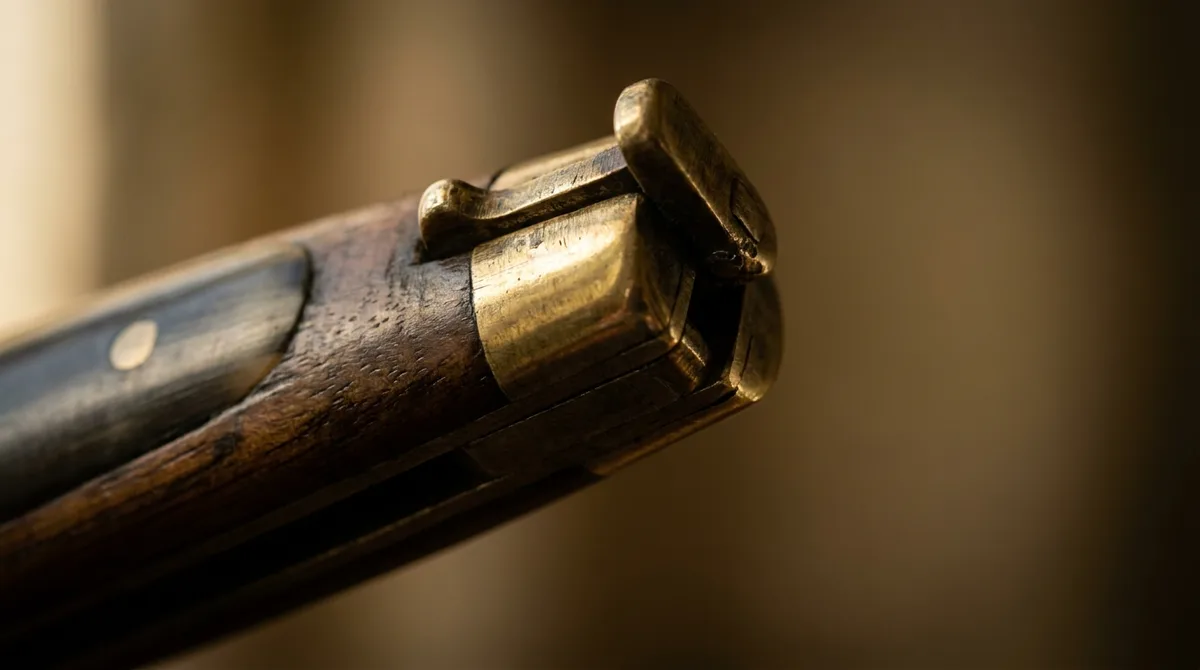
Handles: Channel and Sandwich Construction
Channel construction means each handle is one piece of material with a channel milled or formed into it for the blade to sit in. It is rigid and there is nothing inside to rattle. Traditional Filipino balisongs are channel knives: a brass, steel or copper frame cradling the blade, with inserts of horn, bone, stag or hardwood set into the outside.
Sandwich construction means each handle is built from separate layers: an inner liner, an outer scale (also called a slab), and spacers or standoffs holding the two apart. It is lighter, easier to service, and easier to customise. It is also more things that can come loose.
The screws holding scales and spacers together are often called sexbolts: a barrel with a screw threading into it from the other side. They are small, they are usually the first fastener to loosen, and they are worth checking whenever the knife starts sounding wrong.
A bolster is the reinforced section at the pivot end of the handle. On traditional knives it is often a separate piece of brass or nickel silver, sometimes filed with decorative work, and it does real structural work: it is the material the pivot passes through.
Spacers sit between the two sides of a sandwich handle. They set its internal width, carry a surprising amount of the knife’s weight, and are the loudest single influence on the sound a balisong makes when it closes. Some people chase that sound. It is a legitimate hobby.
The lanyard hole is the hole at the butt end of a handle. On a flipper it is mostly decorative. Do not flip a knife with a lanyard attached.
Bite Handle and Safe Handle
With the knife closed, one handle sits against the sharpened edge and one sits against the spine. The handle on the edge side is the bite handle. Close the knife while holding it and the edge comes home onto your fingers. The handle on the spine side is the safe handle, and it is the one you learn to hold first.
On a knife with a latch, the latch is normally mounted on the bite handle. That gives you a fast way to identify them without looking at the edge: latch side is bite side, on most knives, most of the time. Confirm it visually anyway. This is one of the few pieces of balisong knowledge that is worth being pedantic about, and it is the first thing our beginners flipping guide makes you learn. If you are still building muscle memory, learn it on a trainer.
The Latch and the Latch Gate
The latch is the small swinging or sliding bar that holds the knife shut, and on many designs also holds it locked open. Common types are the simple swinging tab latch, the spring-loaded latch that snaps into place, and the magnetic latch. Some knives have no latch at all, which flippers often prefer because there is nothing to catch a finger mid-trick.
The term latch gate is used loosely, and we will not pretend otherwise. Usually it means the recess or catch on the opposing handle that the latch drops into. Some makers use it for a small stop that keeps the latch from swinging past its range. There is no published standard definition, so if a seller uses the phrase, ask which they mean.
The Full Parts Table
| Part | What it does | What goes wrong |
|---|---|---|
| Blade | Cuts. Carries the tang. | Rust, chipping, bent or broken tip from drops. |
| Edge | The sharpened cutting portion. | Dulls, rolls, or gets dinged by closing onto a handle. |
| Swedge | Slims the spine near the tip. | Rarely fails. Sometimes mistaken for a second edge. |
| Choil | Gives a sharpening stone a run-out point. | Absent on some knives, leaving an unsharpenable stub. |
| Kicker | Tang feature that stops the handles closing too far. | Cannot be adjusted. If the geometry is off, it stays off. |
| Tang | The rear of the blade. Carries the pivot holes. | Wear at the pivot holes; too narrow means play, too wide means bind. |
| Tang pins | Pressed into the tang, stop the handles meeting. | Can loosen or shear. Wear flats over years of use. |
| Zen pins / zen slot | Handle-mounted stop working against a tang feature. | Zen pin screws strip easily. Loosen and the handles start touching. |
| Pivot (peened pin) | Permanent axle, set by hand. | Wears loose over decades. Needs a smith, not a driver. |
| Pivot (screw) | Adjustable, removable axle. | Loosens with flipping, strips if overtightened. |
| Washers | Reduce friction between tang and handle. | Galling if run dry; deform if crushed by overtightening. |
| Bearings | Roll instead of slide. Very low friction. | Trap grit, get notchy, cages crack. |
| Bushing | Sleeve that sets spacing so the pivot can be fully tight. | Wear ring over time; incorrect length causes bind or play. |
| Handles | Enclose the blade, provide the grip. | Dents from drops, bent liners, cracked inserts. |
| Liners / scales / spacers | Build up a sandwich handle. | Fasteners loosen, rattle appears, spacers shift. |
| Bolsters | Reinforce the pivot end of the handle. | Loosen on pinned traditional knives; can wear at the pivot. |
| Latch | Holds the knife closed, sometimes locked open. | Rattles, wears its catch, catches fingers during tricks. |
| Latch gate | The catch or stop the latch works against. | Wears open over time, so the latch stops holding. |
| Lanyard hole | Attachment point at the butt of the handle. | Nothing, unless you flip with a lanyard fitted. Do not. |
Construction and Jargon, at a Glance
Two more tables. The first compares the two ways a handle can be built. The second collects the words flippers use that describe behaviour rather than hardware, and that get mistaken for part names.
| Aspect | Channel construction | Sandwich construction |
|---|---|---|
| Handle build | One piece with a milled or formed channel | Liner plus scale plus spacers, fastened together |
| Rigidity | Very high, nothing internal to shift | Depends on the fasteners staying tight |
| Weight | Usually heavier | Usually lighter, and tunable by changing spacers |
| Servicing | Harder. Often not designed to come apart | Easy. Designed to come apart |
| Customising | Limited to inserts and finish | Scales, spacers and hardware can be swapped |
| Typical on | Traditional Filipino balisongs | Many modern flipping-focused designs |
| Term | What it means |
|---|---|
| Tang tap | The blade contacting the inside of a handle during the swing. A tolerance problem, not a part. |
| Handle play | Movement between the handles when you press them in opposite directions. |
| Blade centring | Whether the blade sits evenly between the handles when closed, rather than resting on one side. |
| Bite | Catching the edge with your hand. The reason the bite handle has that name. |
| Live blade | A sharpened balisong, as opposed to a trainer with an unsharpened bar. |
| Zen pin nipple | The raised contact point on the tang that a zen pin lands on. |
Why Knowing the Names Actually Matters
Two reasons. First, diagnosis: “it wobbles” is not a fault report, while “side-to-side handle play at the pivot, blade still centred” tells a maker exactly what to do. Second, buying. A listing that names a knife’s construction, pivot system and stop system correctly was written by someone who knows the product. One that says “premium high quality butterfly knife with smooth action” was not. That test saves more money than any discount code, and we apply it again in the price guide.
Butterfly knife laws vary by state, county and city. Check your local law before buying or carrying one.
More reading: How to tune a balisong · Washers vs bearings · Cleaning and oiling a butterfly knife · Sharpening a balisong · What is a balisong knife
Steel, hardness and heat treatment
HRC. Rockwell C hardness, the standard scale for knife steel. Everything we make is hardened to 58 to 60 HRC. Below about 56 the edge rolls and will not hold. Above about 62 the steel gets brittle and a balisong tip will chip on the first hard contact, which for a flipped knife is roughly the first week.
Quench. Cooling steel rapidly from high temperature to lock it into a hard structure. Oil, water or air depending on the alloy, and using the wrong one is how blades crack. A quench that has gone wrong is often audible: a soft blade files with a dull, grabby sound instead of the file skating across it.
Temper. Reheating hardened steel to a lower, controlled temperature to trade a little hardness for a lot of toughness. A quenched, untempered blade is glass. It is where budget knives quietly cut corners, because you cannot see it and the customer will not find out for a year.
Forge weld. Joining layers of steel to each other under heat and pressure until they become one piece. This is the basis of real Damascus: alternating layers, folded, drawn out, and etched at the end so the different alloys show as a pattern. The pattern goes all the way through the steel. Acid etched imitation is printed on the surface and will polish off, which is the entire difference between a Damascus knife and a knife with a picture of Damascus on it.
Patina. The stable oxide layer that forms on high carbon steel with use. Grey, blue or brown depending on what the knife has been cutting, it is not rust, and it protects the steel underneath. Some people force one deliberately. Some people phone us about it. Stainless steels like 440C and VG10 do not develop one. The steel comparison guide covers which behaves how.
Terms that get used wrongly
A short list of things that will save you money.
- “Stainless steel” with no grade named is not a specification. It is the absence of one. There are hundreds of stainless steels and they range from excellent to soft rubbish. A seller who names 440C or VG10 is telling you something. A seller who says “stainless” is telling you something else.
- “Damascus” used for an etched pattern on plain steel. Real Damascus is forge welded and the pattern is structural. Price is the giveaway.
- “Handmade” with no maker, no workshop and no photographs of anyone making anything. Hands belong to people, and people have names.
- “Butterfly knife” and “balisong” are the same object. One is the English name, one is the Filipino one. Anyone insisting they are different products is selling something.
Frequently Asked Questions
What is the difference between a tang pin and a zen pin?
Both stop the handles closing onto each other and onto the blade. A tang pin is pressed into the blade’s tang and sticks out on both sides, so the handles hit the pin. A zen pin lives inside the handle and contacts a feature on the tang instead. Zen pins give a cleaner tang line, tang pins have fewer things to loosen.
How do I tell the bite handle from the safe handle?
Close the knife and look at which handle sits against the sharpened edge. That one is the bite handle, because closing the knife while gripping it brings the edge onto your hand. The safe handle sits against the spine. On most latched knives the latch is fitted to the bite handle, but check visually rather than assuming.
Do all balisongs have a latch?
No. Latchless balisongs are common, particularly among flippers, because a latch is one more thing to catch a finger mid-trick. A latch is genuinely useful for carrying and storing a knife closed, and on many designs it also locks the knife open. It is a preference, not a quality marker.
What is a kicker on a balisong?
A kicker is a shaped protrusion on the tang that stops the handles closing too far, doing the same job as tang pins or zen pins without any separate hardware. Fewer parts means nothing to loosen or strip. The trade-off is that the geometry is fixed at the grinding stage and cannot be adjusted afterwards.
Is channel construction better than sandwich construction?
Neither is better, they solve different problems. Channel handles are one solid piece, so they are rigid with nothing inside to rattle, but they are hard to service. Sandwich handles are lighter, easy to take apart and easy to customise, but they depend on small fasteners staying tight. Traditional Filipino balisongs are channel knives.
What is a bushing, and how is it different from a washer?
A washer is a flat disc that sits between the tang and the handle to cut friction. A bushing is a sleeve inside the tang hole that is slightly longer than the tang is thick, so it sets the spacing itself. The practical result is that a bushing knife can have its pivot screw fully tightened and still swing freely.
Why does my blade tap the inside of the handles?
That is tang tap, and it usually means there is more clearance between the tang and the handles than the design intends, or the pivots have loosened. On a screw-pivot knife it is often a tuning job. On a knife where the tolerance was never right to begin with, no amount of tightening fixes it and the knife needs a smith.
What is the choil for on a butterfly knife?
The choil is the small unsharpened notch where the edge ends and the tang begins. It gives a sharpening stone somewhere to run out, so the whole edge can be sharpened evenly. Without one, the section closest to the tang is very difficult to bring to a proper edge and tends to stay blunt.
Can I replace parts on a traditional Filipino balisong?
Some, but not the pivots. Traditional Batangas knives use peened pins that are hammered over at both ends, which is what makes them permanent and rattle-free. Removing them destroys them. Handle inserts, latches and finish work can often be redone by a maker, but pivot work on a pinned knife is a workshop job.
What is a swedge and is it sharp?
A swedge is a secondary bevel ground along the spine of the blade near the tip, used to slim the point and reduce weight. It is normally left unsharpened. If a listing describes a knife as double-edged when it only has a swedge, that is either sloppy writing or a deliberate exaggeration, and worth questioning.