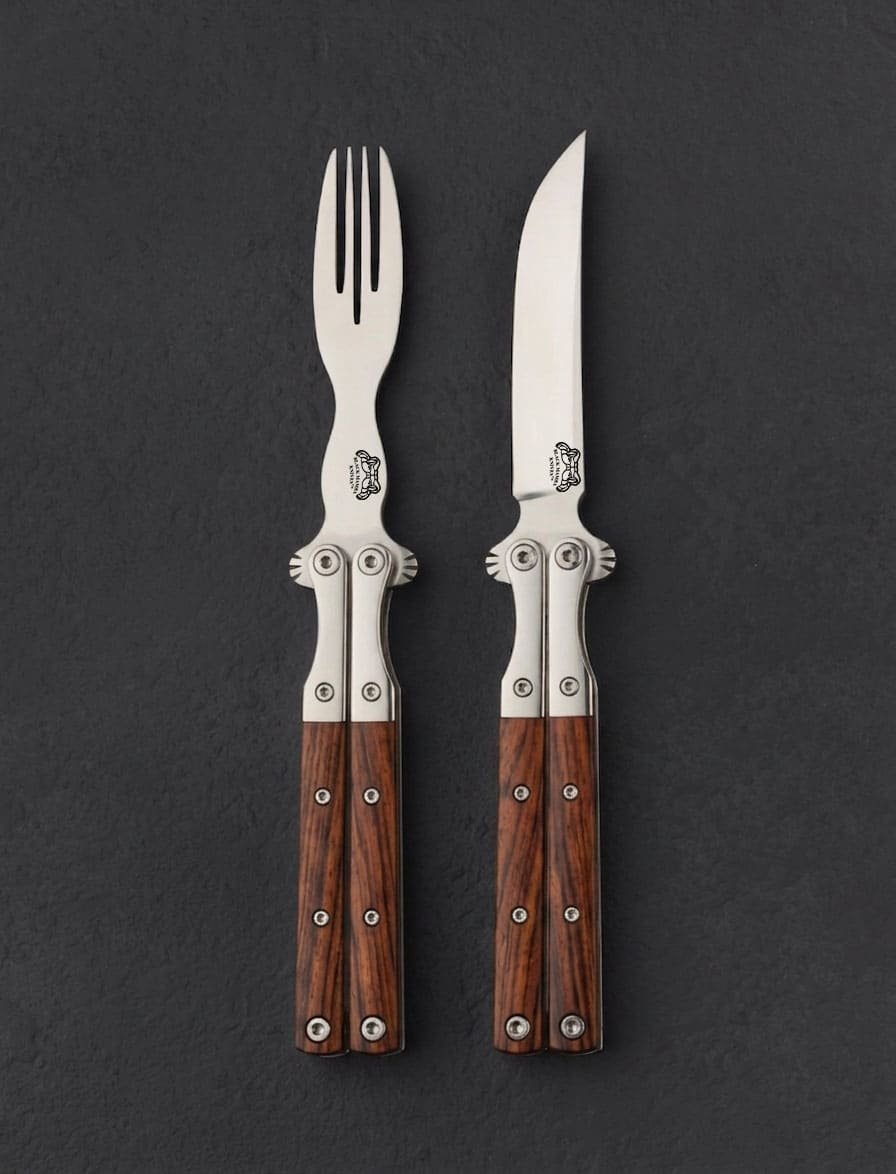
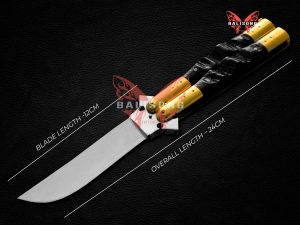
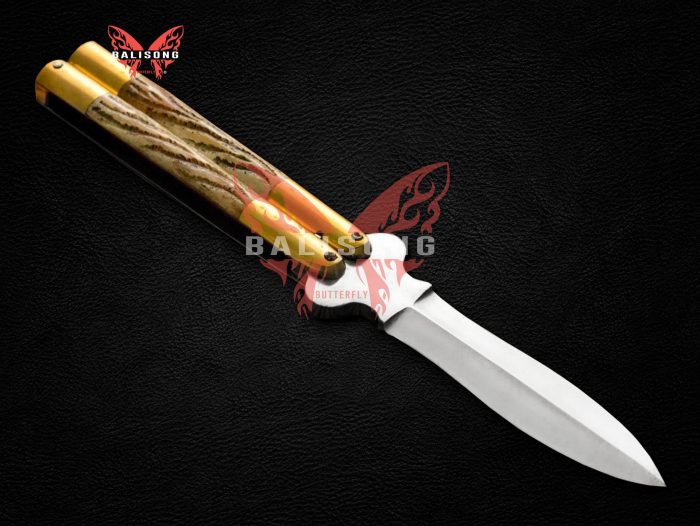
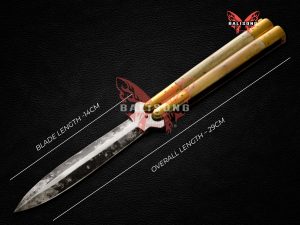
The BF-166 is a two piece balisong steak set, knife and fork, polished high carbon steel, rose wood handles, $245. The knife has a plain edge and no serrations, and that is a deliberate decision rather than a cost saving.
The case against serrated steak knives
Serrations exist to solve one problem: a blunt knife still has to cut something. The teeth concentrate force on small points and tear through a crust or a skin that a dull plain edge would slide off.
That is genuinely useful in a restaurant, where a dozen knives go through a dishwasher nightly and nobody is sharpening anything. It is much less useful at your own table.
The cost is that serrations tear rather than slice. Look at the cut face of a steak that has been through a serrated knife and you will see a ragged edge with juice pushed out of it. A plain edge parts the fibres cleanly and leaves the juice where it belongs. Anyone who has cooked a good piece of beef and then shredded it at the table knows the feeling.
Serrations also cannot be resharpened properly by an ordinary person, which means a serrated steak knife is a consumable pretending to be an heirloom.
Which means these need sharpening
Yes, and high carbon is the easiest steel there is to sharpen. A basic combination waterstone, ten minutes, twice a year for ordinary use. If that sounds like an imposition, buy serrated knives from somebody else and we will part as friends.
Why a fork on a butterfly frame
Because a set that folds should fold entirely. A fixed fork next to a folding knife looks like an afterthought, and this way both pieces store the same way, travel the same way and sit in matching leather.
The fork is not a novelty. Four tines, properly tapered, weighted to sit correctly in the hand. It holds a steak while the knife works, which is the entire job description.
Rose wood at a table
Rose wood is dense, oily by nature and close grained, which is why it has been used for cutlery handles for a very long time. It resists moisture without much help, it darkens slowly to a deeper red brown, and it takes a polish that does not feel slippery.
Care is close to nothing. Wash by hand, dry it, and once a year rub a little mineral oil into the panels if they start looking dry. Never put these in a dishwasher, which is advice we would give about any knife with a natural handle and any knife with a pivot.
What high polish means at the table
These are the pieces people will pick up and look at before they use them, so they get the mirror finish. It is not a working chef’s finish and it does not need to be. Wipe them dry after washing and the shine stays.
They are high carbon, so a patina will start eventually, particularly if they meet a lot of red meat and red wine. Keep them dry and it stays slow.
Specifications for this balisong steak set
| Pieces |
Steak knife and fork, 2 pieces |
| Overall length |
24 cm each |
| Blade length |
12 cm |
| Blade |
High carbon steel, mirror polished, plain edge |
| Hardness |
58-60 HRC |
| Handle |
Rose wood with steel bolsters |
| Sheath |
Fitted leather, included |
| Price |
$245 |
Ordering the BF-166
Both pieces are sharpened where they should be, tuned and checked by hand, and each arrives in its own fitted leather sheath with a gift box.
Laser engraving is $29, chosen on this page. Free shipping inside the United States, flat $49 worldwide.


 Blade Materials – 440c Stainless steel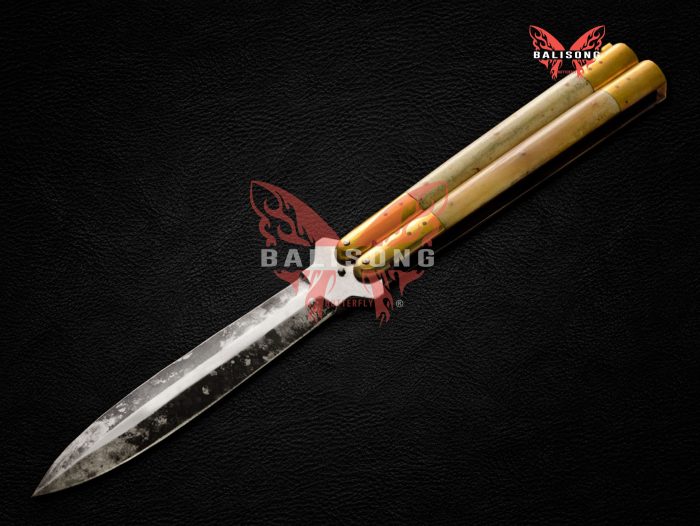
 Blade Materials – 440c Stainless steel
Reviews
There are no reviews yet.