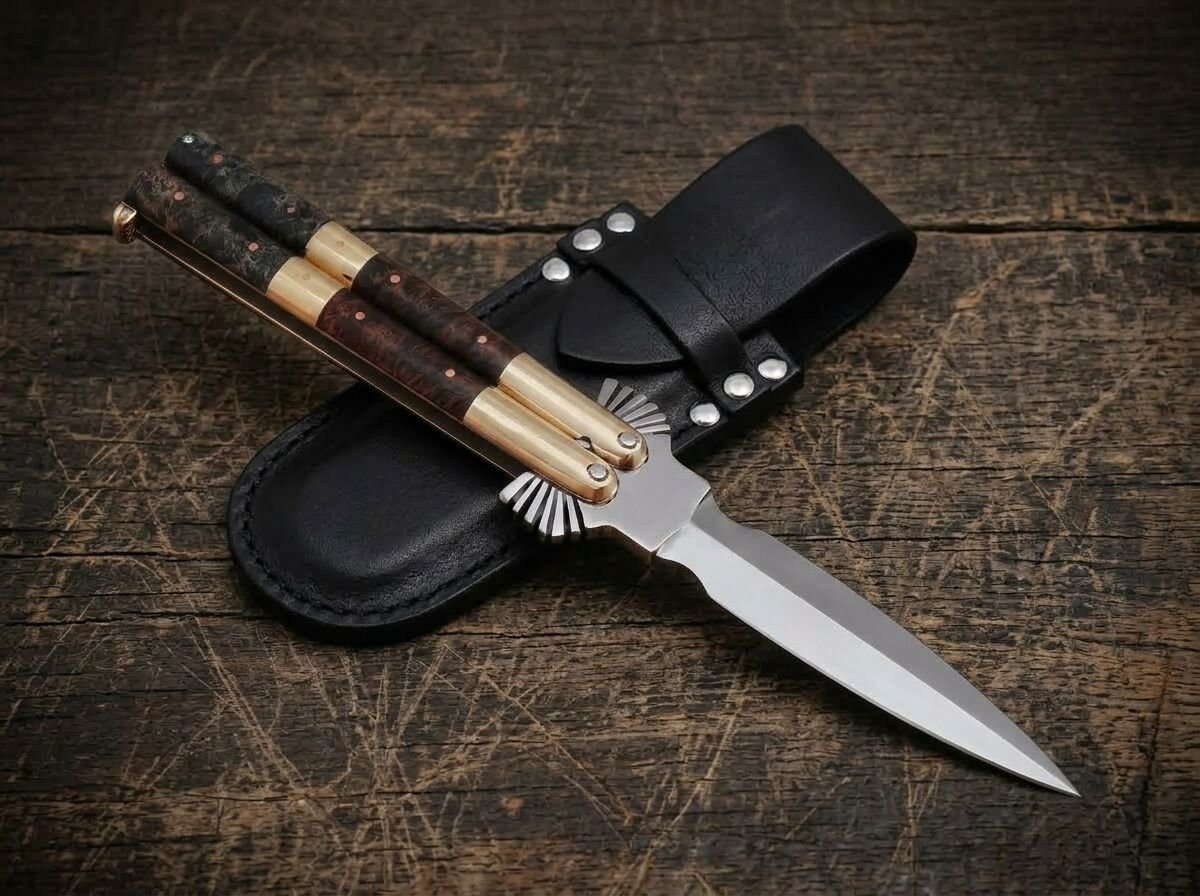
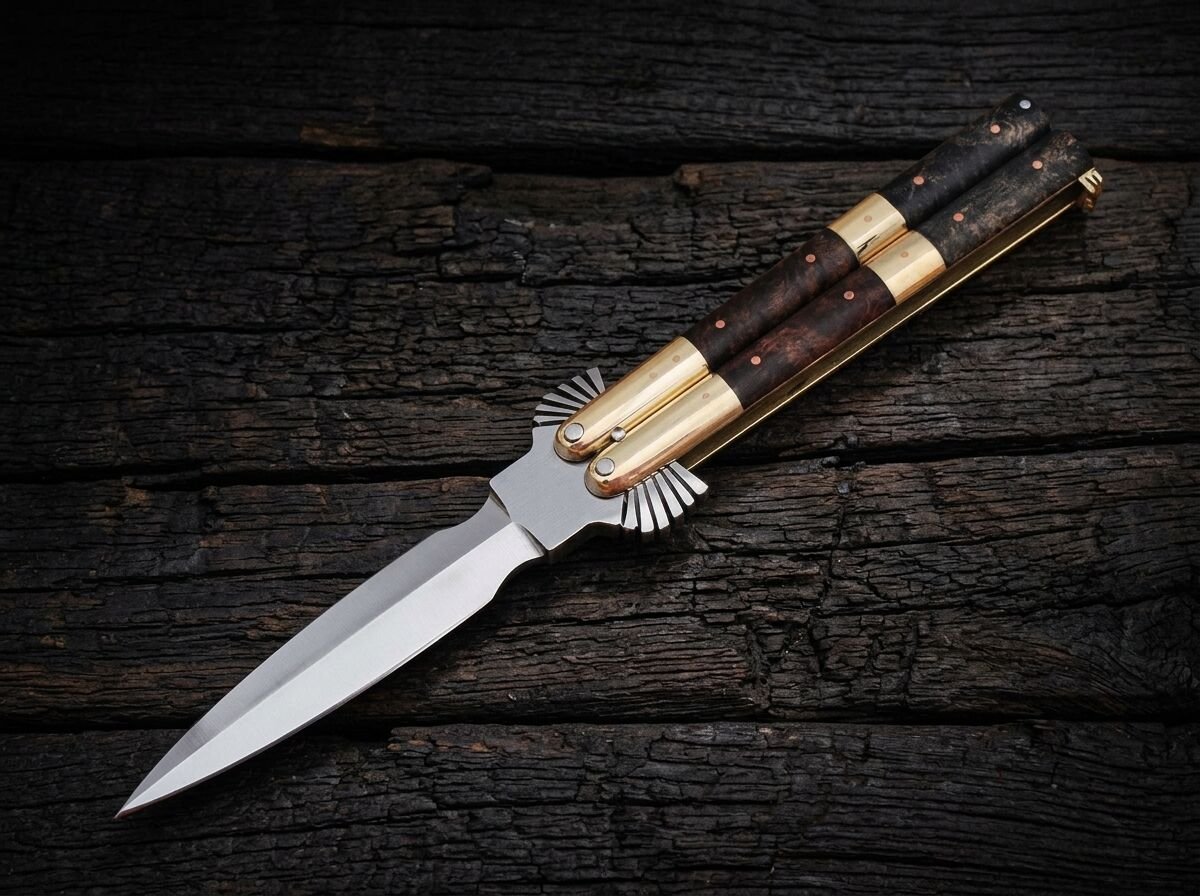
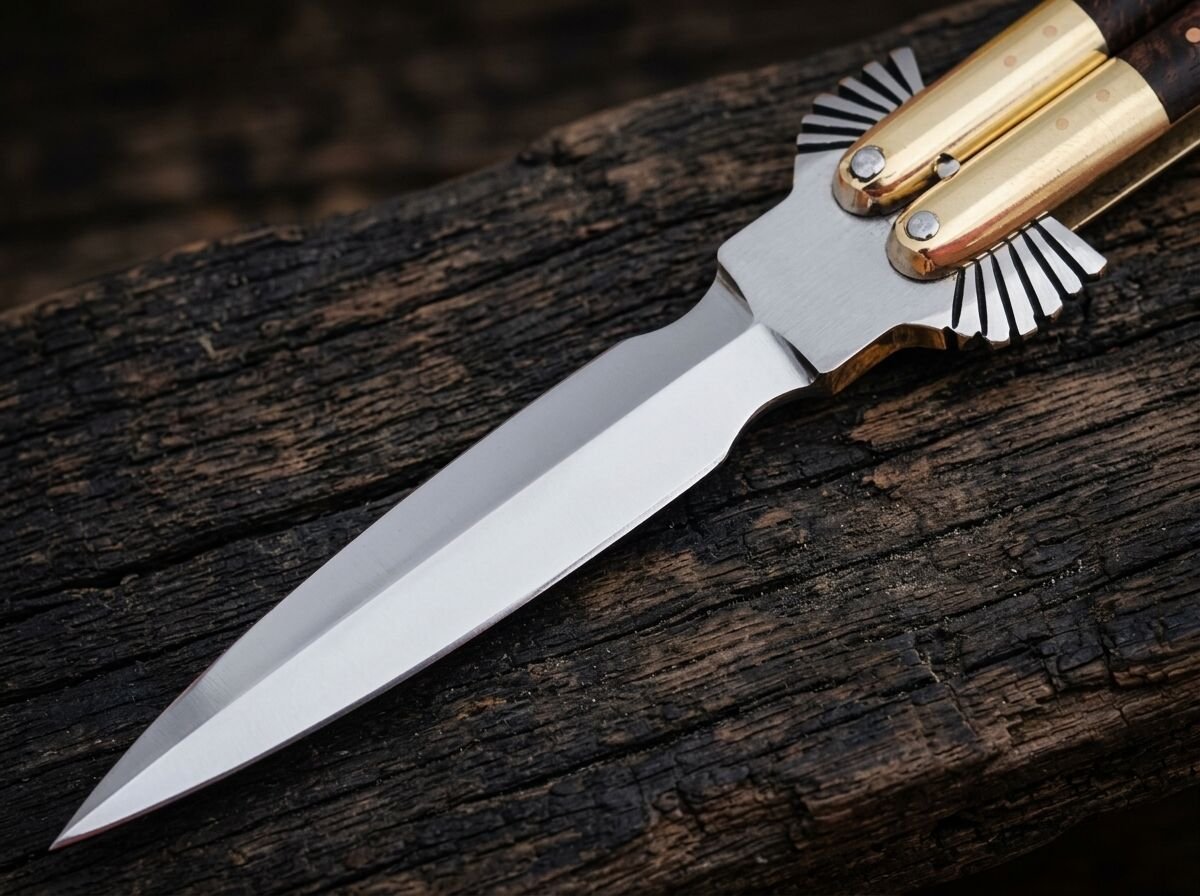
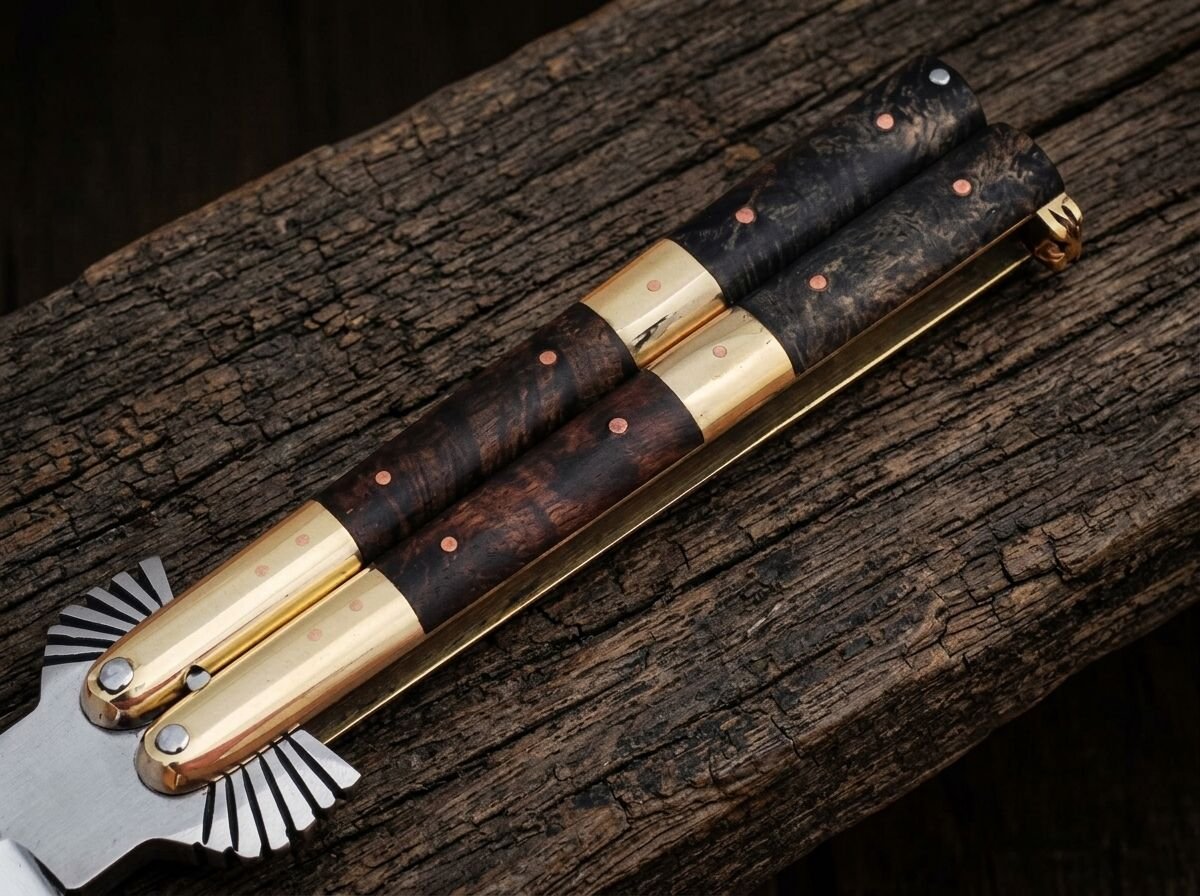
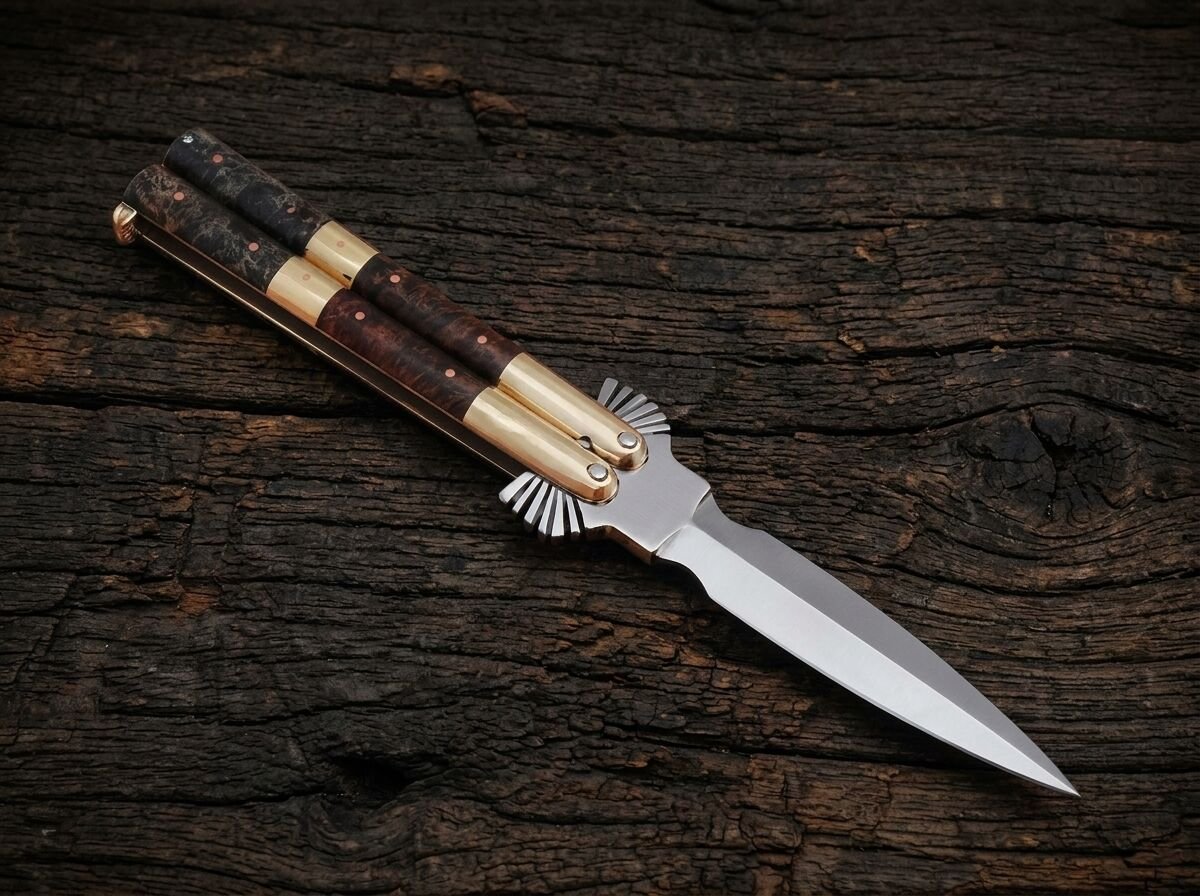
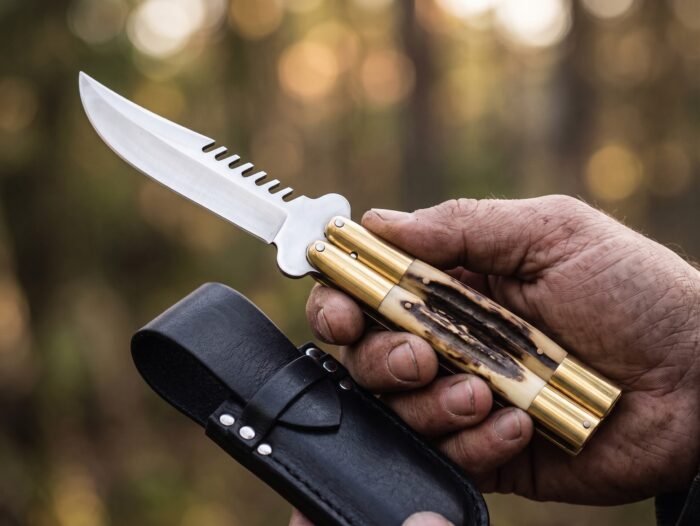
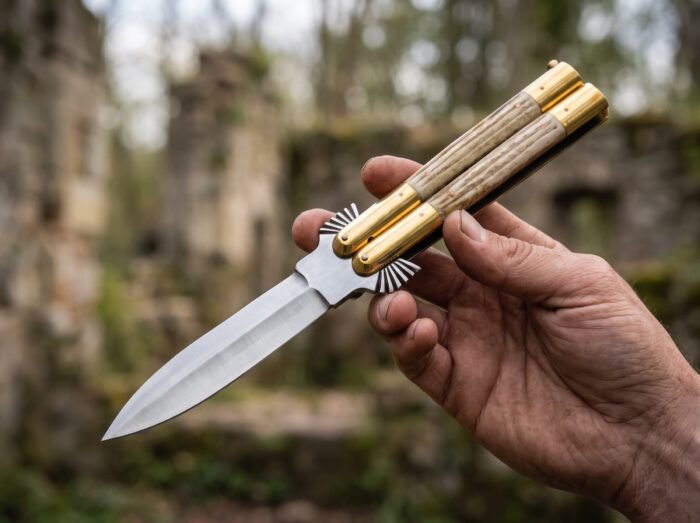
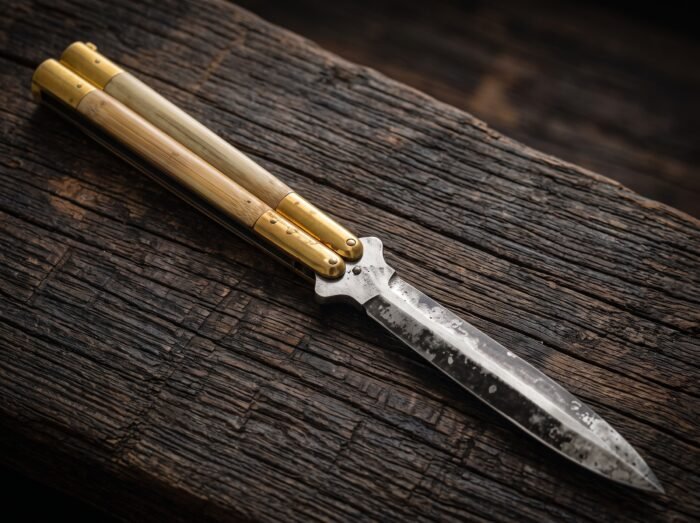
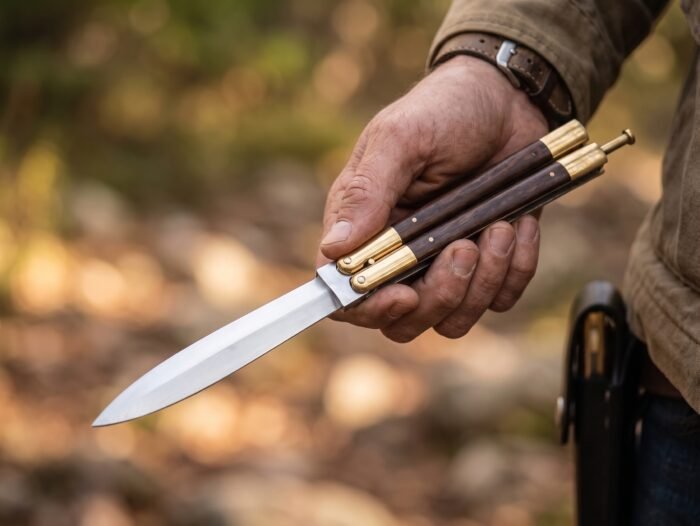
The BF-106 is a dagger-bladed Filipino Traditional balisong: 24cm open, a 12cm D2 blade, 220g, brass with rose wood. It is the cheapest dagger in the series and the heavier of the two rose wood daggers, and it is a good place to explain the part of a handmade knife that nobody photographs.
The pivot is the knife
Everything about how a balisong feels comes down to two pivot pins and a tang pin. The steel decides how long the edge lasts. The pivots decide whether you enjoy owning it, and they are the one component that cannot be specified, only judged.
A pivot has to let the handle fall freely under its own weight, hold the blade centred in the channel when closed, and stay where you set it through thousands of rotations. Those three requirements pull against each other. Tighter helps the second, hurts the first. Looser helps the first, hurts the second.
What hand-fitted actually means on a balisong
It means somebody sets each one, flips the knife, and adjusts it again. Not a torque value on a sheet.
Our target is a handle that drops freely from horizontal and stops within its own arc rather than swinging past it. That is on the loose side of the middle and it is deliberate, because a new owner can tighten a pivot in thirty seconds and a knife too stiff to learn on is useless to everybody.
| Symptom |
Usually |
What to do |
| Stiff out of the box |
Not broken in |
A hundred rollovers. Not a spanner |
| Stiff after a year |
Dirt in the channel |
Clean it before you touch the pivot |
| Handles wobble sideways |
Pivot backed off |
An eighth of a turn, then test. People overshoot constantly |
| Gritty or grinding |
Something in the pivot |
Clean it. Never force a gritty pivot |
| Blade sits off-centre closed |
Alignment |
Email us. This is ours to fix |
| Handle swings past its arc |
Too loose |
Eighth of a turn tighter |
The tang pin, which nobody mentions
The tang pin is the small pin through the tang of the blade. Its only job is to stop the blade rotating past where it should stop, and it is the reason a good balisong opens with a definite click rather than a mushy arrival.
Cheap balisongs frequently do not have one, or have one that does not sit true. That is what people are describing when they say a knife feels vague, and no amount of adjustment fixes it because the fault is in the build.
On this knife the tang pin is fitted and the blade stops where the handles stop. It is a small thing and it is most of what separates a knife you keep from a knife you replace.
The dagger, and the honest caveats
A dagger is symmetrical, so the point sits on the centreline and the knife handles the same whichever way it opens. On a balisong that is a real advantage, because the blade arrives in an orientation you did not fully choose.
Two edges also means no spine to put a thumb on, poor drawing cuts, and twice the sharpening. And double-edged blades are treated differently from single-edged ones under the law in a number of places, sometimes regardless of length. Read the rule that applies at your address before ordering.
Two hundred and twenty grams
The heavier of the two weights in this series. The knife carries itself through a rotation and gives you a moment to correct a mistake, at the cost of changing direction more slowly and tiring your arm sooner.
D2 steel and a rose wood balisong handle
D2 is an air-hardening tool steel: about one and a half percent carbon, eleven to twelve percent chromium, just under stainless. Best edge retention we sell, stubborn to sharpen, diamond plate about twice a year. Heat treated to 58-60 HRC so it rolls rather than chips on impact.
Rose wood is dense and warm brown with a regular grain, darkening quietly over the years. The brass goes brown and that is not damage.
Ordering this D2 dagger butterfly knife
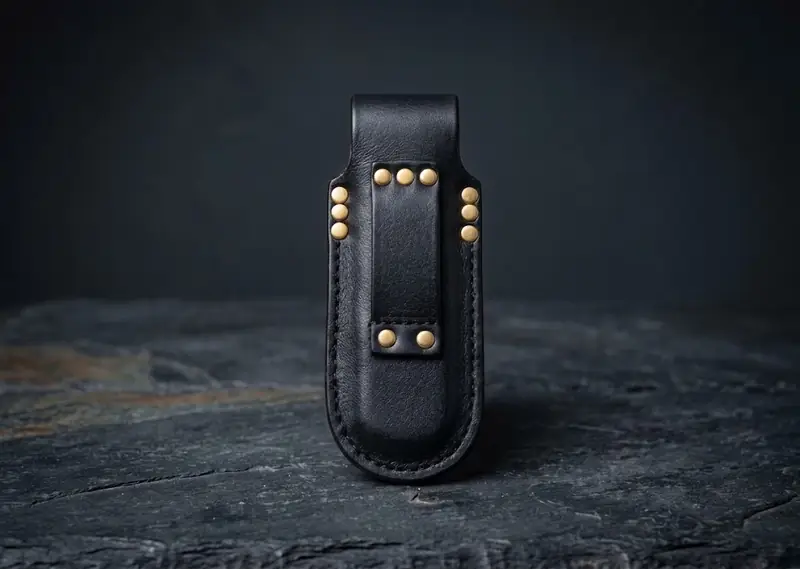
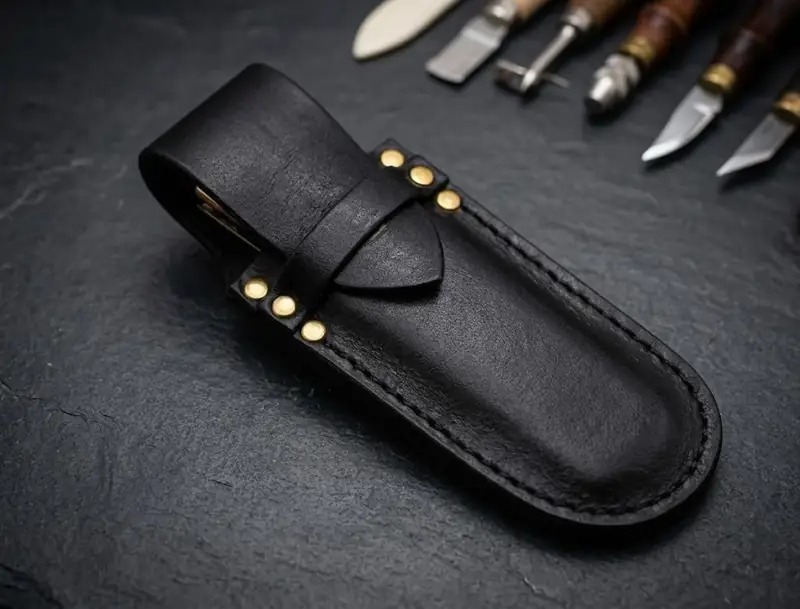
Unsharpened trainer, chosen above Add to Cart. The sheath is leather and cut to this frame. Delivery within the States is free and everything beyond it is $49 for the order.
The pivot and tang pin are what actually decide whether a balisong feels right, and that is worth understanding before comparing knives, which is why our guide to tuning a balisong exists. The Tagani belongs to the D2 Tool Steel Butterfly range. Its dagger profile is shared with the Sibat, which carries the same blade shape at the lighter 200 gram weight.





Mark Bailey –
Knew this was a good one the second I felt the weight in hand. So worth it.
Patrick Morris –
Wasn’t sure what to expect but this one nailed it. Bushings feel buttery smooth after just a bit of use. Worth every penny.
Ruth Mitchell –
Ended up ordering a second one after how happy I was with the first. Worth every penny.
Carol Price –
Wasn’t expecting to be this impressed but here we are. Comes with a nice pouch which is a nice touch. If you’re on the fence just get it. You won’t regret it.
Chloe Davis –
Couldn’t ask for a better balisong honestly. Latch snaps shut clean every time. Already telling my flipper friends to check this out.
William King –
Showed up right on time and looked even better than the photos. This flips cleaner than knives twice the price. Telling everyone I know to check this company out.