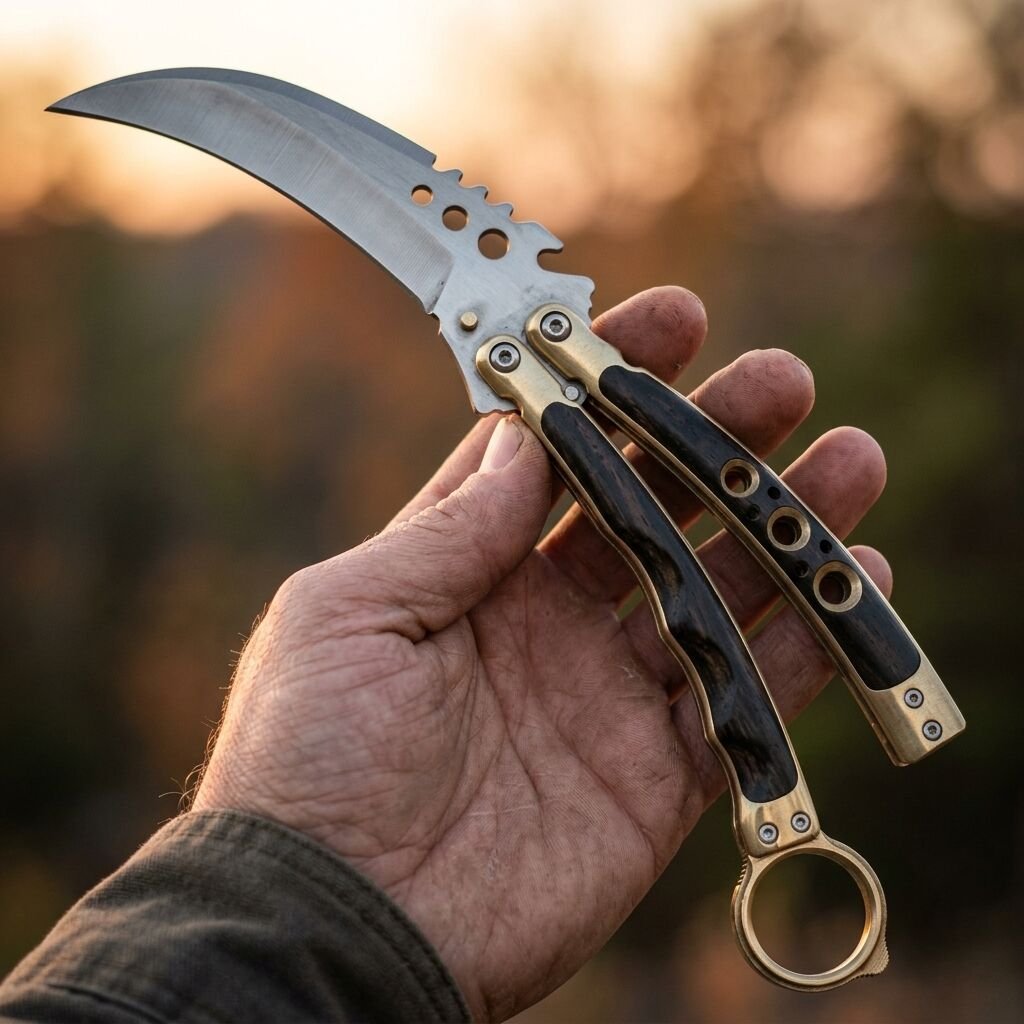
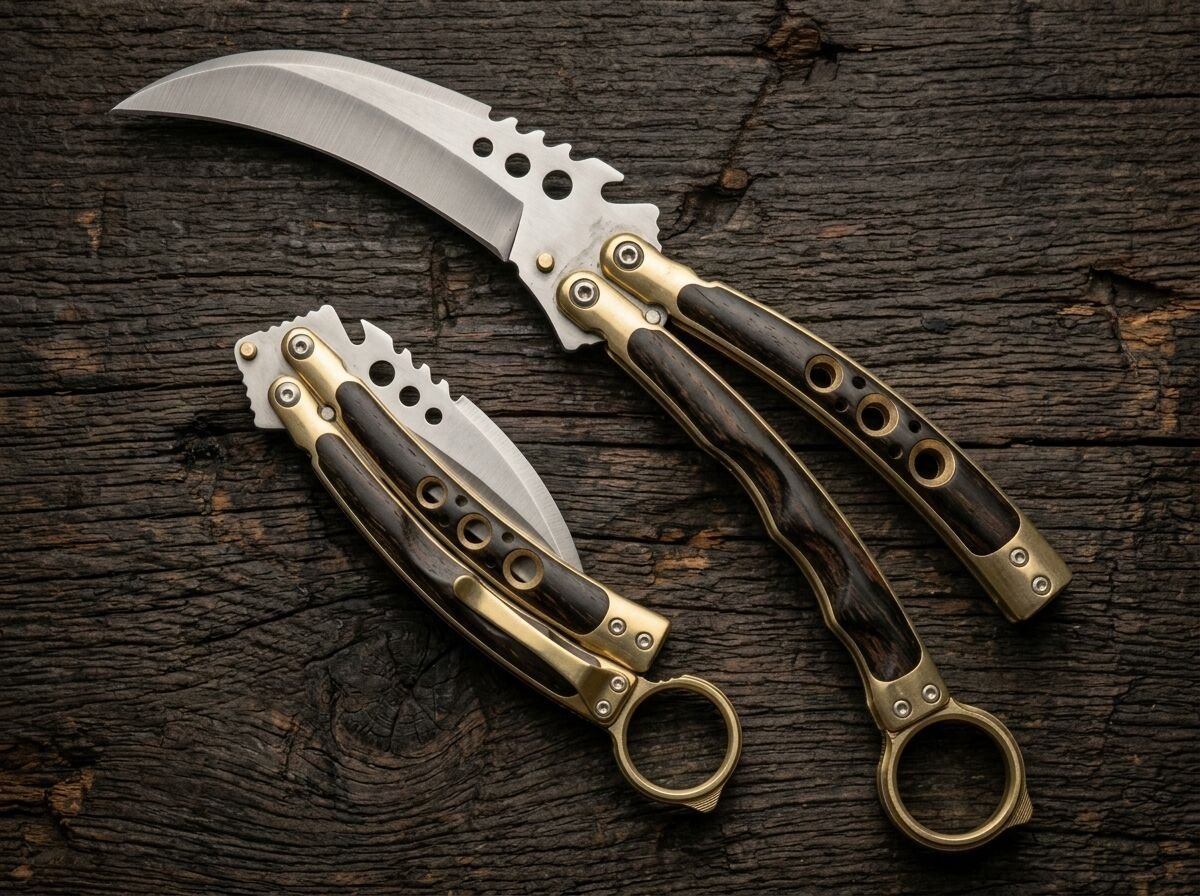
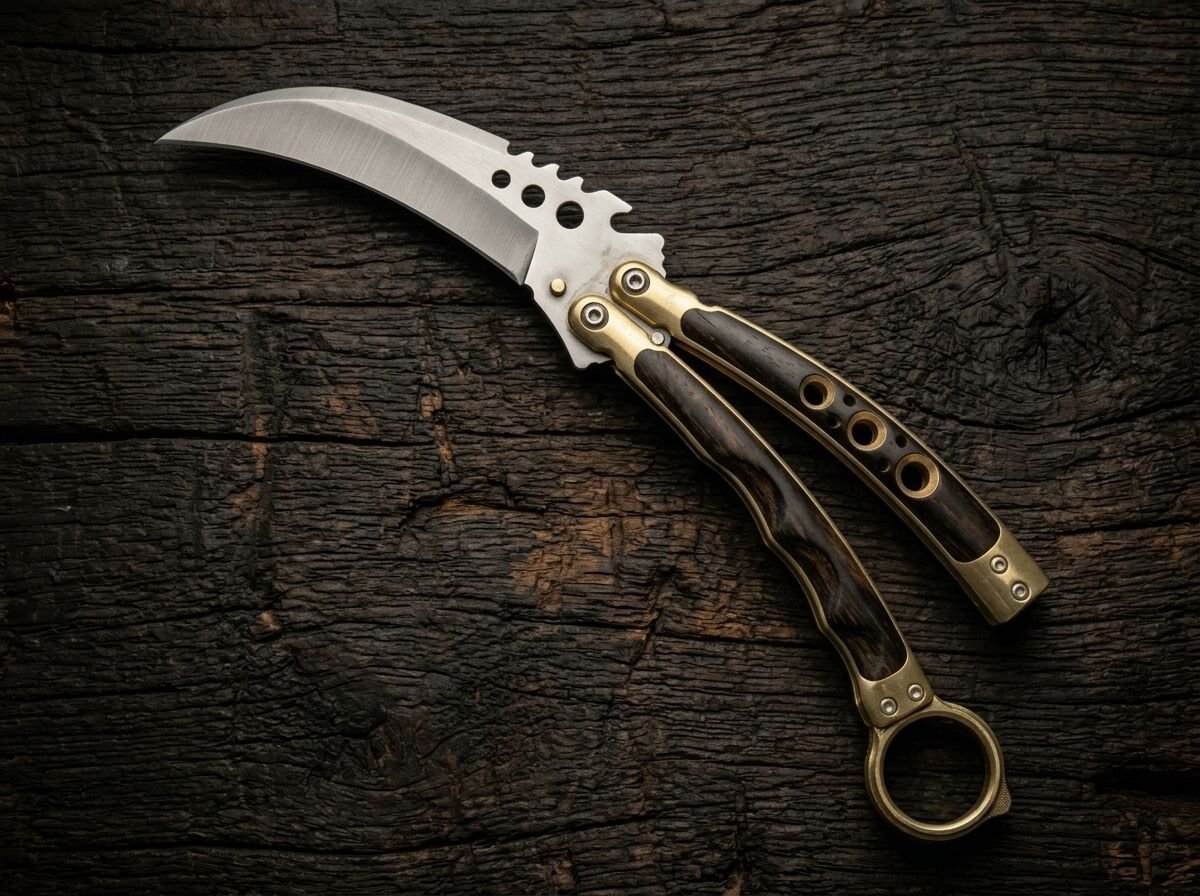
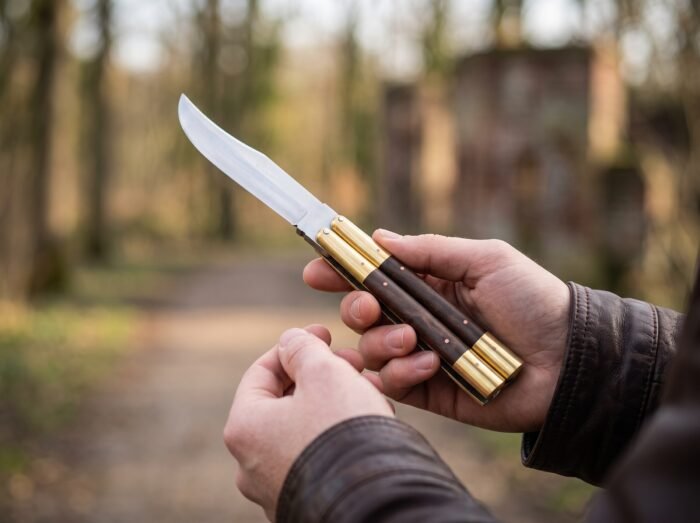
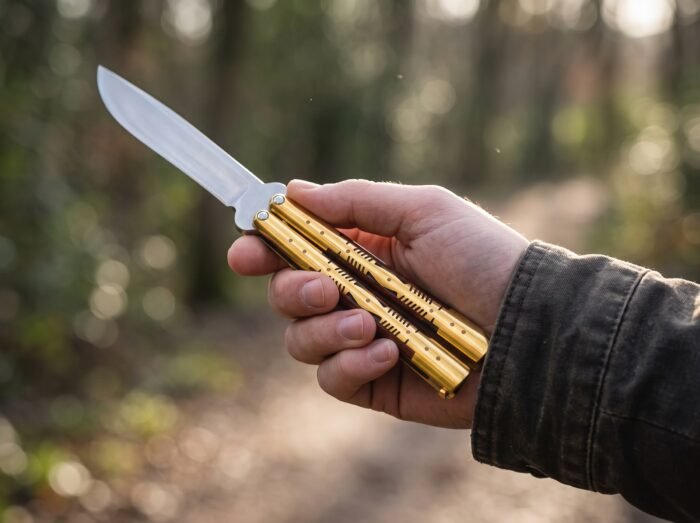
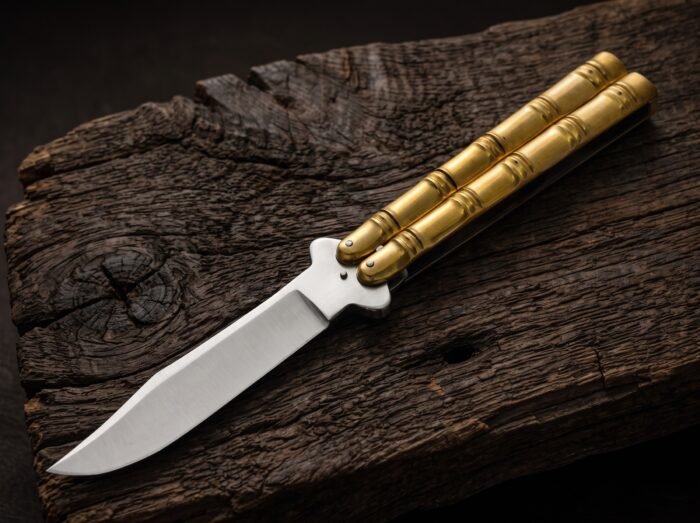
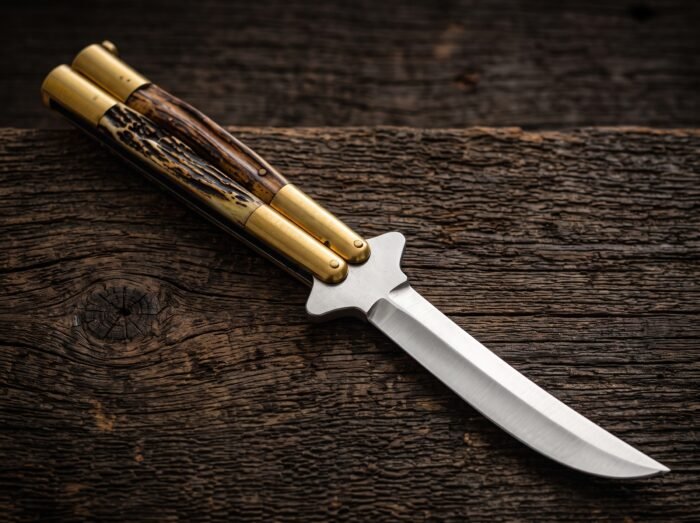
The BF-186 is a karambit balisong with wenge panels set into a brass channel frame, a brass ring, and a satin finished blade. It shares its wood with the BF-183 and almost nothing else, which is the interesting part.
Bolsters against a full frame
The BF-183 has brass bolsters: small blocks at the pivot end, with the wood carrying on to the butt and the ring fixed through it. This knife has a brass channel running the entire length, with the wood sitting inside it like a filling.
|
Bolsters (BF-183) |
Full frame (BF-186) |
| Structure |
Wood carries load at the butt |
Brass carries everything |
| Weight |
Lighter |
Heavier, more at the ring end |
| Feel |
Wood under most of the hand |
Brass edges under the fingers |
| Ageing |
Wood dominates |
Brass darkens and takes over |
| Looks like |
A modern folder |
A Batangas knife |
Neither is better. The frame is the traditional construction and it is more work, but a bolstered handle is lighter and puts more wood against your palm. Pick by which of those you want.
Satin, and why it is the underrated finish
Satin is directional. The blade is ground and then hand finished in one direction so the surface carries fine parallel lines, and light travelling across it produces a soft even sheen rather than a reflection.
It sits precisely between the two finishes people usually argue about. A mirror shows every fingerprint and every new scratch. A stone wash hides everything, including good work. Satin shows the grind lines, which is what you want to see, and forgives ordinary handling, which is what you want forgiven.
It is also the finish that ages most gracefully. Scratches on satin run in the same direction as the finish and disappear into it. Scratches on a mirror sit there forever, mocking you.
Wenge inside brass
Wenge is open grained and near black, brass is smooth and bright, and putting them directly against each other is a hard join to get right. The wood has visible pores running to the edge and the brass has none, so any gap at all reads as a gap.
The panels are fitted proud and then filed down flush with the brass as a single surface, so your thumb crosses the join without finding it. That is the part of this handle that takes the time.
Over the years the brass will darken towards brown while the wenge stays where it is, and the contrast will soften. It looks better then.
Weight, and what it does to the swing
A full brass frame is noticeably heavier than bolsters, and most of that extra mass is out towards the ring. On a karambit balisong that slows the swing down and makes it feel more deliberate.
Whether that is good depends entirely on you. If you like a knife that moves quickly, buy the bolstered one. If you like knowing exactly where the handles are through the whole arc, this is the one.
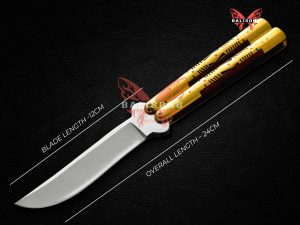
Specifications for this wenge and brass karambit balisong
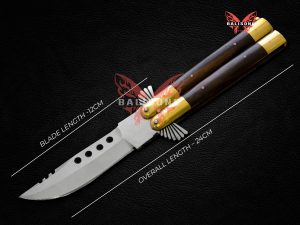
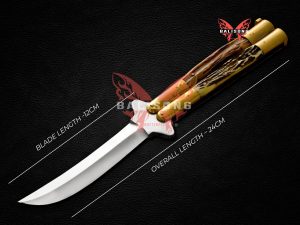
| Overall length |
24 cm |
| Blade length |
12 cm |
| Blade |
High carbon steel, satin polished |
| Hardness |
58-60 HRC |
| Handle |
Wenge wood in a brass frame, brass finger ring |
| Sheath |
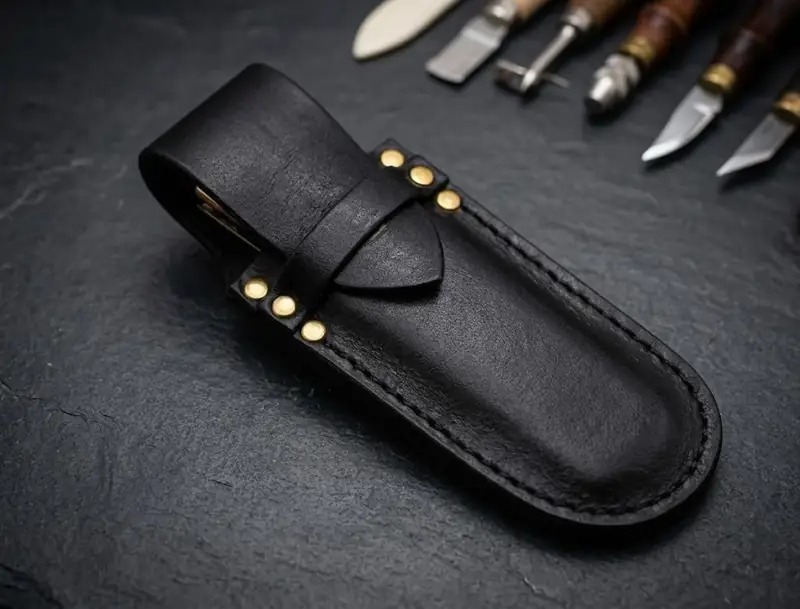
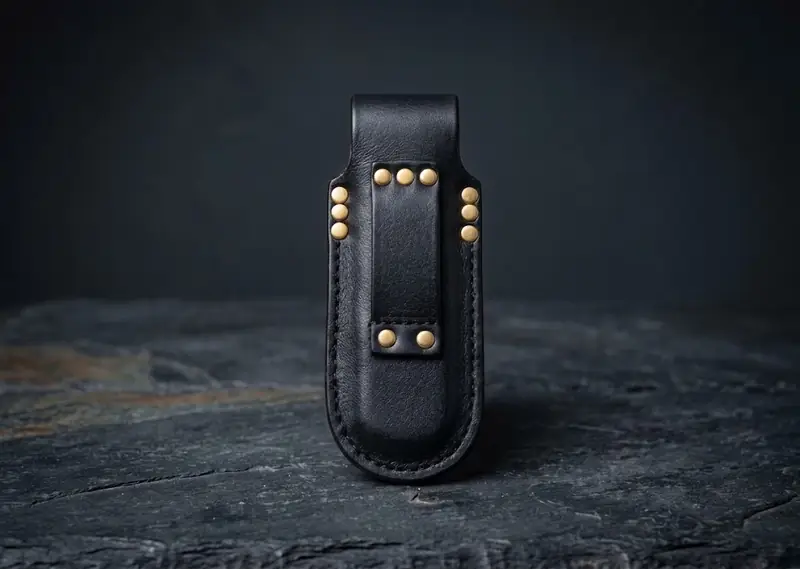
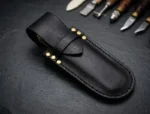
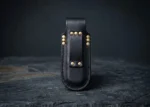
Fitted leather, included |
Ordering the BF-186
Sharpened, tuned and checked by hand, with a fitted leather sheath and a gift box. A drop of mineral oil on the wenge once a year, and nothing else.
Or take it as a trainer instead. Identical frame, identical weight, no cutting edge, and the price does not move.
Laser engraving is $29, chosen on this page. Free shipping inside the United States, flat $49 worldwide.
A full brass frame and a pair of small bolsters are structurally different things, and our guide to balisong anatomy explains the terms for each part of the handle in more detail. The Ulap sits in our karambit balisong range. The Ningning carries the same wenge wood on bolsters rather than a full frame, for a lighter knife with more wood against the palm.


Susan Marsh –
This is exactly what I wanted and then some. Even the smaller details like the pivot screws are finished well. So worth it.
Wyatt Kelly –
Perfect knife. Perfect action. No complaints. Blade came shaving sharp straight out of the box. Love that it’s rooted in real Filipino balisong tradition but made and shipped from the US. Highly recommend this one to any flipper.
Grace Evans –
Happy with this one for the most part. Blade is sharp but not quite razor sharp out of the box. Not my first Balisong Butterfly order and it held up to their usual standard. Would still tell others to give this a try.
Lisa Wood –
Overall a good buying experience. Latch works fine, just a bit stiff at first. Good product. Just not quite perfect.
Cynthia Hughes –
My buddy was speechless when he tried flipping this. Blade came shaving sharp straight out of the box. Great buy overall.
Lisa Nelson –
First rate craftsmanship on this one. Blade came shaving sharp straight out of the box. Great buy overall.
Rafael Alvarez –
I collect balisongs and this one is impressively made.
Mark Anthony Fox –
Got this for a Christmas present and now I want one for myself too. Comes with a nice pouch which is a nice touch. Already added a few more items from this maker to my cart.
Walter Anderson –
Got this for a Christmas present and now I want one for myself too. Not my first order from Balisong Butterfly and it won’t be my last.
Brian Barrett –
This punches way above its price point. Pivots feel dialed in with zero blade play. Would not hesitate to order again.