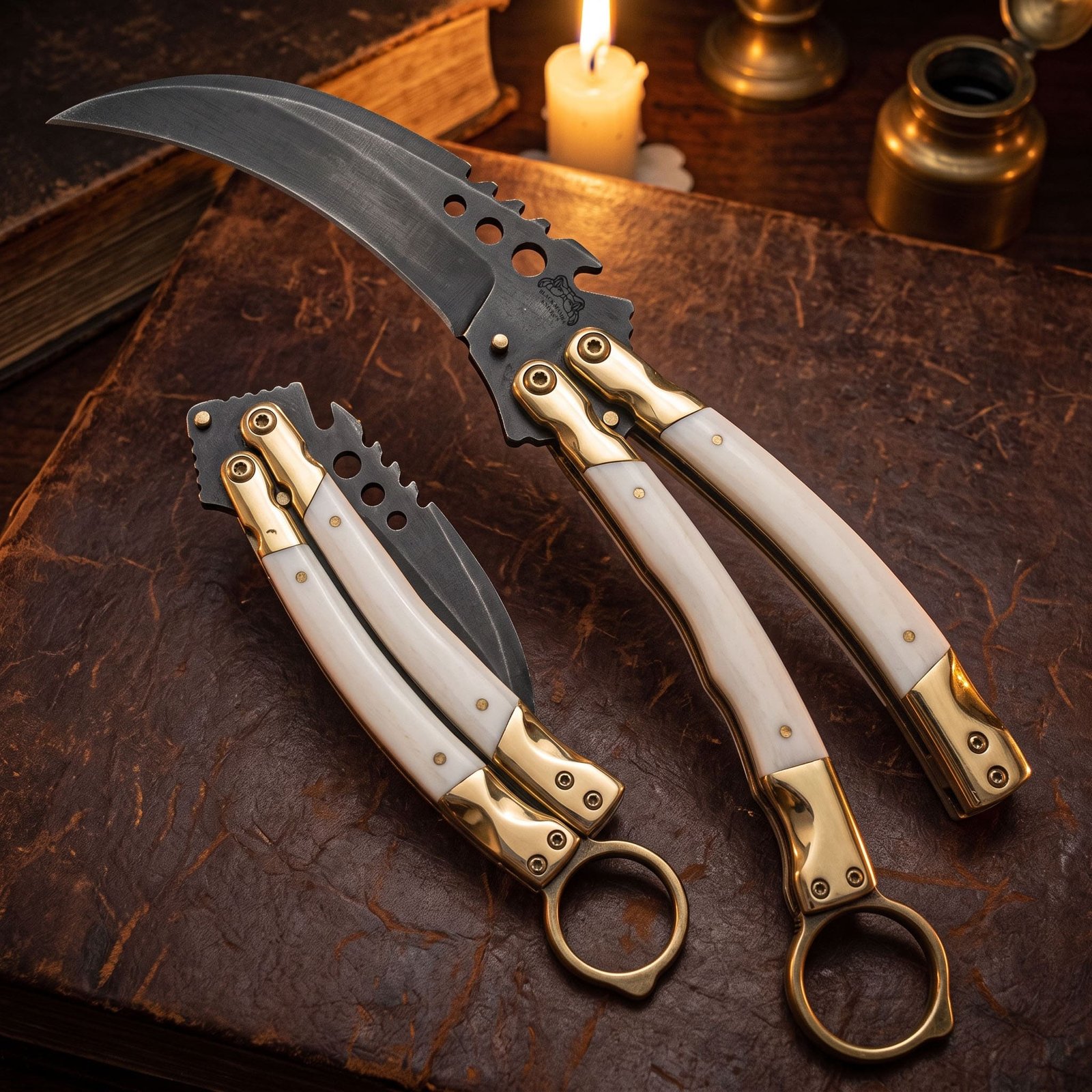
The BF-182 is a karambit balisong with buffalo bone panels in a brass channel frame, a brass ring, and a blade left with its forge finish on. $245.
Why the blade is dark and the handle is not
This is the highest contrast combination in the range and it is deliberate. The blade carries forge scale, the blue black oxide that forms on the surface when steel is worked at heat, and the handle is bone, which is close to white.
A knife built like this is very easy to read from across a room, which is a thing that matters more than people admit. The eye separates the working part from the held part instantly. Compare it to an all steel knife where the two blend into one silhouette.
The edge bevel is ground back to bright steel because scale cannot be left where the apex is, and on a curve that bright line traces the whole belly. It tells you exactly where the geometry changes.
Bone, and why it is not ivory and not plastic
Buffalo bone is mineralised collagen, dense, hard, and considerably tougher than most people expect. It takes a polish, it does not soften in humidity, and it shrugs off knocks that would dent a wooden panel.
You can tell it from plastic in a second. Real bone has fine dark channels running through it, the remains of the blood vessels that fed it, and they run in the direction the bone grew rather than in a decorative swirl. Hold it to a light and the thin edges glow faintly. Plastic does neither.
You can tell it from ivory too, and it matters that you can. Ivory shows a cross hatch pattern of fine curved lines where bone shows straight channels and small pits. We do not work in ivory, and any workshop offering it cheaply is either lying or has a legal problem coming.
Bone against horn
Both come off a buffalo and they behave differently. Horn is keratin, so it is warmer to the touch, slightly flexible, and it can crack along the grain if it dries out for years. Bone is mineral, so it is cooler, harder, completely rigid, and it does not crack from dryness at all.
What bone objects to is being soaked and then dried repeatedly, and being taken from cold to hot water suddenly. Neither is difficult to avoid. Rinse it warm, dry it, and it will need nothing else for the rest of its life, including oil.
Brass, and why the ring is brass too
On the traditional frames we keep the ring in brass rather than switching to steel, and the reason is that a steel ring on a brass frame looks like a repair. It reads as a part that came from somewhere else.
Brass is softer than steel, so the ring will pick up marks faster. It will also darken at the same rate as the frame, which is the point.
Specifications for this bone and brass karambit balisong
| Overall length |
24 cm |
| Blade length |
12 cm |
| Blade |
High carbon steel, forge finish with polished edge |
| Hardness |
58-60 HRC |
| Handle |
Buffalo bone in a brass frame, brass finger ring |
| Sheath |
Fitted leather, included |
| Price |
$245 |
Ordering the BF-182
Sharpened, tuned and checked by hand, with a fitted leather sheath and a gift box.
Or take it as a trainer instead. Identical frame, identical weight, no cutting edge, and the price does not move.
Laser engraving is $29, chosen on this page. Free shipping inside the United States, flat $49 worldwide.


Reviews
There are no reviews yet.