
Blog
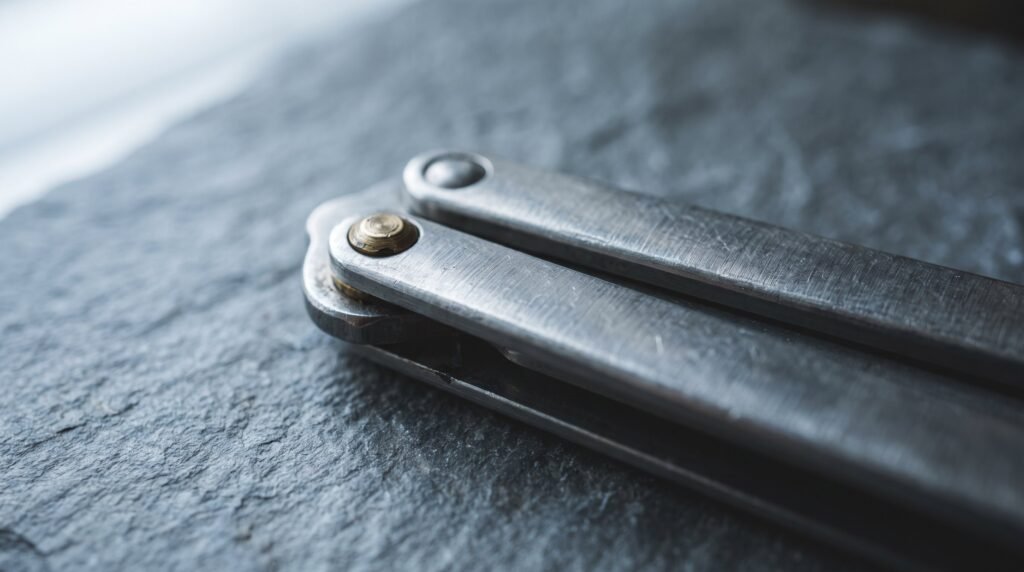
Titanium is the default handle material for modern competitive flipping, and for good reasons: it is roughly half the weight of steel for the same volume, it does not corrode, it flexes and springs back instead of taking a permanent bend, and it can be milled into a one piece channel handle. It is also expensive, slow to machine, and completely unrelated to how a Filipino balisong was traditionally built. We do not make titanium handles, and this article explains both why titanium earned its reputation and why we still reach for horn.
Quick answer: titanium is the right choice if your priority is a light, weatherproof, machined channel handle for heavy trick flipping, and you should buy one from a shop that specialises in exactly that. It is the wrong choice if you want a hand made Filipino balisong with a material you can feel the age of. We build in rosewood, wenge, buffalo horn, stag, bone, micarta, mother of pearl and steel, because those are the materials the knife was born with and the ones that reward hand work rather than a CNC program.
What titanium actually gives you
The titanium used in knife handles is almost always an alloy rather than the pure metal, most commonly the aerospace grade with aluminium and vanadium in it. That alloy is the interesting one: strong, light, and stiff enough to hold a thin section without deforming.
Three properties matter for a balisong. It is about 40 percent lighter than stainless steel for the same shape. It forms a self healing oxide layer the instant it meets air, so it does not rust, ever, under any conditions you will encounter. And it has a lower stiffness than steel, meaning it flexes further before it yields and returns to shape rather than staying bent.
That last property is why titanium is the standard material for frame locks in folding knives. It is also why a dropped titanium handle usually survives an impact that would put a permanent set into a thin steel one.
Weight, and what it does to the flip
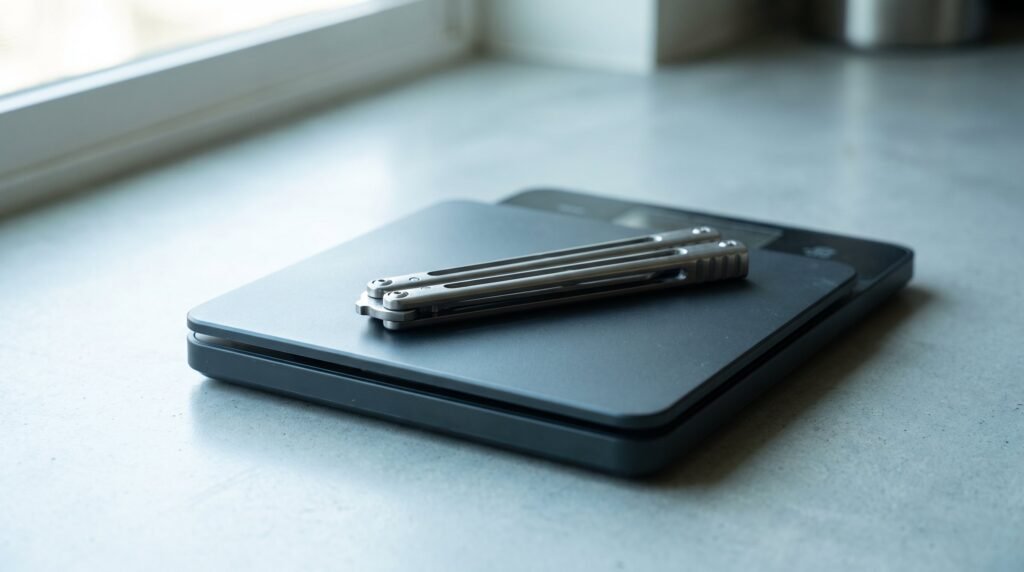
Handle weight decides where the balance point sits, and the balance point decides how the knife behaves in the hand. Titanium sits neatly between the heavy end and the light end of the material list: heavier than wood or micarta, considerably lighter than steel.
The practical result is a knife that has real substance in the hand without the swing weight of steel handles. For someone doing long trick chains, that matters cumulatively. A knife that is slightly heavier does not feel heavier in the first minute, it feels heavier in the fortieth.
What titanium does not do is change how the blade behaves. Blade shape and blade weight still drive the momentum through a swing, which is a bigger factor than most handle debates admit, and we cover that in our breakdown of the eight blade shapes and how each one carries weight.
Corrosion, spring and everyday durability
Titanium’s corrosion resistance is genuinely absolute in normal conditions. Sweat, rain, salt air, a summer of daily pocket carry with damp hands: none of it registers. Steel handles need drying and occasional oil. Titanium needs nothing.
It scratches, though, and it scratches more easily than hardened steel because the surface is softer. Anodised titanium scratches through its colour layer, which shows as bright metal in the marks. Owners generally accept this because the scratches accumulate into a used look rather than damage, but anyone expecting a mirror finish to survive flipping is going to be disappointed by any material.
The spring property is the underrated one. Balisong handles get impacted on their edges thousands of times as the knife closes. A material that flexes and returns handles that better over years than a material that is simply hard.
How titanium machines, and why that shows up in the price
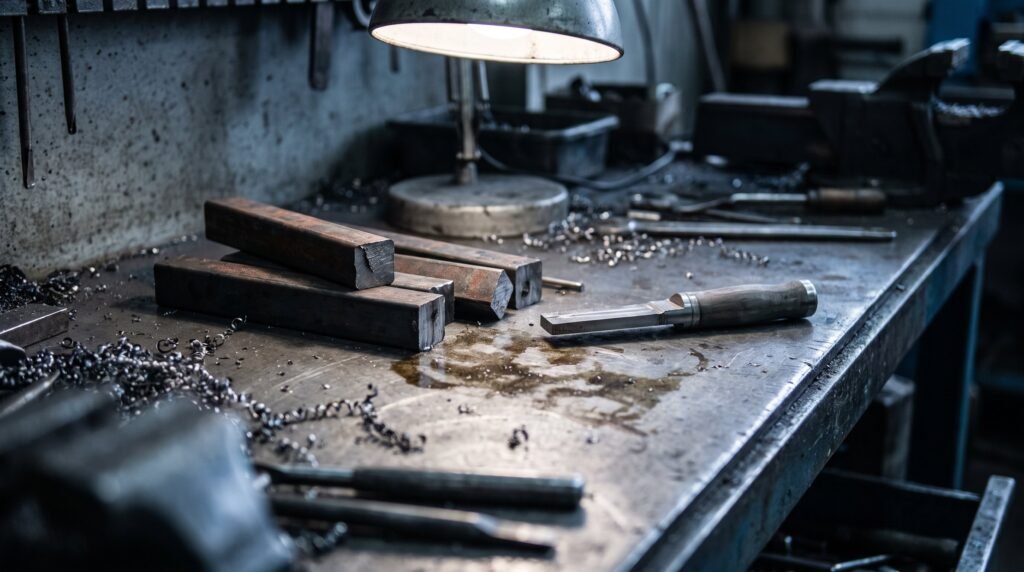
Titanium is difficult in a specific and irritating way. It is gummy rather than brittle, so it does not chip away cleanly, it smears. It conducts heat poorly, which means the heat generated by cutting stays right at the tool edge rather than dispersing into the workpiece, so tools wear fast. It work hardens if the cutter dwells, meaning a hesitation makes the next pass harder than the last. And it galls against tooling.
Then there is the swarf, which is genuinely flammable. Fine titanium chips will ignite, which is a thing every shop that machines it plans for and every shop that does not machine it finds surprising.
All of that translates into slow feed rates, expensive tooling, and machine time. When you see a titanium channel balisong priced well above a comparable knife in another material, most of the difference is not the raw metal. It is the hours of machine time and the cutters consumed getting there.
Where the flipping community’s preference came from
Modern balisong flipping grew up alongside a specific construction method: the channel handle, milled from a single block so the blade sits in a machined slot rather than between two sandwiched slabs. Channel construction is stiffer, has no liner joints to work loose, and gives a cleaner internal surface for the blade to travel in.
Channel construction wants a material that can be milled accurately from solid and still be light enough to hold. That is a description of titanium. Steel is too heavy for a channel handle of that section, aluminium is too soft at the impact edges, and you cannot mill a channel from horn without it being fragile.
So titanium did not win a debate on merit against traditional materials. It won because it is the material that makes the construction method work, and the construction method suited a style of flipping that got faster, longer and more demanding through the 2010s. Once competitive flippers standardised on it, everyone learning from them wanted the same thing, which is how preferences usually spread.
Titanium versus steel versus wood and horn
| Property | Titanium | Steel | Wood (rosewood, wenge) | Buffalo horn | Micarta |
|---|---|---|---|---|---|
| Relative weight | Medium | Heaviest | Light | Light to medium | Light |
| Corrosion | Immune | Depends on grade, needs drying | Not applicable, but can swell | Not applicable, absorbs moisture | Immune |
| Behaviour under impact | Flexes, returns | Hard, can take a set | Dents | Slightly flexible, can gap at liners | Abrades, does not chip |
| Grip when hands are wet | Poor unless textured | Poor unless textured | Fair to good | Poor when polished | Best of the group |
| Warmth in hand | Cool | Coldest | Warm | Warm | Warm |
| Ages into character? | Scratches, stays modern | Polishes back to new | Yes, darkens beautifully | Yes, deepens and polishes | Yes, darkens at contact points |
| Can be hand shaped? | Barely, wants CNC | Yes, slowly | Yes | Yes | Yes |
| Cost driver | Machine time and tooling | Material and finishing | Material grade and matching | Selection and matching | Low, it is the sensible option |
| Best suited to | Heavy trick flipping | Weight, durability, sound | Daily carry and traditional builds | Traditional Batangas character | Hard daily use |
Why we do not build titanium handles
The honest reason is that titanium belongs to a different way of making knives. A titanium channel handle is a CNC part. It is designed in software, cut by a machine, and finished by hand afterwards. Done well it is excellent engineering, and the people who do it well deserve the reputation they have.
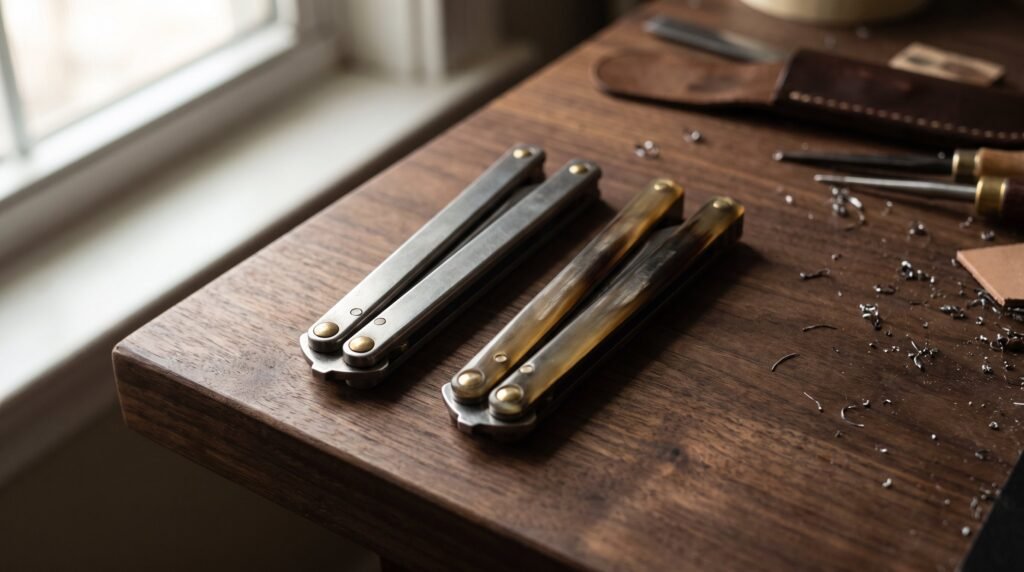
What we do is the older process: material selected by hand, scales fitted individually to liners, pins peened rather than screwed, and the whole handle shaped as one continuous surface so you cannot feel the joint with a fingernail. Buffalo horn is not just an aesthetic choice, it is the material in the knife’s name, since baling sungay means folding horn and the original Taal knives used carabao horn scales. We go into that lineage in our piece on the original Batangas balisong.
There is also a plain workshop answer. Machining titanium properly needs different equipment, different tooling and a different skill set from the one this shop has spent years building. We would rather make an excellent horn or micarta knife than a mediocre titanium one, and if we started tomorrow the first year of them would be the mediocre ones.
When titanium is genuinely worth chasing
Buy titanium if any of these describe you.
- You flip for hours at a time and want the lightest handle that still feels solid.
- You want channel construction specifically, with bearings and zen pins, tuned for aerials and long trick chains.
- Your hands sweat heavily and you want a material that ignores it completely without any care routine at all.
- You want a knife you can anodise in a colour, which is something titanium does and steel does not.
None of that is a compromise, it is a different set of priorities, and a titanium channel knife bought from a maker who specialises in them is a genuinely fine object. We would rather tell you that than pretend our material list covers every case.
When a horn or micarta knife serves you better
Choose one of ours if you want a knife that was made rather than programmed, and if you want to hold something that is warm in the hand in February. Micarta in particular is worth taking seriously by anyone who assumes titanium is automatically the practical option: it is lighter than titanium, it grips better when your hands are wet rather than worse, it costs less, and it takes drops without complaint.
Horn, stag, bone and pearl are the other direction: knives that look like objects with a history and get better with handling. They ask for a little care, which is set out on our knife care page, and they give back something a machined part cannot.
If you are still learning, handle material matters less than practice time, and the sensible move is a trainer in micarta before you spend money on anything exotic. Trainer or live blade, same price, chosen above the Add to Cart button, so you are choosing a knife rather than a category.
More reading. Titanium is one option among many, and the full handle materials comparison puts it beside horn, wood, brass and G10. If the reason you are looking at titanium is how a knife sits in the hand, read weight and balance first, then browse the custom balisongs.
Frequently asked questions
Is titanium stronger than steel?
Not in absolute terms. Hardened knife steel is harder and stiffer. Titanium’s advantage is strength for its weight, plus the ability to flex and return instead of taking a permanent bend. For a handle those properties matter more than raw hardness.
Why is titanium so expensive in knives?
Mostly machine time. It cuts slowly, it destroys tooling, and it needs careful process control to avoid work hardening. The raw metal is a smaller part of the cost than most people assume.
Do you plan to offer titanium handles?
Not currently. It would mean building a different kind of workshop around a different process, and we would rather keep improving the hand fitted materials we already work in. If titanium is what you want, buy it from a shop that lives and breathes CNC work.
Is micarta really lighter than titanium?
Yes, comfortably. Micarta is a resin and fabric laminate with a density closer to hardwood than metal. A micarta handled knife of the same dimensions will be lighter than a titanium one, which surprises people who assume the modern material must be the light one.
Does titanium make a balisong flip better?
It makes it lighter and it makes channel construction possible, and channel construction with good bearings does flip beautifully. But tuning matters more than material. A carefully tuned knife in wood beats a badly tuned one in titanium every time, which is a bigger part of the story than most spec sheets suggest.
Can titanium handles rust?
No. Titanium forms an oxide layer instantly and that layer protects the metal underneath. It will scratch and it will discolour if it gets very hot, but corrosion is not something you will ever have to think about.
What about aluminium handles?
Aluminium is lighter still and cheaper to machine, but it is soft at the impact edges, which is exactly where a balisong handle takes punishment. Anodised aluminium handles tend to look tired quickly on a knife that gets flipped seriously.
Which of your materials is closest to titanium in feel?
Steel handles for the weight and the sound, micarta for the practicality and the indifference to weather. Between the two of them you get most of what people actually want from titanium, arrived at from a different direction.
If you want to see how these materials behave in a finished knife, the steel, blade shape and handle are chosen individually on every listing across our hand made balisong range, or you can specify the whole build yourself on our custom build page.