
Blog
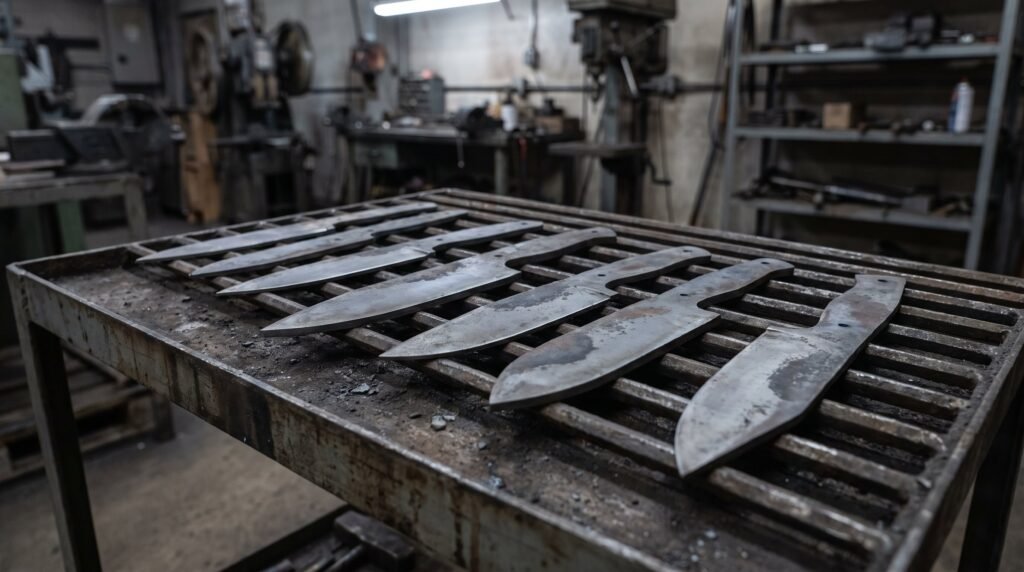
HRC is a number that tells you how far a diamond point sinks into a piece of steel under a known load. That is all it is. It is not a quality rating, it is not a measure of how sharp a knife gets, and a higher number is not automatically better, which is the part most listings would prefer you did not know.
Quick answer: the Rockwell C scale measures resistance to indentation. A knife blade in the high 50s to low 60s is normal for a folding knife. Below about 56 the edge rolls under load and will not hold a sharpening, above about 62 it starts chipping instead of deforming. Every blade we make lands at 58 to 60 HRC, which is the band where an edge holds properly and still forgives you when the knife hits something it should not have. Heat treat, not the name of the steel, decides where a blade ends up in that range.
What the Rockwell C scale actually measures
Hardness in metallurgy has a narrow meaning: resistance to permanent deformation from a localised load. Push something pointy into a surface with a known force and see how deep it goes. Deeper means softer. That is the whole concept, and it has not changed since it was standardised in the early twentieth century.
The C scale is one of several Rockwell scales, each using a different indenter and load for a different range of materials. The C scale uses a diamond and a heavy load, which suits hardened steel. Softer materials get tested on other scales entirely, which is why “HRC 45” on a bit of aluminium is a red flag about the person writing the specification rather than a fact about the metal.
What HRC does not tell you: how tough the steel is, how well it resists wear, how fine an edge it takes, or how it behaves in salt air. Those are separate properties, and a single number cannot carry them.
How the test physically works
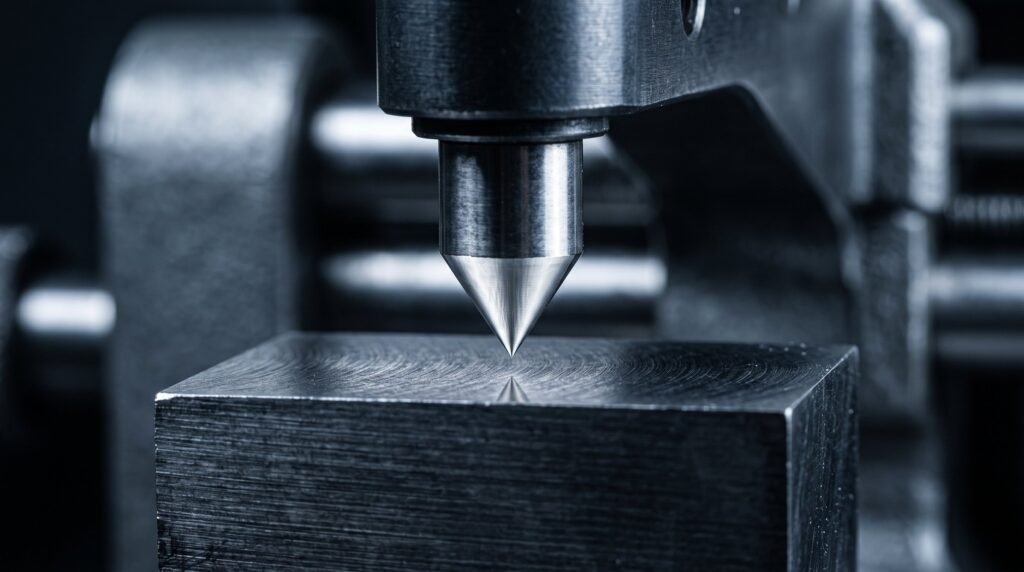
The indenter is a diamond cone with a rounded tip, ground to a precise angle. The test runs in two stages.
First a light preload presses the diamond into the surface, seating it and cancelling out any surface irregularity or dirt. The depth at that point is set as zero. Then the full load is applied, held briefly, and released back to the preload. The machine measures how much deeper the diamond went and stayed.
Each 0.002 mm of permanent depth costs one point on the scale, counted down from 100. So the difference between a blade at 58 and one at 60 is a few microns of depth, which is a genuinely small distance to be arguing about on the internet, and yet here we all are.
Two practical consequences. A real test leaves a small permanent dimple in the steel, so it is done on a tang, a spine, or a test coupon heat treated in the same batch, not in the middle of a finished blade. And the surface has to be flat, clean and properly supported, because a reading taken on a curved or springy surface is not a reading, it is a number.
The trade off nobody can engineer away
Hardness and toughness pull in opposite directions. Harder steel resists deformation, which means it holds a fine edge geometry under pressure. Tougher steel absorbs impact and flexes rather than fracturing. You can improve both a little with better steel and better process, but you cannot escape the relationship.
Too hard and it chips
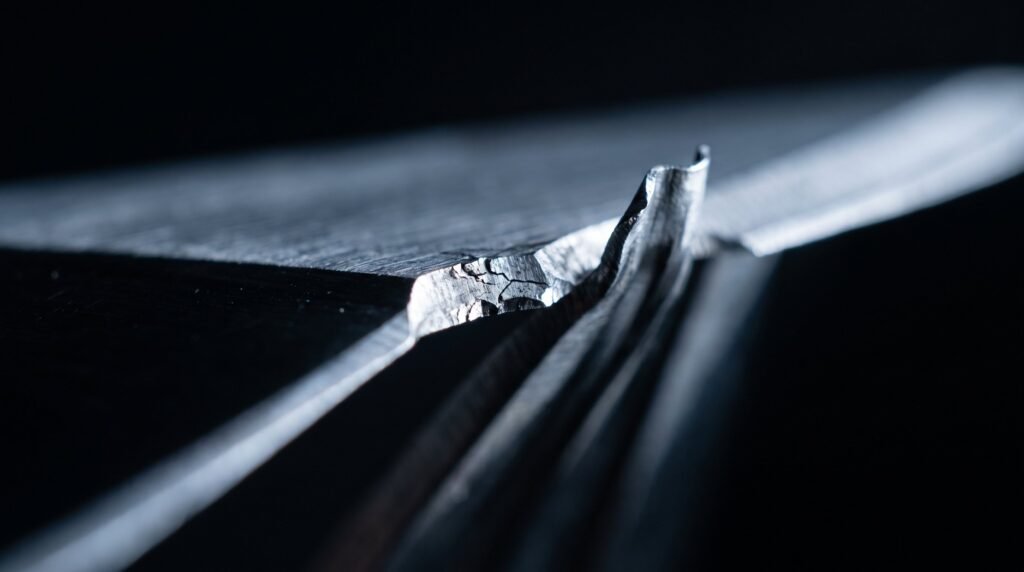
Push hardness up and the steel gets less willing to bend. At the very thin apex of a knife edge, where the geometry is measured in microns, that means an impact removes a piece of steel instead of pushing it aside. Chips do not straighten out. Fixing one means grinding the whole edge back to the depth of the damage, which is a real afternoon’s work.
You hear it before you see it. A blade that is too hard cuts with a slightly brittle, glassy feel and then one day makes a small tick against a staple or a hidden nail, and there is a crescent missing from the edge.
Too soft and it rolls
Go the other way and the apex deforms instead of breaking. The edge folds over to one side, which feels like sudden dullness even though no steel has been lost. A strop or a few passes on a steel will bring it back, and then it will roll again the next day, and the day after.
This is the failure mode of nearly every cheap knife. It is not that the edge wore away, it is that it was never hard enough to stay put under load. If a knife goes blunt within an hour and comes back with three strokes on a stone, you are holding soft steel.
Why 58 to 60 is the band for a folding knife
A balisong lives a particular life. It gets swung, closed against its own handles, dropped, and used as a knife in between. That combination wants an edge that holds, on a blade that will tolerate impact.
58 to 60 HRC is where those two demands meet for a blade of this size. At 60 the edge holds a long time and takes a fine finish. At 58 the steel is a touch more forgiving of abuse and easier to bring back on a stone. Two points does not sound like much, and in the hand it is the difference between a knife that wants care and a knife that shrugs.
Kitchen knives sometimes go higher, because a chopping board is a soft, predictable environment. Machetes go much lower, because their whole job is impact. A pocket knife sits between the two, which is the least glamorous possible answer and the correct one.
Heat treat decides where a blade lands, not the steel name
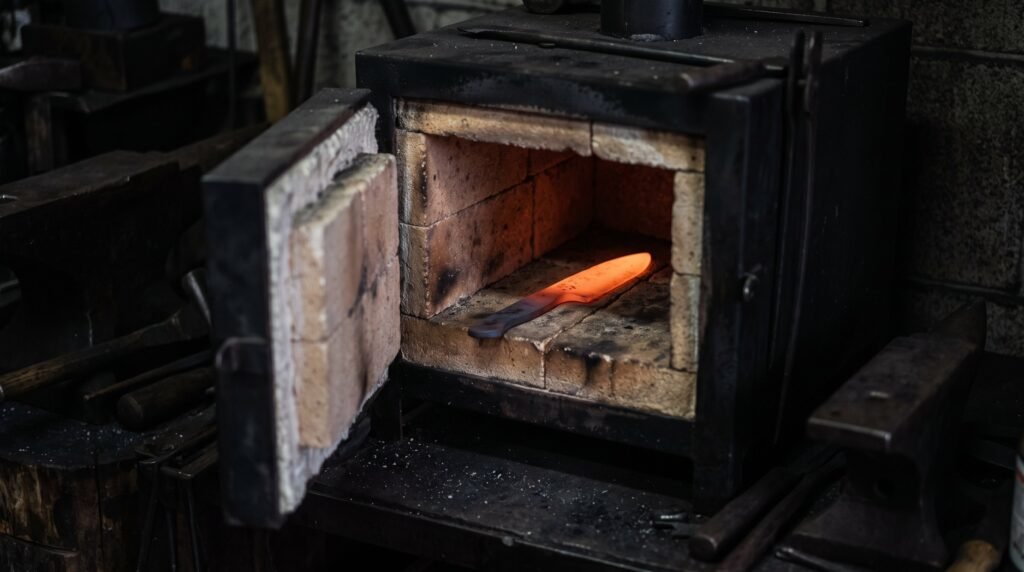
This is the part that gets skipped. The alloy sets the range a steel is capable of. The heat treat decides where inside that range your specific blade actually sits, and whether it got there with the microstructure it needed.
The process is a sequence of decisions with real consequences. How hot the furnace goes for that specific alloy. How long the blade soaks so the carbon and alloying elements dissolve properly. How fast the quench pulls heat out. Whether the blade gets a cold treatment afterwards to convert the leftover soft structure that high alloy steels retain. Then tempering, at a temperature chosen to trade a point or two of hardness for a large gain in toughness, done twice with a cooldown between.
Get the soak wrong and you have a blade that tests soft in a steel that should have been excellent. Rush the quench on a steel that needed speed and you get the same. Skip the temper and you get a blade at maximum hardness and minimum sense, which will chip if you look at it firmly.
Which is why “made from D2” tells you almost nothing on its own. D2 heat treated properly is superb. D2 heat treated by someone working to a price is a piece of expensive steel behaving like a cheap one. We put the practical differences between our steels side by side in D2 versus Damascus versus 440C.
HRC bands and what they actually mean
| HRC band | Typical use | Edge behaviour | Sharpening | What goes wrong |
|---|---|---|---|---|
| Below 50 | Machetes, axes, cheap import knives | Dulls quickly under any load | Very easy, and very frequent | Rolls constantly, will not hold geometry |
| 50 to 55 | Large choppers, some tools | Tough, sacrifices retention | Easy | Edge deforms on hard materials |
| 56 to 57 | Budget folders, some outdoor knives | Acceptable, needs regular touch ups | Easy | Noticeable edge rolling in use |
| 58 to 60 | Quality folding knives, our blades | Holds a working edge for a long time | Straightforward with decent stones | Very little, this is the balance point |
| 61 to 62 | Premium folders, some kitchen knives | Excellent retention, fine edge | Slower, wants good abrasives | Less forgiving of lateral force and impact |
| 63 and above | Specialist kitchen and razor steels | Superb retention in controlled use | Demanding | Chips rather than rolls, tips are vulnerable |
Why hardness numbers in cheap listings are usually fiction
A real Rockwell test needs a calibrated machine, a properly prepared flat surface, several readings averaged, and a technician. It also marks the piece. Nobody is doing that on a knife that sells for less than the cost of the box it ships in.
So the numbers get copied. You will see identical hardness claims across dozens of listings from different sellers, often on knives that are visibly the same product with different logos. You will see impossible pairings, like a hardness in the low 60s claimed for a steel described only as “stainless” with no grade, at a price that does not cover heat treating a blade properly, never mind testing it.
The tell is the same one that gives away fake Damascus and unnamed steel: precision where there should be a specification, and vagueness where there should be a number. A shop that heat treats its own blades will tell you the alloy, the hardness band, and what tempering regime it used. A shop that buys finished blades will tell you the number that was on the invoice.
What our steels do at 58 to 60
All five of the steels we work in are hardened into the same band, and they still behave differently, because hardness is one property among several.
- 440C at 58 to 60 is the balanced stainless choice. High chromium content gives it real corrosion resistance, the chromium carbides give decent wear resistance, and it comes back on a stone quickly. The sensible option for a knife that gets carried in a pocket and occasionally forgotten about.
- D2 is a semi stainless tool steel with a lot of large carbides, so at the same hardness it holds a working edge considerably longer than 440C. It also takes more effort to sharpen and it is not fully stainless, so it wants wiping down. Excellent steel with opinions.
- High carbon has a fine grain and no big alloy carbides to get in the way, which means it takes an extremely keen edge and comes back with very little work. It will patina and it will rust if neglected. Traditionalists accept this cheerfully.
- VG10 is a fine grained stainless with vanadium in it, which gives it the ability to take a very fine edge and keep it, plus good corrosion resistance. At 60 it is at a sensible ceiling: pushed harder it gets noticeably less tolerant of impact.
- Damascus takes its properties from the two steels welded into it, so it behaves broadly like good high carbon steel with the same care requirements, plus a pattern that goes all the way through the blade.
How to judge hardness without a tester
The file test is what workshops actually use, and you can do a rough version of it. A quality file is harder than a knife blade, so drawn across properly hardened steel it skates with a high, scratchy squeal and barely bites. On soft steel it catches and cuts immediately. Try it somewhere invisible, like the flat of the tang, because it leaves marks.
The other test is time. Use the knife for a fortnight and watch how it dulls. Steel that is too soft goes blunt fast and sharpens instantly. Steel that is too hard stays sharp beautifully and then loses a chip. Steel in the right band gets gradually less keen and comes back with ten minutes on a stone, which is exactly what we describe in our guide to sharpening a balisong.
More reading. Hardness only means something next to the steel it belongs to, so read it with D2 vs Damascus vs 440C. A harder edge also changes how you maintain it: see sharpening and rust and patina.
Frequently asked questions
Is a higher HRC always better?
No. Higher hardness buys edge retention and costs toughness, and past a certain point a folding knife starts chipping instead of dulling. The right number depends on what the blade has to survive, which for a balisong includes being dropped on a hard floor.
What HRC are your knives?
58 to 60 across every steel we offer: 440C, D2, high carbon, VG10 and Damascus. The alloy changes what that hardness feels like in use, but the band is consistent because it is the right band for this kind of knife.
Can you test hardness at home?
Not accurately. A calibrated Rockwell machine costs real money and needs proper surface preparation. The file test gives you a useful pass or fail on whether a blade was hardened at all, which is often the question that actually matters.
Does hardness affect how sharp a knife gets?
Not directly. Maximum sharpness is a function of edge geometry and grain structure, not hardness. Hardness affects how long that sharpness lasts. A fine grained steel at 58 can take a keener edge than a coarse grained one at 62.
Why do two knives in the same steel perform differently?
Heat treat. Soak time, quench speed, cold treatment and tempering all change the final microstructure, and two blades from the same bar can end up several points apart with different toughness. The alloy is the starting material, not the outcome.
What is the difference between hardness and edge retention?
Hardness resists deformation, wear resistance resists abrasion. Edge retention is mostly a product of wear resistance, which comes from hard carbides in the steel, and that is why D2 holds an edge longer than 440C at identical hardness.
Does a trainer blade get the same heat treat?
Yes. The steel, the hardening and the tempering are identical, since the only difference is that the bevels are not taken to a cutting edge. Trainer or live blade, same price, chosen above the Add to Cart button, and the same guidance applies in our trainer guide.
If you want to see what 58 to 60 HRC feels like in the hand, every blade in our hand made balisong range is hardened and tempered in our own workshop, with the steel named on every listing rather than left to your imagination.