
Blog
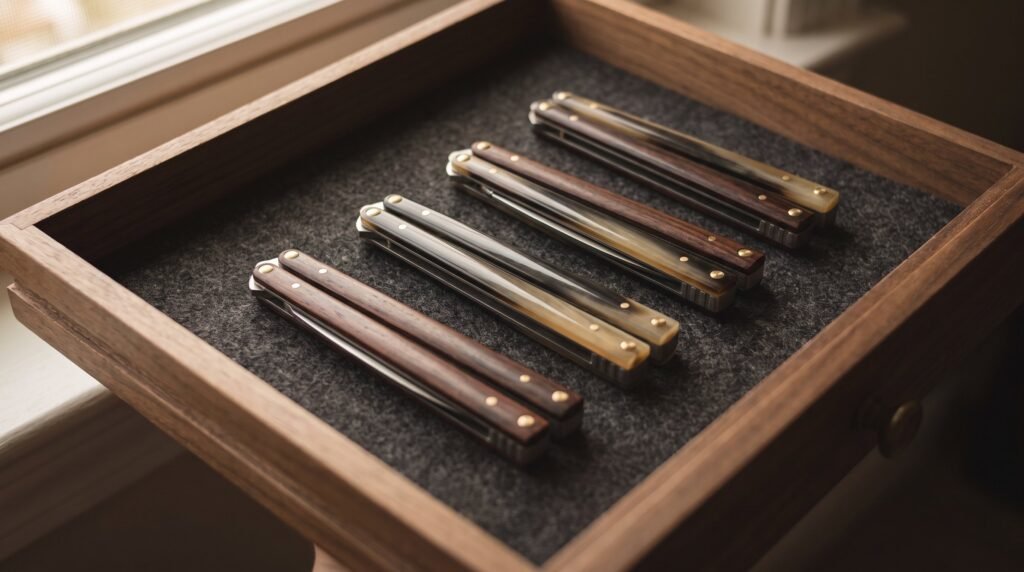
A balisong collection goes wrong in one predictable way: you buy three knives that are basically the same knife wearing different clothes. The fix is to make each of your first three purchases teach you something the last one did not. One to learn on, one to learn steel on, one to look at.
Quick answer: buy a forgiving trainer first, a live blade in a different steel second, and a display piece third. Do not buy your fourth until you can name what your third taught you. Collections almost never make money, and buying as if they will is the fastest route to owning things you do not like.
| What to buy | Why | Rough spend | |
|---|---|---|---|
| First | Traditional Batangas or Drop point, near traditional length, micarta or hardwood, trainer | Forgiving geometry, tough handle, no edge while you learn | Around $110 to $170 |
| Second | Different steel to the first, live blade, different handle material | Teaches you what steel and material actually do in the hand | Around $180 to $280 |
| Third | Damascus, stag, horn or mother of pearl, a shape you do not own | The one you take out to look at rather than to flip | Around $300 upwards |
The first knife: something you will actually flip
The most common mistake in knife collecting is buying the interesting one first. The interesting one sits in a box. The forgiving one gets picked up eleven times a day, and eleven times a day is how you get good.
What forgiving means in practice: a blade near the traditional veinte y nueve length of twenty nine centimetres open, a handle material that does not mind sweat, and no edge. Micarta or a dense hardwood like wenge both work. Rosewood is warmer in the hand and looks better as it ages.
Buy it as a trainer. Trainer or live blade is the same price and is chosen above the Add to Cart button, so choosing the trainer costs you nothing except the ability to cut things, which you do not want yet. Every flipper who learned on a live blade has a story, and every one of those stories has the same ending.
Shape matters less than people think at this stage, but a Traditional Batangas or a Drop point are the two that behave most predictably. Skip the Dagger and the Double edge for now, for reasons that become obvious the first time a Dagger trainer goes past your thumb from the wrong side. The blade shape guide covers all eight if you want the full picture, and our trainer range is where this one comes from.
The second knife: a different steel, on purpose
Your second knife has a job, and the job is education. If your first was 440C, your second should not be. Buy something that behaves differently so you learn what steel means with your hands instead of from a spec sheet.
All our steel is hardened to 58 to 60 HRC, so the difference you feel is in grain structure and carbide content rather than raw hardness. That difference shows up in three places: how the edge feels when it is fresh, how long it stays that way, and how much swearing is involved in bringing it back.
What each steel will teach you
- 440C: sharpens easily, forgives a wandering angle, dulls sooner. A great first live blade.
- D2: holds an edge notably longer and resists your sharpening efforts with the same enthusiasm. Teaches you patience and better stone technique.
- High carbon: the keenest edge of the group and it will patina. Leave a fingerprint on it after cutting an apple and you will have a permanent record of that fingerprint. Some people find this romantic and some people find it alarming.
- VG10: fine grained, clean, stainless, low drama. The steel that makes you understand why fine grain matters.
- Damascus: a pattern made of layers, and the working steel underneath still has to be good. Teaches you to ask what is actually in the billet.
Change the handle material too. If your first was micarta, make the second wood or horn, because how a knife feels in a cold hand at seven in the morning is a real property of the material and you cannot read it anywhere. The steel comparison guide has the technical version.
The third knife: the one you display
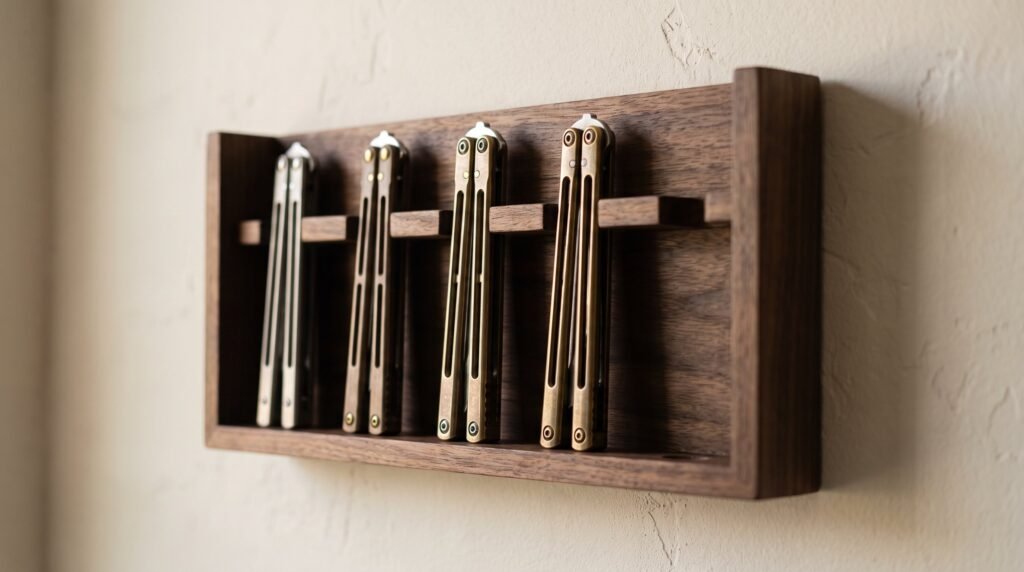
Now you get to buy the interesting one, because now you know what interesting means to you.
This is where Damascus, stag, buffalo horn and mother of pearl earn their place. Real Damascus is forge welded and the pattern runs through the steel, so a scratch reveals more pattern rather than exposing plain metal underneath. Acid etched imitation is printed on the surface and will polish away, which is a thing you learn about a knife roughly six months after you wanted to learn it.
Stag is the one that surprises people. No two pieces are the same because no two antlers are the same, and a maker matching a pair of scales for a single knife is genuinely picking through a pile looking for two pieces whose crown texture and colour agree with each other. That is why stag costs what it costs.
Pick a shape you do not already own. A Tanto if your first two were bellied. A Shark if you want something that does not look like anything else on the shelf. A Mini if you want a contrast in the hand. Our custom build page is the right place to start if you already know the specification, since everything is made to order anyway.
How to avoid buying five versions of the same knife
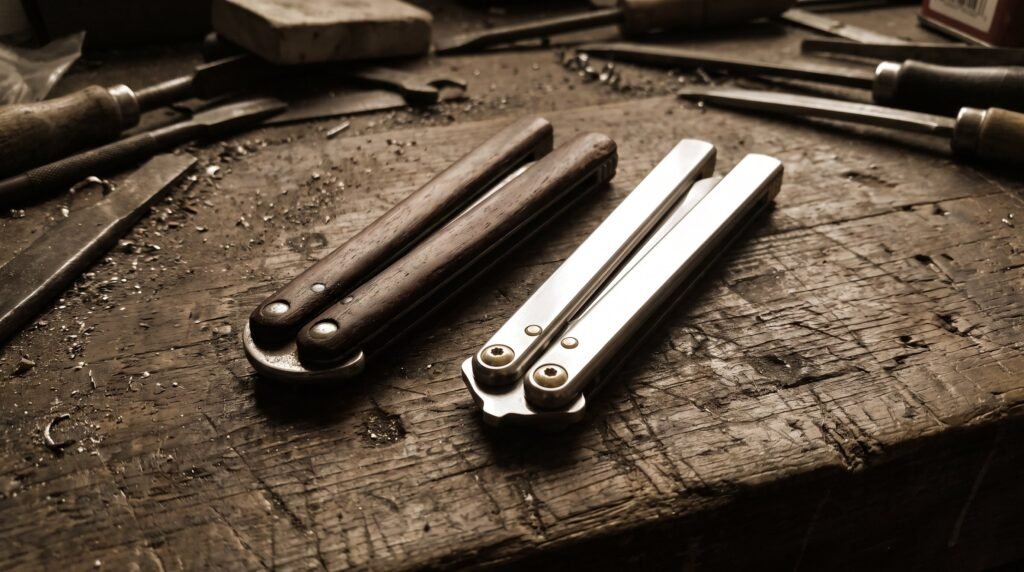
This happens to almost everyone and it happens quietly. You like a knife, so you buy another one you like, and the reason you like it is the same reason, and now you own a shelf that photographs as one object.
The fix is a rule: every new knife must change at least two of the four variables. The four are steel, handle material, blade shape and size.
| Variable | Change it to learn |
|---|---|
| Steel | Edge retention, sharpening feel, corrosion behaviour |
| Handle material | Grip in sweat, weight distribution, how it ages |
| Blade shape | Balance through a rotation, what tasks it suits |
| Size | Rotation speed, wrist load over a long session |
Two changes minimum. If you can only think of one thing that is different, you are buying the same knife again and you know it.
The other useful habit is a waiting period. Give yourself two weeks between wanting a knife and ordering it. Made to order means there is no artificial scarcity pressure on you, and about a third of the knives you want on a Tuesday evening you will not want by the following Tuesday.
Storage, humidity and what horn does when you are not looking
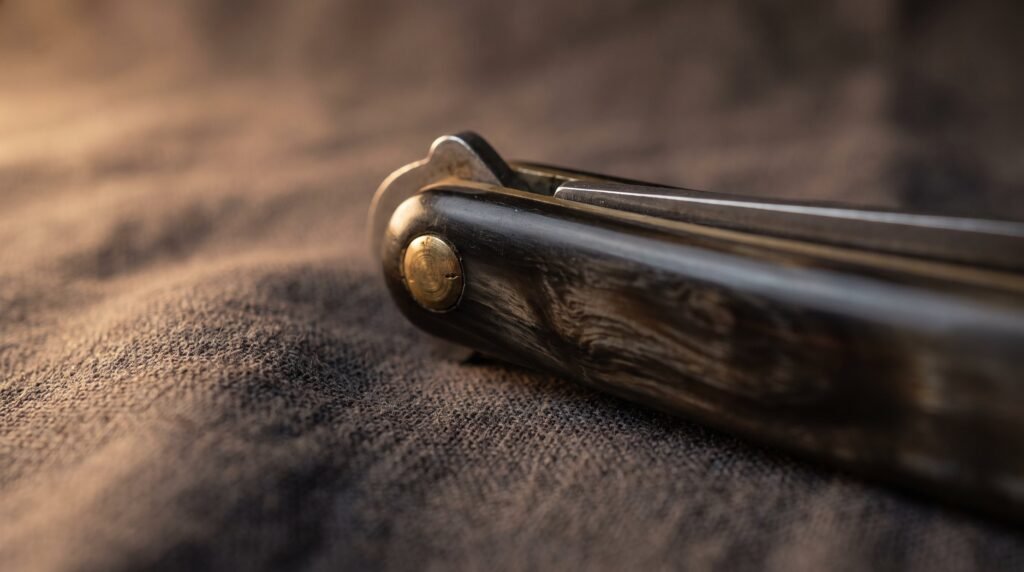
Natural handle materials are still, in a meaningful sense, alive to their environment. Horn, stag and bone all take on and give up moisture, and they move when they do it.
The failure mode is dry, not damp. A knife with horn scales stored through a winter in a heated apartment at twenty per cent relative humidity can shrink very slightly against the liners, and what you see is a hairline gap at the edge of the scale or a fine surface crack. It is not a manufacturing fault, it is the material doing what horn has always done. Somewhere between forty and sixty per cent relative humidity keeps everything happy.
Practical measures that actually work:
- Keep them out of direct sun and off radiators, windowsills and the top of a games console.
- Do not store them long term in the fitted leather sheath. Leather holds moisture and can mark a blade over months. Sheath for carry, open storage for the shelf.
- Wipe blades down after handling. Skin oil is mildly acidic and high carbon steel keeps score.
- Rotate what you carry and flip. A knife that never moves builds up dried lubricant in the pivots and feels gritty when you finally pick it up.
- Silica gel in a closed drawer prevents damp, but check it every few months rather than trusting it forever.
Our knife care guide covers pivots, cleaning and lubrication in more detail. The short version on pivots: light oil, sparingly, and do not overtighten a pivot to kill blade play if the real issue is a worn washer.
Keep a simple record, and keep it boring
You do not need a spreadsheet with forty columns. You need enough that in five years you can answer three questions: what is it, when did I get it, and what did I pay.
Five fields is plenty: model, steel, handle material, purchase date, price paid. Add a photograph of each knife on a plain background when it arrives, because a photograph taken on day one is the only honest record of what the finish looked like before you handled it.
Add one more column that most people skip: a single line on what you thought of it after a month. That column is what stops you buying the same knife twice, and it is far more useful than the price column will ever be.
If you have anything engraved, note what and where. Engraving is permanent, it is personal, and it is the detail you will forget the specifics of first.
Do balisong collections hold their value?
Mostly, no. Here is the honest version, without the auction house language.
Production knives from known makers hold a portion of their value on the secondhand market, typically well under what you paid, and they take time and effort to sell. Custom pieces with unusual materials do better. Engraved knives do worse, because your initials are not a feature to the next buyer. A trainer that has been flipped for a year is worth what a used trainer is worth, which is not much, because it has done exactly what it was made to do.
There is also the awkward fact that a balisong is a hobby item in a category with real legal restrictions in some states, which limits the buyer pool in a way that does not apply to, say, a wristwatch. That is a structural ceiling on resale, not a temporary market condition.
So buy knives because you want to own and use them. If one of them appreciates, treat it as a pleasant surprise rather than a plan. The people telling you butterfly knives are an investment class are, without exception, trying to sell you one.
What to never buy
Some of this is taste. Most of it is not.
- Anything listed as “stainless steel” with no grade. There are hundreds of stainless steels and they range from excellent to worthless. A seller who will not name the grade has told you which end of that range they are at.
- Damascus at a price that cannot possibly cover forge welding. Layered billets take time and fuel and a skilled hand. A $30 Damascus knife is an etched pattern on plain steel, and it will fade.
- Handmade claims with no maker. Handmade means hands. If there is no name, no workshop and no photographs of anyone actually grinding anything, the hands in question belong to a production line the seller has never visited.
- Live blades before you can flip. Buy the trainer version instead. Same knife, same price, no scars.
- Cast or zinc alloy handles. They feel light in a bad way, the pivots wear oval, and they cannot be tuned back into shape.
- Anything you are buying only because it is limited. Scarcity is a marketing tool. Made to order means nobody has to pressure you into a decision.
We wrote about the difference between a real Filipino balisong and a mass produced lookalike in why buy from us, and it is the single most useful thing to read before your first purchase.
Frequently asked questions
How many knives make a collection?
Three, if each one is different for a reason. Twelve near identical knives is a habit, not a collection. The number is not the interesting part.
Should my first knife be a trainer even if I am confident?
Yes. Confidence is not the same as landing a rollover, and the trainer costs the same as the live blade. Trainer or live blade, same price, chosen above the Add to Cart button. You lose nothing by starting unsharpened.
Is it worth buying the same model in two steels?
Once, deliberately, as a comparison. It is a genuinely good way to learn what steel does when every other variable is held constant. Doing it a third time is where it stops being educational.
How should I store knives I do not use often?
Out of the leather sheath, in a drawer or case at moderate humidity, wiped clean, with a light film of oil on the blade. Check them every few months and work the pivots so the lubricant does not dry into the bushings.
Will buffalo horn crack?
It can, if it gets very dry. Keep the room between roughly forty and sixty per cent relative humidity and it will be fine for decades. Horn has been used for balisong handles since the beginning, which is where the name baling sungay, folding horn, comes from.
Do engraved knives sell for less?
Usually, yes, unless the engraving is by a known hand. Engrave a knife you intend to keep, not one you are treating as a store of value.
What is a sensible spend for a first three?
Somewhere between $600 and $1,000 total across the three, spread over a year rather than a weekend. Our range runs from $109.45 to $549.45, so you can build the whole set well inside that if you want to.
Which single knife would you buy if you could only have one?
A Traditional Batangas in D2 with wenge or micarta handles, near traditional length, live blade if you can already flip. It does everything acceptably, it sharpens without a fight, and it is the shape the whole hobby is built around.
If you are at the start of this, begin with a trainer and give yourself a few months before knife two. If you already know exactly what the next one is, the shop lets you set steel, handle and blade shape, and every knife ships made to order with a fitted leather sheath and free US shipping.
More reading. If the third knife is going to be an old one, identifying a vintage balisong will save you money. For what things actually cost, see the price guide, then the handmade picks and the limited editions.