
Blog
You identify an old balisong by its construction, not its looks. Peened pins instead of screws, visible file and hammer marks, a hand-cut brass latch, horn or bone scales that have shrunk below the frame line, and even black patina rather than orange rust all point to age and hand work. Valuing one is harder: without documented provenance, most balisong valuations are educated guesses, and anybody who tells you otherwise is guessing more confidently.
That is the short version. What follows is the checklist we use on the bench when something old comes in, in the order we actually use it, plus an honest section on what these knives are worth and why that question is so much messier than it looks.
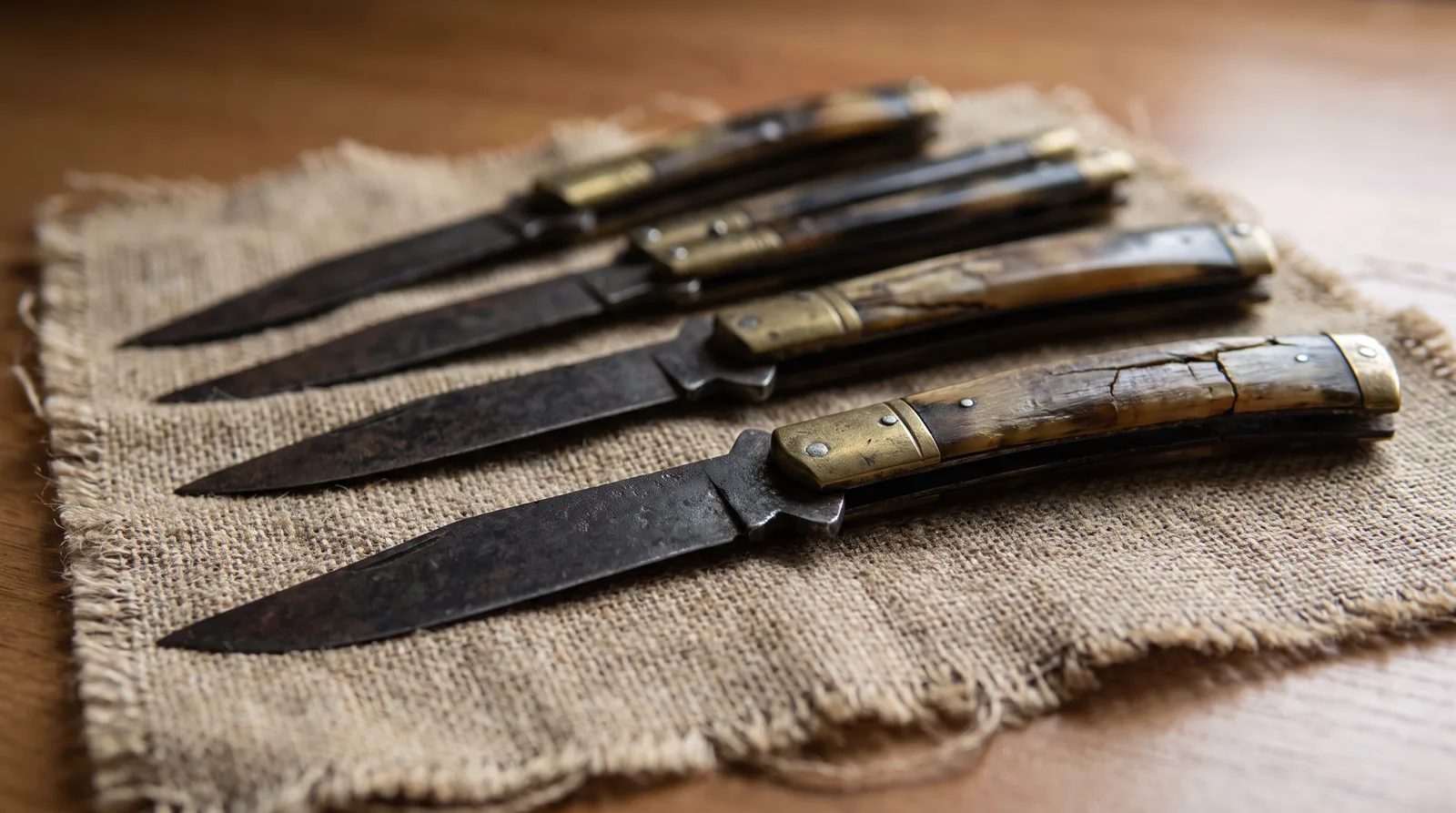
First: what “vintage” even means here
There is no agreed cutoff, and no balisong equivalent of a stamped date code you can look up. Collectors generally use three loose eras:
- Old Batangas village work. Hand-forged blades from recycled leaf spring or bearing steel, horn or bone scales, brass fittings, no marks. Impossible to date closely by inspection alone. Many were made for a domestic market that had no reason to record anything.
- The post-war souvenir wave. Widely described as beginning when American servicemen bought knives in the Philippines and carried them home. That account appears in Filipino writing about the Taal trade, but we have not found figures to support how large the trade actually was.
- The 1980s import boom. Collector writing describes balisongs of this era arriving from the Philippines, Japan and Taiwan, often carrying an importer’s mark rather than a maker’s. This is the era with the most identifiable stamps, and the easiest to research.
If you have a knife and no paperwork, you are almost certainly placing it in one of those three buckets rather than pinning a year. Accept that early and you will make better decisions about it.
The construction tells, in the order to check them
| What to look at | Points older or hand-made | Points newer or production |
|---|---|---|
| Pivots | Peened pin heads, slightly domed and never perfectly round, sitting flush or slightly proud | Torx or slotted screws, washers or bearings, uniform machined heads |
| Surface of the frame | Directional file marks, faint hammer texture, softened corners from hand sanding | Even machine satin or bead-blast; sharp uniform edges from CNC work |
| Latch | Brass, hand-cut, slightly asymmetric, filed to fit that one knife | Stamped or machined, dimensionally identical side to side |
| Scales and inserts | Carabao horn, bone, hardwood; grain runs through; shrinkage gaps at the edges | Moulded synthetic, G10, anodised aluminium, dimensionally perfect fit |
| Blade grind | Slightly uneven plunge lines, hand-finished; edge geometry varies along the blade | Mirror-matched plunges, consistent bevel width tip to ricasso |
| Spacers | Brass or steel spacers pinned into a sandwich frame, often filed to fit | Machined standoffs with threaded ends, or a milled channel with no spacers at all |
| Tang pin | Simple pin, sometimes visibly peened, occasionally replaced or missing | Precision-fitted pin, zero-tolerance stops, sometimes a tang-pin-less design |
| Surface colour | Even grey-black patina on carbon steel; brass gone dull gold-brown | Bright stainless, coated blade, or lacquered brass with no age at all |
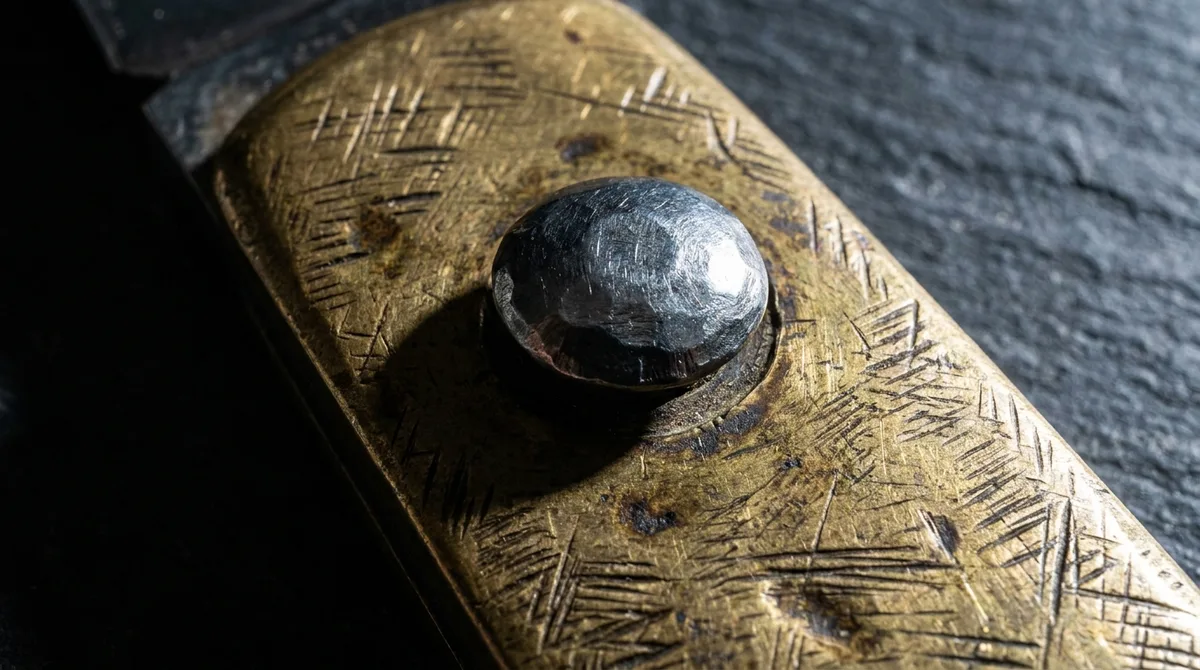
Peened pins versus screws
This is the single fastest tell and worth explaining properly. A peened pin is a rod driven through the handle and the tang, cut slightly long, then hammered so its ends spread into a rivet head. It cannot be undone without destroying it. Look closely at the pin head: peening leaves a slightly irregular dome with faint hammer facets, often with the tiniest ring of displaced metal around it. Machine-set pins are flatter and more uniform.
A screw means the knife was designed to be serviced, which is a modern intention. It does not automatically mean recent — some 1980s knives used screws — but it rules out the traditional village construction entirely. The making guide covers why a maker peens rather than screws.
One caution. A peened pin that has been drilled out and replaced with a screw is a common repair, and it is usually obvious: the hole is oversized, the countersink is clean and modern, and the screw head does not match the age of the metal around it. That repair is not a crime, but it is a value event, and it should be disclosed.
File marks, hammer texture and honest tool work
Hand work leaves directional evidence. Run a fingernail across the flat of an old frame under a raking light and you will usually find fine parallel file lines running one way, then a shallower cross-pattern from the next grit. Modern machine finishing leaves either a very even linear satin or a uniformly matte blasted surface with no directional history.
Hammer texture on a forged blade shows up as gentle undulation in the flat, most visible along the spine and near the ricasso. It is subtle. If a blade has aggressive dimpled “hand-forged” texture across the whole flat, be suspicious: on genuinely old work, forge marks are usually mostly ground away, because the maker was trying to make a good knife rather than advertise the process.
Horn, bone and wood: the tells the material gives you for free
Natural handle materials keep a record of time in a way steel does not.
Shrinkage. Carabao horn loses moisture over decades and contracts. On a knife that has aged, the horn insert sits very slightly below the surrounding brass, and you can feel a fine step with a fingernail. There is often a hairline gap at one end of the pocket. This is one of the harder things to fake convincingly and one of the most reliable indicators of real age.
Checking. Horn and bone develop fine surface cracks, usually running with the grain, from repeated humidity cycling. Fine, shallow and irregular is age. Deep, straight and evenly spaced is damage or a bad blank.
Colour depth. Old horn goes translucent at thin edges and picks up a warmth in the honey-to-black range. Old bone yellows unevenly, and yellows more where a hand held it. Uniform colour throughout usually means dyed or modern.
Wear pattern. A knife carried for thirty years wears where fingers go. If the wear is even across every surface, it has probably been tumbled or wire-wheeled.
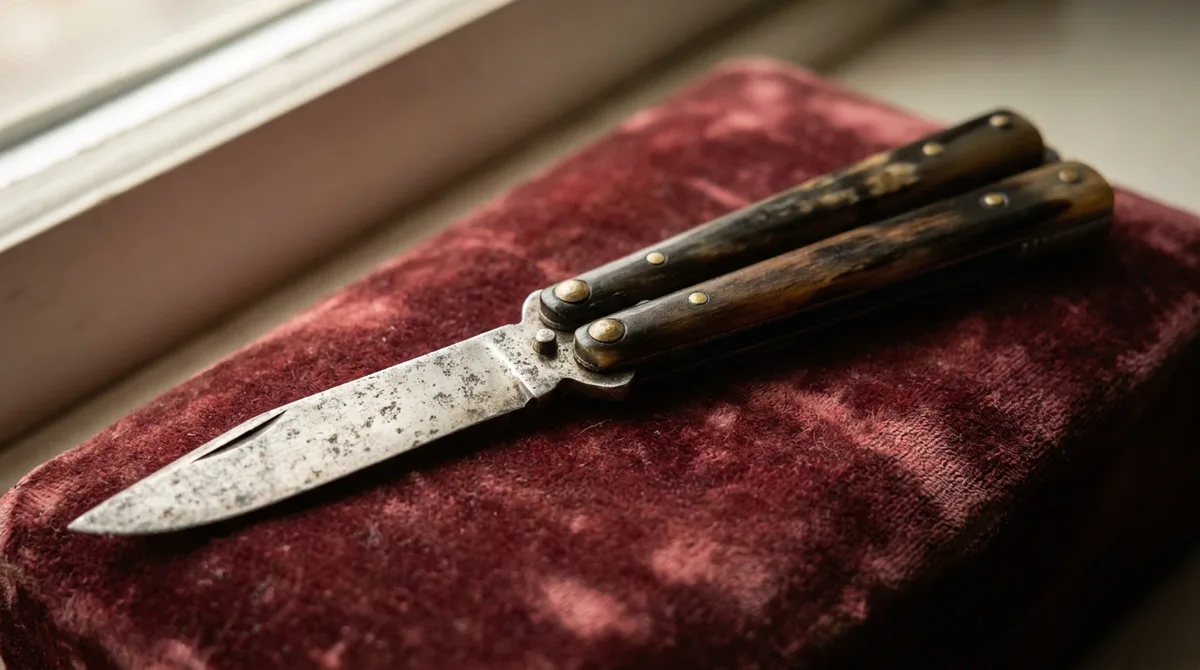
Patina versus rust, and why the difference is money
Patina is stable black or grey-blue iron oxide sitting tight to the steel. It is protective, it is desirable on old carbon steel, and it should not come off on a cloth. Rust is orange or red, it is porous, it lifts, it leaves a pit underneath, and it is still eating the knife while you look at it.
Under magnification the difference is obvious: patina follows the surface, rust sits on top of it in a crust. Rub gently with a dry cloth. If colour transfers, it is active rust and it needs stabilising. If nothing moves, leave it alone.
The expensive mistake is treating patina as dirt. Bright-polishing an evenly patinated old blade removes decades of surface history in about four minutes and takes a meaningful part of the value with it. If you must deal with active rust, do the least possible: oil, a light touch with something soft, and stop. The knife care page covers routine maintenance on carbon steel.
Maker marks, and why most old Batangas knives have none
Expect no mark. That is the normal condition, not a red flag.
The traditional Batangas workshops produced knives for a domestic market through a division of labour in which one person forged, another sharpened, another made handles and another assembled. Published accounts of the Taal trade describe exactly that arrangement. A knife made that way has no single author to stamp, and no commercial reason to carry a name in a market where the town itself was the brand.
Marks turn up mainly on export-era knives. Collector writing on the 1980s balisong boom describes knives imported into the United States carrying importer or brand names — Taylor Cutlery and Valor are two frequently cited in that literature — alongside country-of-origin stamps required for import. We are relaying published collector accounts here rather than examining those knives ourselves, so treat specific attributions as a research starting point and verify before you pay for one.
Collector writing also distinguishes a Batangas handle layout, with the latch on the bite-handle side, from a Manila layout with the latch on the safe side. That is a useful sorting heuristic. We would not treat it as proof of where a knife was made, because latch placement is a design choice any workshop can copy.
Grading condition without kidding yourself
| Grade | What it looks like | What it means for value |
|---|---|---|
| Mint / unused | No wear on pivots or latch, factory or original finish intact, scales unshrunk | Rare and suspicious in old knives. Verify it is not a modern build before paying a premium |
| Excellent | Light handling marks, tight pivots, full original finish, no pitting, all parts original | Top of the realistic range for a genuinely old knife |
| Very good | Even patina, minor scale shrinkage, small handling dings, everything original and working | The condition most desirable vintage examples are actually in |
| Good | Visible wear, some pitting, slight pivot play, scales checked but sound, latch works | A knife to own and enjoy rather than an investment piece |
| Fair | Deep pitting, cracked or missing insert, sloppy pivots, latch bent or non-functional | Parts value, or a restoration project you will not get your money back on |
| Restored / modified | Repinned, rescaled, re-ground, polished bright, screws replacing pins | Judged as a user knife. Originality premium is gone and does not come back |
What restoration destroys
Every one of these is reversible in appearance and irreversible in value:
- Polishing off patina. Removes the surface record. The most common and most costly error.
- Re-grinding the blade. Changes the profile, thins the blade, erases the original geometry and any remaining maker’s grind lines.
- Replacing peened pins with screws. Convenient, and it converts a traditional-construction knife into a modified one.
- Rescaling. New horn or wood on an old frame is a new knife wearing an old coat. If the original scales are cracked but present, keep them in a bag even if you fit replacements.
- Wire-wheeling or tumbling. Produces the giveaway even wear pattern and rounds off crisp original edges.
- Sharpening aggressively. A vintage edge tells you how the knife was used. Take the minimum. Our sharpening guide assumes a working knife, not a hundred-year-old one.
The general rule from every collecting field applies here: stabilise, do not restore. Stop rust, oil the steel, keep the parts, leave the rest.
What is it worth? An honest answer
Probably less than you hope, and nobody can tell you accurately from a photograph.
Here is why. There is no published, auction-backed price guide for balisongs comparable to what exists for older American pocket knives or antique firearms. Most vintage balisongs are unmarked, which means they cannot be attributed to a maker or a year, which means the two things that drive collectible value — who made it and when — are unavailable. What is left is condition, materials, size and how much the person in front of you happens to want it.
What genuinely moves value, in rough order:
- Documented provenance. A photograph, a receipt, a letter, a named original owner with a plausible connection. This is worth more than everything below it combined, and it is what almost nobody has.
- An identifiable mark that can be tied to a known maker or importer and a date range.
- Original condition across all components, especially unmolested pivots and original scales.
- Materials and workmanship — quality of the horn, complexity of the inlay, quality of the forge work.
- Size and completeness, including the original sheath if it exists.
If you are buying, assume no provenance and price accordingly. If a seller offers a story instead of paperwork, you are paying for the story. If you are selling, photograph the pin heads, the scale-to-frame line, the latch and the tang under raking light, and say plainly what you do and do not know. A clearly described knife with an unknown history sells better than an overstated one that a buyer picks apart.
More reading: the history of the balisong, the Batangas balisong, how a balisong is made, what Batangas size numbers mean, and the butterfly knife price guide for what new work costs.
Frequently Asked Questions
How can I tell if my balisong is genuinely old?
Check the pivots first. Peened pin heads with faint hammer facets mean traditional construction. Then look for directional file marks under raking light, a hand-cut brass latch that is slightly asymmetric, and horn or bone scales that have shrunk a fraction below the frame. Any two of those together is a strong signal. None of them is a date.
Why does my old balisong have no maker’s mark?
Because most traditional Batangas knives never had one. They were made by a workshop with a division of labour rather than a single named maker, for a domestic market where the town was the reputation. Marks appear mostly on export-era knives carrying importer names and country-of-origin stamps. An unmarked knife is normal, not a fake.
Should I clean the patina off an old blade?
No. Stable black or grey patina is protective and is part of what makes an old blade valuable. Polishing it off takes minutes and removes decades of surface history permanently. Only deal with active orange rust, which lifts and transfers to a cloth, and do the least possible: oil it, work gently, and stop early.
How do I tell patina from rust?
Colour and behaviour. Patina is even, grey-black or blue-black, sits tight to the steel and does not transfer to a dry cloth. Rust is orange or red, sits on the surface as a crust, lifts when rubbed and leaves a pit beneath. If colour comes off on the cloth, it is active and needs stabilising with oil.
Does horn shrinkage mean the knife is damaged?
Usually the opposite. Carabao horn loses moisture over decades and contracts slightly, leaving the insert a fraction below the surrounding brass and sometimes a hairline gap at one end. That is a normal ageing signature and one of the more reliable indicators of genuine age. Deep, wide splits are damage; a fine step you can just feel is not.
Is a restored vintage balisong worth less?
Yes, in almost every case. Repinning, rescaling, re-grinding and bright polishing all replace original material with new work, and the originality premium does not come back. Restoration can make a knife more usable and more attractive, which is a legitimate reason to do it. Just do not expect it to add money.
What is my vintage balisong worth?
Honestly, without provenance, nobody knows. There is no auction-backed price guide for balisongs, and most old examples are unmarked, so the two biggest value drivers — maker and date — are missing. What remains is condition, materials and demand on the day. Treat any confident valuation from a photograph with suspicion, including one you like.
Are old balisongs better knives than new ones?
Not usually, as knives. Modern known steels, controlled heat treatment and measured hardness produce blades that outperform recycled leaf spring hardened by eye. Old balisongs are valuable as objects, as history and as examples of hand work. If you want a knife to actually flip and cut with, buy a well-made new one and collect the old one.
Can I still flip a vintage balisong?
You can, and you will wear it out faster. Old pivots are peened rather than adjustable, old tang pins are often worn, and old scales are dry and brittle. Every catch and drop is damage you cannot undo on an irreplaceable object. Flip a trainer or a modern knife and keep the old one for handling gently.
Where can I get an old balisong authenticated?
There is no central authority, which is the frustrating truth. Knife collector forums, Filipino martial arts communities and experienced dealers can give informed opinions, and several opinions are better than one. Photograph the pin heads, the scale-to-frame line, the tang, the latch and any marks under raking light before you ask anyone.