
Blog
Flippers avoid getting cut by doing four unglamorous things: learning on a blunt trainer, marking the bite handle so they never grip it by accident, letting the knife fall instead of catching it, and practising over a soft floor with shoes on. Almost every beginner injury traces back to one of those four being skipped. None of them require skill. All of them require doing it every session.
That is the short version. The rest of this page is the detail behind it: exactly where in a flip the edge meets skin, what gloves and tape actually do as opposed to what people hope they do, how to set up a practice space, and an honest look at why the injury rate in this hobby is almost entirely self-inflicted.
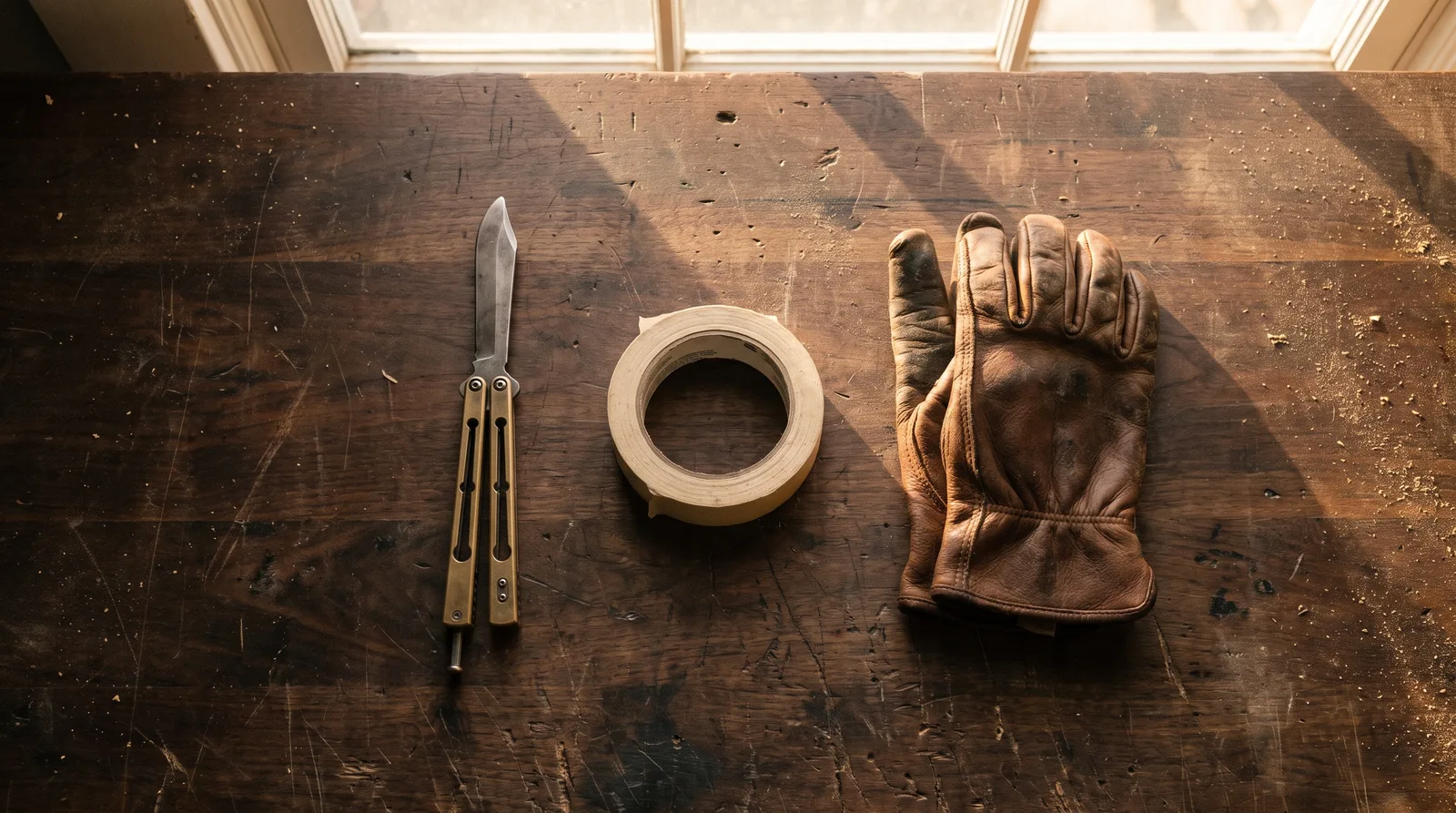
Where cuts actually happen
Balisong injuries are not random. They cluster into a small number of situations, and once you know the list you can watch for them. Very few happen at the moment people expect, which is mid-trick with the knife moving fast. Most happen at the boundaries: starting a move, recovering a failed one, or handling the knife when you were not really paying attention.
| Situation | What goes wrong | Typical injury | How flippers prevent it |
|---|---|---|---|
| Bite handle confusion | You grip the handle the edge folds into, and the blade closes onto your fingers | Cuts across the inside of the index and middle fingers | Mark the bite handle; check grip before every set |
| Catching a drop | Reflex grab as the knife falls | Deep palm and fingertip cuts, the worst injuries in the hobby | Train the reflex out by dropping on purpose |
| The aerial reflex | You reach for a throw that is already going wrong | Cuts to the palm, back of the hand and forearm | Learn aerials on a trainer only, for months |
| Latch on the unexpected side | A new knife has the latch on the safe handle instead of the bite handle | You use the latch as your bite-handle cue and grip the wrong one | Verify the latch position on every new knife |
| Latch not dropped | The handle jams part way through the swing | Wrist strain, rebound cuts, dropped knife | Make the latch drop a deliberate first step |
| Autopilot handling | Flipping while watching a screen or talking | Nicks during moves you have done a thousand times | Treat easy tricks with the same attention as hard ones |
| Loose or dry pivots | The handles swing unevenly or stick | Unpredictable travel, mistimed catches | Keep the pivots even, clean and lightly lubricated |
| Flipping tired or intoxicated | Timing and grip strength degrade before you notice | Everything above, more often | Stop when your forearm burns; do not flip drunk |
The bite handle problem, in detail
The single largest category of beginner cuts is holding the wrong handle. It sounds too simple to be a real hazard, and that is exactly why it keeps happening. A closed balisong looks symmetrical. It is not. One handle houses the edge and one houses the spine, and in ordinary light, at speed, with a knife you have owned for a week, they are easy to confuse.
Three fixes, in order of usefulness:
- A physical marker. An O-ring, a wrap of coloured electrical tape or a single paint dot on the bite handle. It works by touch, which means it works when you are not looking.
- A verified latch rule. On many traditional Batangas-pattern knives the latch is fixed to the bite handle, but this is not universal. Open any new knife slowly with two hands, see which handle the edge folds into, and only then decide what your latch rule is for that knife.
- One knife at a time. Swapping between balisongs with different latch conventions is how experienced flippers get cut. If you own several, re-check before you switch.
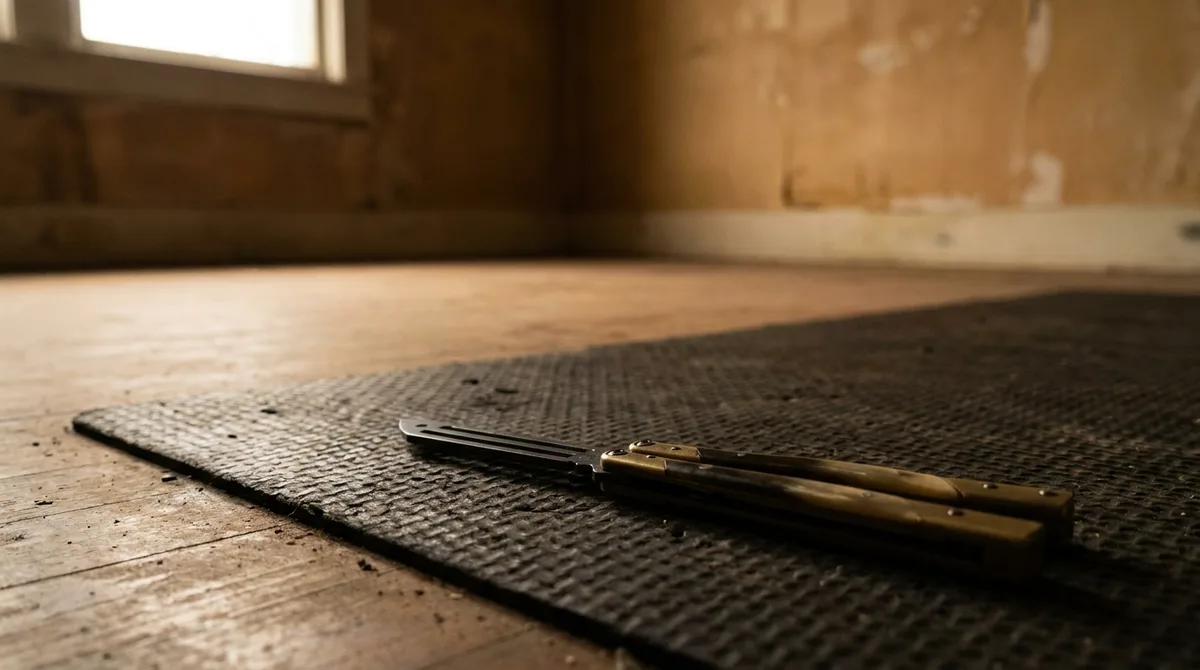
The drop rule
Never catch a falling balisong. A falling knife has no safe handle, because it is rotating and you have no idea which face is presented to your hand at the moment you close it.
This is harder than it sounds, because the grab is a reflex, not a decision. The way to remove it is to practise dropping deliberately. Stand over a rug or a folded towel, start a move, and simply open your hand halfway through. Do it enough times and your nervous system stops treating a dropped knife as an emergency. That reflex training is worth more than any protective equipment on this page.
Two practical extras: wear shoes, and keep your feet apart rather than under the knife. A dropped balisong lands point-first surprisingly often.
The aerial reflex
Aerials, where the knife leaves your hand entirely, are where the drop rule collides hardest with instinct. The knife is in the air, you can see the catch is not going to work, and the hand goes for it anyway.
The honest advice is not “be careful with aerials”. It is: do not do aerials on a live blade until they are boring on a trainer. Not competent, boring. That usually means months rather than weeks. Every experienced flipper you see throwing a sharp knife has spent a very long time throwing a blunt one first, and most of them still learn new aerial variations on a trainer before moving them across.
Gloves and tape: what each one actually does
People buy protective gear hoping it makes flipping safe. It does not. It changes which injuries you get.
| Measure | What it genuinely does | What it does not do | Verdict |
|---|---|---|---|
| Blunt trainer | Removes the cutting edge entirely | Does not stop bruises or dropped-knife foot injuries | The only measure that actually works |
| Tape on the edge | Blunts a live blade well enough to survive most learning mistakes | Adds thickness that changes balance and can peel mid-session | Good stopgap on a sharp knife you already own |
| Light glove | Reduces nicks, blisters and knuckle abrasion | Does not stop a real cut from a sharpened edge | Comfort, not protection |
| Cut-resistant glove | Resists slicing to a degree | Bulk ruins grip feel and catches, and it does not stop a point | Rarely used by flippers; teaches bad habits |
| Bite handle marker | Prevents the most common single cause of cuts | Nothing, if you ignore it | Free, effective, do it |
| Soft practice surface | Protects the knife’s tip and pivots on a drop | Protects the knife, not you | Worth it for the knife’s sake |
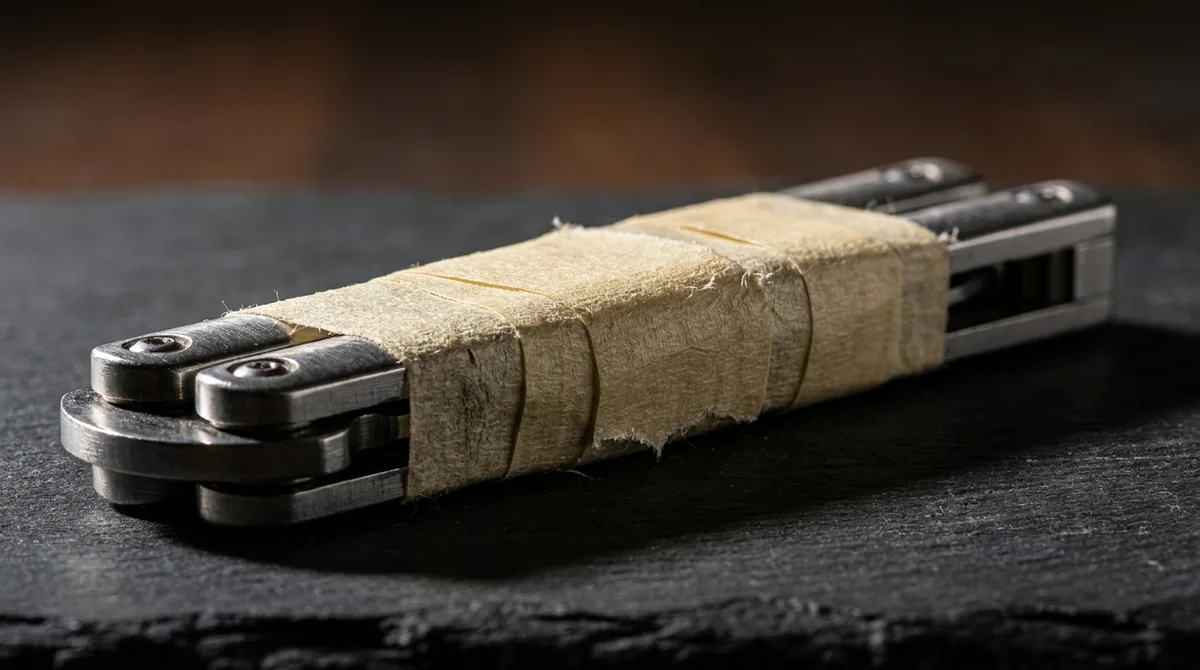
Electrical tape is the usual compromise on a live blade: thick enough to matter, thin enough not to unbalance the knife. Wrap the cutting edge only, replace it when it starts to shred, and do not convince yourself a taped blade is a trainer. It is a sharp knife with a temporary lid on it.
Setting up a practice space
| Item | What good looks like | Why |
|---|---|---|
| Floor | Carpet, rug, yoga mat or folded towel | Saves blade tips and pivot screws on drops |
| Footwear | Closed shoes, always | Point-first landings are common |
| Space | Arm’s length clear in every direction, standing | Room to step back from a bad swing |
| Height | Standing, not sitting | Sitting puts your thighs directly under the knife |
| Clothing | Long sleeves you do not mind marking; nothing loose at the wrist | Sleeves catch handles mid-swing |
| Lighting | Bright enough to read the bite handle marker | Most confusion happens in poor light |
| People and pets | Nobody within about two metres | A launched knife travels further than you expect |
| Session length | Stop when your forearm burns | Fatigue produces the sloppy reps that cause cuts |
| First aid | Plasters and antiseptic in the room, not upstairs | You will need them eventually |
| The knife itself | Even pivots, positive latch, clean and lubricated | Unpredictable hardware is a safety problem |
Maintenance is a safety measure, not housekeeping
A balisong that swings unevenly teaches you to compensate for a fault, and the compensation stops working the moment the fault changes. Uneven pivot tension, a gritty pivot, a latch that catches halfway, a loose tang pin: all of these make the knife’s travel unpredictable, and unpredictable travel is what puts an edge somewhere your hand already is.
Check pivot screws are seated and even. Keep the pivot area clean. Use a small amount of a light lubricant rather than a lot of a heavy one. If the latch drags, work out why before your next session rather than during it. Our knife care page covers the maintenance routine, and the sharpening guide covers what to do when the edge does need attention.
When a live blade is appropriate
There is no qualifying exam. There is a reasonable test: on a trainer, can you run your basic open, basic close, horizontal open and a rollover a hundred times each, cleanly, while holding a conversation? If your hands still need your eyes, a sharp knife is early.
When you do move across, move across one trick at a time. Take the moves that are automatic and leave the ones that are not on the trainer. The mistake is treating the switch as a graduation that applies to your whole repertoire at once.
On this site a trainer is the same knife as the sharp version with the final sharpening pass left off, selected as an option on the product page, at the same price. We would sell more knives if trainers were a cheap separate product you outgrew and replaced. They are not, and saying so costs us the upsell. The trainer butterfly knives page explains how the option works and the trainer knives guide covers what a trainer does and does not teach.
The honest part: most of these injuries are avoidable
Balisong flipping has a reputation for being dangerous, and the reputation is only half earned. The knife is not unusually hazardous as an object. What makes the hobby cut people is that it is the rare skill where the practice equipment and the finished tool are usually the same item, and where beginners routinely start with the sharp version because it looks better.
Almost nothing on this page is a technique. Marking a handle, letting a knife fall, wearing shoes, standing up, keeping the pivots clean and starting blunt are all decisions rather than skills. Flippers who make those decisions get the occasional nick from a mistimed rollover. Flippers who skip them get the cuts that need attention. The difference between the two groups is not talent and it is not experience. It is setup.
The other honest thing worth saying: nobody gets through this hobby with zero marks. If your standard is never being nicked, this is not the pastime for you. If your standard is never needing stitches, that is entirely achievable, and the list above is how it is achieved.
Butterfly knife laws vary by state, county and city, so check your local law before buying or carrying one.
More reading: how to open a butterfly knife, the balisong trainer knives guide, how to flip a balisong for beginners, your first real balisong buying guide, and balisong knife care.
Basic wound care, and when to stop and get seen
We are knife makers, not clinicians, and this is general information rather than medical advice. If you are unsure about a wound, the right answer is to have somebody qualified look at it.
For a small clean cut: apply firm direct pressure with a clean dressing and hold it, without lifting to peek, for a solid ten minutes. Most small cuts stop in that time. Rinse with clean running water once bleeding is controlled, dry the surrounding skin, and cover it. Keep it clean and dry, change the dressing daily, and watch it over the next few days.
Get medical attention if any of this applies
- Bleeding that does not stop after ten to fifteen minutes of firm direct pressure, or that is spurting.
- The wound gapes open, or you can see anything other than skin and fat inside it.
- You cannot bend or straighten the finger normally, or bending it is weak. That suggests a tendon.
- Numbness, tingling or a dead patch anywhere beyond the cut. That suggests a nerve.
- Any deep cut to the palm or the inside of the fingers, even one that looks small and has stopped bleeding.
- Anything left in the wound, or a wound contaminated with dirt, grease or metal.
- You do not know when you last had a tetanus booster.
- Spreading redness, heat, swelling, increasing pain or discharge over the following days.
Timing matters with hand injuries. Tendon and nerve repairs have much better outcomes when they are done early, and “I’ll see how it is next week” is how a repairable injury becomes a permanent one. If a finger is not working properly, go the same day.
Frequently Asked Questions
What is the most common butterfly knife injury?
Cuts across the inside of the fingers, caused by gripping the bite handle instead of the safe handle so the blade closes onto the hand. It is the most common injury precisely because it is the least dramatic mistake. Marking the bite handle with an O-ring or a wrap of tape prevents nearly all of them.
Should I catch a balisong if I drop it?
No, and this is the one rule with no exceptions. A falling knife is rotating, so there is no safe handle to reach for. The reflex grab causes the deepest injuries in the hobby. Step back, keep your hands clear, wear shoes, and practise deliberate drops over a soft surface until the reflex is trained out.
Do gloves prevent balisong cuts?
Light gloves reduce nicks, blisters and knuckle abrasion, which is genuinely useful, but they will not stop a sharpened edge. Cut-resistant gloves are bulky enough to ruin your grip feel and catches, which introduces new mistakes. Treat gloves as comfort, and rely on a blunt trainer or taped edge for actual protection.
Is taping the blade a real substitute for a trainer?
It is a reasonable stopgap if you already own a sharp knife, not an equivalent. Electrical tape blunts the edge enough to survive most learning mistakes, but it adds thickness that changes balance, and it peels during long sessions. Re-tape often, and never treat a taped blade as if it were unsharpened.
How long should I use a trainer before switching to a live blade?
Until the core moves are boring rather than merely possible. A workable test is running your basic open, close, horizontal open and a rollover a hundred times each without fumbling, while talking to someone. Then move one trick at a time, keeping anything unreliable on the trainer.
Where should I practise flipping?
Standing, over carpet or a folded towel, with an arm’s length of clear space in every direction and closed shoes on. Sitting puts your legs directly under the knife. Keep other people and pets well clear, because a launched balisong travels considerably further than beginners expect.
Are aerials safe to learn on a sharp knife?
Not for a long time. Aerials put the knife out of your control entirely, and the instinct to reach for a failing catch is very hard to suppress. Learn them on a trainer until they are dull, then move them across individually. Most experienced flippers still learn new aerial variations blunt first.
Does the latch always sit on the bite handle?
No. It is a common convention on traditional patterns, but it is not universal across makers or designs. If you use latch position as your bite handle cue, verify it on every new knife by opening it slowly with two hands and watching which handle the cutting edge folds into.
Can a badly tuned balisong actually cause injuries?
Yes. Uneven pivot tension, a gritty pivot or a latch that catches part way through a swing all make the knife’s travel unpredictable, and unpredictable travel is what puts an edge where your hand already is. Maintenance is a safety measure, not tidiness. Check the pivots before long sessions.
What should I do if I cut myself while flipping?
Stop, put the knife down somewhere safe, and deal with the cut properly rather than carrying on. Keep plasters and antiseptic in the room where you practise. Anything deep, gaping, numb or still bleeding heavily after ten minutes of firm pressure needs medical attention rather than a plaster and optimism.