
Blog
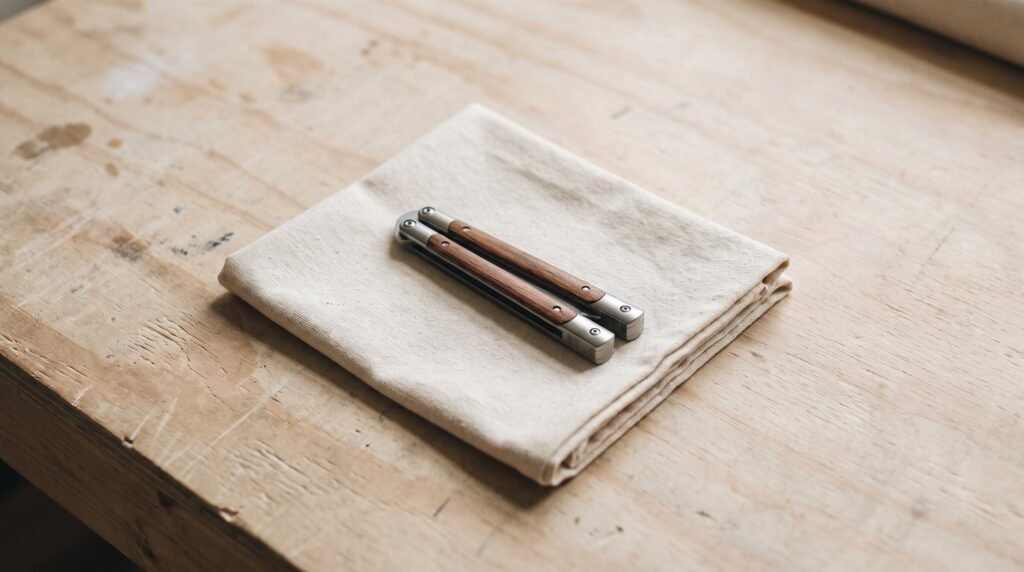
Moving a balisong from one place to another is mostly a question of paperwork and packing, with one absolute rule sitting on top of it: a knife does not go in the cabin of an aircraft. Ever. After that, the rules get local, and the law that matters is the law where the knife ends up, not the law where it started. This page is a practical walk through checked baggage, driving across state lines, international travel, shipping and moving house.
Quick answer: carry on is never an option for any knife, sharpened or not, including a trainer. Checked baggage is generally the route for domestic flights, packed so nothing can move and nothing can cut a handler. Driving is governed by the rules of every place you pass through and especially your destination. International travel means customs, and some countries simply do not allow these knives in at all. Shipping means honest declaration, good packing and insurance. Knife law changes constantly and varies by state, city and country, none of this is legal advice, and you must check current rules for your own route before you travel.
Carry on is not a grey area
In the United States, knives are not permitted through the passenger screening checkpoint. Not folded, not sheathed, not blunt, not “it’s only a trainer”. Security officers work from what an item is and what it looks like on an x-ray, and a balisong trainer has the same silhouette as a balisong with an edge on it, because it is the same knife with an unsharpened blade. You will lose it, you will lose your place in the queue, and depending on the officer and the jurisdiction you may lose considerably more of your day than that.
People try. We have had customers email us afterwards, usually to ask whether we can replace a knife that a screener took off them in Denver. We can make another one. Nobody can get that one back.
The same logic applies at most secure checkpoints anywhere: courthouses, stadiums, government buildings, many workplaces. If there is a metal detector and a queue, the knife should not be on you.
Checked baggage: how to do it properly
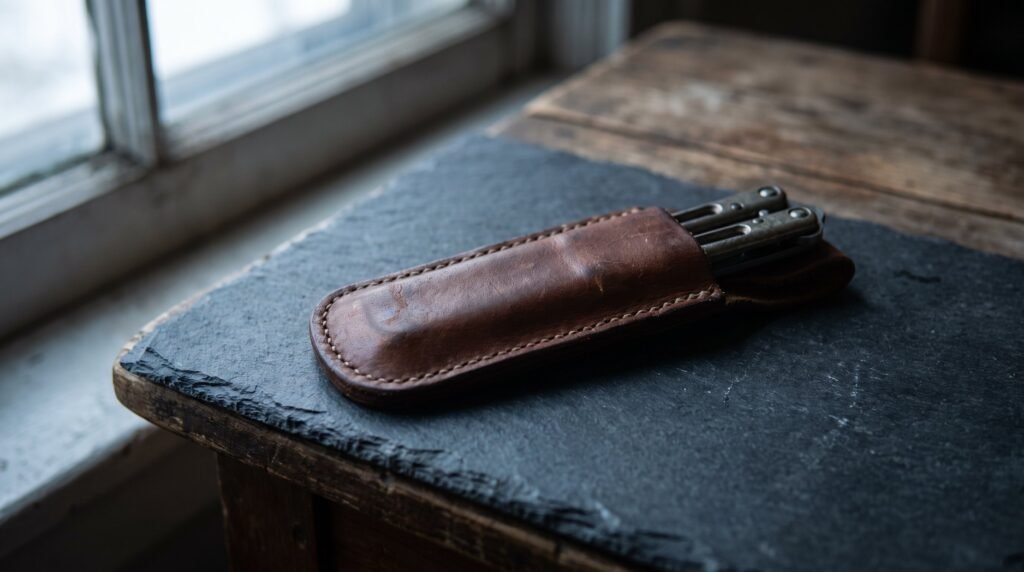
Domestically in the US, a knife in checked baggage is generally acceptable, and the practical requirement is that it must be sheathed or securely wrapped so it cannot injure a baggage handler or an inspector. Every knife we make ships with a fitted leather sheath, and this is exactly the situation that sheath is for.
The packing sequence we use
- Latch the handles closed. A balisong has no spring and no bias toward open, so a latched knife stays shut, but latch it anyway.
- Sheath it, then wrap the sheathed knife in a soft layer, then put it inside something rigid: a small hard case, a shoe, a rolled jacket inside a packing cube. Rigid beats padded when a bag gets thrown.
- Put it in the middle of the case, not against the outer wall, and not in an outside pocket.
- Assume the bag will be opened and inspected. Pack so that an inspector’s hand goes nowhere near an edge.
- Photograph it before it goes in. If the bag is lost you will want the picture.
Airlines and countries set their own rules on top of the baseline, and some carriers require you to declare bladed items at check-in. Ask at the desk rather than assuming. It costs you thirty seconds and it is the single cheapest insurance available.
Crossing state lines by road
This is the part people get wrong, and they get it wrong in a predictable way: they check the law where they live, and then drive somewhere else.
The law that applies to you is the law of the place you are physically in at that moment. Drive through four states and you have passed through four sets of rules, plus whatever cities and counties along the way have added on top. A knife that is entirely unremarkable at home can be a problem two hours down the interstate, and the fact that you were only passing through is not usually a defence in itself, though some jurisdictions do have transport provisions that treat a knife in transit differently from a knife carried on the person.
The general shape of good practice: a knife being transported is not a knife being carried. Keep it packed, sheathed, out of reach of the driver’s seat, and not on your body. Do not have it loose in a door pocket. Do not have it in the glovebox where a traffic stop will put it in somebody’s hand within a minute.
Before any long drive, read our state by state guide to balisong laws for your destination and for anywhere you plan to stop overnight, then verify against current local sources. Statutes get amended. City ordinances get added quietly. An article written last year, ours included, is a starting point and not an authority.
International travel and customs
Once a border is involved, the question stops being “can I carry this” and becomes “may this item enter the country at all”. Those are different questions and the second one is stricter.
A number of countries prohibit the import of balisongs outright, regardless of what you intend to do with it, and a handful of those treat a trainer exactly the same as a live blade because the restriction is written around the mechanism rather than the edge. Customs officers do not negotiate on this. An item that may not be imported is seized, and depending on the country you may be looking at a fine and a formal record of the seizure on top of losing the knife.
Practical rules we give people who ask:
- Check the destination country’s customs prohibited-items list before you pack, not after you land.
- Check any country you transit through if you will clear customs there.
- Never post a knife home to yourself as a way around an import rule. That is the same import, with a paper trail.
- If you are unsure, leave it at home. A knife is replaceable. A customs record is not easily unwound.
We ship worldwide at a flat rate, and we are honest with customers about this: we cannot guarantee that any country’s customs will admit a package, and a destination’s import rules are the customer’s responsibility to know. That is not us dodging, it is that no seller anywhere can promise you what a border agency will do.
Shipping a balisong
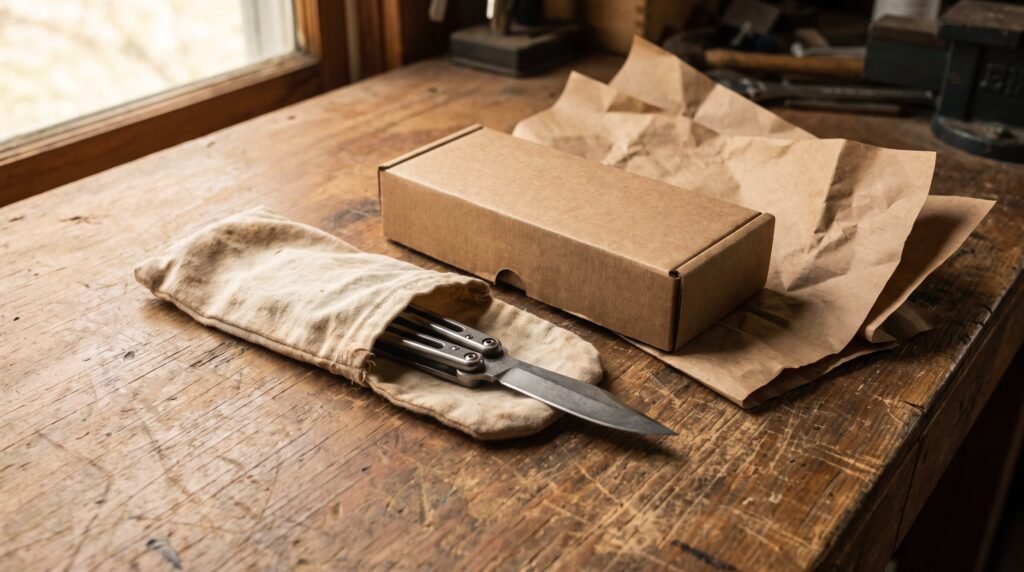
Shipping is where good habits pay for themselves. A knife in a padded envelope is a knife that arrives bent, or arrives with a corner of the blade tip through the packaging, which is how a sorting facility ends up deciding your parcel is a hazard.
How a knife should be packed for post
- Sheathed, latched, edge fully covered.
- Wrapped so it cannot move at all inside the inner box. Movement is what causes damage, not impact.
- Inner box inside an outer box, with fill between them. Double boxing is not overkill for something with a point on it.
- Declared honestly on the label and on any customs form, with a real description and a real value.
- Insured for what it would cost to replace, not for the minimum the carrier includes by default.
- Signature on delivery. For anything with an edge, adult signature where the carrier offers it.
Why some carriers refuse
Carriers set their own acceptance policies, and those policies are stricter than the law in many cases. Some will not carry bladed items at all in their international service. Some accept them domestically but not by air. Some will accept the parcel and then hold it at a hub because a scan flagged the shape. This is a commercial decision by the carrier, and arguing it at a counter never works. Check the carrier’s prohibited and restricted items page before you buy the label.
Under-declaring the contents to get around a carrier’s policy is the worst idea available. It voids the insurance, it makes any loss unrecoverable, and it turns a shipping problem into a customs declaration problem.
Moving house with a collection
If you have more than a couple of knives, treat the move as a logistics job rather than as packing.
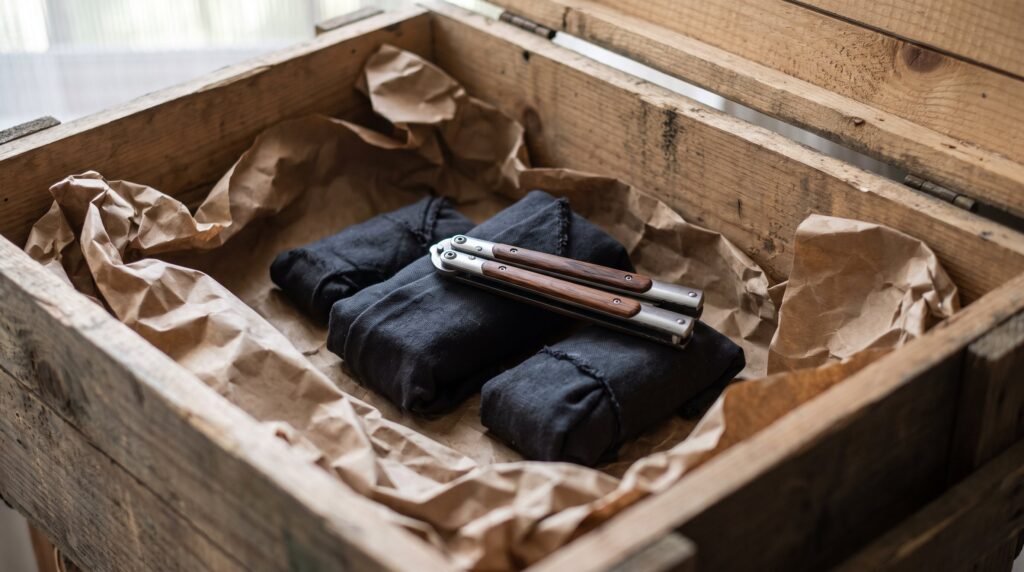
Make a written inventory with model, steel, handle material and value, and photograph each knife. Removal firms frequently exclude high-value and bladed items from their liability cover, so read the contract rather than assuming your household policy carries over. Many people move a collection themselves in their own vehicle for exactly this reason.
Two more things worth knowing. First, a long move in a truck means temperature swings and condensation, which is how a high carbon blade that has been fine for three years arrives with orange freckles on it. Oil everything before it goes in the box and keep silica gel in with them. Our knife care guide covers the storage side properly. Second, if the move crosses a state line, the destination’s law applies to the collection the moment it arrives, so check before the truck is loaded rather than after it is unloaded.
Situation by situation
| Situation | Live blade | Trainer | What actually decides it |
|---|---|---|---|
| Aircraft cabin, carry on bag | Never | Never | Screening rules, no discretion worth relying on |
| Aircraft, checked bag, domestic US | Generally yes, sheathed and secured | Generally yes, sheathed and secured | Carrier policy plus destination law |
| Aircraft, checked bag, international | Depends entirely on destination | Depends entirely on destination | Destination import rules, not departure rules |
| Driving within your own state | Check carry vs transport rules | Usually easier, still check | State law plus city ordinances |
| Driving across state lines | Destination and every state en route | Destination and every state en route | Wherever the wheels currently are |
| Posting domestically | Carrier policy dependent | Usually easier | Carrier’s restricted items list |
| Posting internationally | Often refused or seized | Often treated identically | Destination customs prohibited list |
| Moving house, same state | Inventory and insure separately | Same | Removal firm’s exclusions |
| Moving house, new state | Check destination law before loading | Check destination law before loading | Destination law on arrival |
| Secure venue, courthouse, stadium | Leave it at home | Leave it at home | Venue policy, enforced on the spot |
The honest disclaimer
We forge, grind and finish knives. We are not lawyers, we are not customs brokers, and we do not know your local ordinance. Knife law in the US has changed substantially over the last decade, in both directions, and it continues to change. Municipal rules can be stricter than state rules. Airline and carrier policies change without announcement.
Everything on this page is general information about good practice, not legal advice. Before you fly, drive, post or move with a knife, check the current rules for every jurisdiction and carrier involved, from a primary source. If you cannot get a clear answer, the safe decision is to leave the knife where it is.
More reading. Before any trip, read balisong laws by state and the background in why butterfly knives got banned. If your knife is going in a case for a week, rust and patina covers how to store it.
Frequently asked questions
Can I take a butterfly knife in my carry on if it is a trainer with no edge?
No. Screening does not carve out an exception for unsharpened blades, and a trainer looks identical to a live knife on an x-ray. It will be taken. Put it in the checked bag or leave it at home.
Do I need to declare a knife at airline check in?
Some carriers require it, some do not, and it costs nothing to ask at the desk. Declaring is always safer than not declaring, because the failure mode for an undeclared bladed item found in a bag is far worse than the failure mode for asking a question.
If it is legal where I live, can I take it anywhere in the US?
No. Your home state’s law follows you exactly as far as the state line. Beyond that you are under someone else’s rules, and cities and counties can add restrictions of their own. Check the destination every time.
What happens if customs seizes my knife?
It depends on the country, and outcomes range from the item simply being destroyed to a fine and a formal record. You are very unlikely to get the knife back. This is why we tell people not to gamble on a border.
Can I ship a balisong to myself abroad?
Posting an item into a country is an import, and the same prohibitions apply as if you carried it in your bag, with the added detail that the declaration is in writing. If the destination bans import, posting it does not change that.
How should I store a knife during a long move?
Clean and oiled, sheathed, in a sealed container with a desiccant pack, and not in a hot vehicle for weeks. High carbon steel will find any moisture you leave it near. Our sharpening guide is worth a read afterwards, because a long spell in storage is a good moment to reset an edge.
Is a trainer a safe option for travel?
It removes the edge from the equation, which helps in some places and means nothing in others, because plenty of rules are written around the opening mechanism rather than sharpness. It is a sensible choice for practising away from home, but do not treat it as a legal exemption. Our trainer guide explains what a trainer is and is not.
Do you ship internationally?
Yes, at a flat worldwide rate, with US shipping free. What we cannot do is guarantee that a given country’s customs will release the parcel, because that decision is not ours and no seller can promise it. Check your own import rules first.
If you are choosing a knife to travel with, or deciding between a trainer and a live blade for a trip, start on our butterfly knife range. Every knife is made to order, ships with a fitted leather sheath, and is offered as trainer or live blade, same price, chosen above the Add to Cart button.