
Blog
A cheap butterfly knife is a fine idea right up to the moment you flip it. Most budget balisongs look the part in the listing photo and then turn loose, gritty or vague within a few weeks, because the money was saved on the parts a photo cannot show you, mainly the pivot and the tang pin. If you are spending Black Friday money on a balisong, this is what separates a cheap one from a good one, where the cost really goes, and when the smartest cheap buy is not a live blade at all.
The short answer
If you want to learn to flip and the budget is tight, a trainer is a better cheap buy than a cheap live blade. If you want a real knife that still flips properly years from now, put the money into the pivot, the tang pin and the steel, and pay nothing extra for decoration. The cheapest knife in our shop at the time of writing is the Falcon in VG10 at $141.95, and it uses the same pivots, the same tang pin and the same heat treat as the dearer knives in the range.
Where a cheap balisong saves its money
A balisong has very few parts. Two handles, a blade with a tang, two pivot pins, usually a latch, and a small tang pin. When a knife is cheap, the savings have to come out of those few parts, because there is nowhere else on the knife to hide them.
Pivots: washers, bushings and whatever came in the bag
The pivot is where each handle rotates around the blade, and it decides how the knife feels. Washers are thin discs that sit between the tang and the handle. Phosphor bronze washers are the standard good option, smooth and slightly damped. PTFE and nylon washers cost very little and feel slippery from day one, but they are soft enough to compress under pivot pressure, which is why a budget knife develops play that comes back every time you tighten it.
Bushings are a precision sleeve in the tang hole that sets the gap for you, so the pivot can be fully tightened and left alone. That works beautifully when the bushing is made accurately. A cheap bushing is a sleeve of roughly the right length, which is a polite way of describing wobble. Our washers versus bearings guide walks through each system and what fails on it.
On the knives we sell, the pivots are set and checked by hand before the knife goes in the box. On a budget clone, the pivot is whatever came off the line, and you find out how well it was assembled the first time you try a fan.
The latch
The latch is the small catch that holds the handles closed. On cheap knives it tends to be thin stamped steel that sits slightly proud of the handle, so it rattles, catches a finger on every rotation, or both. A good latch sits flush and stays out of your way while you flip. Plenty of trick knives skip the latch entirely.
The tang pin
The tang pin is the small pin through the tang that stops the blade rotating past where it should when the knife opens or closes. A lot of cheap knives leave it out or fit it loosely, and the action feels vague because the blade never stops in quite the same place twice. On a knife with an edge, the blade stopping where you expect it to is a feature worth paying for.
Blade steel
Budget listings like to say “stainless steel” and stop there, which tells you about as much as a wine labelled “red”. Without a named grade and a hardness you are guessing, and soft steel dents, rolls and gives up its edge on a cardboard box. Named steels such as 440C, VG10, high carbon and D2 behave predictably when they are heat treated properly. Ours are hardened to 58 to 60 HRC across the shelf.
Handle material
Cheap balisongs are usually zinc alloy or stamped steel under a coating. Zinc alloy casts cheaply, which is why it is everywhere, but it is brittle next to brass or steel, and the pivot holes are where that shows first. Thin stamped handles flex, and a flexing handle means the two halves stop meeting square at the pivot. A balisong that does not close square rattles for the rest of its life. Our handles are brass or stainless steel with inserts such as kamagong wood or carabao horn.
Why a cheap clone flips badly
A clone copies the outline of a well known design and none of its tolerances. It looks right in photographs, mostly because photographs do not flip. Put the savings above together and you get a very familiar knife. Side play in the pivot makes the blade knock on every rotation. A loose or missing tang pin lets the blade overrotate and land somewhere different each time. Handles that do not close square give you the rattle, and the weight sits wherever the casting put it, so the balance point is a surprise.
Muscle memory built on a badly balanced knife also does not transfer cleanly to a good one, so the money saved on the first knife gets spent again in relearned tricks.
When a trainer is the smarter cheap buy
If the plan is to learn, a trainer is the honest answer. It has the shape and weight of a real knife with a blunt edge, and everybody drops a balisong while learning. Everybody. A cheap trainer that rattles is annoying. A cheap live blade that rattles is annoying with a sharp edge attached.
On our site the trainer is not a separate, cheaper product. Every knife has a Choose your blade box just above Add to Cart where you pick Sharp or Trainer, and the price is the same either way, because the trainer is the same knife with the final sharpening pass left off. You learn on exactly the balance you will carry later, which a bulk aluminium trainer cannot give you. If the budget will not stretch that far yet, a basic trainer from anywhere still beats a bargain live blade, and you can step up once your knuckles stop filing complaints. Our balisong trainer guide covers what to look for in one.
Buying for someone else this Christmas? The butterfly knife stocking stuffers guide covers which sizes fit a stocking and what to check before you wrap one.
Cheap butterfly knife vs a good one, part by part
| Part | Typical cheap balisong | What to look for instead |
|---|---|---|
| Pivot | Polymer washers or a loose pin, play comes back after tightening | Pivots set by hand, bronze washers or accurate bushings, no side play |
| Latch | Thin stamped latch that rattles or catches fingers | A flush latch that stays out of the way, or no latch at all |
| Tang pin | Loose or missing, the blade stops in a different place each time | Fitted properly, the blade stops in the same place every time |
| Blade steel | “Stainless steel”, grade and hardness never given | A named steel and a stated hardness, such as 440C or VG10 at 58 to 60 HRC |
| Handle | Zinc alloy or thin stamped steel that can flex | Brass or stainless steel with solid inserts such as kamagong wood or carabao horn |
| Closing | Halves do not meet square, so it rattles | Closes square and quiet |
| Learning | Live edge from day one | A trainer with the same balance as the knife you will carry |
What Black Friday money gets you here
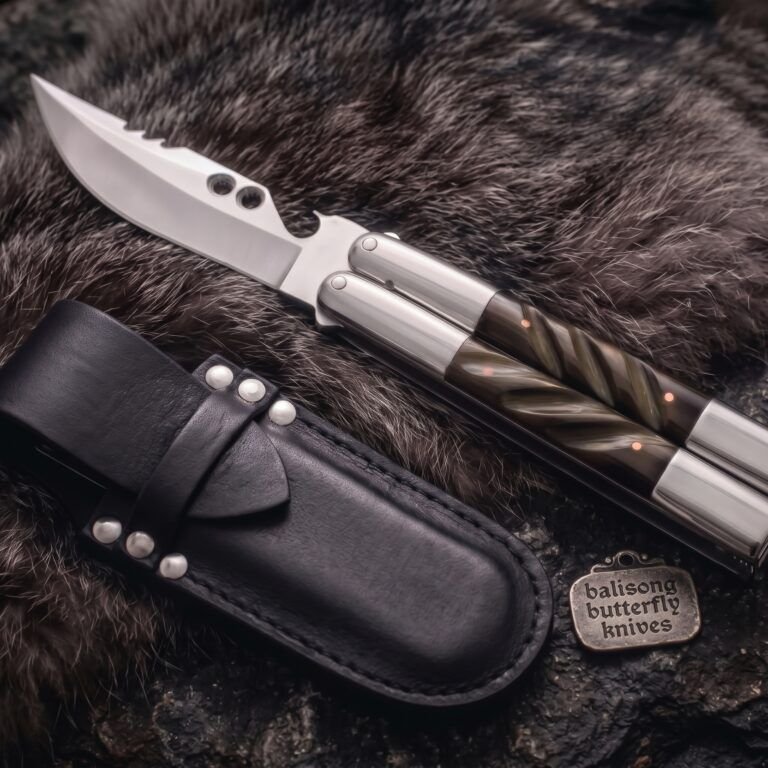
Our knives start at $141.95 at the time of writing. The cheapest few, such as the Falcon in VG10 and the Argentine Ant in 440C, are not stripped back versions of the dearer ones. They share the same pivots, tang pin and hardness. The price difference across the range comes mostly from hand work on the handle contour and finishing time on the brass, which is where the hours go on a handmade knife.
The offers running on any given day are shown in the bar at the top of every page and on every product page. As this goes up, buying two knives adds a free mystery butterfly knife with a $100 value to the order, and spending $300 takes an extra 15% off. If you would rather browse by steel, start with the VG10 balisongs, the 440C balisongs or the high carbon balisongs, or see every balisong in the shop.
How to judge a cheap listing before you buy
Look for a named steel and a stated hardness. If neither appears, assume the answer is not one you would like. Look for any mention of the tang pin and of what the pivot runs on, because a seller who got those right usually says so. Read reviews that talk about the action after a month of use rather than the unboxing, since every knife feels fine for the first evening. And if the listing spends more words on the colour of the coating than on the pivot, you already have your answer.
For the bigger picture on size, weight and handle choice for a first knife, our first balisong buying guide goes through it step by step.
Questions people ask
Are cheap butterfly knives worth buying?
As a learning tool, a cheap trainer can be. As a live knife, most cheap balisongs go loose within weeks, because the savings come out of the pivot, the tang pin and the heat treat. Spend on those parts and skip the decoration.
What makes a butterfly knife flip well?
A pivot with no side play, a tang pin that stops the blade in the same place every time, handles that close square, and balance that suits your hand. Blade steel matters for the edge, not for the flip.
Washers or bushings on a budget balisong?
Bronze washers are forgiving and easy to tune. Bushings let you tighten the pivot fully and forget it, but only when they are made accurately. Cheap polymer washers compress over time, so the play keeps coming back.
Should a beginner buy a cheap live balisong or a trainer?
A trainer. Everyone drops the knife while learning, and a blunt edge makes that a non event. On our site a trainer costs the same as the live blade, because it is the same knife without the final sharpening pass.
How much does a good butterfly knife cost?
Our knives start at $141.95 at the time of writing. The cheaper models use the same pivots, tang pin and hardness as the dearer ones, and the price difference mostly reflects hand work on the handle.