
Blog
Hold the knife by one handle, work out which one is the bite handle, and drop the latch. Let the free handle fall open under gravity, then swing it up and around the top so it slaps back against the handle in your palm. That is the basic open. Reverse it to close. Learn all of it on a trainer before an edge ever enters the picture.
That is the short version, and it is enough to get a first open out of you today. The rest of this page is the detail that decides whether your first month is fun or full of plasters: how to identify the bite handle in under a second, three openings worth learning in order, and the specific mistakes that put beginners in the bathroom looking for antiseptic.
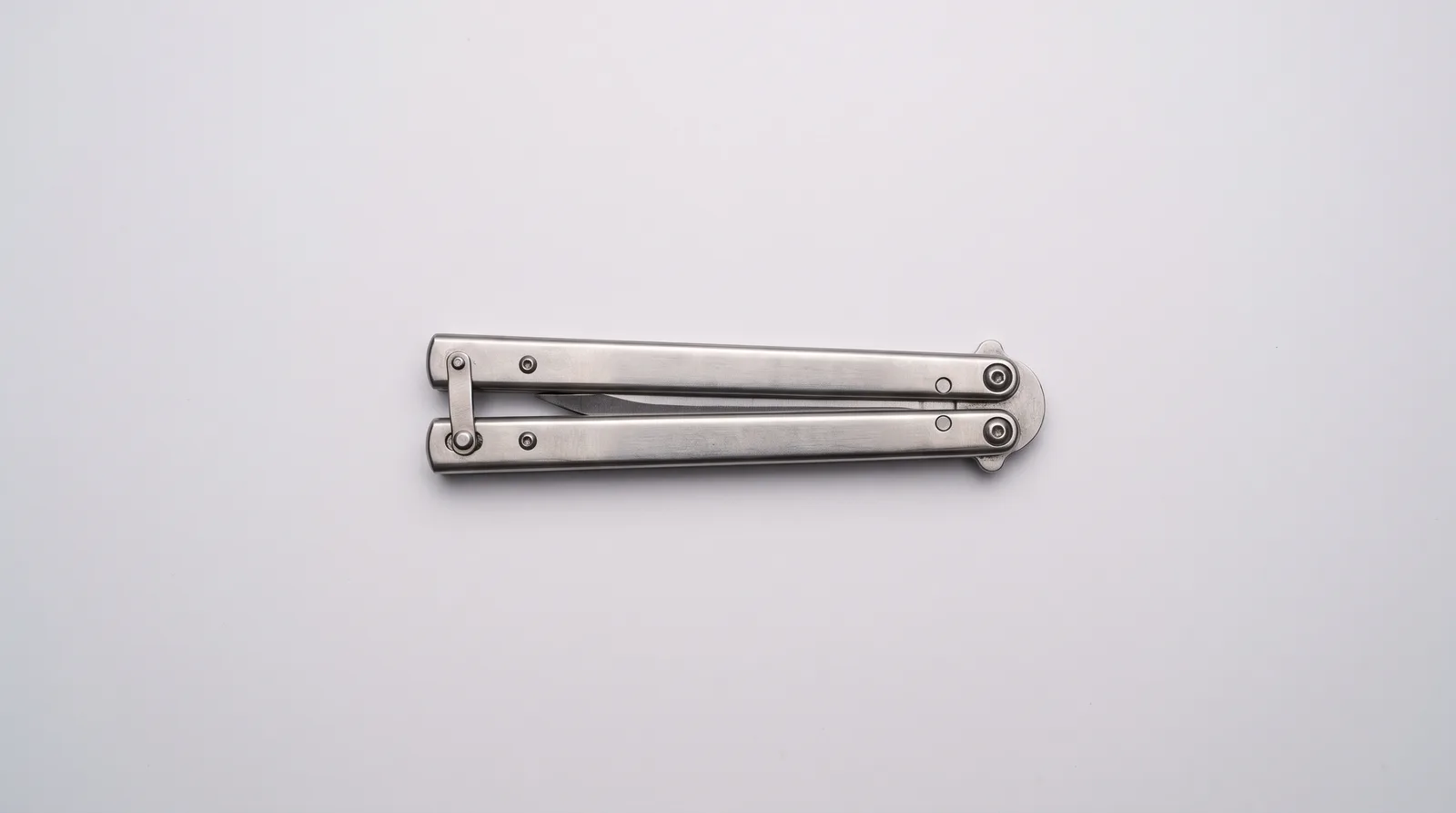
Step zero: find the bite handle, every single time
A closed balisong has two handles. One sits against the sharp side of the blade. The other sits against the spine. The one that meets the edge is the bite handle. The one that meets the spine is the safe handle. Every opening in this guide starts from the safe handle, and almost every beginner cut is a bite handle held by mistake.
There are three reliable ways to tell them apart, and you should be able to do at least one of them without looking:
- The latch. On most traditional Batangas-pattern knives the latch is fixed to the bite handle. Not all makers do it the same way, so confirm it on your own knife once, then trust it.
- Look at the edge. Open the knife slowly with two hands and see which handle the sharpened side folds into. That handle is the bite handle. Do this once with any new knife before you flip it.
- Mark it. An O-ring, a wrap of electrical tape or a single dot of paint on the bite handle gives you a tactile cue that survives bad light and tired hands. Experienced flippers who have stopped needing it still do it on unfamiliar knives.
If you take one thing from this page, take that. Trick names are optional. Knowing which handle bites is not.
The parts, and why each one matters to a beginner
| Part | What it is | Why it matters when you are learning |
|---|---|---|
| Bite handle | The handle the cutting edge folds into | Holding it during a flip is how most beginner cuts happen |
| Safe handle | The handle the spine folds into | Your grip handle for every move on this page |
| Latch | The small catch that holds the knife shut | It must be released before any opening, and it clicks when it seats |
| Pivots | The two screws or pins the handles rotate on | Their tension decides whether the knife swings freely or fights you |
| Tang pins or zen pins | Stops that limit how far the handles close onto the blade | They set the sound and the feel of the handle slap |
| Kicker or choil | The step at the base of the blade | Keeps the edge off the inside of the handle when closed |
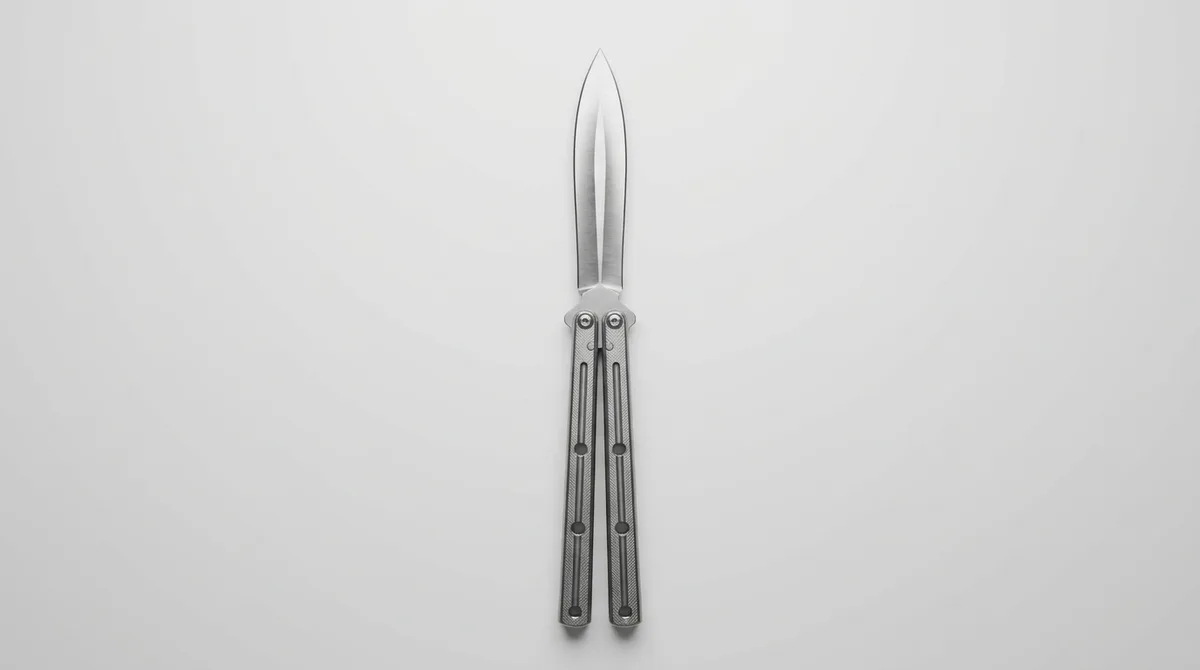
Learn this on a trainer, and mean it
A trainer will not make you a flipper faster. It will just stop you needing stitches. The moves are identical, the weight is identical, the timing is identical, and the only thing missing is the part that opens your fingers.
On this site a trainer is not a cheaper second product. It is the same knife with the final sharpening pass left off, chosen with a Sharp or Trainer option on the product page, at the same price as the sharp version. That is worth saying plainly because it costs us the easy upsell: you are not buying a practice knife and then a real one. You are choosing which one knife you receive. Plenty of people order the trainer first, learn on it, and later order a sharp one they already know how to handle.
If you want the longer argument, our balisong trainer knives guide covers what a trainer does and does not teach, and the trainer butterfly knives page explains how to select the blunt option on any knife in the range.
The two-handed safe open (not a trick, still worth knowing)
Before any flip, learn to open the knife deliberately with two hands. This is how you inspect a new knife, how you check which handle bites, and how you open one in front of someone without looking like you are performing.
- Hold the closed knife in your non-dominant hand, latch facing up.
- Release the latch with your thumb.
- With your dominant hand, take the bite handle and swing it slowly away from the blade until it is fully open.
- Bring it around and close it against the safe handle. The knife is now open and locked in a normal grip.
Slow, boring, and completely safe. Do it twenty times with any new balisong so your hands learn the geometry before your wrist gets involved.
Move one: the basic open
This is the move everything else is built on. Stand up, feet apart, nothing valuable in front of you.
- Grip the safe handle in a normal fist, blade pointing down, latch facing away from your palm.
- Drop the latch. Push it clear with your thumb so the free handle can move. If the latch is stiff, work it a few times before flipping. A latch that catches halfway through a swing is a genuine hazard.
- Let the bite handle fall open under its own weight. Do not throw it. Gravity plus a small wrist dip is enough, and the whole handle should hang straight down from the pivots.
- Rotate your wrist upward so the falling handle swings up and over the top of your hand in one continuous arc.
- Catch it against the safe handle in your palm. You want a clean single slap, not a rattle.
The mistake almost everybody makes is powering step three. The balisong does the work. Your wrist is a hinge, not a whip. If the handle is overshooting or wrapping around your knuckles, you are using twice the force you need.
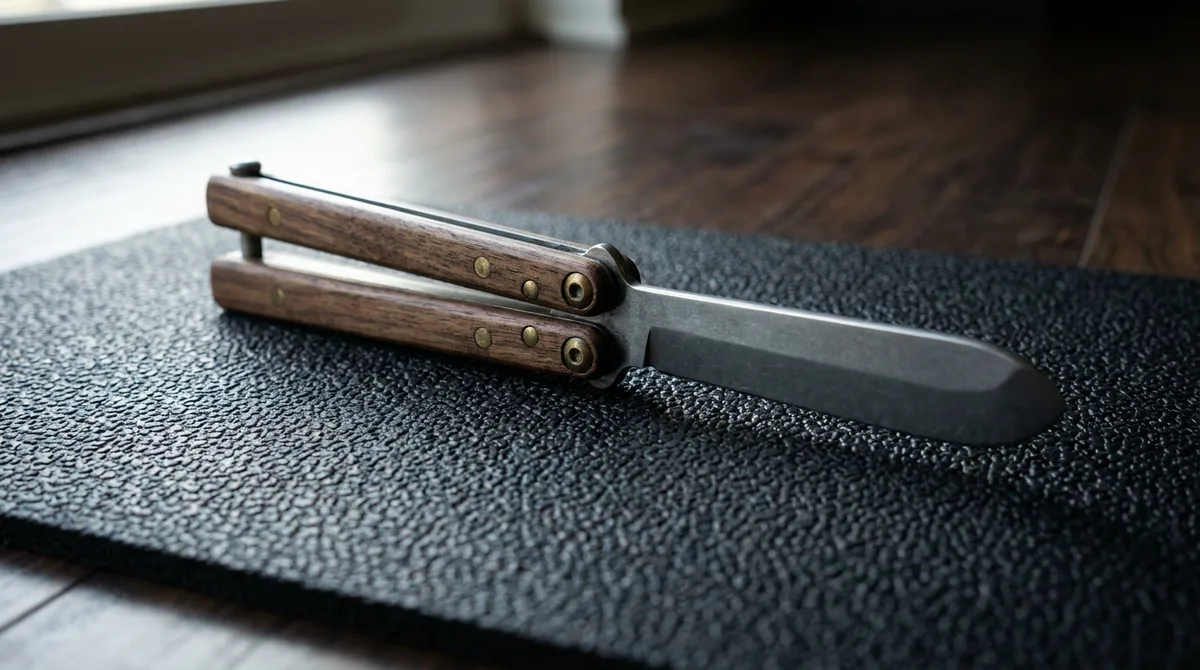
Move two: the basic close
Closing is the same motion in reverse, and it is where the edge is genuinely live, so learn it on a trainer first without exception.
- From the open, locked position, hold the safe handle and let the bite handle fall away from your palm.
- Let it swing down and under, past the blade.
- Rotate your wrist to guide it back up and around the top.
- Catch it flat against the safe handle so the knife is closed, then seat the latch with your thumb.
The two things to watch: keep your fingers wrapped around the safe handle only, and do not let the blade travel through the space your fingers occupy. If a close feels like it is going somewhere unexpected, open your hand and let the knife go. That is a deliberate skill, covered properly in our butterfly knife safety guide.
Move three: the horizontal (lazy) open
Also called the lazy open or the horizontal open, this is the flat, low-effort opening most people find easier than the vertical one, and it is the first move that starts to look like flipping rather than fiddling.
- Hold the safe handle with the knife horizontal, blade pointing away from you, palm roughly facing the floor.
- Drop the latch.
- Swing the knife outward and let the bite handle fall open in the horizontal plane, so it travels sideways rather than up and down.
- Continue the arc and bring the free handle back around into your palm.
- Close your hand as it arrives. The catch is a squeeze, not a grab.
Because the blade travels in a plane away from your body, a fumbled horizontal open usually ends with the knife on the floor instead of in your hand. That is the correct outcome and the reason it is a good early move.
Common mistakes and what they actually cost you
| Mistake | What it looks like | Consequence | Fix |
|---|---|---|---|
| Gripping the bite handle | The knife closes onto your fingers instead of your palm | The single most common beginner cut | Mark the bite handle and check before every set |
| Forgetting the latch | The handle jams half open, the knife stops dead | Wrist strain, dropped knife, occasional cut on the rebound | Make the latch drop a conscious first step until it is automatic |
| Over-swinging | The handle wraps past your palm and bounces | Rattly, uncontrolled opens and lost fingers on the catch | Halve the force, let gravity start the handle |
| Catching a drop | Reflex grab as the knife falls | Deep cuts to the palm and fingertips | Practise letting it fall on purpose, wearing shoes |
| Flipping over a hard floor | Chipped tips, bent pivots, marked handles | Damage to the knife rather than to you | Practise over a rug, a bed or a folded towel |
| Learning on a sharp blade | Every mistake above, with an edge attached | Slow learning, because fear makes you tense | Trainer first, sharp later |
| Loose or dry pivots | The handles wobble or grind | Unpredictable swing, which is what actually cuts people | Check pivot tension and keep them lightly lubricated |
A first-week practice routine
Twenty minutes a day beats three hours on a Sunday. Muscle memory is built by repetition spread over days, not by one long session that ends when your forearm gives up.
- Days one to two. Two-handed opens only. Learn the knife, find the bite handle without looking, get used to the weight.
- Days three to four. Basic open and basic close, slowly, one at a time, resetting the latch between each.
- Days five to six. Chain them. Open, close, open, close, without stopping. Aim for smooth, not fast.
- Day seven. Add the horizontal open. Accept that you will drop the knife. Let it drop.
Once those three moves are reliable, the next steps are rollovers and fans. Our beginner flipping guide takes you through the progression, and the trick names glossary tells you what everyone is talking about when they use words like zen rollover and chaplin.
When a live blade becomes appropriate
There is no certificate and no fixed number of hours. A workable test is this: can you perform the basic open, the basic close and the horizontal open a hundred times each without a single fumble, on a trainer, while holding a conversation? If yes, a sharp knife will not surprise you. If you are still watching your hands, it will.
Two more honest notes. First, a live blade changes your flipping whether you want it to or not, because your body knows the edge is there and adds tension. Second, most experienced flippers keep a trainer permanently and learn every new trick on it, then move it across. That is not timidity, it is just cheaper than healing.
What hardware actually helps a beginner
Very little of the beginner experience is about steel. It is about pivots, balance and how much the knife punishes a bad swing.
| Feature | What to look for as a beginner | Why |
|---|---|---|
| Pivot action | Free, even swing on both handles with no grit | An uneven knife teaches you to compensate for a fault |
| Balance | Slightly handle-forward or neutral | Blade-heavy knives accelerate faster than a new wrist can time |
| Weight | Something you can hold at arm’s length without shaking | Fatigue causes the sloppy reps that cause cuts |
| Handle texture | Grippy, not slick or polished smooth | Fewer unintended drops while you learn the catch |
| Latch | Positive click, easy thumb release | A sticky latch interrupts swings mid-flight |
| Edge | Blunt, until the moves are automatic | Everything above is easier to learn without an edge |
Butterfly knife laws vary by state, county and city, so check your local law before buying or carrying one.
More reading: how to flip a balisong for beginners, the trainer knives guide, butterfly knife safety for beginners, your first real balisong buying guide, and what a balisong knife actually is.
Frequently Asked Questions
Which handle do I hold to open a butterfly knife?
Always the safe handle, which is the one the blade’s spine folds into. The other handle, the bite handle, meets the cutting edge and is the one that causes most beginner injuries. On many traditional knives the latch is mounted on the bite handle, but confirm it on your own knife by opening it slowly with two hands.
How long does it take to learn the basic open?
Most people get a recognisable basic open inside a single twenty-minute session. Making it smooth and repeatable takes a week or two of short daily practice. Speed is not the goal early on. A slow, clean open with a single handle slap is worth more than a fast one that rattles and slips.
Do I really need a trainer first?
You do not need one, but you will learn faster with one because you will not be tense. Every mistake on this page is survivable on a blunt blade and expensive on a sharp one. Learning the movement pattern without fear is the whole point, and it is why most experienced flippers still own a trainer.
What is the difference between the basic open and the lazy open?
The basic open travels in a vertical plane, with the free handle swinging up and over the top of your hand. The lazy or horizontal open travels flat, out to the side and back. Most people find the horizontal version easier first because the blade moves away from the body rather than past it.
Why does my balisong feel stiff or gritty?
Usually pivot tension or dirt. Pivots that are too tight fight your swing, and pivots that are dry pick up grit that grinds. Check the pivot screws are even, clean the pivot area, and use a small amount of a light lubricant. A knife that swings unpredictably is a safety problem, not just an annoyance.
Should I wear gloves while learning?
A light glove on the flipping hand reduces nicks and blisters, and many people use one early on. It will not stop a serious cut and it slightly changes your grip feel, so treat it as a comfort measure rather than protection. Tape on the edge of a live blade does more for actual safety.
What do I do if I drop the knife?
Nothing. Move your feet, keep your hands out of the way, and let it land. A falling knife has no safe handle, and the reflex grab is one of the most reliable ways to get a deep cut. Practise dropping deliberately over a soft surface so the reflex is trained out early.
Is it better to practise standing or sitting?
Standing, with clear space in front of you and shoes on. Sitting puts your thighs directly under the knife and limits how far you can step away from a bad swing. Practise over carpet, a rug or a folded towel so drops do not damage the tips or the pivots.
How do I know when the knife is properly closed?
The handles sit flat against the blade with no gap, and the latch seats with a small positive click. If the latch will not close, the blade is not fully seated between the handles, usually because one handle has not travelled all the way. Reset it with two hands rather than forcing the latch.
Can I learn all this with a cheap import balisong?
You can, but loose pivots, uneven handles and sloppy tolerances teach you to correct for a fault rather than to flip. A knife with even, free-swinging pivots and a positive latch makes the difference between practising the move and fighting the tool. That matters more for beginners than steel type does.