
Blog
Neither is better in the abstract. Washers give a smoother, quieter, lower-maintenance pivot that tolerates neglect and dirt. Bearings give a faster, freer swing that most flippers prefer, at the cost of more parts, more cleaning and more things that can go wrong. Bushings are a third option that lets you fully tighten the pivot and forget about it. Traditional Filipino balisongs use none of the three.
That is the short version. Below is what each system actually does, what fails on it, what it costs, and a decision table for picking one, including the honest case for a hand-fitted pinned knife with no washers at all.
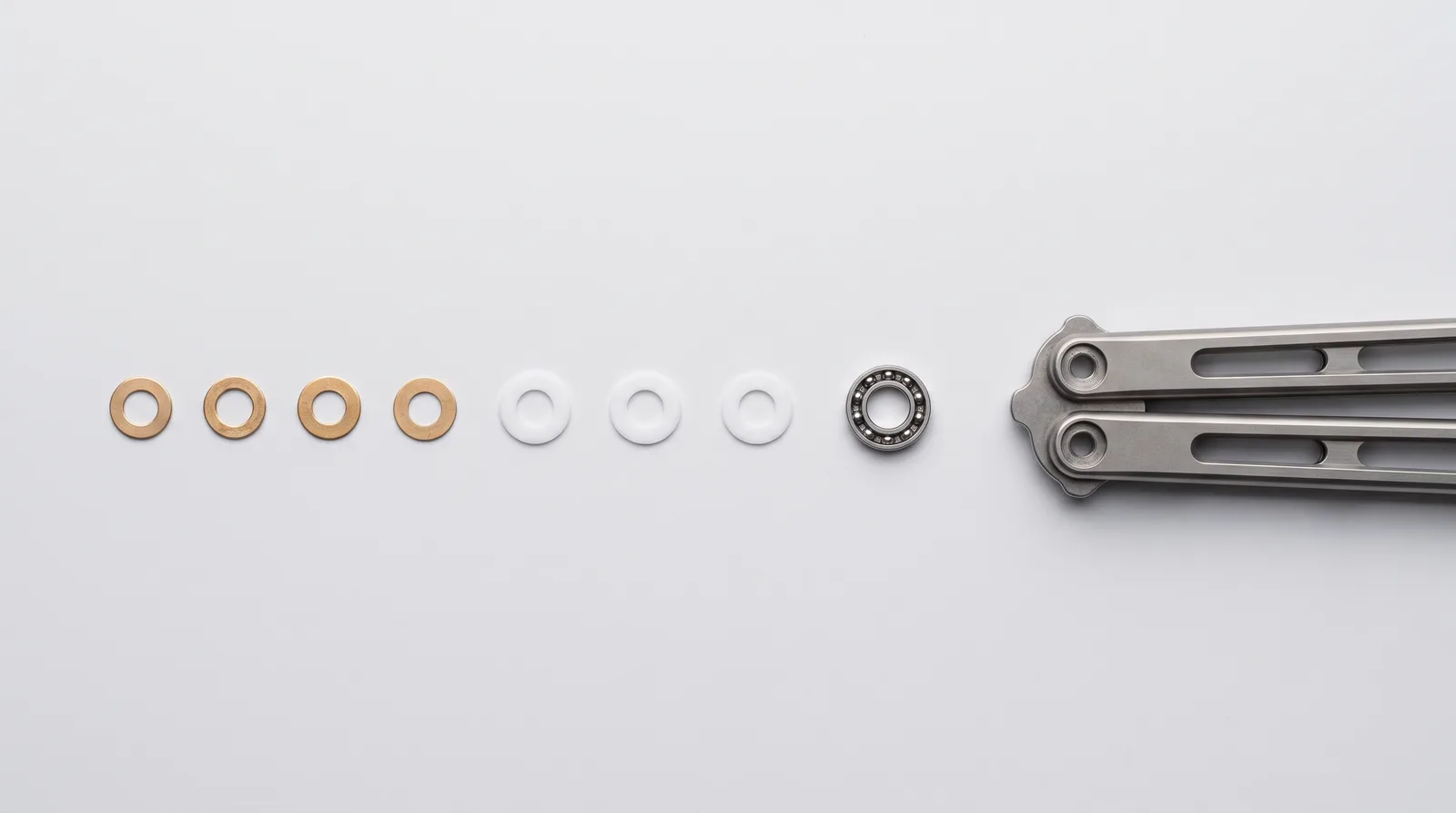
The Three Pivot Systems
Everything between the flat of the blade’s tang and the inside of the handle exists to stop steel dragging on steel. There are three mainstream ways to do it.
- Washers. Thin flat discs, one per side per pivot, so four on a typical knife. The handle slides on the washer face.
- Bearings. Small ball bearings, usually in a ring-shaped cage, so the handle rolls rather than slides.
- Bushings. A precision sleeve in the tang hole, very slightly longer than the tang is thick, which sets the spacing itself.
If those parts are unfamiliar, the balisong anatomy guide shows where each one sits.
Phosphor Bronze Washers
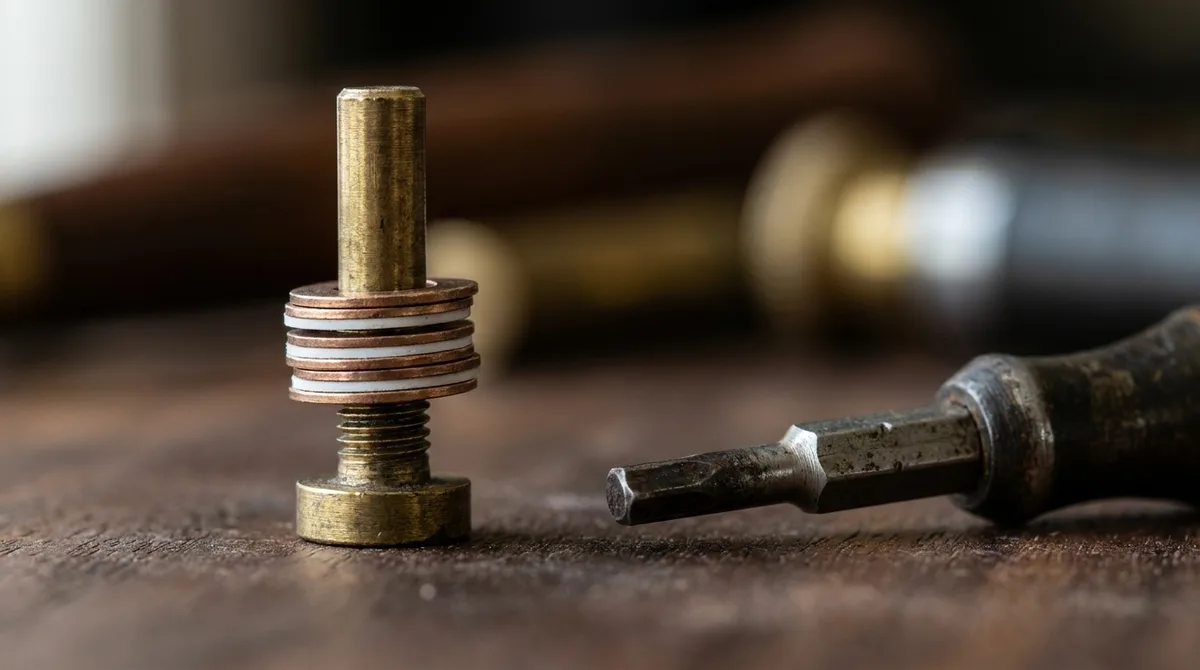
Phosphor bronze is the standard premium washer material and has been for decades. It is a soft, self-lubricating bearing alloy that will not scratch the blade’s flats, wears in rather than wearing out, and is forgiving of the imperfect tolerances that come with anything handmade.
The feel is a slightly damped, weighty swing. Flippers describe it as smooth rather than fast. Some people prefer that on purpose: a washer knife has a little more resistance to fight against, which makes some tricks easier to control and makes the knife feel more solid in the hand.
What goes wrong: run a bronze washer dry and you get galling, which is metal picking up on metal and shows as a squeak and then a gritty spot. One drop of oil prevents it. Overtighten and you can deform the washer, which is permanent and needs a new washer.
PTFE and Nylon Washers
PTFE and nylon washers appear on lighter builds and on more affordable knives. They are slippery from the start with no break-in, they add almost no weight, and they cost very little.
The trade is compression. Polymer washers are softer than bronze, so they deform under pivot pressure over time, which is why a knife with them can develop play that comes back after tuning. They are also cheap to replace, which softens the complaint considerably. Treat them as a consumable rather than a component.
They have one genuine advantage worth naming: because they are non-metallic, they are quieter, and on a knife with soft handle materials they are less likely to transmit a harsh metallic ring.
Bearing Systems
Bearings replace sliding friction with rolling friction. The result is obvious the first time you try one: the handles drop under their own weight and keep going, and the knife feels fast rather than deliberate. For chaotic and rollover-heavy flipping, that is a real advantage, and it is why so many modern flipping-focused designs use them.
The costs are also real. A bearing pivot has many small independent moving parts, which means many small places for grit to lodge. A gritty bearing does not feel loose, it feels notchy, and no amount of tightening fixes it: it has to be stripped and cleaned. Cages can crack. Races can gall if run dry or overtightened. And bearings are the least tolerant system of the four hardest things a balisong meets, which are pocket lint, dust, sand and drops onto concrete.
Bearings also change the sound of the knife. Some people love it. Some people find it clattery. Neither of you is wrong, and this is worth handling before you buy rather than after.
Bushings, the Option People Forget
A bushing sits inside the pivot hole in the tang and is very slightly longer than the tang is thick. Because the bushing sets the spacing between the handles, you can tighten the pivot screw all the way down and the handle still turns freely on the bushing.
That single property removes most of the reason people tune knives. There is no tension to balance, no sweet spot to find, no screw slowly backing off toward a rattle. Our tuning guide is mostly a guide to problems bushing owners do not have.
What you give up is adjustability and, usually, outright speed. A bushing is a fixed dimension. If it wears, or if it was made slightly wrong, you replace it rather than tune around it. Bushings are also less common, so parts are harder to find.
What “Smooth” and “Fast” Actually Mean
These two words get used as if they were synonyms and they are close to opposites. Fast means low resistance: the handle accelerates readily and keeps its momentum, which is what bearings deliver. Smooth means consistent resistance: no notches, no catches, no dead spot, which is what good washers deliver.
A knife can be fast and rough, which is what a dirty bearing feels like. A knife can be smooth and slow, which is what a well-fitted traditional knife feels like, and plenty of flippers prefer exactly that because a slower swing is easier to control while learning. If you are still at the stage of dropping the knife, speed is not your friend. Learn on a trainer and worry about pivot systems later.
Head to Head
| Phosphor bronze washers | PTFE / nylon washers | Bearings | Bushings | Peened pin, no washer | |
|---|---|---|---|---|---|
| Feel | Smooth, damped, weighty | Slick, light, less solid | Fast, free, keeps momentum | Consistent and predictable | Deliberate, solid, quiet |
| Break-in | Yes, improves with use | None needed | Minimal | Minimal | Set at the bench by the maker |
| Maintenance | Low. Oil occasionally | Low, but expect replacement | High. Clean and re-oil regularly | Very low | Very low |
| Dirt tolerance | Good | Good | Poor. Grit is the enemy | Good | Good |
| Typical failure | Galling if run dry | Compression, then play | Notchiness, cracked cage | Wear, then replacement | Pin works loose after years |
| User-serviceable | Yes | Yes | Yes, but fiddly | Yes, if parts exist | No. Needs a smith |
| Adds cost | Small | Negligible | Moderate | Moderate | None, but the fitting labour does |
The Maintenance Reality
This is where the decision usually gets made, because it is the difference you live with every week rather than the one you notice in the shop.
| Task | Washers | Bearings | Bushings |
|---|---|---|---|
| Oil the pivot | When it squeaks or feels dry | Regularly, and after anything dusty | Occasionally |
| Full strip and clean | Rarely | Whenever the swing goes notchy | Rarely |
| Re-tune pivot tension | Periodically, more if flipped daily | Periodically | Almost never |
| Replace the friction parts | Years, or after overtightening | Sooner, especially if run dirty | Only when worn |
| Recovery from grit | Usually wipes clean | Needs disassembly | Usually wipes clean |
| Tolerates being ignored | Well | Badly | Well |
The method for all of it is in the cleaning and oiling guide.
What Traditional Batangas Knives Use, and Why That Is Not a Defect
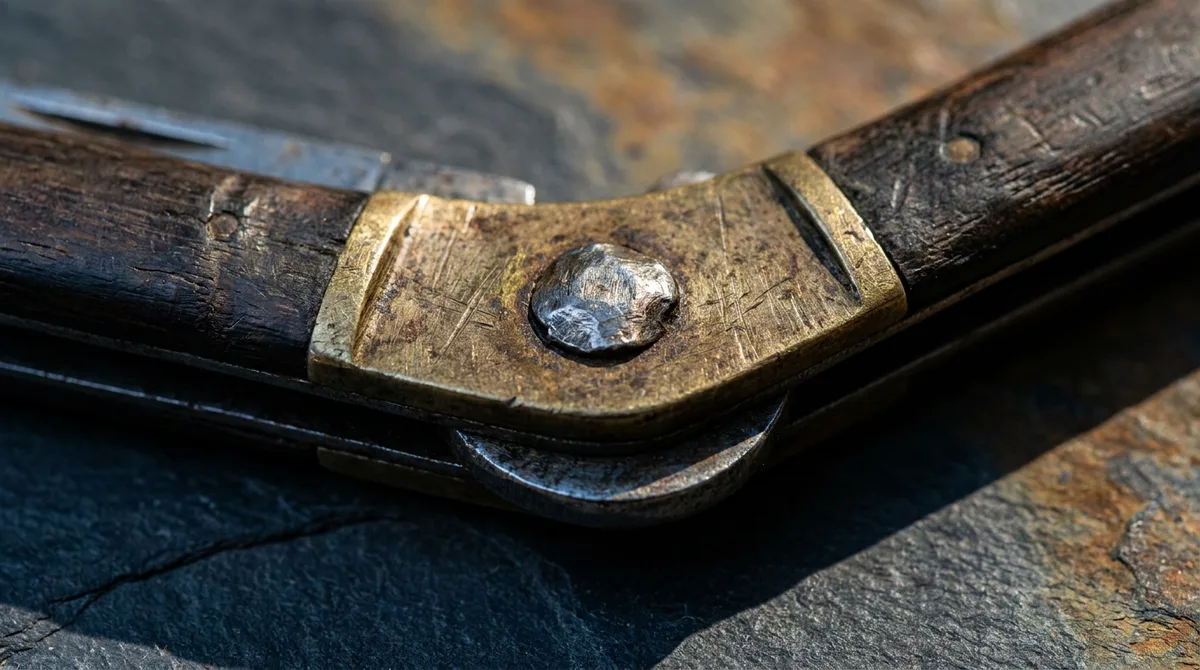
A traditional Filipino balisong made in the Batangas tradition has no washers, no bearings and no bushings. The pivot is a solid pin, driven through the handle and tang and then peened, meaning hammered at both ends so it mushrooms and cannot come out. The handles are channel-built frames of brass, steel or copper carrying inserts of horn, bone, stag or hardwood, and the fit between tang and handle is achieved by hand at the bench.
People raised on modern flippers sometimes read that as a missing feature. It is not. It is a different engineering answer to the same problem, and it has properties the modern answers do not:
- Nothing can back off, because there is no thread. A pinned knife holds its tune for years without attention.
- Nothing can be lost. There are no loose washers to drop on a workshop floor and no cage to crack.
- There is nowhere for grit to hide, so the knife tolerates being carried, used and neglected.
- The tolerance is fitted to that specific blade and those specific handles, rather than assembled from standard parts.
What you accept in return is that you cannot service it yourself. If a peened pin eventually works loose, it needs a maker with the right tools, not a driver set. That is the honest trade, and for a knife bought as a piece of craft it is usually the right one. The Batangas balisong guide goes through how these knives are built.
One more thing worth saying because it costs us sales: if what you want is the fastest possible chaotic flipping knife, a hand-fitted traditional pinned balisong is not the most efficient way to get it. Buy it because you want a handmade knife with a century of tradition behind it, and enjoy that it also flips well.
Which Should You Buy
| If you are… | Best fit | Why |
|---|---|---|
| A complete beginner | A trainer first, then washers | Slower and more controllable while you build muscle memory, and far more forgiving of being dropped |
| Learning aerials and rollovers | Bearings | The momentum genuinely helps, and speed matters more than dirt tolerance on a practice knife |
| Buying a handmade piece for the collection | Peened pin, traditional build | The pivot is part of the craft. Servicing is a maker’s job by design |
| Wanting one knife you never think about | Bushings, or a pinned traditional knife | Both remove the tuning cycle entirely |
| Using it for cutting and outdoor work | Washers | Tolerates dust, grit and damp far better than bearings |
| Using it in the kitchen | Washers | Easier to clean thoroughly, and fewer places for food residue to sit |
| Buying on a tight budget | PTFE or nylon washers | Cheap, slick out of the box, and cheap to replace when they compress |
| Unsure and want the safest default | Phosphor bronze washers | The fewest ways to be disappointed. Smooth, durable, forgiving, easy to live with |
On price, the pivot system is rarely the thing you are paying for. Across our own catalogue, prices run from $50 to $535 with a median around $166, and what moves a knife up that range is normally the steel, the handle materials and the hours of hand work, not the parts around the pivot. If you want the full breakdown of what drives balisong pricing, the price guide covers it, and the steel guide covers the part of the knife that actually does deserve the money.
Can You Convert a Knife From One System to the Other?
Sometimes, and less often than the internet suggests. Swapping bronze washers for PTFE, or the reverse, is usually straightforward if the thicknesses match, and mismatched thickness is exactly what throws a blade off centre. Going from washers to bearings is harder, because the bearing assembly needs somewhere to sit and the pivot diameter has to suit it. Converting a pinned traditional knife to anything is not a modification, it is a rebuild.
Before ordering parts, measure. Pivot diameter, washer outer diameter and washer thickness all have to be right, and a set that is close but not correct will give you a knife that is either bound solid or permanently off centre.
Butterfly knife laws vary by state, county and city. Check your local law before buying or carrying one.
More reading: Balisong anatomy · How to tune a balisong · Cleaning and oiling a butterfly knife · The Batangas balisong · Butterfly knife price guide
Frequently Asked Questions
Are bearings better than washers on a balisong?
Not better, different. Bearings are faster and freer, which most flippers prefer for aerials and rollovers. Washers are smoother, quieter, more tolerant of dirt and much less demanding to maintain. If the knife will be carried, used for cutting, or simply ignored between sessions, washers are usually the better long-term choice.
What are phosphor bronze washers and why are they used?
Phosphor bronze is a soft, self-lubricating bearing alloy. As a washer it will not scratch the blade’s flats, it wears in rather than wearing out, and it forgives the small tolerance variations that come with handmade knives. That combination is why it has been the default premium washer material in folding knives for a long time.
Do bearing balisongs need more maintenance?
Yes, noticeably. A bearing pivot has many small moving parts and grit lodges in them. When that happens the swing goes notchy rather than loose, and tightening does nothing: it has to be stripped and cleaned. Washer knives usually recover from the same treatment with a wipe and a drop of oil.
What is a bushing pivot and is it worth having?
A bushing is a sleeve in the tang hole that is slightly longer than the tang is thick, so it sets the handle spacing itself. That means the pivot screw can be tightened fully and the handle still swings freely. It removes almost all pivot tuning. Worth having if you want a knife you never think about.
Why do traditional Filipino balisongs not use washers or bearings?
Because they solve the same problem differently. The pivot is a solid pin, peened over at both ends, with the tang-to-handle fit made by hand at the bench. Nothing can back off, nothing can be lost and there is nowhere for grit to hide. The trade is that the pivot is not user-serviceable.
Is a knife without bearings lower quality?
No. Bearings are a design choice aimed at speed, not a quality marker. Plenty of expensive, superbly made knives use washers or peened pins, and plenty of cheap knives advertise bearings. Judge a knife by its fit, its finish, its steel and how it behaves in your hand, not by the parts list around the pivot.
Can I put bearings in a washer balisong?
Sometimes, but it is not a drop-in job. The bearing assembly needs the right diameter to sit on and the right total thickness, and getting either wrong leaves the knife bound or off centre. Swapping between washer materials is far easier, provided the thickness matches. Measure before you order anything.
Which pivot system is best for a beginner?
Start on a trainer, then a washer knife. A slightly damped swing is easier to control than a free-running one while you are still learning, and washers survive being dropped on hard floors better than bearings do. You can always buy a faster knife once your hands know what they are doing.
How do I know if my bearings are dirty?
Dirty bearings feel notchy or gritty rather than loose, and often make a fine sandy noise if you swing the handle slowly next to your ear. Tightening the pivot will not help and may make it worse. The fix is disassembly, cleaning and fresh lubricant, which is a bench job rather than a wipe-down.
Does the pivot system change how much a balisong costs?
Less than most buyers expect. Bearing and bushing assemblies add some cost, but across a range the main price drivers are the steel, the handle materials and the hours of hand work. A knife is rarely expensive because of its washers, and a knife is never good because of them either.