
Blog
Rust is a chemistry problem with a storage solution. High carbon and Damascus balisongs will corrode if you leave them wet, salty or sealed in a warm pocket, because they contain almost no chromium. 440C and VG10 resist it well, D2 sits in between despite the name. Dry the blade, oil it thinly, store it out of the sheath, and rust becomes a thing that happens to other people.
That is the short version. The longer version is worth reading because the three things people call rust are actually three different conditions, only one of which is a problem, and because the standard internet advice about removing it will destroy a Damascus etch in about four seconds.
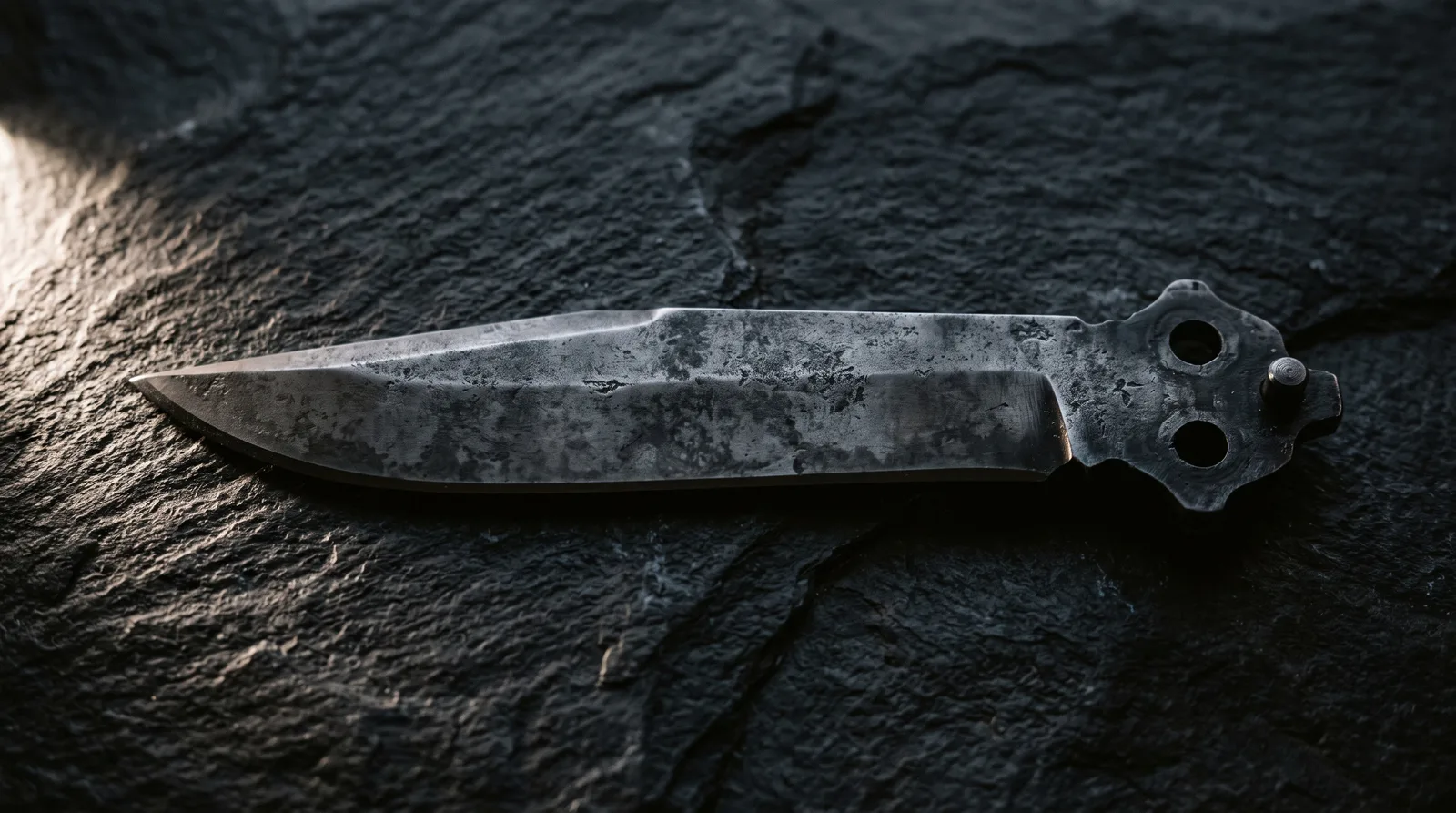
Why some balisong steels rust and others do not
Corrosion resistance comes down mostly to chromium dissolved in the steel matrix. Free chromium forms a thin oxide layer that reforms almost instantly when scratched, and that passive layer is what stainless means. The key word is dissolved: chromium locked inside chromium carbides is doing metallurgical work elsewhere and is not protecting anything.
That single fact explains the whole ranking. High carbon steel has essentially no chromium, so nothing forms a passive layer and the iron reacts with water and oxygen directly. 440C carries roughly sixteen to eighteen percent chromium and is properly stainless. VG10 sits around fifteen percent chromium with molybdenum and vanadium and behaves similarly well.
D2 is the interesting one, and the one people get wrong. It is nominally around 1.55 percent carbon and eleven to twelve percent chromium, which sounds stainless. But that high carbon content pulls chromium into carbides, and thermodynamic modelling puts D2’s chromium in solution at roughly 9.3 percent even at unrealistically high austenitising temperatures, lower still at the temperatures anyone actually uses. To get eleven percent chromium in solution you would need something like sixteen to seventeen percent total. D2 is semi-stainless, and it will spot if you neglect it.
Damascus follows its component steels. Pattern-welded Damascus built on 1095 and 15N20 contains no meaningful chromium at all, in either layer, which is precisely why the acid etch works: the two steels corrode at different rates and that difference is the pattern. A Damascus balisong is a high carbon knife wearing a pattern, and it needs high carbon care.
Corrosion risk by steel
| Steel | Chromium picture | Corrosion risk | What neglect looks like | Hardness we run |
|---|---|---|---|---|
| High carbon | Essentially none | High | Orange spotting within days in humidity; even fingerprints etch in | Varies by model |
| 1095 and 15N20 Damascus | None in either layer | High | Same as high carbon, plus the risk of ruining the etch during cleanup | 58 to 60 HRC |
| D2 | 11 to 12 percent nominal, roughly 9.3 percent maximum in solution | Moderate, semi-stainless | Isolated dark pinpoints, usually near the edge and pivots | 58 to 62 HRC |
| 440C | About 16 to 18 percent, properly stainless | Low | Surface haze in salt air, rarely more if dried | 58 to 60 HRC |
| VG10 | About 15 percent, plus molybdenum and vanadium | Low | Occasional tea staining, wipes off | Varies by model |
None of this makes high carbon a worse steel. It sharpens beautifully and is what the Batangas tradition was built on. It just asks for ten seconds of attention that 440C does not. For how these steels cut rather than corrode, see D2 vs Damascus vs 440C and the best steel for a balisong.
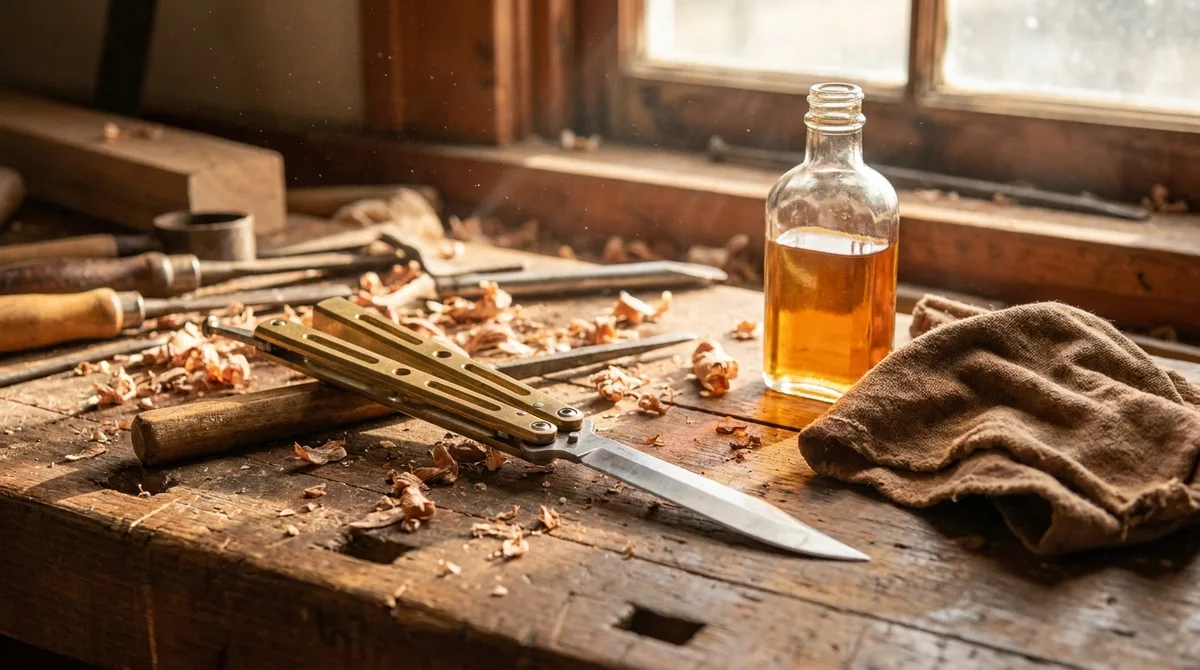
Stain, patina and pitting are three different things
Almost every panicked message we get about rust is actually about one of the first two.
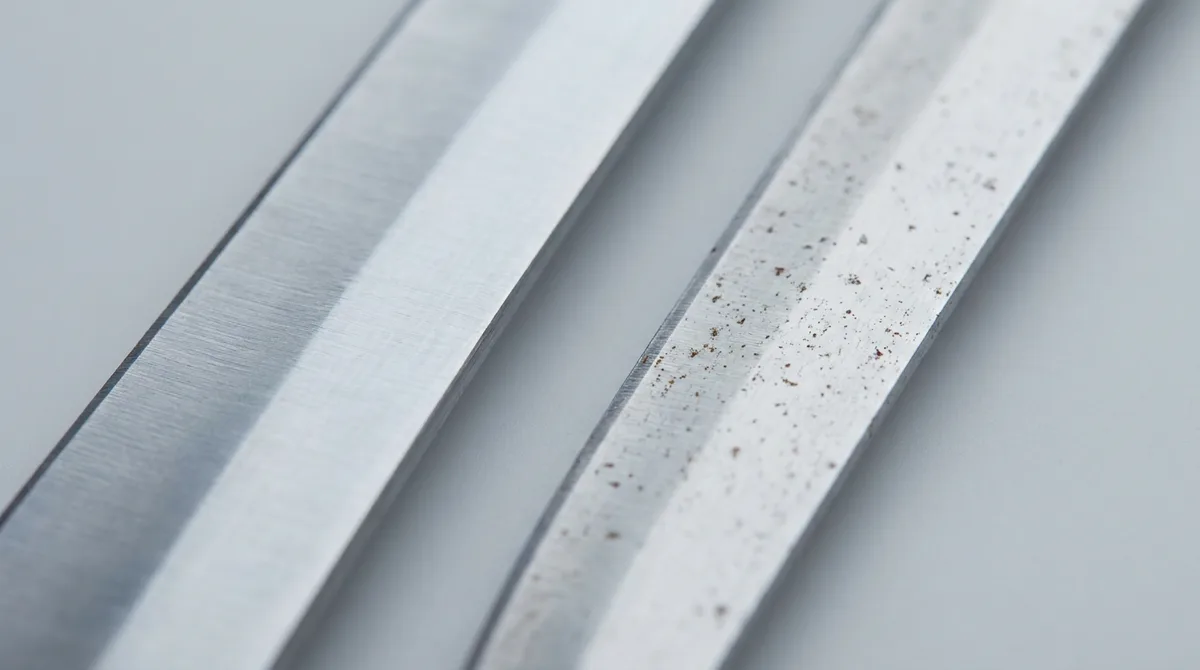
A stain is surface discolouration sitting on top of the steel. Tea-coloured, grey, sometimes iridescent. It has not consumed any metal. It usually comes off with a cloth and a little oil, or a soft eraser.
Patina is a stable layer of iron oxide, mostly magnetite, that forms on carbon steel through use and mild oxidation. It is grey, blue-grey or brown, adheres firmly, and is genuinely protective: a patinated blade rusts more slowly than a bare one. Chefs deliberately encourage it on carbon kitchen knives. It is not damage.
Rust, properly, is red or orange iron oxide that is flaky, does not adhere well, and holds moisture against the steel underneath. Left alone it becomes pitting, which is metal loss. Pitting is permanent. You can remove the rust from a pit but you cannot put the steel back, and a pit near the edge is a stress concentration and a weak point.
The test in your hand: patina is smooth and does not come off on a white cloth. Rust is powdery and does. If your cloth comes away orange, act. If it comes away clean, you have a patina and you should leave it alone.
Humidity, pockets and the storage mistakes that cause most rust
Steel does not need to be dunked to corrode. Ambient humidity above roughly sixty percent is enough for carbon steel to start over weeks, and it accelerates sharply with salt, acid or heat.
The reliable offenders, in the order we actually see them:
- Leather sheaths and pouches. Leather is tanned with acidic and salty compounds and it holds moisture. Storing a carbon blade in leather long term is one of the fastest ways to pit it. Sheaths are for carrying, not for storing.
- Pockets. Warm, humid, and full of sweat, which is salty. A knife that lives in a pocket needs wiping more often, not less.
- Fingerprints. Skin oil is mildly acidic and skin salt is not mild at all. On high carbon, a thumbprint left overnight can etch a visible thumbprint.
- Sealed containers with no desiccant. An airtight box traps whatever humidity was inside when you closed it, then cycles it against the steel with every temperature swing.
- Citrus, tomato, onion. If the knife touches food, acid plus carbon steel produces patina fast and rust not long after if it is not washed and dried immediately. This matters for our kitchen balisongs more than anywhere.
- The garage, the car and the basement. Unheated spaces swing through the dew point twice a day.
- Engraved recesses. Any cut surface, including an engraved mark, has more surface area than the flat around it and holds moisture and residue. Wipe into it, not just over it.
What actually works is dull and cheap. Wipe the blade after handling. A thin film of mineral oil or a purpose-made knife oil, applied with a cloth rather than poured, is enough. Store the knife dry, out of any sheath, in a drawer or roll rather than a sealed box, and throw a silica gel packet in with it if you live somewhere humid. Our knife care page covers the routine in more detail.
Forced patina: the honest version
Forcing a patina means deliberately reacting a carbon blade with a mild acid, usually mustard, vinegar, coffee or citrus, to produce a controlled oxide layer instead of waiting for an uncontrolled one.
The honest assessment: it does slow subsequent rusting, because a covered surface reacts more slowly than a bare one. It is not armour. A forced patina is thin, and a knife left wet will still rust through it. It permanently changes how the knife looks, and that change is not reversible without removing metal. Some people love the mottled grey it produces and some think it looks like a knife left out in the rain.
On Damascus, think much harder. The pattern you can see is itself the product of a controlled acid etch that darkens one steel more than the other. Adding a second, uneven acid reaction on top of it can flatten the contrast, blotch it, or overtake the original etch entirely. If you want a patina on a Damascus balisong, understand that you may be trading the pattern for it.
And two flat cautions. Do not force a patina on 440C or VG10: they are stainless, the result is uneven blotching rather than a patina, and there is nothing to gain. Do not treat a forced patina as a substitute for drying and oiling. It is a supplement, not a replacement.
Removing rust, from least to most aggressive
The rule is simple: start with the gentlest thing that could possibly work, and stop as soon as the orange is gone. Every step down this table removes metal, finish or both.
| Method | Aggression | Use on | Never use on | Notes |
|---|---|---|---|---|
| Dry cloth and oil | None | Everything | Nothing | Removes surface stain and light haze. Always try this first. |
| Soft pencil eraser | Very low | All steels | Nothing | Surprisingly effective on light orange spotting. Wipe and oil after. |
| Cork or hardwood with a drop of oil | Low | All steels, including Damascus if worked gently | Nothing | Cork is softer than steel and harder than rust. An underused method. |
| Non-woven abrasive pad, fine grade, with oil | Moderate | Satin-finished carbon, D2, 440C, VG10 | Damascus, mirror polish | Leaves a directional satin. Work along the length, never in circles. |
| Metal polish or fine compound on a cloth | Moderate | Stainless, polished carbon | Damascus | Will lift the darkened layer out of an etched pattern. |
| Wet abrasive paper, 1000 grit and finer, with oil | High | Heavy rust on plain carbon, D2, 440C | Damascus, anything you care about the finish of | You are refinishing the blade, not cleaning it. Commit or do not start. |
| Chemical rust remover or acid dip | High and indiscriminate | Plain carbon, as a last resort | Damascus, and anything with the pivots assembled | Attacks the good steel too, and will run into the pivot area where you cannot rinse it out. |
| Wire brush, coarse abrasive, rotary tool | Destructive | Nothing on a balisong | Everything | Removes pattern, finish, heat treat integrity at the edge, and value. |
A balisong adds one complication a fixed blade does not have. Rust likes pivots, because pivots trap moisture and are hard to dry. If you have corrosion in the pivot area, flush it with a light oil, work the handles through their range, and wipe the excess. Do not put chemical rust remover anywhere near a pivot: you will never rinse it fully out, and it keeps working after you have stopped looking.
What damages a Damascus etch
Worth its own section, because this is the most common irreversible mistake we hear about.
The visible pattern on a genuine pattern-welded blade is a topographic and tonal difference produced by acid. The nickel-bearing layer, 15N20 in a typical 1095 and 15N20 billet, resists the etchant and stays bright. The 1095 darkens. Remove the dark layer and you remove the contrast, leaving a blade where the pattern is faintly visible in raking light and invisible otherwise.
Things that will do that: metal polish, any abrasive compound, non-woven abrasive pads, abrasive paper, ultrasonic cleaners with aggressive solutions, and prolonged scrubbing with anything gritty. Things that will not: a clean cloth, oil, a soft eraser used lightly, and patience.
If a Damascus blade has genuine rust rather than a stain, treat the smallest possible area with cork and oil and accept that a perfectly uniform result is not achievable at home. A slightly imperfect pattern is better than a uniformly flat one. If it is a piece you care about, ask before you start rather than after.
A separate point worth making: most so-called Damascus on marketplaces is acid-etched print or laser marking on plain stainless. It has no layers, so there is nothing to lose, but it also washes off with polish. Our Damascus balisongs are pattern-welded, which is why they need this care in the first place.
A maintenance routine that takes ninety seconds
- After handling, wipe the blade with a dry cloth. Both faces, edge to spine, including the tang.
- If it got wet, dry it properly before it goes anywhere, especially the pivot area.
- Put a drop of oil on the cloth, not on the blade, and wipe a thin film over the steel.
- One drop of light oil at each pivot, work the handles, wipe the excess off the outside.
- Store it dry, out of leather, in a drawer or a roll. Silica gel if the room is humid.
- Check it monthly if you are not using it. Rust found in week one is a wipe; rust found in month six is a pit.
Sharpening interacts with all of this, because a fresh edge is bare steel with no oxide layer on it at all and is the most corrosion-prone part of the knife. Oil the edge after sharpening, every time. Our sharpening guide covers the geometry side.
Living with patina
A high carbon balisong is not a stainless knife that failed. It is a different object with a different relationship to time. It will grey, and it will pick up marks from what it cuts and where it has been. On a knife handled daily that surface is a record, and a lot of owners come to prefer it to the factory finish.
If you want a knife that looks the same in ten years as it does today, buy 440C or VG10 and enjoy the low maintenance. If you want a knife that ages, buy high carbon and let it. Both are legitimate. What is not legitimate is buying high carbon and then being upset that it behaves like high carbon.
More reading: the routine basics are on our knife care page, edge work is in the sharpening guide, the steels are compared in D2 vs Damascus vs 440C and best steel for a balisong, and the mechanism that makes pivots matter is explained in balisong vs switchblade.
Frequently Asked Questions
Will a high carbon balisong definitely rust?
Only if you let it. High carbon steel has essentially no chromium and forms no passive layer, so it reacts with moisture directly. Wiped after handling, kept lightly oiled and stored dry out of leather, a high carbon blade can go years without a spot. Left wet or sealed damp, it can spot in days.
Is D2 stainless?
No, semi-stainless. D2 carries eleven to twelve percent chromium nominally, but its high carbon content ties much of that up in carbides. Modelling puts chromium in solution at around 9.3 percent at best, and true stainless behaviour needs roughly eleven percent dissolved. In practice D2 resists corrosion far better than plain carbon and noticeably worse than 440C.
What is the difference between patina and rust?
Patina is a stable, adherent grey or blue-grey oxide that protects the steel underneath and does not come off on a cloth. Rust is red or orange, flaky, holds moisture against the metal and does come off on a cloth. Patina is fine and often desirable. Rust is a problem that becomes pitting if ignored.
Can I remove pitting?
You can remove the rust sitting in a pit, but not the pit. Pitting is metal that is gone. Deep pits can be sanded flat only by removing the surrounding steel down to their depth, which changes the blade geometry. The practical answer is to stop the corrosion, oil it, and accept the mark.
Should I force a patina on my balisong?
On plain high carbon, it is a reasonable choice: it slows later rusting and many people like the look. It is permanent and it is not a substitute for drying and oiling. On Damascus, be careful, because you can flatten the etched contrast. On 440C or VG10, do not bother. They are stainless and the result is blotchy.
What oil should I use on a balisong?
A light mineral oil or a purpose-made knife oil. Apply it to a cloth and wipe a thin film on rather than pouring it onto the blade. If the knife ever touches food, use a food-safe mineral oil. The exact product matters far less than whether you actually do it.
Why is my Damascus pattern fading?
Almost always abrasion. Metal polish, abrasive pads, compounds and abrasive paper all remove the darkened layer that creates the contrast, and once that layer is gone the pattern goes flat. Clean Damascus with a cloth and oil only. If there is real rust, use cork and oil on the smallest possible area.
Is it safe to store a balisong in a leather sheath?
For carrying, yes. For storage, no. Leather is tanned with acidic and salty compounds and holds moisture against the steel. Long-term storage in leather is one of the most reliable ways to pit a carbon blade. Store the knife dry in a drawer or a roll and keep the sheath for transport.
Does humidity alone cause rust without water contact?
Yes. Ambient humidity above roughly sixty percent is enough for carbon steel to begin corroding over weeks, and salt, acid or heat speeds it up considerably. This is why garages, cars and basements are bad storage: they cycle through the dew point regularly. A silica gel packet in the drawer is cheap insurance.
Does rust affect how a balisong flips?
It can. Corrosion in the pivot area increases friction and makes the action gritty and inconsistent, which is far more noticeable than a spot on the blade face. Flush the pivots with light oil, work the handles through their range and wipe the excess. Never put chemical rust remover near an assembled pivot.