
Blog
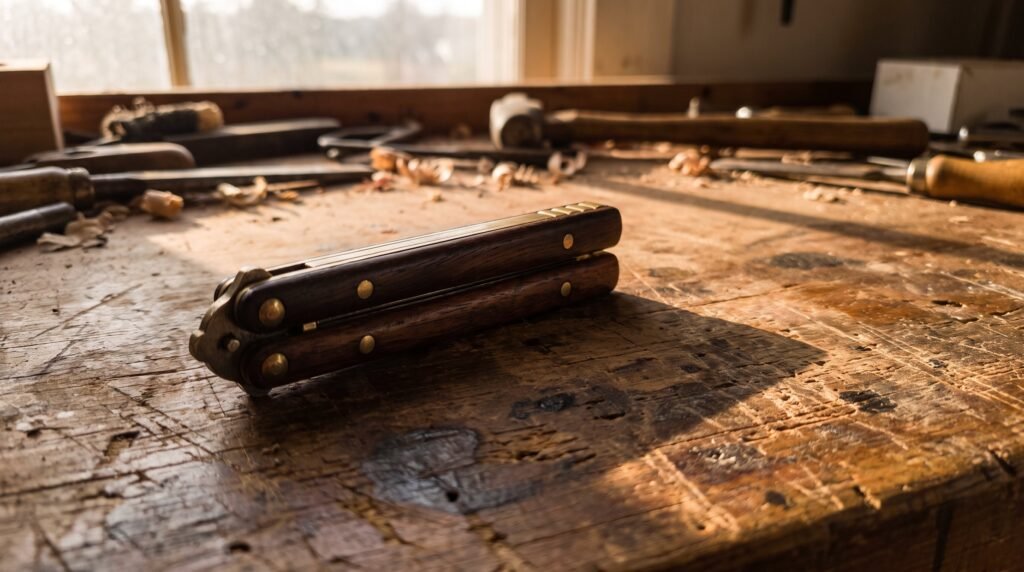
To flip a butterfly knife, hold the safe handle (the one that closes over the blade’s unsharpened spine), let the bite handle swing freely, and learn three foundation moves: the basic open, the basic close, and the vertical open. Once those feel automatic, add the fan and the twirl. Start on a blunt trainer, practice slowly over a soft surface, and speed comes on its own. That is how to flip a butterfly knife in a nutshell. Everything below breaks it into steps.
Safety and legal note: balisong ownership and carry laws vary by state, city, and country. Always check your local laws before buying or carrying a butterfly knife, and treat every blade with respect.
Before You Flip: Start With a Trainer (Seriously)
Every experienced flipper says the same thing: learn on a trainer first. A trainer has a blunt, unsharpened “blade,” so early fumbles cost you nothing but pride. If you only have a live blade, wrap the edge in layers of painter’s tape so a slip cannot cut you.
Ground rules before your first flip:
- Clear your space. No pets, no people, no glass tables. You will drop the knife. Everyone does.
- Practice over something soft. A bed, carpet, or grass protects your floor and your knife. Wood, horn, and stag handles deserve a soft landing.
- Wear closed shoes. A dropped knife finds bare feet with uncanny accuracy.
- Know your local laws. Some U.S. states treat balisongs like any pocket knife; others restrict carry or sale. This is not legal advice. Check the rules where you live.
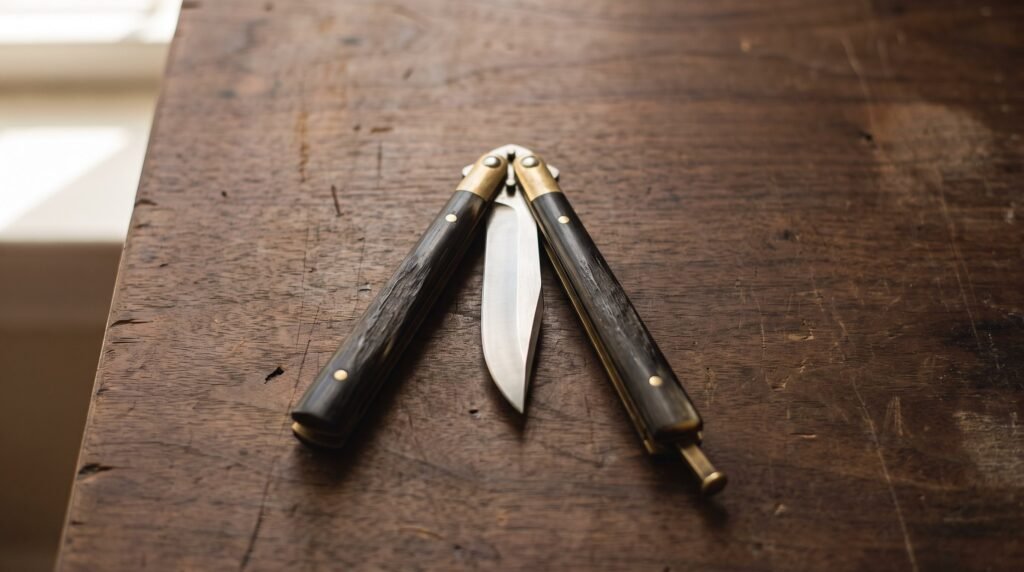
Balisong Anatomy: Bite Handle vs. Safe Handle
You cannot flip safely until you can identify the two handles at a glance. One can cut you and one cannot.
- Safe handle: the handle that sits against the spine (dull back) of the blade when closed. Hold this handle and the edge always swings away from your fingers. Beginners use it for almost every trick.
- Bite handle: the handle that closes over the sharp edge. Grip it and swing carelessly, and the edge lands on your fingers, hence the name.
- Latch: the small locking arm, usually on the bite handle, that locks the knife open or closed. Leave it unlatched while flipping.
- Pivots: the two pins or screws the handles rotate around. Smooth, well-fitted pivots separate a knife that flips like silk from one that fights you. This is where handmade fit and finish shows.
Quick check before every session: close the knife and confirm which handle covers the edge. That habit prevents the classic beginner cut.
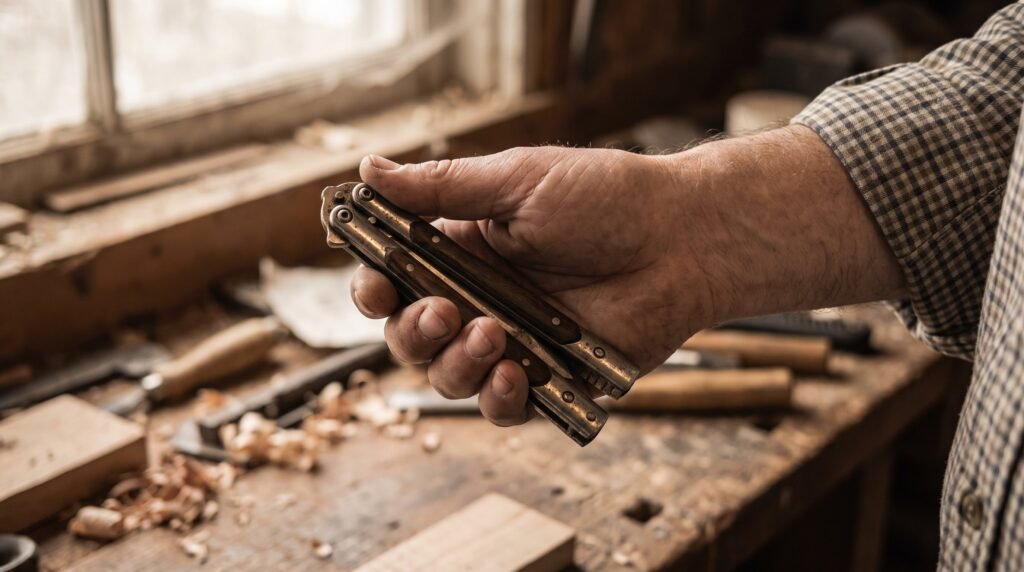
How to Use a Butterfly Knife: The Grip
Almost all beginner tricks start from the same position:
- Hold the safe handle in your dominant hand like a hammer handle, thumb along the side or lightly on top.
- Keep the grip firm but relaxed: a white-knuckle grip kills the swing; a limp grip sends the knife flying.
- Let the bite handle hang free and unlatched, so it can rotate a full circle around the pivot.
- Keep your wrist loose. Flipping is wrist and fingers, not arm. If your shoulder is working, you are muscling it.
- When catching, wrap your fingers around the handle only. Never let a finger drift over the channel where the blade closes.
Six Beginner Butterfly Knife Tricks, Step by Step
If you searched for how to flip a butterfly knife, these six moves are your curriculum. Learn them in order. Each teaches a pattern the next builds on. Practice slowly until you can land a trick ten times in a row, then add speed.
1. The Basic Open (Backhand Open)
The fundamental deployment. It teaches the wrist flick behind almost everything else.
- Step 1: Hold the closed knife by the safe handle, bite handle facing away, latch open.
- Step 2: Flick your wrist down and slightly back so the bite handle and blade swing away from you, around the pivot.
- Step 3: Let the swing carry the bite handle over the back of your hand, rotating your wrist so your knuckles point up as it passes.
- Step 4: Flick your wrist forward again. The bite handle swings around and lands against the safe handle in your palm. Open.
If the bite handle slaps your knuckles, your wrist is stiff. Soften the motion and let momentum, not force, carry the handle.
2. The Basic Close
The basic open in reverse. Do not skip it: a flipper who can open but not close smoothly is only half trained.
- Step 1: Start with the knife open, gripping the safe handle, edge facing away.
- Step 2: Flick your wrist so the bite handle swings away and over the back of your hand, just like the open.
- Step 3: As it comes around, rotate your wrist back and let the bite handle fold shut over the blade. Your fingers stay on the safe handle the whole time, so the edge never comes near them.
- Step 4: Catch the closed knife and latch it if you are done.
3. The Vertical Open (Gravity Open)
The easiest open: a great confidence builder for day one.
- Step 1: Hold the closed knife vertically by the safe handle, tip pointing down, latch open.
- Step 2: Rotate your wrist a quarter turn so the bite handle falls away and swings down under gravity.
- Step 3: With a small downward flick, snap the bite handle around so it swings up against the safe handle.
- Step 4: Close your fingers around both handles. Open.
4. The Fan
The first flourish most people learn: the knife spins in a continuous circle beside your hand like a fan blade.
- Step 1: Hold the open knife by the safe handle between your thumb and the base of your fingers, grip loose.
- Step 2: Swing the knife forward and down, then rotate your wrist in a smooth circular motion. Like turning a doorknob back and forth in rhythm.
- Step 3: As the blade and bite handle swing around the pivot, open your fingers slightly and let the safe handle rotate around the web of your thumb.
- Step 4: Keep the circular wrist motion going. Momentum keeps the knife spinning. That continuous spin is the fan.
Start painfully slow. The fan is pure rhythm; speed without rhythm just means a dropped knife.
5. The Twirl (Pinwheel)
A rolling flourish where the knife makes a full rotation and lands open in your grip. Looks advanced, but beginner-friendly.
- Step 1: Hold the closed knife by the safe handle, latch open, thumb along the side.
- Step 2: Flick your wrist forward so the bite handle swings out and around, like the start of a basic open.
- Step 3: As it comes around, loosen your grip and let the whole knife carry through one extra rotation around your thumb: the “pinwheel.”
- Step 4: As the rotation completes, close your fingers and catch both handles together, knife open.
6. The Thumb Rollover
Your first “rollover”: the family of tricks where the knife rolls over a finger, and the gateway to intermediate flipping.
- Step 1: Hold the open knife by the safe handle, thumb lying flat along the handle’s side.
- Step 2: Flick the bite handle up and over your thumb, letting the knife pivot on the thumb like an axle.
- Step 3: As the bite handle rolls over and comes around the far side, release the safe handle with your fingers.
- Step 4: Catch the safe handle again as the rotation finishes, knife still open.
Walk the knife over your thumb with your other hand a few times first, so your brain learns the path before your wrist tries to power it.
Common Butterfly Knife Trick Mistakes (and How to Fix Them)
- Gripping the bite handle by accident. The number one cause of beginner cuts. Check which handle covers the edge every time you pick the knife up.
- Death-gripping the handle. Tension ruins the swing and bruises knuckles. Relax until the knife almost slips, then add back just enough pressure.
- Muscling with the arm. Pin your elbow lightly against your ribs during practice so only the wrist can move.
- Chasing speed too early. Fast and sloppy becomes a permanent habit. Earn speed: ten clean slow reps before every faster attempt.
- Practicing over concrete or tile. Drops chip blades, crack handles, and bend pivots. Stay over a bed, carpet, or grass until your catch rate is high.
- Flipping with the latch closed or half-latched. The handles jam mid-swing and the knife jumps unpredictably. Latch fully open, always.
- Ignoring maintenance. Dry, dusty pivots make even a great knife feel gritty. A drop of oil and a wipe-down after each session. Our knife care guide covers the full routine for D2 and Damascus blades.
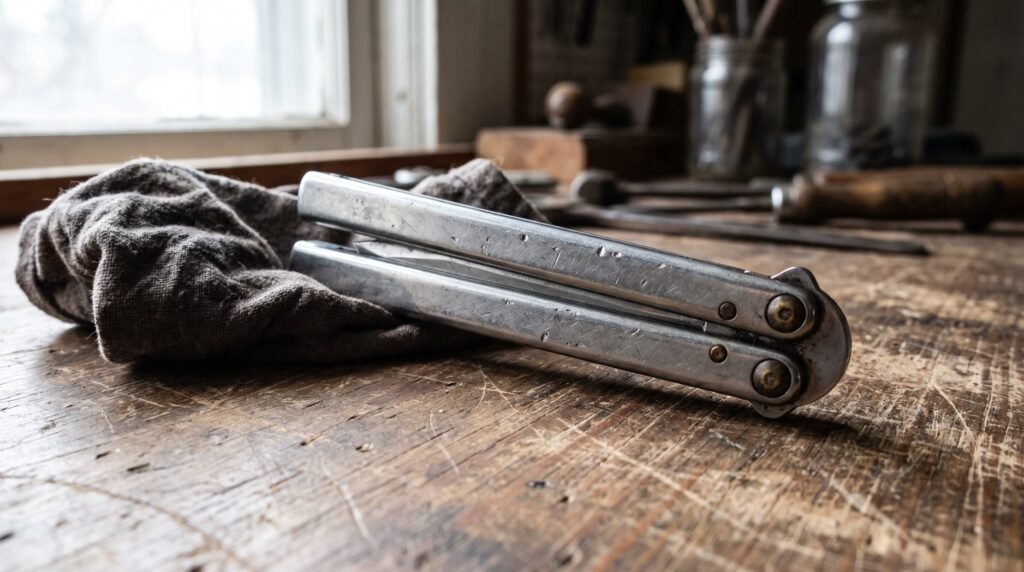
Balisong Flipping Practice That Builds Real Skill
Short, frequent, focused sessions beat marathon practice. A simple first-month plan:
| Stage | Focus | Goal before moving on |
|---|---|---|
| Week 1 | Basic open, basic close, handle identification | 10 clean opens and closes in a row |
| Week 2 | Vertical open + linking open and close | Open-close-open cycles with no knuckle contact |
| Week 3 | The fan, slow speed | 5 continuous fan rotations without a drop |
| Week 4 | Twirl and thumb rollover | Each trick landed 10 times in a session |
Three habits that separate flippers who progress from flippers who plateau:
- Practice both hands early. Even five minutes per session with your off hand pays off later.
- Film yourself. Your phone will show you the stiff wrist or early release you cannot feel.
- End every session on a success. Land one clean rep of your best trick, then stop.
When You’re Ready for a Real Handmade Balisong
Trainers are for learning, but most flippers eventually want the real thing, and there is a difference between a mass-produced factory knife and one made the way it has been for generations in Batangas, the Philippine province where the craft was born: blade, pivots, and handles fitted individually so the knife swings true. Our history of the balisong traces that lineage.
Every knife in our authentic Filipino balisong collection is handmade. No two are identical. A few starting points (sale prices at the time of writing):
- BF-02 Argentine Ant, 440C steel. One of the most affordable ways into a handmade piece, currently $110.
- BF-120 Mini Balisong, D2 steel with stag horn handle: a smaller, easy-handling format, currently $137.50.
- BF-162 Damascus steel with black horn handle: a showpiece from our Damascus steel collection, currently $275.
Honest advice: a hand-forged Damascus balisong with a horn handle is a knife to flip carefully and display proudly. Not one to drop on concrete two hundred times while learning the fan. Learn on the trainer; let the handmade piece be the reward. We also engrave names on personalized butterfly knives, the traditional Filipino weapons collection is worth a look for anyone drawn to the culture behind the knife, and you can browse everything in the full balisong shop.
Frequently Asked Questions
Is it legal to own and flip a butterfly knife?
It depends on where you live. In the United States, some states permit balisong ownership and carry, others restrict carry or sale, and city ordinances can differ from state law. Laws change, so check your current local laws before buying, carrying, or practicing in public.
What is the easiest butterfly knife trick for beginners?
The vertical (gravity) open, because gravity does most of the work. The basic open and basic close are the most important, though. They build the wrist mechanics every other trick uses, so learn all three in your first week.
Should I learn to flip on a trainer or a real balisong?
A trainer, without question. It lets you make every beginner mistake with zero risk of cuts or damage to an expensive blade. Move to a live blade once you can run the basic open, close, and a slow fan without knuckle contact.
How long does it take to learn to flip a balisong?
Most beginners land a clean basic open within a day or two, get comfortable with the fan and twirl in three to four weeks, and start rollover combinations after a couple of months. Ten focused minutes a day beats occasional hour-long sessions.
Do flipping tricks damage the knife?
Drops are the real enemy. They chip edges, crack natural handle materials, and can bend pivots. Practice over soft surfaces and keep the pivots clean and lightly oiled. Our knife care guide covers the full routine, and the shop Q&A answers common questions about steel and handle care.
What makes a balisong good for flipping?
Weight balance, smooth pivots, and handles that fit your hand. Handle-biased balance makes swings predictable, and fit and finish matter more than any spec sheet: a hand-fitted balisong with rattle-free pivots simply swings better than a loosely assembled factory knife.
Final reminder: flip in a clear space, keep blades away from children, and verify your local knife laws before you buy or carry. Stay safe and enjoy the art. Batangas flippers have practiced it for generations, and it rewards patience.
Related guides
When the trainer starts to feel easy, our balisong knives page has every knife as a live blade, and as a trainer at the same price.