
Blog
The difference is stored energy. A balisong has none: two handles pivot around the tang and you open it entirely with your hand. A switchblade, also called an automatic, holds a compressed spring that throws the blade out when you press a button or lever. An assisted opener sits between them, with a spring that only takes over after you start the blade moving yourself.
That is the short version, and it is the version that matters, because almost every argument about these three knives is really an argument about mechanism. Once you can see what is actually storing and releasing energy inside the handle, the rest of it, including why the law treats them so differently, stops being confusing.
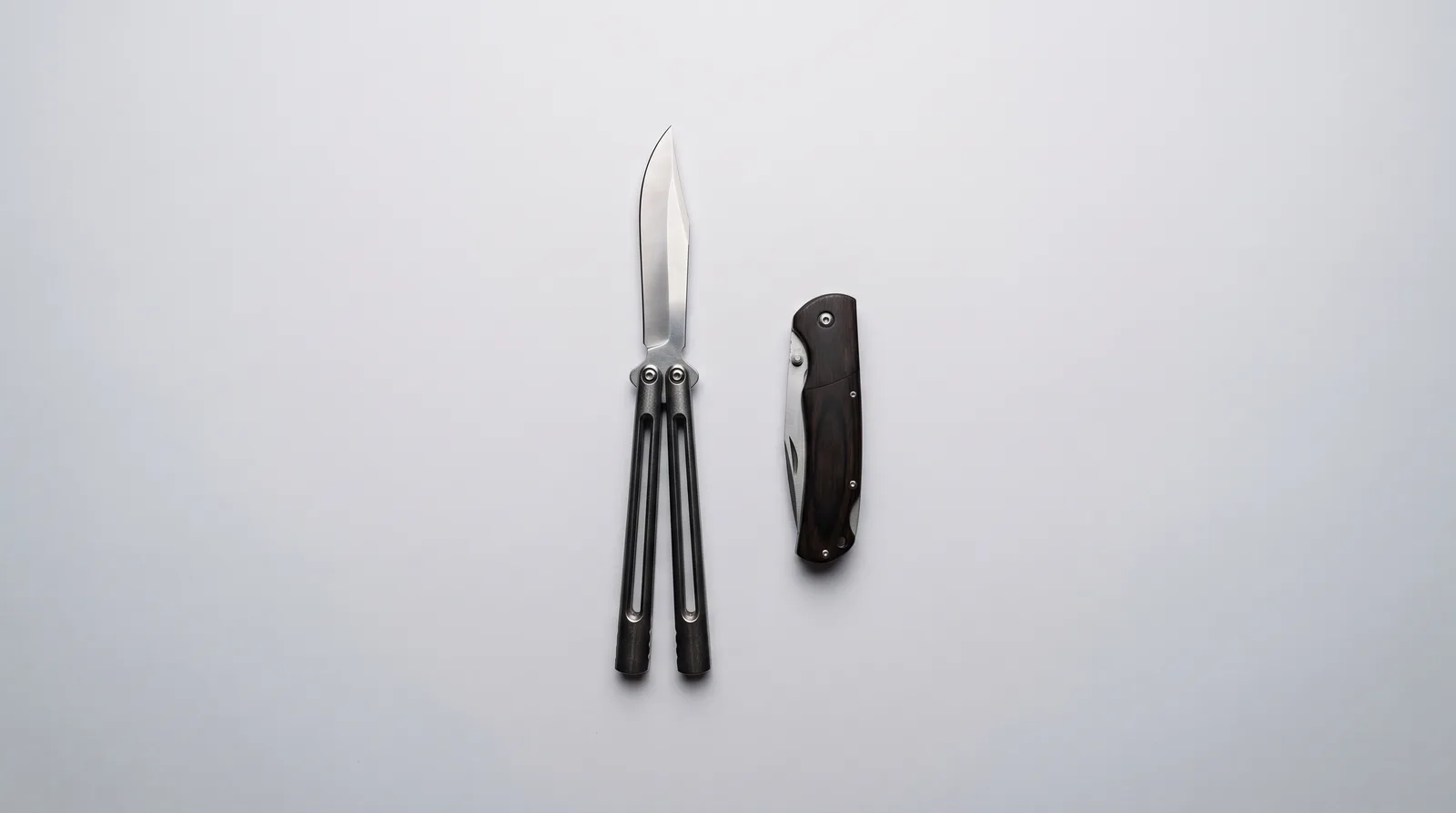
What a balisong actually does
A balisong is two handles, a blade, two pivot pins and usually a latch. The blade tang sits between the handles. When the knife is closed, the blade is sandwiched inside the two handle channels. To open it you swing one handle away, rotate the blade through, and bring the handles back together around the tang with the edge now exposed.
There is no spring anywhere in that description. There is no button. There is no detent creating a bias toward opening, and there is nothing holding potential energy of any kind. Every joule that opens a balisong comes out of your wrist. Drop one and it does not deploy. Leave one on a shelf for ten years and it will be exactly as closed as you left it.
This is also why flipping exists as a hobby at all. A knife that opens itself has nothing to learn. A knife that requires a specific sequence of hand movements has an entire skill tree, which is what our beginner flipping guide is about, and what butterfly knife tricks are built on.
What a switchblade actually does
A switchblade, automatic knife or auto is a knife with a spring under load while the knife is closed. A catch holds that spring in place. Press the button or slide the lever and the catch releases, and the spring drives the blade to full extension without further input from you.
There are two main layouts. A side-opener throws the blade out sideways on a pivot, the same arc a normal folder swings through. An out-the-front, or OTF, drives the blade forward out of the tip of the handle, either single action, meaning it fires open and you retract it manually, or double action, meaning the same slider fires it both ways.
The mechanism is the definition. It is not about how fast the knife opens, how it looks, or what it is made of. It is about whether energy was stored in the knife before you touched it.
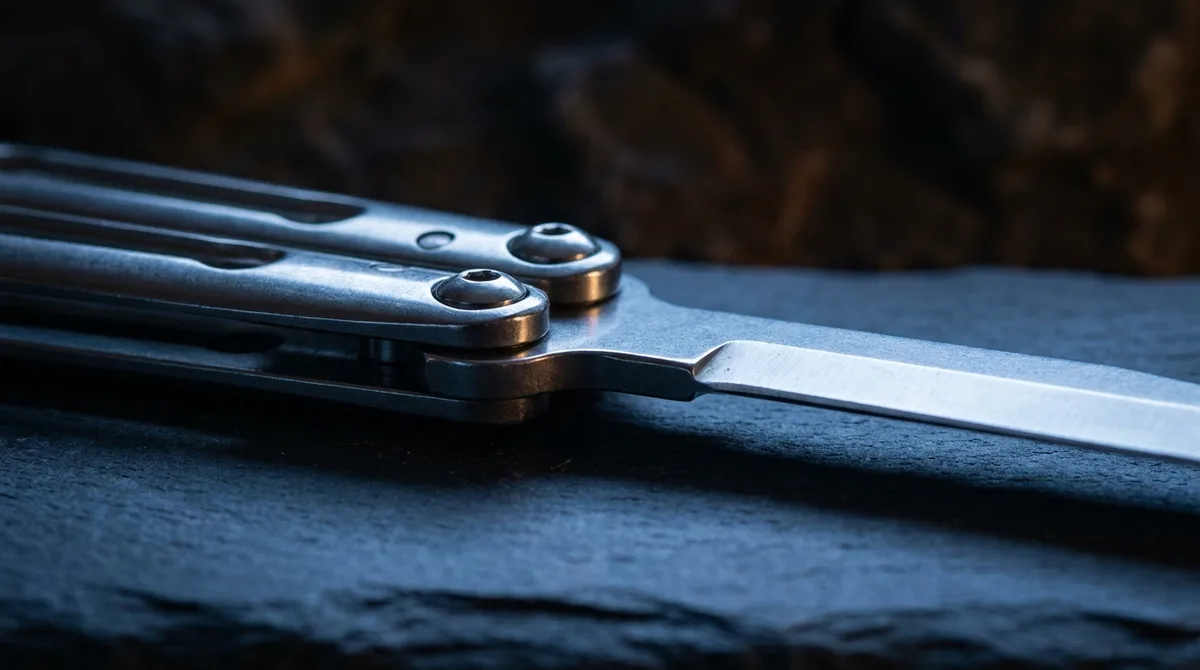
What an assisted opener actually does
An assisted opener has a spring, torsion bar or similar element, but it is arranged so the knife is biased toward closure while shut. Nothing happens until you push the blade past a threshold with a thumb stud or flipper tab. Past that point the spring takes over and completes the opening.
Federal law describes this precisely. The exemption at 15 U.S.C. 1244(5) covers a knife containing “a spring, detent, or other mechanism designed to create a bias toward closure of the blade and that requires exertion applied to the blade by hand, wrist or arm to overcome the bias toward closure to assist in opening the knife.” That language was added by amendment in 2009, and it exists specifically because assisted openers were at risk of being reclassified as switchblades.
The practical test is simple. If you can open it without touching the blade, it is an automatic. If you have to move the blade yourself first, it is assisted.
Mechanism comparison
| Property | Balisong | Switchblade / automatic | Assisted opener | Ordinary manual folder |
|---|---|---|---|---|
| Stored energy when closed | None | Yes, spring under load | Yes, but biased to close | None, or a closing detent |
| Release trigger | Hand and wrist motion only | Button, lever or slider | Manual push on the blade | Manual, all the way |
| Opens if dropped | No | No, but fires if the button is knocked | No | No |
| Number of moving handles | Two | One | One | One |
| Blade path | Rotates between handles | Side swing or out-the-front | Side swing | Side swing |
| Skill required to open | Real, and takes weeks | None | None to speak of | Minimal |
| Can be practised safely unsharpened | Yes, trainers are a real category | Not meaningfully | Not meaningfully | Not meaningfully |
| Typical failure point | Pivot wear, loose pins | Spring fatigue, worn catch | Torsion bar breakage | Lock wear |
Why the mechanical distinction matters legally
Most knife statutes in the United States, and many abroad, are written around deployment mechanism rather than around blade shape or size. A rule that says “no knife that opens automatically by pressure on a button” is describing a mechanism. That is why the automatic category exists as a legal category at all.
The complication for balisongs is that some definitions reach further than mechanism. The 1958 federal definition includes knives opening “by operation of inertia, gravity, or both,” and various state definitions add phrases like “flip of the wrist.” Those words can capture a knife that has no spring at all, which is how a purely manual knife ends up sitting in a legal category built for spring-powered ones. We wrote the full account of how that happened in why are butterfly knives illegal.
Butterfly knife laws vary by state, county and city, so check your local law before buying or carrying one. The current picture is in our balisong laws by state guide, and that page, not this one, is where legal questions belong.
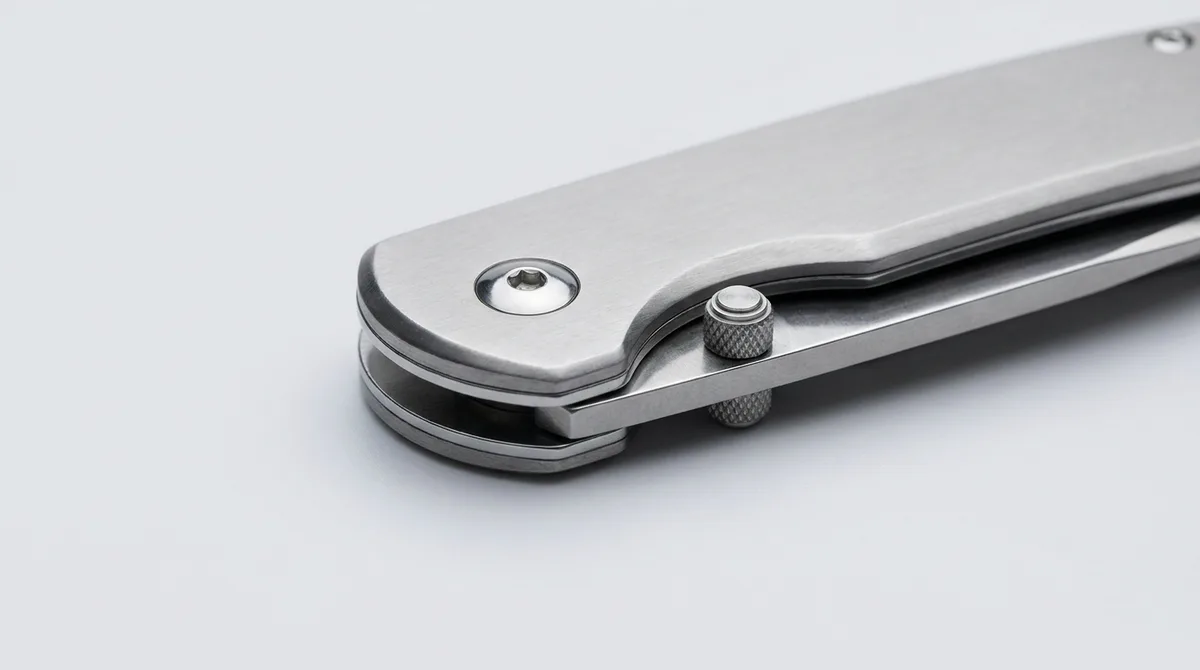
Which is which: identifying a knife in hand
People get this wrong constantly, including sellers. Here is how to tell what you are actually holding.
| What you see | What it means | Category |
|---|---|---|
| Two handles that separate and swing | Manual pivot design, no stored energy | Balisong |
| A button, plunger or lock-release on the handle spine or face | A catch holding a loaded spring | Automatic, side-opening |
| A slider on the handle, blade exits the end | Spring-driven linear deployment | Automatic, out-the-front |
| Thumb stud or flipper tab, blade snaps once nudged | Bias toward closure overcome by hand | Assisted opener |
| Thumb stud, blade moves only as far as you move it | No assistance at all | Manual folder |
| Nail nick, needs two hands | Traditional slipjoint or lockback | Manual folder |
| Two handles, blade has no edge and rounded tip | Practice tool, same mechanics | Balisong trainer |
| Blade fires forward when a lever is pulled and can leave the handle | Projectile mechanism, a separate legal category entirely | Ballistic knife |
One more test that settles most arguments: hold the knife closed and shake it. If nothing you do without pressing anything can open it, and nothing you press can open it either, it is manual. If a control opens it, find out whether that control moves the blade or releases a catch.
The confusion that will not die
A few specific misunderstandings come up often enough to be worth naming.
- “A balisong is a type of switchblade.” Mechanically, no. Legally, in some jurisdictions, yes, because of the wording described above. Both statements can be true at once, which is why the argument never ends.
- “Fast means automatic.” A practised flipper opens a balisong very quickly. An unpractised one takes several seconds and may drop it. Speed is a property of the user, not the mechanism.
- “Spring assisted is the same as spring loaded.” They are separated by a specific federal exemption written in 2009. The difference is which way the spring is biased when the knife is shut.
- “Butterfly knife and balisong are different things.” They are the same knife. Balisong is the Filipino name, butterfly knife the common English one. We cover the naming in balisong vs butterfly knife.
- “A ballistic knife is a kind of automatic.” No. A ballistic knife launches the blade away from the handle. It has its own federal provision at 15 U.S.C. 1245 and is a different category.
Maintenance follows mechanism
The three designs fail and wear in different ways, so they need different attention.
A balisong is almost all pivot. Its performance depends on two pins, the bushings or washers around them, and the tension you set. It has no spring to fatigue and no catch to wear round, which is one reason a well-made balisong is a genuinely long-lived object. What it does need is pivot cleanliness, occasional retensioning and a habit of not letting grit into the channels. The blade itself needs the same care as any other, covered in our knife care page and in balisong rust and care.
An automatic depends on a spring that spends its whole life under load and a catch surface that takes an impact every time it fires. Those are consumable parts on a long enough timescale. An assisted opener depends on a torsion bar that is repeatedly flexed, which is the part most likely to snap.
Which one is right for you
If you want a knife that opens fast with no learning curve, an automatic or an assisted opener does that job, and neither of them is what we make.
If you want an object with a craft tradition behind it, a mechanism you can learn and keep improving at, and no springs to wear out, that is a balisong. It is a slower answer. It rewards practice in a way a button does not, and the people who stay with balisongs stay for exactly that reason.
If you are not sure yet, start with a trainer. A trainer will not make you a flipper faster. It will just stop you needing stitches while you find out whether you enjoy this. Once you know, our live blade range and the price guide will tell you what a good one costs. If you are buying for somebody else, read the engraved butterfly knife gift guide before you order.
More reading: start with what is a balisong knife, then the legal history in why are butterfly knives illegal, the current position in balisong laws by state, the practice tools in our trainer knives guide, and the blade shapes in butterfly knife blade types.
Frequently Asked Questions
Is a butterfly knife a switchblade?
Mechanically, no. A switchblade stores energy in a spring and releases it with a button. A balisong stores no energy and is opened entirely by hand. Legally the answer depends on the jurisdiction, because some statutory definitions reach beyond mechanism to cover knives opened by inertia or a flick of the wrist.
What is the difference between automatic and assisted opening?
An automatic is biased toward opening: a spring is under load and a catch holds it until you press a button. An assisted opener is biased toward closure and does nothing until you push the blade past a threshold yourself. Federal law recognises the distinction in the exemption at 15 U.S.C. 1244(5).
Does a balisong have a spring inside it?
No. A conventional balisong is two handles, a blade, two pivot pins and usually a latch. There is no spring, torsion bar, detent or stored energy of any kind. That is why it will not open if you drop it, and why it needs to be opened by a learned hand movement rather than a control.
Which opens faster in practice?
An automatic, for anyone who has not put in the hours. It opens at the same speed for a beginner and an expert. A balisong opens as fast as the person holding it, which for a practised flipper is quick and for a new owner is not. Speed is a property of the user.
Are balisongs more or less reliable than automatics?
Different failure modes. A balisong has no spring to fatigue and no catch to round off, so its wear points are the pivots, which are serviceable. An automatic carries a spring under permanent load and a catch that takes an impact on every deployment. Neither is fragile, but the balisong has fewer things that can eventually stop working.
Is a balisong trainer legally the same as a live blade?
Not necessarily, and not always different either. Some statutes are written around the opening mechanism rather than the presence of an edge, which can capture unsharpened trainers. In practice a trainer causes far fewer problems than a live blade, but it is not a guaranteed exemption. Check the wording that applies where you live.
What is a ballistic knife and is it related?
A ballistic knife launches its blade away from the handle using a spring or other propellant. It is not an automatic, not a balisong, and has a separate federal provision at 15 U.S.C. 1245 added in 1986. It shows up in these conversations only because people confuse the categories.
Why do some places treat manual balisongs as harshly as automatics?
Because the definitions were written first and the balisong was fitted to them afterwards. The 1958 federal wording covers knives opening by inertia or gravity, and several states use phrases like flick of the wrist. Those words describe how a balisong behaves in a skilled hand, even though nothing inside it is powered.
Can you convert a balisong into an automatic?
Not without rebuilding it into a different knife entirely. There is nowhere in a balisong to house a loaded spring and a catch, because the blade sits between two moving handles rather than in a fixed frame. Anyone selling a spring-powered butterfly knife is selling something that is no longer a balisong.
Which should a beginner buy?
A trainer, then a live blade once the basic openings are reliable. That order costs you nothing in progress and saves you cuts. If speed of access is genuinely your requirement rather than the craft and the skill, a balisong is the wrong tool and we would rather say so than sell you one.