
Blog
Buy single edge unless you have a specific reason not to. A single-edge balisong keeps a safe handle you can grab without thinking, sharpens on any stone in ten minutes, and cuts everything a normal person cuts. A double-edge balisong is a better thrusting blade and a more striking object, but it removes the safe handle, doubles the sharpening work, and is regulated more tightly in some places.
That is the short version. It is also not the whole story, because plenty of the most beautiful traditional Filipino blades are double edged, and a lot of experienced flippers own one on purpose. Here is what actually changes, so you can decide rather than guess.
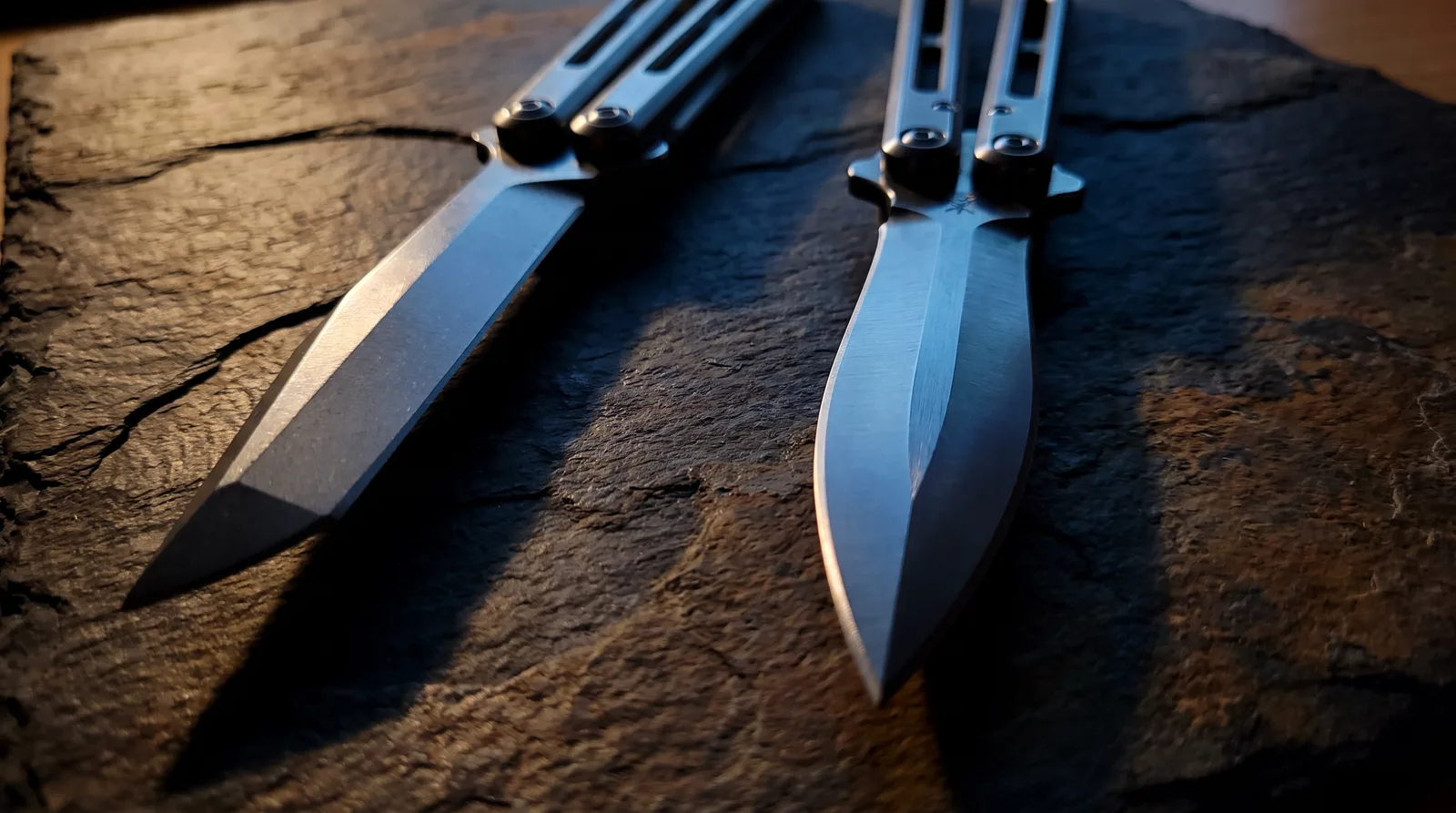
What a double edge really changes
On a single-edge balisong, one handle sits against the sharpened edge when the knife is closed and one sits against the spine. The first is the bite handle, the second is the safe handle. Every beginner tutorial, every trick name and every piece of received wisdom in the hobby assumes those two handles exist and are different.
Sharpen the spine and that distinction disappears. Both handles are now bite handles. There is no handle you can grab carelessly, no handle you can let slide through your fingers, and no forgiving side when a rotation goes wrong. That is the single most important consequence, and it is much more important than the extra cutting edge.
One thing to check before you argue about any of this: is your knife actually double edged? Plenty of balisongs have a swedge, an unsharpened secondary bevel along the spine, that looks like a second edge in photographs and is not one. Some have a swedge sharpened only near the tip. Run a thumbnail along the spine, carefully, at the point closest to the handle. If it does not catch, it is a swedge, and you have a single-edge knife with a dramatic profile. Our guide to butterfly knife blade types covers the grinds you will see.
Double edge vs single edge at a glance
| Factor | Single edge | Double edge |
|---|---|---|
| Safe handle | Yes, one handle is never sharp | No. Both handles bite |
| Suitable for learning tricks | Yes, with a trainer first | No. Not as a first live knife |
| Sharpening time | One edge, standard technique | Two edges, both must match |
| Sharpening difficulty | Beginner-friendly | Intermediate. Symmetry is the hard part |
| Slicing and general cutting | Better. A spine gives you something to push on | Worse. Nowhere safe for a thumb |
| Point strength | Depends on grind, generally stronger | Thinner tip on most dagger grinds |
| Batoning, prying, food prep | Possible within reason | Effectively ruled out |
| Legal exposure | Lower in most places | Higher in some places. Check locally |
| Display and collecting | Traditional and clean | Symmetrical, dramatic, historically authentic |
| Resale interest | Broad | Narrower but keen |
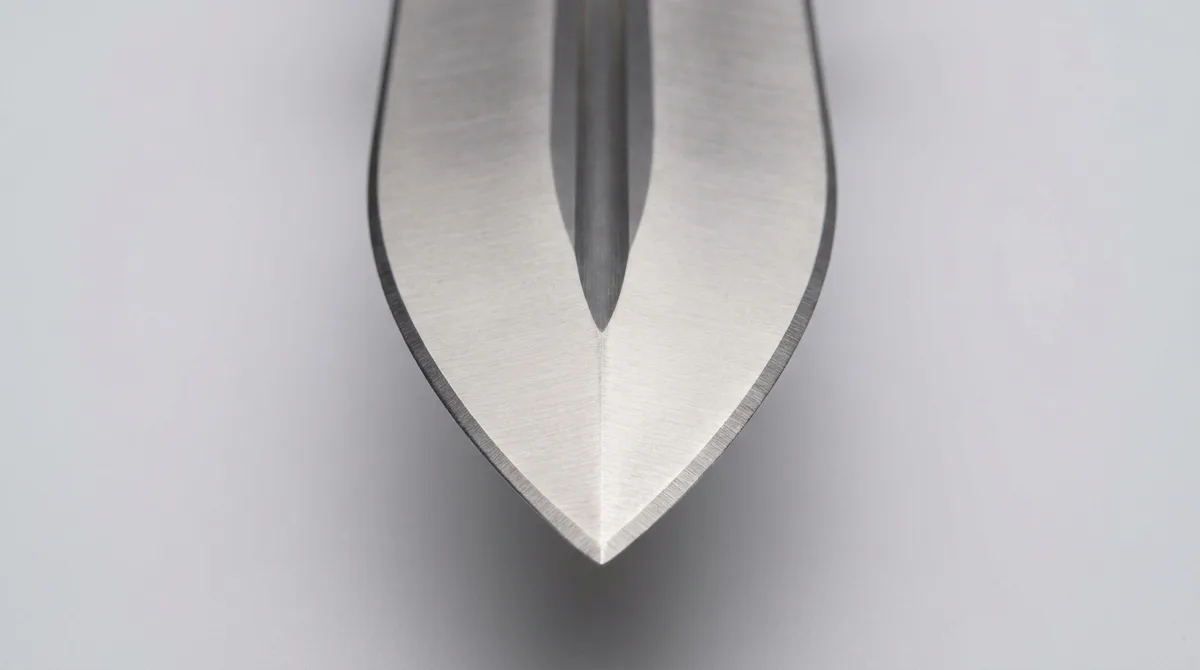
The safe handle problem, honestly
Flipping a balisong is a process of learning which handle is which without looking. Beginners hold the safe handle and rotate the bite handle away from them, because the cost of a mistake on the safe side is a knock on the knuckles rather than a cut. That entire scaffolding is gone on a double-edge knife.
This does not make double-edge balisongs unusable. Experienced flippers handle them fine, because at that point you are not relying on a forgiving handle, you are relying on hands that already know where the knife is. It makes them unforgiving. The gap between a small error and a serious cut narrows a lot.
The practical consequence is simple. If you cannot already run your core openings and rollovers cleanly on a live single-edge knife without looking, a double edge is not your next purchase. Get there first with a trainer, then a live single edge, then decide.
Handling a double edge: what changes in practice
| Situation | Single edge | Double edge | What to do differently |
|---|---|---|---|
| Picking the knife up closed | Grab the safe handle | No safe handle exists | Grab by the pivot end, or the latch, not mid-handle |
| Learning a new trick | Trainer, then live | Trainer, then live single edge, then double | Add a whole step. Do not skip it |
| A rotation going wrong mid-flip | Roughly even odds of the safe side | Every side is the sharp side | Let it drop. Never grab at a falling double edge |
| Catching an aerial | Catch the safe handle | Both handles are live | Catch on the pivot end, or do not throw it |
| Handing the knife to someone | Latched, handle first | Latched, handle first, and say so out loud | Assume they will grab it wrong. They will |
| Cleaning and oiling | Hold the spine | There is no spine | Hold the flats with a cloth; work away from both edges |
| Cutting a box open | Thumb on the spine for control | Nothing to push on | Use a different knife. Genuinely |
| Storing it loose in a bag | Latched is fine | Latched, and preferably in a sheath or pouch | Two edges means twice the surface to find your fingers |
Sharpening: twice the work, and symmetry is the trap
A double edge is not simply two single edges. The two bevels meet at the point, and if they are not close to symmetrical the tip ends up off-centre and weak. That is the part people get wrong, not the sharpening itself.
What actually changes:
- Alternating strokes. You cannot finish one edge and then start the other, or you will drift the geometry. Work both edges in matched passes, counting strokes, and check the point often.
- No spine to rest on. Many sharpening guides and clamp jigs hold a knife by its spine. On a double edge there is nothing to clamp that is not an edge, so you are freehanding or using a jig that grips the flats.
- Burr management is doubled. Every pass on one side raises a burr you then have to deal with on the other, on both edges. It is easy to chase a burr around a dagger grind for half an hour.
- Tip work is fiddly. The last centimetre of a dagger point wants very light, very controlled strokes. It is also the part that snaps if you lean on it.
Budget roughly double the time you would spend on a single edge, and more than double the first few times. Our balisong sharpening guide covers the fundamentals; the double-edge additions above sit on top of that, not instead of it.
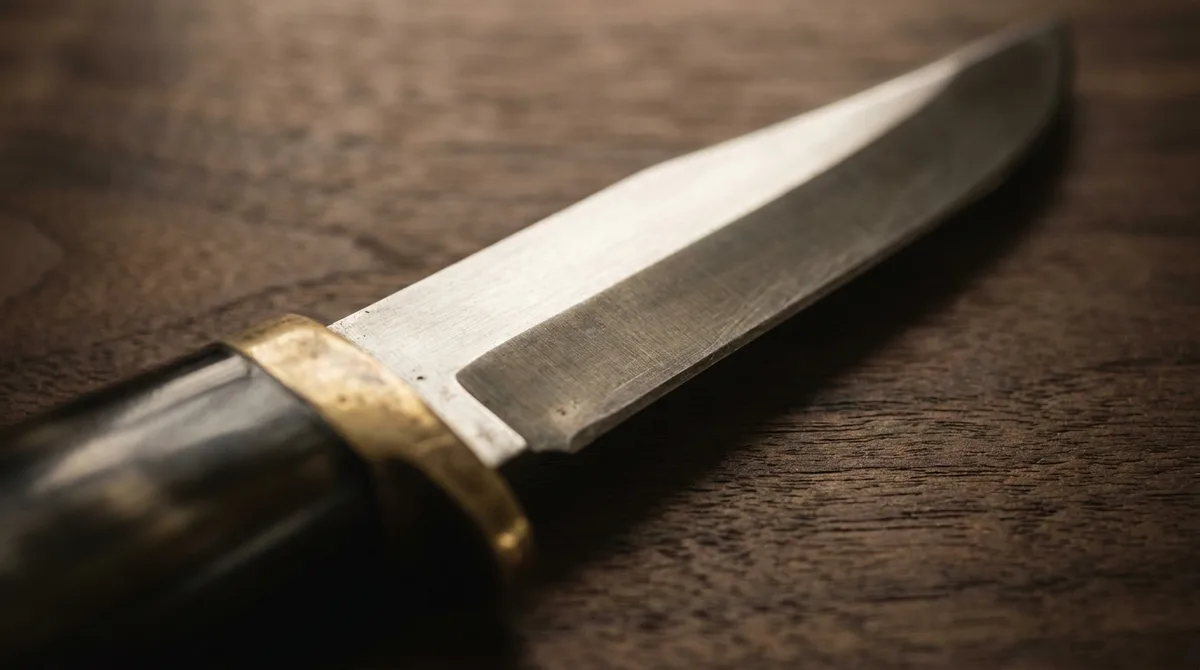
Cutting performance and real use cases
For ordinary cutting, single edge wins and it is not close. A spine gives you a place to put a thumb, a place to rest the blade against a work surface, and a safe way to apply force. A double edge takes all of that away and gives you a second edge you will use approximately never while opening a parcel.
Where double edge earns its place:
- Traditional and historical pieces. Dagger-ground blades are part of the Filipino blade tradition, and a double-edge balisong is the more historically resonant object for a collector.
- Display and symmetry. A symmetrical grind photographs and displays beautifully, particularly in patterned Damascus where the pattern runs evenly to both edges.
- Thrusting geometry. A dagger point penetrates better than most single-edge profiles. That is a fact about the geometry, not a recommendation about use.
- Owners who already flip well and want a knife that demands more attention.
What double edge is not for: food, cardboard, cordage, camp chores or anything where you would ordinarily brace a thumb on the spine. Use a single-edge knife for those and keep the double edge for the display case and controlled practice.
Legality, in one line
Butterfly knife laws vary by state, county and city. Check your local law before buying or carrying one.
The extra thing worth knowing is that some jurisdictions treat double-edged and dagger-style blades under separate rules from single-edged ones, so the answer for a double-edge balisong is not automatically the same as the answer for a single-edge one in the same place. We cannot tell you which applies where you live, and anyone selling you a knife who claims they can is guessing. Our balisong laws overview is a starting point for your own research, not a substitute for it.
Who each one suits
Buy single edge if this is your first balisong, or your second; if you want to actually cut things with it; if you are still building trick vocabulary; if you sharpen your own knives and want that to stay a ten-minute job; or if you simply want the lowest-friction version of owning one of these.
Buy double edge if you already flip a live single-edge knife confidently without looking; if you are buying primarily as a collector and the piece will spend most of its life displayed; if you specifically want the traditional dagger geometry; and if you have checked that a double-edged blade is fine where you live.
Buy neither yet if you have never flipped. Buy a trainer. A trainer will not make you a flipper faster, it will just stop you needing stitches, and it costs less than the plaster bill.
If you already own a double edge
Three habits are worth building immediately.
First, change your default grab. Stop reaching for the middle of a handle and start picking the knife up by the pivot end. It feels awkward for a week and then it is automatic.
Second, retire the phrase safe handle from your vocabulary for this knife. Not as a slogan, as a genuine mental correction. People get cut because a habit from another knife fired at the wrong moment.
Third, drop it. When a rotation goes wrong, open your hand and let the knife hit the floor. A chipped tip costs a sharpening session. A grab at a falling double edge costs considerably more. Flip over a mat or a carpet and this becomes an easy decision.
More reading: Butterfly knife blade types covers the grinds and profiles behind these two options, how to sharpen a balisong gets you started on the edges themselves, and balisong weight and balance explains why a dagger grind often feels more blade-heavy than the single edge you are used to. See also handle materials and latch types for the rest of what makes a knife feel the way it does.
Frequently Asked Questions
Is a double-edge balisong more dangerous than a single-edge one?
Yes, meaningfully. A single-edge balisong has a safe handle you can grab without being cut, and that forgiving side is what beginners rely on while learning. A double edge removes it: both handles sit against a sharpened edge. The knife is not unsafe in trained hands, but the margin for a mistake is much smaller.
Can beginners learn to flip on a double-edge balisong?
They should not. Learn on a trainer, then move to a live single-edge knife, then consider a double edge once your core openings and rollovers run cleanly without looking. Skipping straight to a double edge removes the safe handle at exactly the stage where you most need it.
How do I tell if my balisong is truly double edged?
Look at the spine near the handle rather than at the tip. Many balisongs have a swedge, an unsharpened bevel along the spine that looks like an edge in photographs, and some have a swedge sharpened only near the point. Run a thumbnail carefully along the spine near the tang. If it does not catch, it is not a second edge.
Is a double edge harder to sharpen?
Yes, roughly twice the work and more than that the first few times. The difficulty is not the sharpening itself but keeping the two bevels symmetrical so the point stays centred. You also lose the spine that many jigs and guides clamp against, so most of the work is freehand.
Are double-edged knives legal?
Butterfly knife laws vary by state, county and city, and some places treat double-edged and dagger-style blades under separate rules from single-edged ones. That means the answer for a double edge is not automatically the same as for a single edge in the same location. Check your local law before buying or carrying one.
Does a double edge cut better?
Not for ordinary tasks. A single edge gives you a spine to brace a thumb on and a safe way to apply force, which is most of what makes a knife pleasant to cut with. A dagger grind penetrates better on a thrust, but there is nothing safe to push on when you are opening a box.
Why are some traditional Filipino balisongs double edged?
Because dagger geometry has a long history in Filipino bladework, and the symmetrical grind is part of that tradition rather than a modern styling choice. For a collector, a double-edge piece is often the more historically resonant object, which is a large part of why they remain popular for display.
Is the tip weaker on a double-edge balisong?
Usually, yes. Most double-edge balisongs use a dagger grind, which brings both bevels together at a fine, symmetrical point. That penetrates well and chips more easily than a broader single-edge profile. It is one more reason not to pry, baton or otherwise lean on a double edge.
Can I have one edge on a double-edge knife blunted?
You can grind a second edge off, but you are removing steel permanently and you will end up with a thinner, asymmetric blade rather than a proper single-edge grind. It also destroys the value of a collectable piece. If you want a single edge, buy a single edge; it is cheaper than the regrind.
Which should I buy if I only ever want one balisong?
Single edge. It flips more forgivingly, sharpens faster, cuts better, and carries less legal complication in most places. A double edge is the right second or third knife for someone who already flips well and wants the traditional dagger geometry in the collection.