Blog
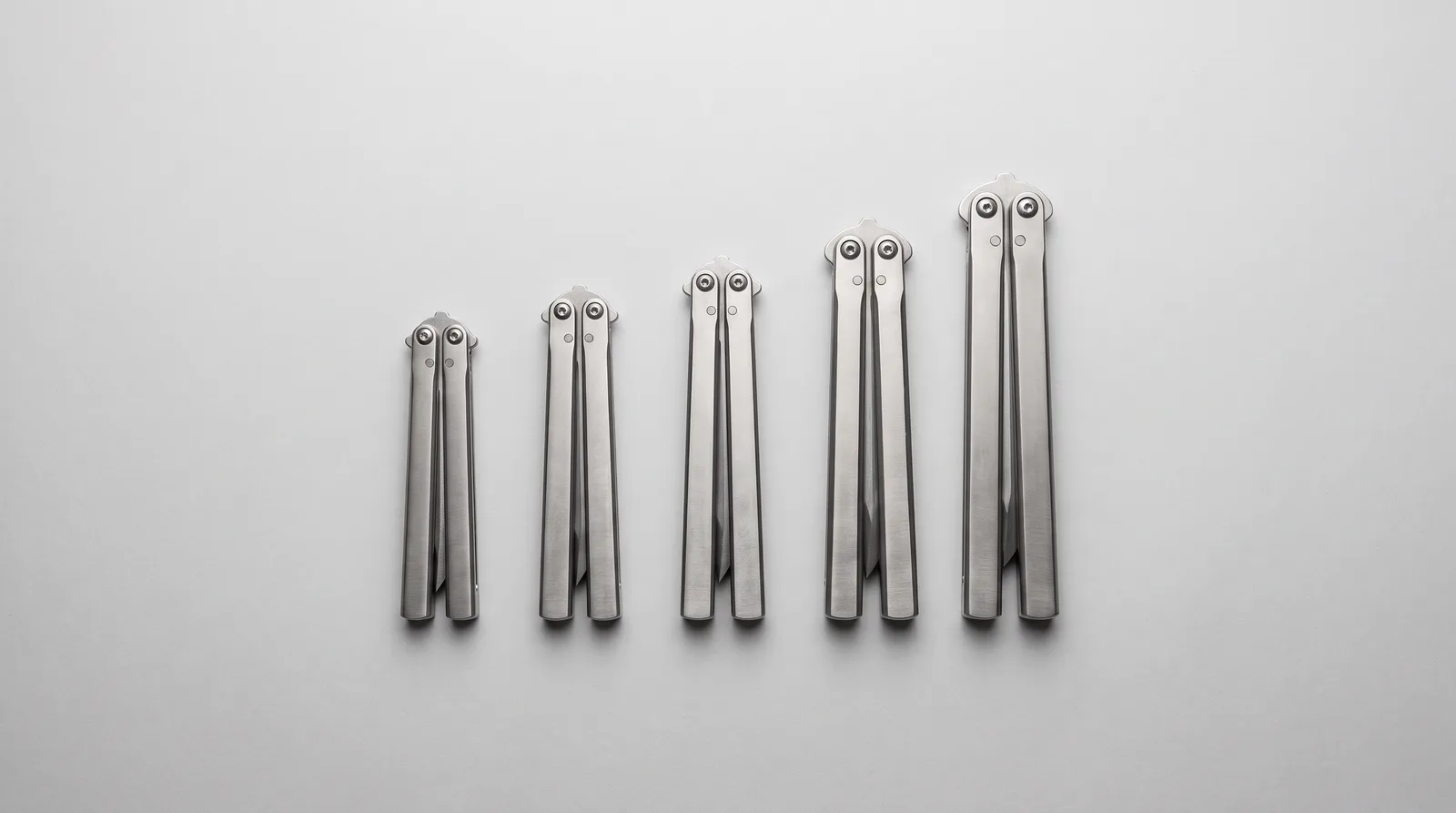
Balisongs are usually described by overall open length, with blade length quoted separately. The common working sizes run from about 20 cm to about 30 cm open, with blades of roughly 9 cm to 18 cm. A 24 cm knife with a 12 cm blade, weighing around 175 g, is the size most people end up flipping. Bigger is slower and more forgiving on a late catch; smaller is faster and less tolerant of sloppy hands.
That is the short version. The longer answer matters because size is the one specification that changes how a balisong feels in your hand more than steel, finish or price, and it is the one most listings describe worst.
How a balisong is actually measured
Four numbers matter, and sellers rarely give you all four.
- Overall length, open. Blade tip to the butt of the handles with the knife locked open. This is the headline figure in the Batangas tradition, where a knife is named by this number in centimetres. A 24 and a 29 are named for exactly this.
- Blade length. Usually measured from the tip to where the sharpened edge stops. Some sellers measure to the plunge line, some to the tang, and the two differ by several millimetres. Ask which.
- Handle length, which is the number nobody quotes. Roughly overall length minus blade length, give or take a centimetre of overlap at the pivot. This is the number that decides whether the knife fits your hand, and you will almost always have to work it out yourself.
- Weight. The most underrated specification on the page. Two knives of identical length can behave completely differently at 150 g and 220 g.
Because these are hand-made objects, expect variance. A knife sold as a 24 might measure 23.6 or 24.3 cm and be correctly described. If a listing quotes lengths to a tenth of a millimetre, it is either a machine-made knife or a machine-made spec sheet. The Batangas naming convention itself, and why the number is in centimetres rather than inches, is covered in what Batangas sizing numbers mean.
Real sizes and what they weigh
These are measured figures from our own catalogue rather than industry averages — 93 products that publish full dimensions, counted today.
| Open length | Blade | Handle (approx.) | Typical weight | Best for | Poor for |
|---|---|---|---|---|---|
| 15 cm | 7 cm | 8 cm | around 165 g | Collecting, display, novelty | Flipping of any kind. Too little handle to catch |
| 20 cm | 9 cm | 11 cm | around 135 g | Small hands, light pocket tasks, discreet size | Learning. Light knives punish imprecise input |
| 22 cm | 10 cm | 12 cm | 150–175 g | Compact traditional feel, smaller hands who still want to flip | Large hands; wide presentational tricks |
| 24 cm | 12 cm | 12–13 cm | 150–220 g, typically 175 g | The all-rounder. Learning, everyday flipping, most tricks | Nothing much. This is the default for a reason |
| 29 cm | 14 cm | 14–15 cm | 200–225 g, typically 205 g | The classic bente nueve. Slow rolls, presentation, traditional feel, cutting | Fast aerials; small hands; long practice sessions |
| 30.5 cm | 18 cm | 13 cm | heavier still | Collection pieces, large traditional builds, blade-forward designs | Flipping. The blade dominates the balance |
Read the 30.5 cm row carefully, because it makes a point the length number hides: it has a longer blade than the 29 but a shorter handle. That is a blade-heavy knife, and blade-heavy knives behave differently from handle-heavy ones regardless of what the overall number says.
What size actually does to the flip
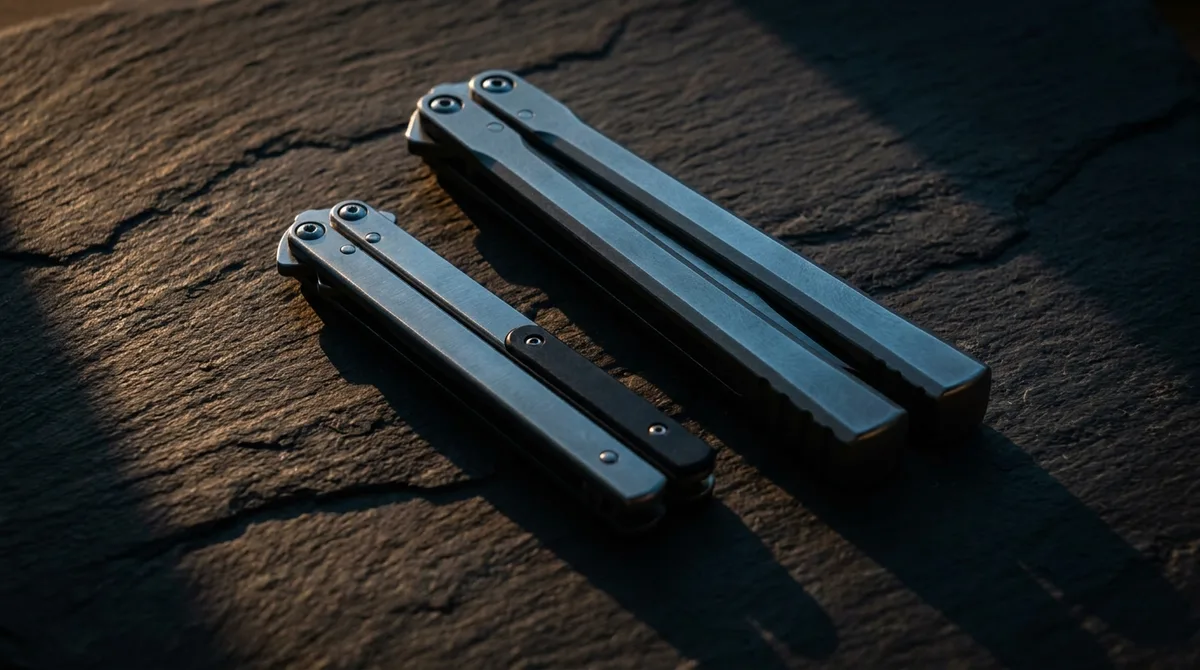
The physics is simple and the consequences are not. A balisong rotates around its pivots, and how hard it is to start and stop that rotation depends on how far the mass sits from the pivot. Longer handles put mass further out. That means:
- Slower to accelerate. Same wrist input, less rotation. A big knife feels lazy at first.
- Harder to stop. Once it is moving it wants to keep moving, so your catch has to be committed.
- More forgiving of late timing. Because rotation is slower, you get a fractionally larger window to catch. This is the single reason some people learn faster on a bigger knife.
- More punishing when it goes wrong. More mass moving means a harder hit on your knuckles, and a longer edge passing your fingers.
- More tiring. An hour with a 205 g knife is noticeably more work than an hour with a 175 g one.
Small knives invert all of that. They spin fast, stop easily, and give you almost no margin on timing. They also reward clean technique, which is why some experienced flippers deliberately practise on something small.
Trick difficulty by size
Nothing here is a hard rule, and every one of these has been done on every size by somebody stubborn.
| Trick type | Easier on | Why |
|---|---|---|
| Basic opens and closes | 24 cm | Enough rotational mass to carry through, short enough to control |
| Rollovers and fanning | 24 cm and up | The knife carries itself between positions instead of stalling |
| Aerials | 22–24 cm | Less mass to throw and catch; a heavy knife lands hard |
| Fast chained combos | 22–24 cm | Quicker rotation means faster transitions per second |
| Slow, wide presentational work | 29 cm | Momentum smooths the motion and the knife has visual presence |
| Behind-the-back and body work | 24 cm | Less knife to clear past your own arm |
| Two-knife work | Matched, lighter pair | Fatigue becomes the limiting factor within minutes |
If you are starting from zero, the beginner flipping guide assumes something in the 22 to 24 cm range, and you should be doing all of it on a trainer first. A trainer will not make you a flipper faster. It will just stop you needing stitches.
Matching a size to your hand
The measurement that matters is your hand length: wrist crease to the tip of your middle finger, palm flat. Handle length should sit close to that, or slightly under it. A handle much longer than your hand overhangs when you squeeze, and overhang is what catches the web of your thumb.
| Hand length (wrist crease to fingertip) | Comfortable handle | Suggested overall size | Notes |
|---|---|---|---|
| Under 16 cm / 6.3 in | 10–12 cm | 20–22 cm | A 29 will overhang noticeably. Accept a lighter knife and clean technique |
| 16–18 cm / 6.3–7.1 in | 12–13 cm | 22–24 cm | The 24 is the natural fit for most adults in this band |
| 18–20 cm / 7.1–7.9 in | 13–15 cm | 24–29 cm | Either works. Choose on whether you want speed or presence |
| Over 20 cm / 7.9 in | 14–15 cm+ | 29 cm and up | A 24 will feel small and cramped in chained combos |
This is a fitting rule of thumb from handling knives with people, not an industry standard. Nobody publishes one. If you can hold a knife before buying, that beats any table on this page, including ours.
Weight matters as much as length
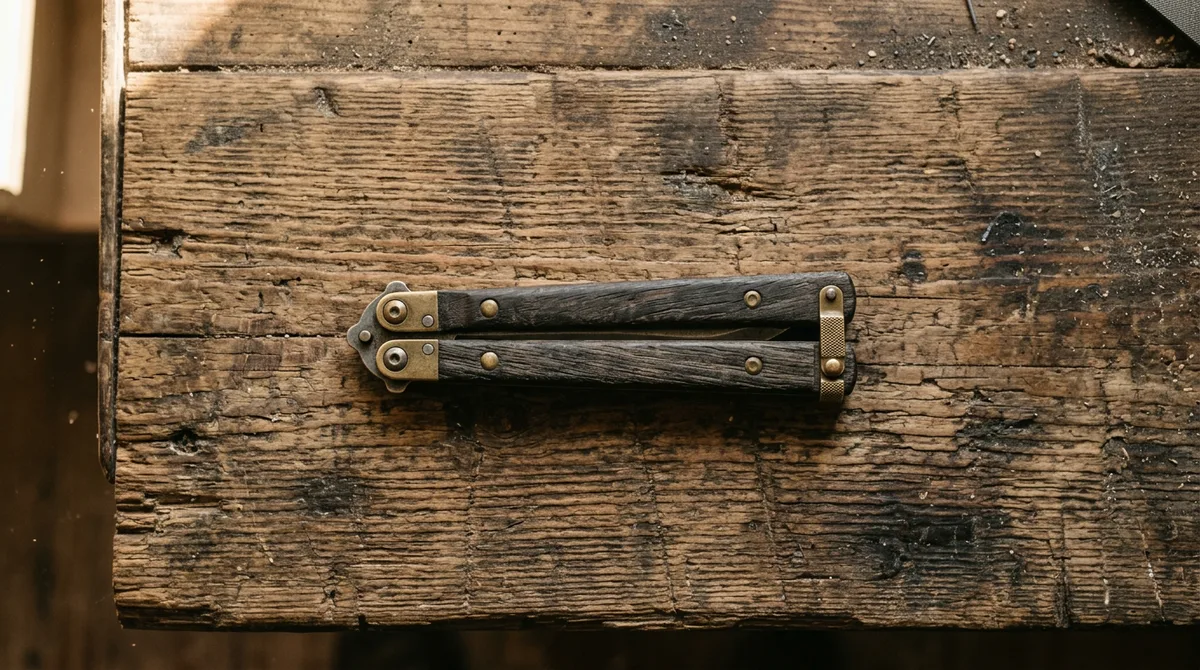
Two 24 cm knives at 150 g and 220 g are not the same knife. The catalogue spread at that size is exactly that wide, and it is driven by frame material — brass frames are substantially heavier than steel or titanium ones of the same dimensions.
Around 175 g is the figure most people settle on for a 24, and it is the median for a reason: heavy enough that rotation carries through a slightly late wrist, light enough that an hour of practice does not leave your forearm complaining. Under about 150 g a knife starts demanding precision. Over about 200 g it starts demanding stamina.
Balance point matters too. Hold the closed knife on one finger. If it balances at or just behind the pivots it is handle-neutral and will flip predictably. If it balances well forward of the pivots it is blade-heavy, which usually means it was designed to cut rather than to spin.
What a small balisong is good for, and what it is not
Good for: pocketability. Fitting a small hand. Being a genuinely useful small cutting tool. Practising precision, because a light knife will not carry a sloppy input for you. Collecting, where miniature work can be beautifully executed.
Not good for: learning. This surprises people, because small sounds safer. It is not. A short handle gives you less to catch, less rotational mass to carry the knife through a movement, and a much smaller timing window. Beginners drop small knives more, not less.
It is also not good for most tricks that involve the knife travelling around your hand, because there is less handle to hook and hold. And a very small balisong is not a substitute for a proper folding knife if you actually need to cut things — the blade is short, the handle is short, and the leverage is poor.
If safety is the concern, the answer is a trainer with an unsharpened blade in a normal size, not a live blade in a small one. The trainer range exists for exactly this.
Choosing your first one
Three straightforward cases.
You want to learn to flip. 24 cm, around 175 g, in a trainer first. Move to a live blade when you can do a basic open, close and rollover without thinking. Then buy the same size in steel so nothing about the muscle memory changes.
You want the traditional Filipino object. 29 cm, brass frame, horn or bone inserts. It is heavier and slower and that is the point. The authentic Filipino balisong category is where these live, and the Batangas guide explains what makes them what they are.
You want a knife that cuts. Look at blade length and steel before overall size, and read the steel guide. A 14 cm blade in properly hardened steel does real work; a 7 cm blade on a novelty knife does not.
If none of those fit, you can specify blade length, frame material and inserts yourself with the custom balisong builder.
One practical note before you buy: butterfly knife laws vary by state, county and city, and some places set limits by blade length specifically, so check your local law before buying or carrying one.
More reading: Batangas sizing numbers explained, how a balisong is made, identifying a vintage balisong, butterfly knife blade types, and the price guide.
Frequently Asked Questions
What size balisong should a beginner buy?
A 24 cm knife with roughly a 12 cm blade, weighing around 175 g, is the standard answer and a good one. It has enough rotational mass to carry through imperfect timing without being heavy enough to tire your wrist or hurt when it lands. Buy it as a trainer first, then the same size with a live blade.
How is a balisong measured?
Normally by overall length with the knife open, tip to handle butt, with blade length quoted separately. Handle length is rarely listed and you usually have to derive it: overall minus blade, give or take a centimetre of pivot overlap. Weight is listed less often than it should be and matters more than most people expect.
Is a bigger balisong harder to flip?
Harder for fast work, easier for slow work. A longer knife rotates more slowly for the same input, which widens your catch window and helps beginners, but it also resists being stopped and hits harder when you miss. Fast aerials and chained combos are meaningfully harder on a 29 than on a 24.
What is the most common balisong size?
Around 24 cm overall with a 12 cm blade. On this site that size accounts for roughly half of every product with published dimensions, and it is the size most people who flip regularly settle on. The 29 cm bente nueve is the more famous size but the less commonly flipped one.
How do I know if a balisong is too big for my hand?
Measure your hand from wrist crease to middle fingertip with the palm flat, then compare it to the handle length. If the handle is much longer than your hand, it will overhang when you squeeze, and that overhang catches the web of your thumb during rollovers. Roughly equal, or slightly shorter, is comfortable.
Are small balisongs safer for learning?
No, and this catches people out. A short handle gives you less to catch, less rotational mass to carry the knife through a movement, and a much smaller timing window, so beginners drop small knives more often. If safety is the goal, use an unsharpened trainer in a normal size instead of a live blade in a small one.
Does weight matter more than length?
They matter differently. Length sets how fast the knife rotates; weight sets how much effort starting and stopping it costs and how hard it hits. Two 24 cm knives at 150 g and 220 g feel like different knives. Around 175 g suits most people at that length, which is why it is the common figure.
What does blade-heavy mean and does it matter?
Balance the closed knife across one finger. If it tips forward, mass sits ahead of the pivots and the knife is blade-heavy. Blade-heavy knives are usually designed to cut rather than spin, and they feel less predictable in the roll. Handle-neutral or slightly handle-heavy is what most flippers want.
Can I use a large balisong for everyday cutting?
A 14 cm blade in properly hardened steel is a genuinely capable cutting tool, so yes in terms of capability. Whether you can carry one is a separate question entirely and depends on where you are, since some jurisdictions set limits by blade length. Check your local law before you rely on it for anything.
Should I buy the same size trainer as my live knife?
Yes. The whole value of a trainer is that the muscle memory transfers, and it only transfers cleanly if the length, handle shape and weight are close. Learning on a light 20 cm trainer and then picking up a 205 g 29 cm knife means relearning your timing with a sharp edge in your hand.