
Blog
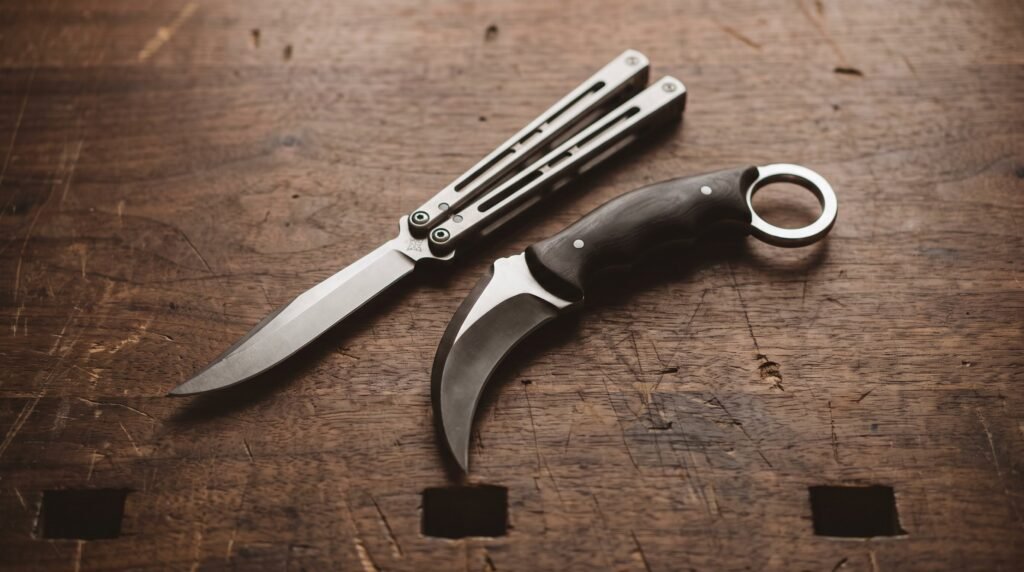
A karambit is a curved, hooked blade with a finger ring, built for pulling cuts. A balisong is a straight bladed folding knife with two handles that rotate around twin pivots. They get compared constantly because both come from Southeast Asia and both look dangerous in a photograph, but they solve completely different problems, and only one of them is a hobby you can practise on the sofa.
Quick answer: if you want something to flip, learn, fidget with and get genuinely good at, buy a balisong. If you want a curved utility blade that hooks, rips and retains in the hand, buy a karambit. If you want the curve inside a balisong chassis, that is the butterfly karambit, and it is a real thing we make rather than a marketing mashup.
Where each knife actually came from
The karambit started as a farm implement in the Malay archipelago, most strongly associated with West Sumatra and Java, then spread across Indonesia, Malaysia and the Philippines. The shape is borrowed from a tiger claw, and before that from a sickle. It was used for harvesting rice, splitting husks, dressing game and general agricultural work long before anyone filmed it in slow motion. The ring on the end existed so a wet hand holding a wet blade in a wet field did not lose the knife.
The balisong came out of Taal, Batangas, in the Philippines, in the early 1900s. The name comes from baling sungay, folding horn, because the early handles were carabao horn. Perfecto de Leon is the name most often attached to its formalisation, and Barangay Balisong is a real place you can still find on a map. The traditional benchmark size is veinte y nueve, twenty nine centimetres open, which is a measurement, not a marketing claim. We go through all of that properly in our history of the balisong.
So one is descended from a farm tool and one is descended from a pocket knife with theatrical ambitions. That difference never really goes away.
The geometry, side by side
Put both on a bench and the differences are structural rather than cosmetic.
| Feature | Karambit | Balisong |
|---|---|---|
| Blade profile | Curved, hawkbill, concave edge | Straight or gently bellied, eight shapes we make |
| Handle | One handle, usually with a finger ring | Two handles, bite and safe, twin pivots |
| Primary cutting action | Pull, hook, draw | Push, slice, point work |
| Deployment | Fixed or single fold, one motion | Rotational, two handles, many motions |
| Sharpening difficulty | Harder, curve needs a narrow stone or rod | Straightforward on a flat stone |
| Skill ceiling | Low as an object, high as a system | Very high as an object, effectively endless |
| Practice safely without a live edge | Rarely | Yes, trainer or live blade, same price, chosen above the Add to Cart button |
The detail people miss: a karambit’s edge is on the inside of the curve, which means the tip arrives before the edge does. A balisong’s edge sits on a straight or slightly bellied line, so the edge and the tip arrive together. That single fact explains most of the behaviour differences below.
How each one cuts
A karambit cuts on the pull. You hook material and draw back, and the concave edge funnels whatever you are cutting deeper into the belly of the curve instead of letting it slide off. That is why it was good at rice stalks and is still good at cordage, packaging strap, hose and anything that wants to escape a straight edge. It is poor at anything requiring a flat, controlled slice on a board, because the geometry fights you.
A balisong cuts like a good folding knife, because that is what it is. Push cuts, draw cuts, point work, and with a Traditional Batangas or Drop point profile you get a usable belly for food and general tasks. The Tanto gives you a reinforced point. The Dagger and Double edge are symmetrical and less practical as tools, which we say out loud rather than pretending otherwise. Our blade shape guide covers what each of the eight actually does.
One thing nobody warns you about: sharpening a karambit properly means either a round rod, a narrow stone, or a lot of patience. We sharpen curved blades on the inside of a ceramic rod because a flat bench stone only ever touches two points on the curve. A straight balisong blade is far more forgiving. Our sharpening guide assumes a straight edge for that reason.
How each one carries
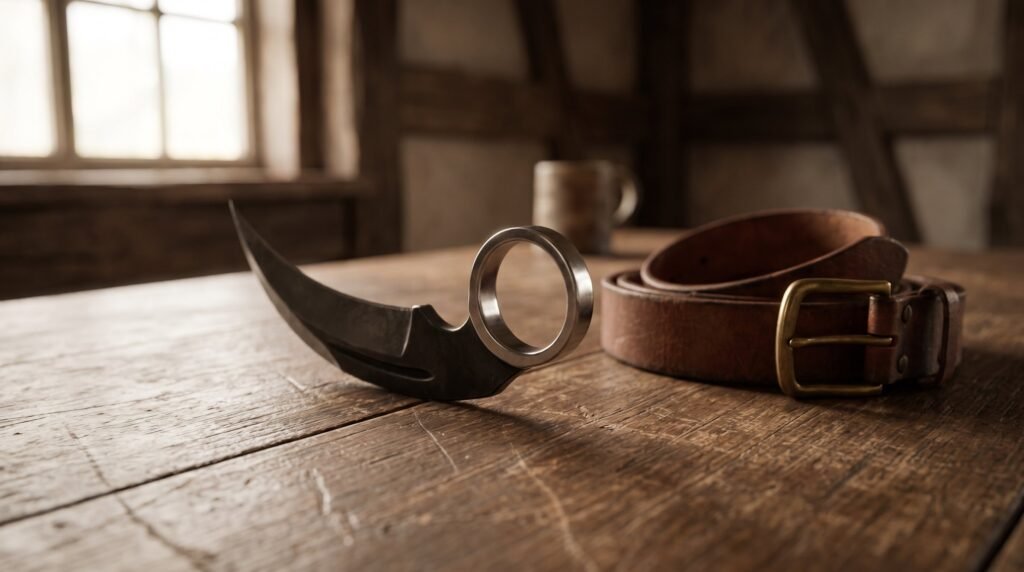
A traditional karambit is often fixed blade, worn in a sheath, ring outward, and drawn in one motion. Folding karambits exist and use a wave feature or a ring pull to open on the draw. Either way, it is one action: get hand on knife, knife is open.
A balisong lives closed in a pocket or a sheath and opens by rotating two handles around your fingers. Every knife we make ships with a fitted leather sheath, which matters more than people expect, because a balisong rattling loose in a pocket will eventually mark its own handles. Horn and stag in particular will pick up scuffs from keys within a week.
Deployment speed is roughly equal in trained hands, which surprises people who assume the balisong is slower because it looks busier. What is not equal is the failure mode. A fumbled karambit draw means you have not opened the knife. A fumbled balisong opening means you have a spinning object with an edge somewhere in it. That is not a reason to avoid balisongs. It is a reason to learn on a trainer.
How each one is learned
Karambit skill is almost entirely a martial arts question. The knife itself has no technique. You learn ring retention, grip transitions and body mechanics from an instructor in a Filipino or Indonesian system, or you do not learn them at all. There is no solo hobby version of karambit practice that meaningfully improves the knife handling.
Balisong skill is the opposite. The knife has enormous technique built into it, and you can practise alone, badly, for months, and still improve. Rollovers, fans, aerials, chaplins, the whole vocabulary. It is a genuine hobby with a learning path, and we mapped that path in the tricks guide.
The practical consequence: a karambit bought by someone with no training is an ornament. A balisong bought by someone with no training is a project. Projects are more fun.
The butterfly karambit, and why we build it
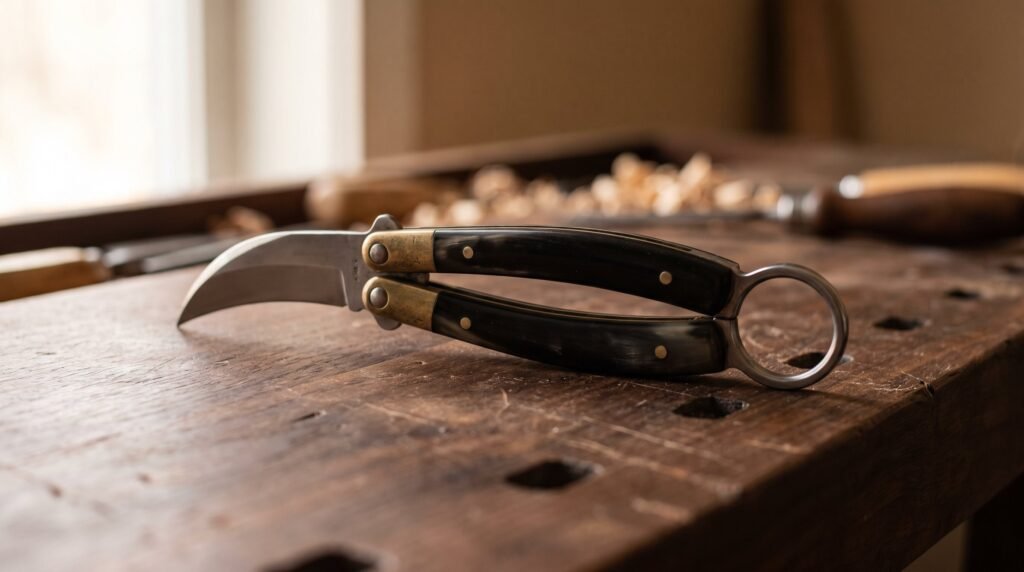
Take the hawkbill curve and mount it in a balisong chassis, twin pivots, two handles, latch and all. That is the karambit butterfly knife. It is not a novelty we invented for the website. Curved balisong blades have existed in Batangas for a long time, because a farm knife culture and a folding knife culture living in the same province were always going to trade ideas.
What changes when you combine them
The weight moves. A hawkbill puts more mass forward and lower than a straight blade of the same length, so the knife swings faster through a rollover and wants to keep going. Flippers describe it as the knife having opinions. Balance is genuinely different, and if you have only ever flipped straight blades your first fifty rollovers will overshoot.
The tip becomes the thing you respect. On a straight balisong the dangerous zone during a fan is the edge, which sits where you expect it. On a curved blade the point sweeps a wider arc and it sits closer to your knuckles at the top of the rotation. We have watched experienced flippers pick one up confidently and then quietly go and find a trainer.
The grind gets harder for us too. Grinding a concave edge on a hollow ground curve means the contact patch on the wheel is constantly moving, and the heat concentrates at the tip where the steel is thinnest. Overheat it and you will hear it later, on the file: a curved blade with a soft tip files with a dull, grabby sound instead of skating. That is a batch that does not go out.
Self defence, honestly
We are a knife shop, so you would expect us to sell this section hard. We are not going to.
Neither of these knives is a sensible self defence plan for an untrained person. A karambit in an untrained hand is a knife you will likely lose or injure yourself with, and every advantage the ring and curve provide is contingent on training you do not have yet. A balisong requires a deployment sequence under stress, which is the worst possible condition for a fine motor skill.
There is also the legal question, which is not optional and is not the same in every state. Carry law, blade length, opening mechanism and intent all matter, and a knife that is perfectly legal to own at home can be illegal to carry two counties over. Read our state by state legality guide before you carry anything, and treat any forum post that says “it’s fine everywhere” as what it is, which is someone guessing.
Buy either of these because you like knives, because you want to learn a skill, or because you want a well made object. Those are good reasons and they are the honest ones.
Which should you buy
Pick the balisong if you want something to do. It rewards practice, you can start on a trainer, and the skill floor is low while the ceiling is nowhere in sight.
Pick the karambit if you want a curved utility blade, you already train in a system that uses one, or you simply like the shape and want it made properly rather than stamped out of unnamed “stainless steel” by a factory that will not tell you the grade.
Pick the butterfly karambit if you already flip and you want a knife that behaves differently in your hand. It is not a beginner knife. It is a second or third knife, and it is a very good one.
All of ours are made to order in 440C, D2, high carbon, VG10 or Damascus, hardened to 58 to 60 HRC, with handles in rosewood, wenge, buffalo horn, stag, bone, micarta or mother of pearl. Prices run from $109.45 to $549.45 depending on steel, handle and finish work.
More reading. For the curved blade inside a balisong frame specifically, we go deeper on the butterfly karambit and you can see the range in karambit balisongs. For how a curve compares with every other profile we grind, see blade types, and for the basics what a balisong is.
Frequently asked questions
Is a karambit better than a balisong for everyday cutting?
For cordage, strapping, hose and anything you can hook, yes. For food, board work, whittling and general point tasks, the balisong wins comfortably. If you only want one knife for opening boxes and cutting string, a Drop point balisong is the more useful object.
Can you flip a karambit like a balisong?
Not a standard karambit, because it has one handle and no pivot pair. A butterfly karambit flips, because it is a balisong with a curved blade. Ring spinning on a fixed karambit is a different skill and a much better way to open your own hand.
Which is harder to sharpen?
The karambit, by a wide margin. A flat stone touches a curved edge in about two places. You want a ceramic rod, a narrow diamond file or a slipstone, and you sharpen the inside of the curve in short sections.
Are both legal to own?
Ownership rules and carry rules are different things, and both vary by state and sometimes by city. Balisongs specifically are restricted in some places because of the opening mechanism. Check the legality guide for your state before you order, and check it again before you carry.
Which one is safer to learn on?
The balisong, because you can practise the entire motion with a trainer. Trainer or live blade, same price, chosen above the Add to Cart button. There is no equivalent way to practise karambit work solo without an edge doing something useful.
Does the curved blade change the balance a lot?
Yes. Mass moves forward and down, so rotations accelerate through the bottom of the arc. Expect to overshoot for the first week. Flippers who move from a straight Traditional Batangas to a hawkbill usually describe it as the knife arriving early.
What steel should a karambit be?
Something that holds a fine edge on a thin tip without chipping. D2 and VG10 both work well. High carbon takes a scary edge and will patina, which some people want and some people do not. Damascus is chosen for looks first, and there is nothing wrong with that as long as the seller can tell you what is actually in the billet.
Can I get a curved blade with a custom handle?
Yes. Handle material, steel, finish and engraving are all specified before we start cutting, because everything is made to order. If you already know the specification you want, tell us and we will build to it.
If the curve is what caught your eye, go and look at the karambit butterfly knives and pick your steel and handle. If you are still deciding, the full shop is the better starting point, and every knife on it ships with a fitted leather sheath and free US shipping.